Improve care for all: How to start a healthcare reform petition

Improve care for all: How to start a healthcare reform petition
A step-by-step guide to creating an impactful healthcare reform petition for critical issues like affordable medication, access to mental healthcare, disability protections, and reproductive rights.Healthcare is one area where the U.S. consistently ranks last among high-income countries.
Research from the Commonwealth Fund shows that the U.S. has a lower average life expectancy and higher avoidable mortality than other middle and high-income countries. This is despite U.S. citizens spending more on healthcare than any other nation.
In contrast, countries with universal healthcare systems provide vital medical care without the financial burdens many Americans face. Health emergencies in places like the UK aren’t a financial concern, but in the U.S., can lead to bankruptcy.
Starting a petition on Change.org can be a powerful tool for driving change, whether advocating for lower prescription drug costs, expanding Medicaid coverage, or increasing access to mental health services. Petitions have historically played a crucial role in influencing policy shifts.
Use this step-by-step guide to launching an effective healthcare reform petition that fights for an equitable and accessible health system.
Why should you start a healthcare reform petition?
Petitions can help healthcare professionals advocating to improve systemic issues, patients and families affected by healthcare issues, and activists and advocacy organizations focused on healthcare reform.
Here are some examples of petitions that won significant results:
A mother petitioned her insurance to cover speech therapy for her toddler, who experienced severe speech delays after repeated ear infections. Despite initial coverage, Cigna denied further therapy, leaving her son struggling to communicate. With the support of almost 40,000 signers, the petition successfully pressured the insurance company to cover the treatment.
With over 11,400 signatures, this petition helped ensure insurance coverage and access to Cochlear Baha System implants, a life-changing hearing solution.
A nursing student petitioned Governor Gavin Newsom to remove barriers preventing nursing graduates from working during the COVID-19 crisis. She called for temporary licensing for new nurses to address the urgent need for healthcare workers. Governor Newsom responded and the nursing students were able to begin working promptly after starting the petition.
Another nursing professional who started a petition that achieved victory during the height of the COVID-19 crisis is Dr. Daihnia Dunkley. She petitioned the Biden administration to include a registered nurse in the COVID task force. Watch her story below.
Some key areas where healthcare petitions can make a significant impact include:
Universal healthcare
A 2022 study found that 41% of adults in the U.S. had some debt caused by medical or dental bills. In fact, working-age cancer survivors find themselves worse off financially as a result of medical bills, according to another study.
Another 2022 study showed that “if the U.S. had a single-payer universal health care system in 2020, nearly 212,000 American lives would have been saved that year.” The analysis also showed that the U.S. would have saved $105 billion in COVID-related hospital expenses alone.
Affordable prescription drugs
Globally, people in the U.S. pay some of the highest prices for prescription drugs. For example, a study published in 2024 showed that prescription drug prices in the U.S. are significantly higher than in other nations, “with prices in the United States averaging 2.78 times those seen in 33 other nations.”
The gap widens even further for brand-named drugs, with prices in the U.S. averaging over 4 times higher than other nations.
A 2024 poll showed that three in 10 people struggle to afford their prescription drugs.
Petitions advocating for causes such as lower insulin prices or price caps on essential medications can lead to real change.

Access to mental health services
Despite growing awareness of mental health issues, access to care remains challenging due to high costs and provider shortages.
Research by the Kaiser Family Foundation (KFF) shows that mental health care needs are rising in the U.S., and that uninsured adults are report receiving mental health treatment less than insured adults.
Another recent KFF study showed a 45% increase in young adults (ages 18 to 26) receiving mental health treatment between 2019 and 2022 — ” a steeper increase than in any other age group.”
Protections for people with disabilities
Many Americans with disabilities struggle to receive adequate healthcare. More than a quarter of adults in the U.S. report a functional disability.
Individuals with disabilities face significant health disparities and are more likely to report certain medical conditions. In 2022, for instance, 43.6% of people with disabilities reported experiencing depression, compared to just 13.7% of those without disabilities.
Advocacy through petitions can lead to policy changes that ensure equitable healthcare access for people with disabilities.
Reproductive healthcare rights
Reproductive rights have been increasingly under threat in the last few years. Petitions can play a crucial role in advocating for access to contraception, abortion services, and maternity care.
As of March 2025, abortion is illegal in 12 states.
Furthermore, maternity care deserts — areas without easy access to obstetric providers — have recently been identified in 35% of U.S. counties.
Funding for public health initiatives
Public health programs, such as vaccine distribution, disease prevention, and community clinics, rely on government funding.
Investing in public health initiatives and in prevention not only saves lives but also reduces costs in the long term. Studies have shown that every dollar spent on evidence-based prevention programs can generate $5.60 in savings.
Petitions can pressure lawmakers to prioritize funding for these essential health services.

How to start a healthcare reform petition
These best practices and guidelines will make the process of creating your own petition easy and straightforward.
Follow these steps to ensure your petition includes all the key elements for success.
1. Identify the issue you want to address
Focus on specific healthcare problems rather than broad reforms. Having a narrow focus increases the chances of success by making the petition’s objective clear and actionable.
For example, this teen in Illinois petitioned for enhanced mental teen health services in their state and won.
2. Research and build your case
To strengthen your petition, gather data from reputable sources to demonstrate the problem you’re addressing and support your claims, including:
Kaiser Family Foundation (KFF): An independent source for health policy research, polling, and news
Centers for Medicare and Medicaid Services (CMS): A federal agency overseeing Medicare, Medicaid, and health insurance regulations where you can find data and policy updates
The Commonwealth Fund: A foundation focused on healthcare system performance, equity and innovation, with research on improving access and affordability
National Academy for State Health Policy: A nonpartisan group helping state policymakers develop and implement effective health policies
Families USA: A nonprofit advocating for affordable, high-quality healthcare, especially for underserved communities
Talking to patients, healthcare professionals, and policy experts can add credibility and strengthen the impact of your petition. Gather statistics, legal precedents, and expert opinions on the issue.
Research similar successful petitions and past healthcare advocacy efforts to discover what helped them reach their goals. For example, a petition asking for expanded comprehensive benefits for caregivers of severely disabled veterans achieved its goal with the support of over 204,700 signatures. It includes data and statistics backing the change they wanted to see.
3. Choose the right decision-maker
Your petition should be directed at those who have the power to implement the change you want to see, such as:
Federal agencies (organizations such as the Food and Drug Administration or the Department of Health and Human Services), which oversee policies and regulations that impact healthcare access and affordability
Elected officials such as state legislators and governors
Hospital administrators
Insurance companies and pharmaceutical manufacturers
Once you’ve identified who to address, reach out through multiple channels to increase the chances of connecting and engaging with them.
You can contact them via email, social media and letters with a link to your petition as well as calling their office.
4. Write and publish your petition
Having a petition with a clear structure is essential to gaining traction. Make sure to include these key elements:
Problem statement: Clearly define the issue, who it affects, and why it matters. Use compelling language and relevant data to illustrate the urgency.
Proposed solution: Specify the action you want the decision-maker to take. Keep it realistic, actionable, and results-oriented.
Call to action: Directly encourage people to sign and share your petition. Make it clear how their support can help drive change.
For example, a petition started in October 2024 asks for Medicare to not limit telehealth coverage starting in April 2025. The petitioner clearly states the problem, what they seek to achieve, backs their claims with data and encourages supporters to help stop this policy change.
Draft your petition using a tool like Google Docs or Microsoft Word, or draft it directly on Change.org. The Change.org platform is free and user-friendly, allowing you to publish and share your petition with a global audience. By creating a petition on Change.org, you gain access to tools that help spread awareness, engage supporters, and connect with decision-makers.
5. Attract supporters and raise awareness
Once you publish, it’s time to spread the word! Social media and other digital outreach methods can be a valuable way to expand the reach of your petition.
Share the petition in healthcare advocacy communities, including Facebook groups, Reddit forums, and patient support networks. Reach out to activists who may have insights on groups to maximize outreach.
Medical professionals, patient advocacy groups, and public health organizations are excellent groups that will have an interest in reaching the same goal as your petition.
Engaging with healthcare journalists and media outlets to spread the message can also be helpful. Get in touch with a concise news hook.
For example, the petition from California nursing students and graduates asking to be allowed to help during the Covid-19 pandemic got the attention of media organizations such as CNN.
6. Engage decision makers and mobilize supporters to apply pressure
Beyond signatures, you can encourage supporters to take part in social media campaigns or direct advocacy efforts, such as writing letters to your target decision maker or attending government hearings.
With Change.org, you can use petition updates to keep supporters in the loop of what’s happening (reaching milestones, media noise, etc.) but also to inspire them to mobilize to apply further pressure.
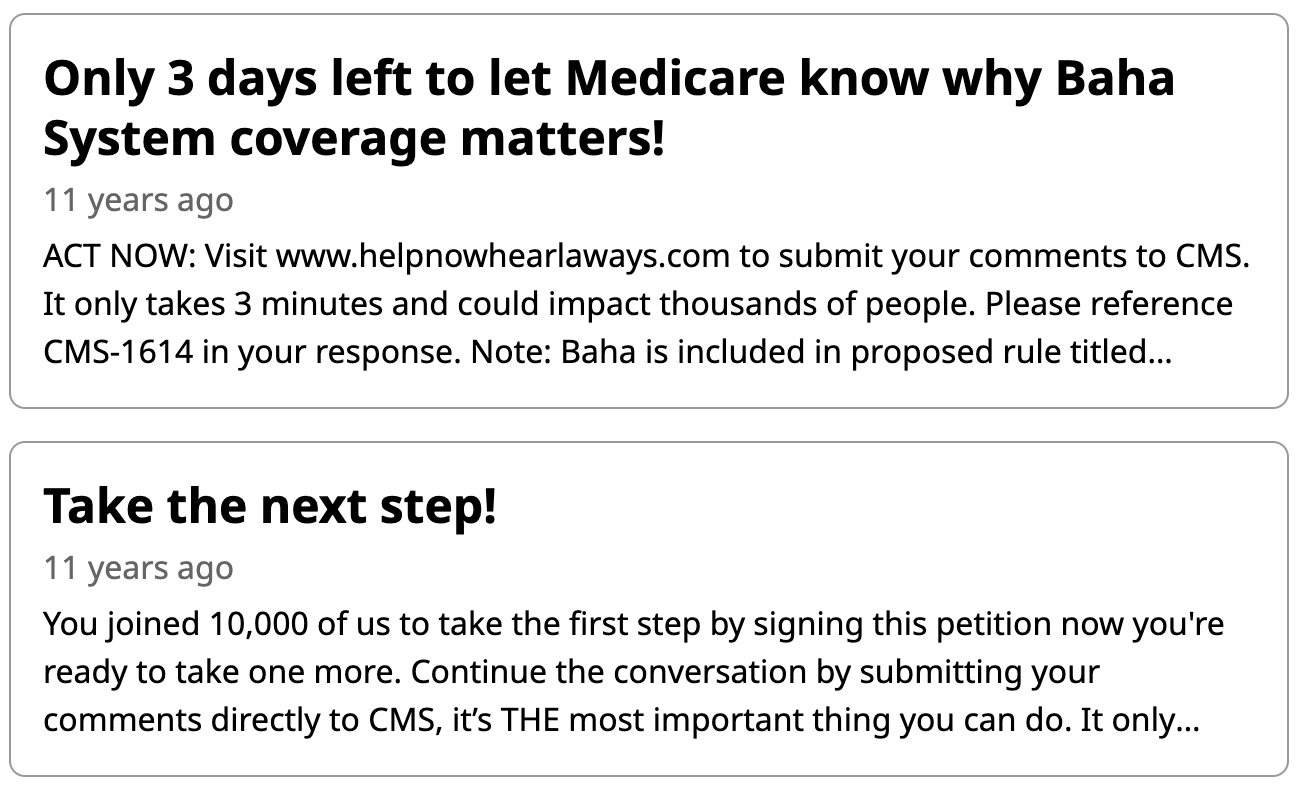
For example, the petition for the Cochlear implant included updates providing resources for signers to voice their support by contacting the Centers for Medicare & Medicaid Services (CMS) and achieved its goal.
Start a healthcare reform petition today
By following these steps you, too, can launch a petition that drives meaningful change in the U.S. healthcare system.
Even raising awareness of these injustices is an important achievement.