How to collect signatures and turn your petition into real change

How to collect signatures and turn your petition into real change
Collecting signatures is just the beginning. Change.org is built to support the full arc of a campaign — from your first share to the moment a decision maker responds. This guide walks through how to grow your petition fast and how to use Change.org's built-in escalation tools to turn that support into real, documented change that achieves your goals.In this article you will learn:
There's nothing like the rush of seeing those first signatures rolling in for your petition. One petition starter, Lori, who got over 100 signatures in the first week of launching her petition said, "I felt gratitude, joy, somewhat victorious, you know?"
Those signatures can be the fuel for real change — whether it's as big as creating federal legislation or as hyper-local as getting a speed bump in your neighborhood. Even if those signatures don't result in all of your demands being met, raising awareness about issues is a win on its own.
You may question if this actually works. It does. From a Virginia law protecting dogs in harsh weather to a UK campaign that got free school meals extended to 800,000 children, see 10 petitions that led to powerful victories — real signature counts, real decision makers, real outcomes.
In this guide, you’ll learn how to grow your petition — and how to turn that support into real-world impact.
Haven't started your petition yet? You can draft one in minutes using Change.org's plugin in ChatGPT, then come back here to grow it.
How to collect signatures for a petition online
Many successful petitions grow through small, consistent actions.
For example:
The team behind the petition to stop a large mining operation in the Porcupine Mountains gained 1,000 signatures in its first week and over 460,000 in total. They achieved this by urging current supporters to share the petition online, creating social media accounts and a website for their cause, and even launching contests to further extend their reach.
An Alabama resident started a petition to stop a state bill that would classify THC products as controlled substances. The petition starter successfully helped to amend the bill and gained over 2,000 signatures by generating news coverage through online and local outreach.
Share your petition on social media
After creating your petition, you can easily share it across platforms like Facebook, Instagram, X, and Reddit directly from your Change.org dashboard.
You can also add a personal message each time you share your petition from the dashboard to provide further details. The dashboard generates ready-to-post images sized for different social channels, so you're not starting from scratch each time.
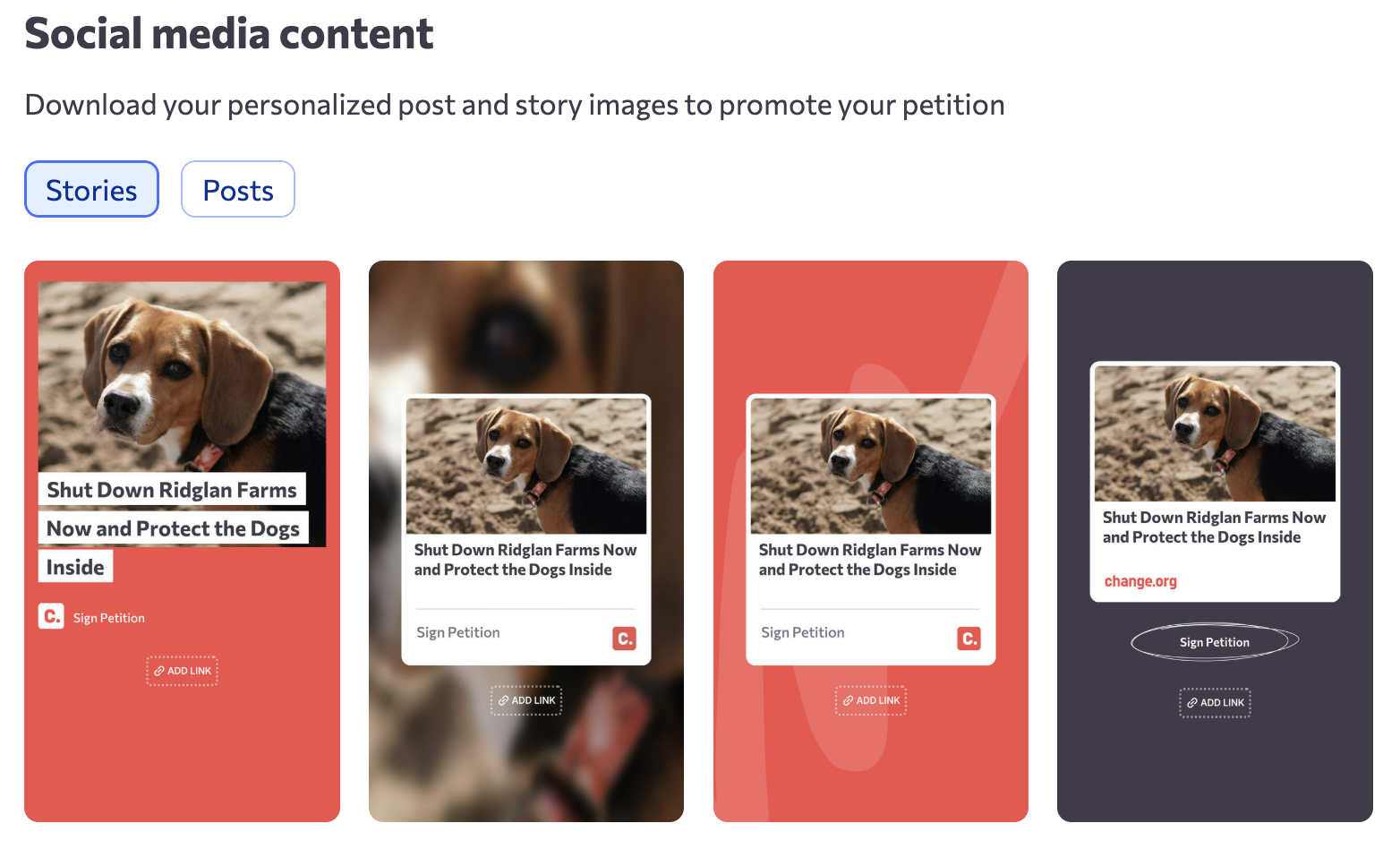
→ How to share a petition on Instagram as a Post or Story
Instagram is a popular visual platform, making it a great place to grab attention for your cause. You can post directly to your feed or use Instagram Stories to link to your petition.
Take or upload a photo to your Story.
Tap the sticker icon (smiley face) at the top of the screen.
Select the Link sticker.
Enter your petition URL and tap "Done."
Post your Story. Followers can tap the link to visit and sign.
For Posts, include the petition link in your bio and direct people there in your caption (e.g., "Link in bio to sign!"). You can use photos, infographics, or one of the image assets generated in your petition dashboard to help your post stand out.
→ How to share your petition on TikTok
TikTok's algorithm rewards engaging, authentic content. Use short videos to tell your story and why the petition matters. The following are some key tactics. Take a deeper dive in our complete guide to campaigning on TikTok.
Tell your story directly to camera — Be personal and passionate. Use captions to highlight key points.
Show visuals that connect to your cause — Whether it's footage from a protest, the problem you're addressing, or before/after images, compelling visuals help tell the story.
Use trending sounds and hashtags — Research what's popular and align your video with trends that fit naturally.
Add your petition link in bio and direct viewers to it — Say "link in bio to sign" in your video and caption.
Encourage others to duet or stitch your video — This helps your message spread and invites your community to participate in the campaign. Check out this great example from a Change.org petition starter:
→ Additional tactics beyond your own profiles:
In addition to sharing your petition on your personal social media accounts, you can expand your reach by tapping into online communities, public forums, and people with influence.
Join Facebook groups related to your petition topic or location and share it there. If your petition is about local environmental concerns, look for city or neighborhood sustainability groups. For broader topics like education or health policy, find issue-based communities where members are likely to care and engage.
Join online message boards on Reddit related to your topic or location and share. Subreddits like r/environment, r/politics, or r/YourCityName are ideal for sharing relevant petitions. Some subreddits limit promotion, so frame your post as a discussion or ask for support constructively.
Link to your petition in the comment section of related news articles. If a local newspaper or blog covers an issue your petition addresses, post a comment explaining your petition and link to it. This reaches people already interested in the topic and gives your petition more visibility.
Message influencers directly and ask them to repost. Identify influencers or public figures who align with your cause. Reach out via DM or email with a short, compelling message and your petition link. Look for speakers at past events on your issue, nonprofit advocates, or creators who use hashtags related to your cause.
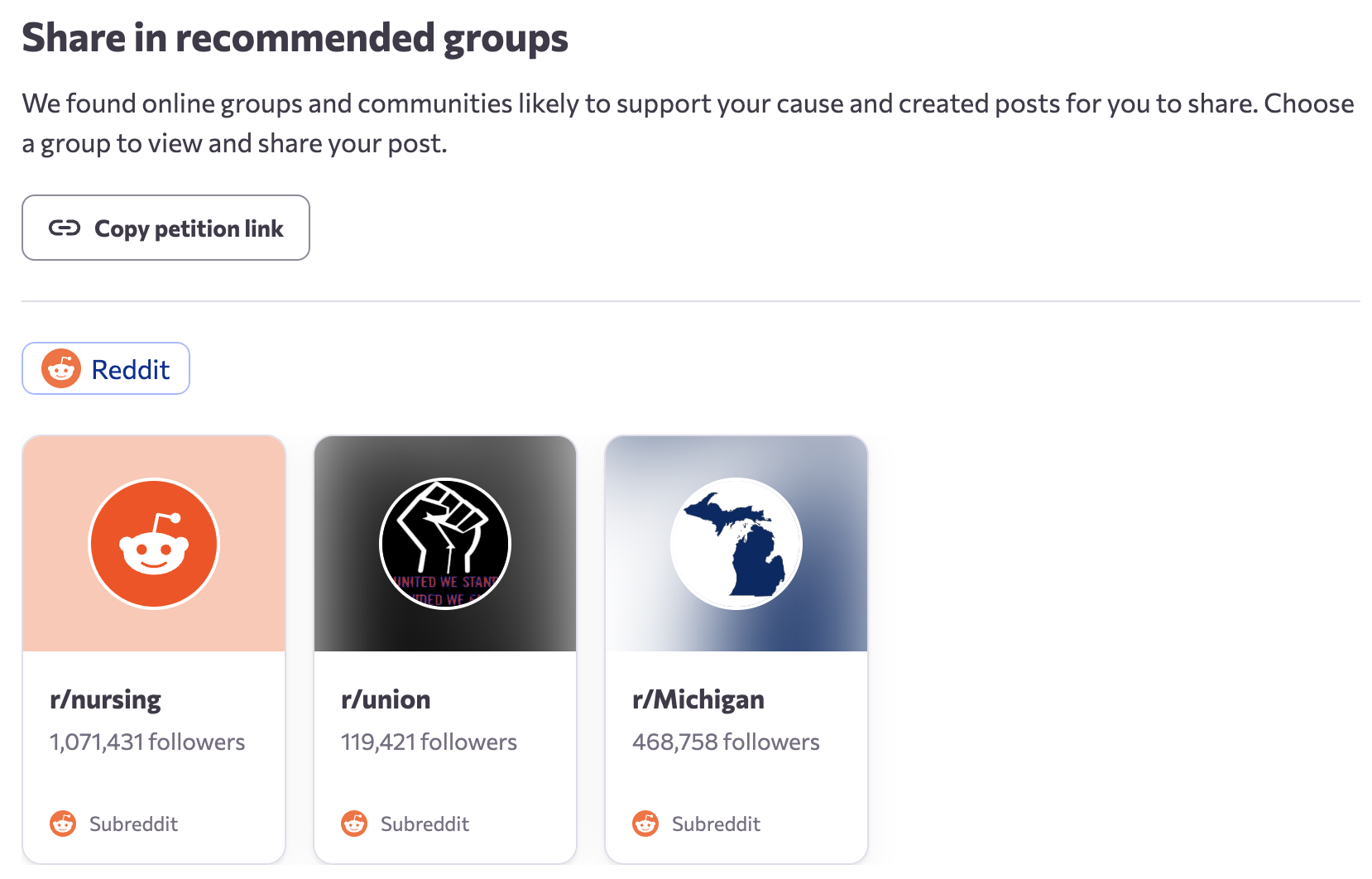
Your Change.org dashboard recommends online groups with the right audiences for your petition. You can share your petition in these communities directly through the dashboard.
More helpful resources:
Email and text your petition
One of the most effective ways to grow support for your petition is by reaching out directly through email and text. Start with people who know you — friends, family, former colleagues, local leaders, or members of support groups. These are the people most likely to sign and share right away because they trust you and care about what you're doing.
You can do this right from your petition dashboard.
"I loved that. That was easy. It was like a no brainer [to share with close friends first]." – Lori, Community Safety Advocate
If you're still figuring out what the right next step is for your situation, start here first: How to turn outrage into action that actually works.
What happens after someone signs your petition?
Signatures are where your campaign starts — not where it ends. Change.org is built to support the full arc of a campaign, from your first signatures to the moment you win. Here's how successful petition starters escalate from gathering support to driving real outcomes.
Step 1: Keep supporters engaged with petition updates
The moment someone signs, they become part of your campaign. Change.org's petition update tool lets you send messages directly to every signer as an email — and post those updates publicly on your petition page for anyone to see.
Effective updates do more than report progress. Use them to:
Share milestones and media coverage to build momentum
Ask signers to share the petition again with a specific new audience
Invite supporters to take coordinated action, like attending a city council meeting or contacting an official directly
Recruit volunteers for offline campaign efforts
Campaigns that send regular updates consistently outperform those that go quiet after launch. Aim for at least one update per week while your campaign is active.
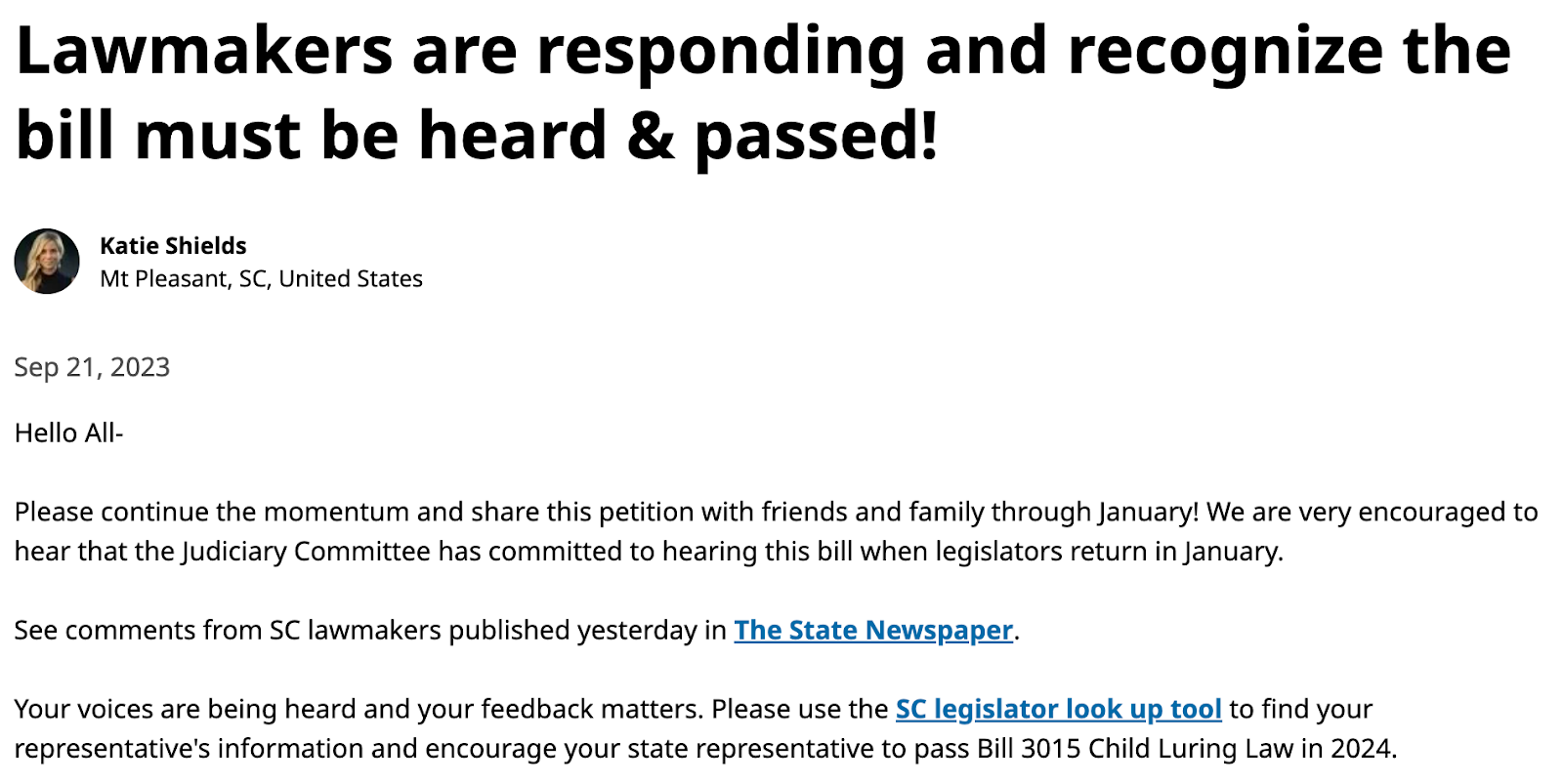
→ Read our guide to what supporter info you get when someone signs your petition, what you can download, and how to reach your supporters after they sign.
Step 2: Show decision makers the depth of your support
Signatures aren't just a number. Change.org gives you tools to show decision makers exactly who is behind your petition and how broadly support runs.
Signer comments and videos — When signers leave text or video comments explaining why they support your petition, those reasons become part of the record. You can share them directly with decision makers as evidence of real community concern, not just a headcount.
Geographic support map — Your petition page includes a map showing the ZIP codes where your signers are located. For local campaigns, this is a direct way to prove that support comes from the community a local official represents.
Signer export — You can export the names and ZIP codes of signers who have shared that information. That list is yours to use when you deliver your petition, brief a journalist, or make the case to an official that this is a legitimate constituency.
Step 3: Reach decision makers directly through the platform
Change.org helps connect your campaign to the people who can act.
Decision makers are automatically added to petitions once they reach 10 signatures
Petition starters can email them directly through the platform using suggested messaging and provided contact information
Decision makers are notified as support grows
Change.org’s Civic Engagement team may reach out to decision makers directly to ensure they are aware of the campaign.
Decision makers can also respond publicly on your petition page, creating a visible record of accountability that you and your supporters can point to.
Step 4: Bring in press and public attention
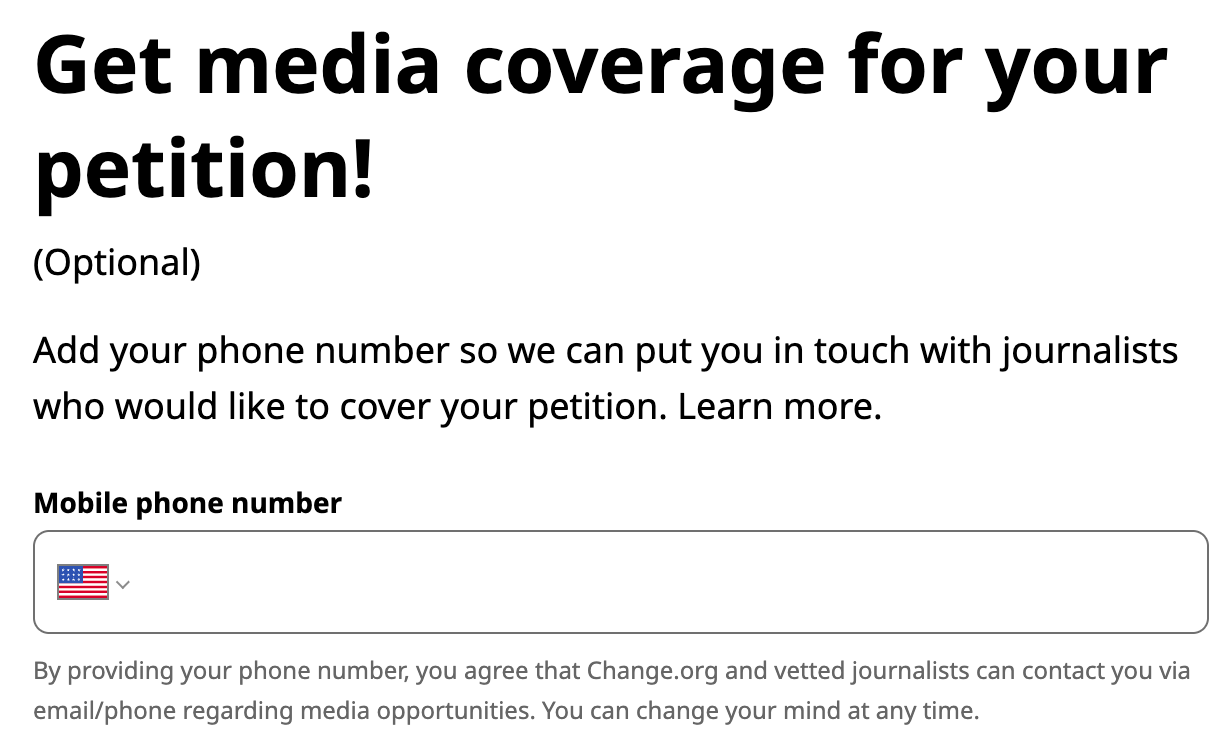
If you want media coverage, Change.org's team can connect you directly with journalists who cover your issue. Press coverage drives new signers, signals urgency to decision makers, and creates a public record of your campaign that outlasts the petition itself.
Step 5: Declare your victory
When your campaign wins, mark it. Change.org's Declare Victory feature lets you document what happened — in as much detail as you want — and share the outcome with every supporter who helped make it happen. Those documented wins become part of the public record of what organized people can accomplish on this platform.
Not sure a petition can actually lead to real change? Read real stories of ordinary individuals who started petitions that became movements — and won.
Ready to take your campaign from signatures to outcomes? Our decision-maker guide walks through exactly how to deliver your petition, engage local officials, and win at the local level. → How to win with local officials
How Change.org campaigns win: the full picture
Signatures are the foundation. What you build on top of them determines whether your campaign wins or stalls. Every successful Change.org campaign follows the same basic path:
Gather support → Engage signers → Apply pressure → Drive a response → Document the win
The steps above — petition updates, geographic proof, direct decision-maker outreach, press, and victory documentation — are all built into Change.org. What separates campaigns that win from campaigns that stall is whether petition starters use them as a connected sequence, not just a checklist of features.
Common dead ends to avoid
Most campaigns that don't win make one of these mistakes:
❌ Collecting signatures and going quiet — Supporters who don't hear from you lose interest and don't take further action. Regular updates keep them in the campaign.
❌ Treating signatures as the endpoint — A signature count alone rarely moves a decision maker. What moves them is proof of who signed, where they're from, and why they care.
❌ Not making direct contact with the decision maker — Petitions that never reach the right person don't create pressure. Use Change.org's direct outreach tools to make sure yours does.
❌ Ignoring supporter stories — Supporter Voices comments and videos are your most persuasive evidence. Leaving them unused is leaving your strongest argument on the table.
❌ Waiting for a round number to act — Decision makers respond to organized, consistent pressure — not milestone counts. Start your outreach early and keep it going.
Campaign playbooks
The same basic workflow applies across campaign types. Here's how it plays out in practice.
Federal or institutional campaign — From petition to policy: how to pressure a federal agency or major institution
1. Launch your petition and build toward a signature threshold that signals scale — federal targets respond to volume.
2. Send regular updates asking supporters to take coordinated action: submit public comments to a regulatory agency, email their representatives, or share the petition with a specific ask.
3. Use Change.org's direct outreach tools to contact the relevant decision maker and deliver your signatures
4. Request press coverage help from the Change.org team to extend reach beyond your existing supporter base and signal urgency to the institution
5. Document the outcome with the Declare Victory feature so the win is on the public record.
The playbook in action ➡️ Ashley Haugen launched the Ban Water Beads Now petition after her daughter nearly died swallowing water beads marketed as child-safe toys. She used petition updates to mobilize supporters to submit comments directly to the Consumer Product Safety Commission and to email their lawmakers.
Over 112,000 signatures were delivered to the CPSC. Major retailers including Amazon, Walmart, and Target committed to stop selling water beads as toys, and in March 2026 a federal safety rule went into effect. "Change helped me give her something I would not have been able to on my own," Haugen wrote — "the knowledge that what happened to her matters to hundreds of thousands of people."
Local government campaign — From petition to planning board: how to stop or shape a local government decision
1. Launch your petition and focus early sharing on residents directly affected — neighbors, local community groups, nearby institutions.
2. Use the geographic support map and signer export to show local officials that the opposition comes from within their own constituency.
3. Send updates to mobilize supporters for in-person moments: public comment periods, planning commission meetings, city council sessions.
4. Use updates to route supporters to direct contact with local officials — a message to the mayor, an email to a council member, a public comment submission.
5. Coordinate with local press to extend the campaign's visibility and put the decision maker on record.
The playbook in action ➡️ When the Port of Whitman proposed rezoning land adjacent to a residential neighborhood, elementary school, and assisted living facility in Pullman, Washington for a heavy industrial biodiesel plant, residents launched a petition opposing it. The community used petition updates to turn online signatures into in-person action — mobilizing supporters to attend a Port of Whitman commission meeting, stage a downtown protest covered by local radio, and email the governor. At 7,426 signatures, the Port of Whitman voted to withdraw their rezoning application and abandon the land purchase entirely.
Running a local campaign? Our decision-maker guide covers exactly how to deliver your petition, engage local officials, and win. → How to win with decision makers
Use your powerful online petition to get signatures offline
An online petition can also be a powerful tool in person. Taking your petition offline helps you connect directly with your community, build awareness, and gather even more support from people who may not see it online.
→ Read our complete guide to offline strategies for growing your petition
Collect signatures in high-traffic areas
Face-to-face conversations are a great way to share your passion and get real-time support. Head to public places where foot traffic is high and you're allowed to engage with passersby — like college campuses, downtown areas, public parks, or outside busy transit stations. Have your petition page open on a smartphone or tablet so supporters can sign right there.
Plan a local event
Hosting an event can energize your campaign and bring people together around your cause. Consider reserving free meeting space at a public library or having a meetup at a community center. Independent bookstores, coffee shops, and other local businesses often welcome grassroots efforts — especially if your cause aligns with their values.
Know the rules: Petition circulation laws and best practices
If your petition relates to official policy or legislation, requirements may vary. If your petition is aimed at local or legislative change, it's essential to collect signatures from registered voters, ideally within the decision maker's constituency.
Key considerations:
Some states require petition circulators to be residents or registered voters who are at least 18 years old
Rules differ for paid vs volunteer signature collection — Some large-scale campaigns use paid petition circulators. Always check your state's latest laws before hiring or becoming a paid circulator.
Public spaces are generally fair game, but private property may restrict petition activity. Be respectful, avoid disruption, and seek permission when needed.
Always check local regulations before collecting signatures.
Start strong with these proven tactics
Every signature is a step toward change — and now you've got the tools to grow your petition and see it through to a win. Whether you're sharing online, in your local community, or rallying friends and supporters, these tactics will help you build real momentum.
Don't wait. Start your petition, use what works, and watch your impact grow.