Do online petitions work and how many signatures do you need?
Do online petitions work and how many signatures do you need?
Can online petitions really create meaningful change? Does it need a lot of support behind it to make an impact? Discover the answers and find out all the details on what makes a persuasive petition in this guide.In this article you will learn:
The right to petition is a fundamental pillar of democracy. Citizens don’t have to sit by while their concerns go unknown or ignored by the officials in power. They can use petitions to raise problems and call on the government and other leaders to address them.
But, whether you’re the person starting a petition or signing it, you might wonder what value and impact it really has. Can a petition actually do anything? Can it make a difference? Can it convince the people with authority to take action and create positive change? We can definitively say: yes, it can.
Over 115,000 petitions on Change.org alone have achieved victory, and many more have created awareness about different issues — which is a win on its own. Change.org petitions have earned nearly 600 million signatures so far from people just like you.
For example, some recent petitions that achieved their goals include:
A petition to stop the rezoning of 185-acre site in Hoffman Estates, Illinois to build data centers gathered 3,456 signatures from community members. The petition starter called for supporters to write letters and attend Village Board meetings, since the board had the final say on the rezoning. The data center developer, Karis Critical, ultimately withdrew its request.
A petition to reinstate WIAA-sanctioned lacrosse at Pulaski High School generated nearly 1,000 shares from players, parents, coaches, and community members after the school board voted to end the program's eligibility without public input. The petition starter asked supporters to attend school board meetings, write letters, and speak up in addition to signing, since the board had the final say on the program's status. The board ultimately reversed course, and Pulaski Boys' and Girls' Lacrosse will continue as a WIAA-sanctioned program for the 2027 season.
Both are examples of how taking action alongside a petition can build sustained pressure at any level of decision-making — from a developer pursuing a 185-acre project to a local school board overseeing a single team's future.
In this guide, find out more about what makes a successful petition and how much support you need behind it so you can create one that wins.
Why petitions work
Online petitions are a powerful tool for driving awareness and influencing decision makers. A single signature might seem small, but when combined with thousands or even millions, it becomes a powerful driver of results. Here’s how petitions create impact:
Sharing concerns and shaping public opinion
Petitions give individuals a platform to express concerns and demonstrate widespread support for an issue.
They serve as a visible signal of public sentiment, showing decision-makers the level of concern and urgency around a topic.
The more signatures a petition gathers, the harder it is for leaders, companies, or institutions to ignore.
Influencing media and public discourse
Journalists and media outlets can use the traction of online petitions to gauge public interest.
A petition with significant engagement can turn an issue into a newsworthy story, amplifying its reach when it’s mentioned in newspapers or online publications.
Media coverage can put additional pressure on decision-makers to respond or take action.
Engaging supporters and driving action
Petitions help organizations and advocates identify and connect with people who care about an issue.
Signing a petition is often the first step in civic engagement, encouraging supporters to take further action such as attending events, contacting officials, or donating to a cause.
Many successful campaigns use petitions as a foundation for larger movements, driving long-term impact.
Online petitions make civic participation accessible to everyone — regardless of background or resources — to make their voice heard and contribute to meaningful change.
💡 Read our petition platform comparison guide to find your right fit
The impact of digital petitions
Online petitions work because of their ability to gather a significant number of advocates quickly, building undeniable public support that decision makers can’t ignore. Many local wins happen on the timeline of a meeting, hearing, or vote. Larger corporate or policy shifts can take longer, while making progress and hitting milestones along the way.
All it takes is one person with a problem to solve and a vision to make a difference on Change.org.
What happens between the first signatures and a concrete result? A common pattern on Change.org combines public momentum, official notice, and coordinated follow-through.
Early momentum, visible proof
Signers share their personal experiences, perspectives, and reasons for signing in the Supporter Voices section. Their general locations appear on the ZIP code map of where signers are coming from on the petition page. When a petition reaches 100 or more signatures with at least 60 percent of signers geographically concentrated, a constituent count can display under a listed official’s name. This is concrete proof of in-district support.
Automatic decision-maker surfacing
As a petition gains support, Change.org adds relevant local decision makers so the right people see it. The Civic Engagement team sends notification emails when decision makers are listed and again when petitions reach key supporter thresholds. Learn more about how Change.org connects advocates with their elected officials.
Direct outreach and public responses
Petition starters can email listed officials from their petition dashboard using suggested messaging, and can export supporter names and ZIP codes to use when formally delivering the petition. Officials can post public responses on the petition page.
Media and public events
Petition updates email supporters and post on the petition page. Starters can use updates to drive turnout at hearings, coordinate phone calls, and share media coverage. Change.org can connect starters with journalists when they want help reaching the press.
A large-scale example of reach
A petition started by the Nashville Zoo against a proposed data center right next to the zoo shows how fast a local issue can scale when the stakes are clear. Started in June 2026, the petition drew more than 500,000 signatures in a matter of weeks as supporters came together to protect sensitive wildlife next to the proposed site. With that many names, local officials will hear about it from staff, from the press, and from people at the grocery store.
Thousands have started and won petitions. Build awareness and support for your cause. → Start your petition today.
Do boycotts and online campaigns actually change corporate behavior?
Short answer: yes, when they are visible, specific, and tied to reputational stakes or community trust.
After Kanye West made a series of public antisemitic statements, more than 175,000 people signed a petition calling on Adidas to end its partnership with him. Adidas cut ties with Ye shortly after, joining other brands and agencies that had already done so. The petition's organizer, the Campaign Against Antisemitism, said the scale of public response helped push a major global brand to act.
After the 2024 Eggsposé revealed that Hardee's had fallen behind on a decade-old promise to go cage-free, animal welfare nonprofit The Humane League launched a petition pushing parent company CKE Restaurants to report its progress. CKE responded by publishing detailed cage-free progress for both Carl's Jr. and Hardee's, and reaffirmed its commitment to be 100% cage-free by the end of 2025 — a shift expected to move 1.3 million hens out of cages annually once complete.
A petition calling for Starbucks to stop using plastic straws gathered hundreds of thousands of signatures. In 2018, Starbucks announced it would phase out plastic straws globally by 2020, significantly reducing plastic waste.
Community standards do not move by themselves. People push, and the business adjusts.
Examples of successful online petitions
While many petitions win by targeting a single decision-maker or business, others can influence laws and government decisions. Here are a few examples of petitions that achieved major local and national results.
Freeing Virgilio Aguilar Mendez: Over 600,000 people signed a petition calling for the release of Virgilio Aguilar Mendez, a Guatemalan man wrongly convicted due to a flawed legal process. Thanks to public pressure, legal advocacy, and the petition's momentum, Virgilio was finally freed from prison in 2024.
Conversion therapy for minors ban in Canada: A petition urging the Canadian government to ban conversion therapy gained massive support. In response, Canada passed legislation in 2021, making conversion therapy illegal nationwide.
Government returns deported immigrant: Maria Mendoza Sanchez, a dedicated oncology nurse in Oakland, CA, was deported to Mexico in 2017 despite living in the U.S. for over 20 years. A petition advocating for her return gained widespread support, alongside legislative efforts by Senator Dianne Feinstein and Representative Barbara Lee. Thanks to relentless community advocacy, Maria was able to return to the U.S. in 2018, reuniting with her children and demonstrating the power of public pressure in challenging unjust immigration policies.
How many signatures does your petition need to win?
Whether you’re campaigning for significant, high stakes causes, or simple neighborhood issues like getting a speed hump on your street — how many signatures do you need to get results?
The answer depends on your goal. Here’s what you should know about gathering signatures and maximizing your petition’s effectiveness:
Petitions for a federal response
In the U.S., petitioning the federal government is a protected right under the First Amendment. Federal petitions should be directed to elected officials, like your senators or representatives.
Research government websites or ask your elected officials if and what the criteria is for petitions where you live.
Many petitions win with fewer signatures
You don’t need hundreds of thousands of signatures to make a difference. Many successful petitions on Change.org have fewer signatures but still create significant change.
For example, a petition to save a community mural in Los Angeles gained over 42,000 signatures (with a goal of 50,000) after local officials instructed a business to remove a mural. The petition resulted in a productive dialogue with the mayor’s office, leading to a mutually agreeable solution.
Another petition that received 570 signatures asked for the installation of metal detectors in Barrow County schools following a tragic incident at a Georgia high school. The petition called for funding to implement this safety measure and urged the Barrow County School System to prioritize student protection. In response, the school board authorized the purchase of the metal detector system.
A petition successfully convinced the Sunbury City Council to join the Penn State Local Climate Action Plan (LCAP) program to improve the city’s sustainability and flood resilience with just 150 signatures.
While it’s tempting to focus on the number of signatures, each one represents a real person who supports your cause. Even a petition with a few hundred signatures can make a meaningful impact.
How to maximize your petition’s support and awareness
Creating a petition is just the beginning. Your next steps depend on your cause’s scope (local, state, or national) and the stakeholders who can implement change. Here are four ways to amplify your petition and move your cause forward:
1. Connect with your decision maker
Once a decision-maker is listed on your petition, there are a few ways to reach them directly.
Email them yourself. From your petition dashboard, you can email your listed decision-maker directly using suggested messaging.
Encourage supporters to do the same. Add your decision-maker's email address to your petition page and in petition updates so supporters can reach out too. A decision-maker hearing from one petition starter is easy to dismiss. Hearing from dozens or hundreds of constituents is harder to ignore.
Change.org's outreach works in parallel. Once your petition meets certain thresholds, Change.org's Civic Engagement team follows up directly with your decision-maker by phone and email, separate from the automatic notifications they receive as your petition grows.
2. Keep supporters engaged
Unlike paper petitions, Change.org allows you to send email updates to your supporters. Use this feature to re-engage them, encouraging further actions like sharing the petition or contacting representatives.
3. Attract media attention
Leverage your petition to gain media exposure. Organize events such as rallies, events, and protests and use your petition to inform and mobilize your supporters. Larger crowds often attract media interest, amplifying your message.
4. Amplify personal stories
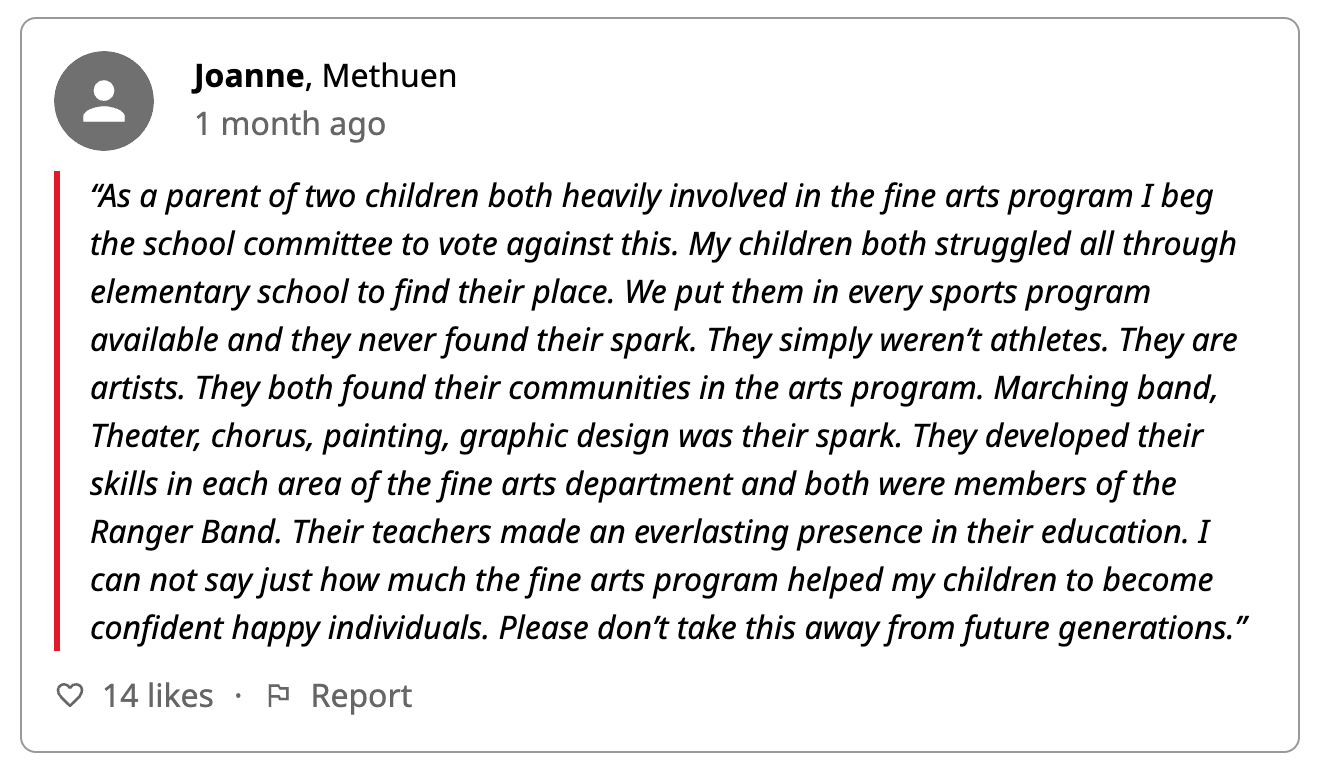
Make your petition more compelling by sharing personal stories from your supporters. Use the Supporter Voices section to gather quotes and experiences that highlight the importance of your cause. You can add these to your petition description and share them on social media.
This adds a human element that resonates with others, like the following example from a petition that successfully saved a Fine Arts Director position at a high school.
Make change with an online petition
Petitions are more than just a collection of signatures; they are a powerful tool for speaking up. Whether you're calling for local change or national action, your petition can spark conversations, influence decision-makers, and even shape public policy. Strategic efforts like engaging supporters, using media attention, and focusing on a clear goal can create real, lasting impact.
→ Start your petition today
Frequently asked questions
Does Change.org notify decision-makers automatically? Yes. As a petition gains signatures, Change.org identifies and adds relevant decision-makers, and sends them notification emails as the petition is listed and again as it hits key signature thresholds.
Can I contact a decision-maker directly through Change.org? Yes. Petition starters can email their listed decision-maker directly from the petition dashboard using suggested messaging, and can add the decision-maker's email to the petition page and updates so supporters can reach out too.
Do I need a large number of signatures for a petition to succeed? No. While large petitions can create national attention, many petitions win with a few hundred to a few thousand signatures, especially when the target is a single local decision-maker like a school board or city council.
What's the difference between winning a local petition and a national one? Local petitions typically need fewer signatures but rely on geographic concentration and direct outreach to a specific official. National petitions usually need broader public pressure and media attention to influence a company or government policy.
Do petitions actually change corporate behavior? Yes, when the pressure is visible, specific, and tied to a company's reputation or values. Petitions have led companies to end partnerships, change sourcing practices, and shift public policies after sustained public pressure.
What happens after a petition reaches its decision-maker? Decision-makers can respond publicly on the petition page. Change.org's Civic Engagement team also follows up directly by phone and email once a petition meets certain criteria, and helps facilitate a public response. In many cases, the decision-maker goes further and makes the change the petition is asking for, at which point the petition is marked as a Victory.