Can one person start a movement? Real stories of everyday people who did
Can one person start a movement? Real stories of everyday people who did
Four ordinary people — a mother, a college student, a community volunteer, and a grieving father — started petitions that led to a federal safety law, a corporate ban, a city policy reversal, and a signed state bill.One person can absolutely start something that becomes a real movement, and that’s how some of the biggest social change in history has occurred. All it takes is one idea from one person who decides to take action. It happens on Change.org every day — and the people who start those movements are not politicians, celebrities, or professional organizers. They are parents, students, neighbors, and volunteers who had something real at stake and decided to say so.
Discover the stories of four of those people who built a movement on Change.org.
Ashley Haugen: From one daughter's injury to a federal safety law
Ashley Haugen didn't set out to take on the Consumer Product Safety Commission or the biggest retailers in the country. She wanted to protect other children from what happened to her daughter Kipley, who suffered a brain injury after swallowing a water bead containing toxic chemicals. This was a product that had been marketed as a safe sensory toy for kids.
Ashley started a petition calling on the CPSC to require clearer warning labels and restrict water beads from being marketed as children's toys. She had no lobbying experience and no organizational backing. What she had was her daughter's story, and the certainty that other families didn't know what she now knew.
100,000 people signed. National media followed — the Today Show, CBS News, and others. The pressure reached the CPSC and 11 major retailers, including Amazon, Target, Walmart, and Etsy, all of whom committed to stop selling water beads as toys. In March 2026, the Water Bead Toy federal safety rule took effect — a real regulatory standard that will protect children for generations.
It took 3.5 years.
"Change helped me give her something that I would not have been able to on my own," Ashley said, "the knowledge that what happened to her matters to hundreds of thousands of people."
Danielle Gletow: From a local shelter crisis to a city reversed
Danielle Gletow spent 15 years advocating for children in the welfare system. She also saved dogs. Then she learned that animals at the Trenton Animal Shelter were facing euthanasia due to overcrowding and mismanagement. Furthermore, the shelter manager was refusing help from local rescues out of what she described as personal pettiness. So, she decided to start a petition calling on Trenton Mayor Reed Gusciora to intervene.
She wasn't a city official. She had no formal standing. She had a cause, a willingness to put her name on it, and a refusal to accept that the animals had no options.
Within about a year, the city responded. Full shelter access was restored. Volunteers who had been banned were reinstated. City administration began collaborating directly with rescue volunteers under a new acting director of Health and Human Services. Dozens of dogs that had been held offsite were made accessible again.
A local problem. A specific target. One person who decided enough was enough.
Mia Adcock: From contaminated drinking water to a corporate ban
Mia Adcock was a college student from Wilmington, North Carolina when she started her petition. Her qualification wasn't a chemistry degree or a corporate law background. It was that she had grown up drinking water contaminated by PFAS — "forever chemicals" — that a company had been discharging into the Cape Fear River for nearly 40 years.
When she learned that REI and other outdoor companies were using the same class of chemicals to waterproof their products, she wrote a petition asking REI to lead the industry away from PFAS. She framed it simply: no one's drinking water should be polluted for a rain jacket.
130,000 people signed. Supporters showed up at REI store locations across the country. The campaign combined the petition with direct action, store visits, emails to the CEO, and calls to customer service. The message broke through.
REI announced a ban on PFAS across all textile products and cookware from all of its 1,000+ brand partners — a policy change with industry-wide implications that went well beyond a single company's product line.
It took about one year. Mia's credential was simply that her and her community were directly impacted.
Eric Henry: From a father's grief to a signed state law
Eric Henry lived in Chippewa Falls, Wisconsin his whole life. He didn't live far from where 10-year-old Lily’s body was found. As a father, he was devastated and disturbed that no alert had been sent when she went missing, because her disappearance didn't meet the strict criteria for an Amber Alert.
He started a petition calling for a new alert system with lower activation thresholds. He called it the Lily Alert. He had no political experience, no connections in the state legislature, and no legal background. He had a name, a cause, and a belief that his community could do better.
Legislators took notice. Eric attended meetings with senators, security experts, police officers, and attorneys. He tracked every step of the process in petition updates written in his own voice — honest, specific, and grateful. A bill was drafted. Cosponsors were secured. The Wisconsin Senate passed it. The Assembly followed.
On April 9, 2024, Governor Tony Evers signed SB 981 into law, creating a new statewide child alert system in Wisconsin.
It took about two years. Eric started it because he was a father who lived nearby and thought someone had to do something.
What these four campaigns have in common
None of these people had credentials that qualified them to win. Ashley wasn't a regulatory lawyer. Danielle wasn't a city official. Mia wasn't a chemist. Eric wasn't a legislator. What they had was something harder to dismiss than a title: direct personal experience, a specific ask, and a documented record of support that decision makers couldn't ignore.
Each campaign took sustained effort over months or years. None of them won overnight, but they did ultimately win.
They also each had a specific target. Not "the system" or "corporate America" or "politicians" — a named official, a named company, and a named regulatory body that supporters could help put pressure on.
FAQ
Do I need experience or credentials to start a petition?
No. The four campaigns above were started by a mother, a community volunteer, a college student, and a father. None of them had political experience or organizational backing when they began. Personal experience with an issue is its own form of authority — often more persuasive to decision makers than formal expertise, because it is harder to dismiss.
How long does it usually take?
It varies. These campaigns took between one and 3.5 years. The timeline depends on the complexity of the issue, the responsiveness of the decision maker, and the momentum the campaign builds. These campaigns ended with documented wins, not open-ended struggles. Some campaigns might achieve different outcomes than the original goal depending on how the issue progresses, or some but not all of a petition’s goals might be reached. So, victory can look different for each campaign and take shape over time.
What if my issue feels too small or too personal?
Danielle's petition was about one animal shelter in one city. Eric's was about a missing child in a small Wisconsin town. Both of them won. The scale of the issue at the start has no bearing on whether it can create real change — what matters is whether there is a specific decision maker with the power to act and a community of people who care enough to say so.
What is the difference between a petition that wins and one that doesn't?
The campaigns that win tend to share three things: a named decision maker with actual authority over the issue, a specific and achievable ask, and early momentum that demonstrates real community support. Change.org’s petition guides cover each of these components in detail.
One person is how every movement starts
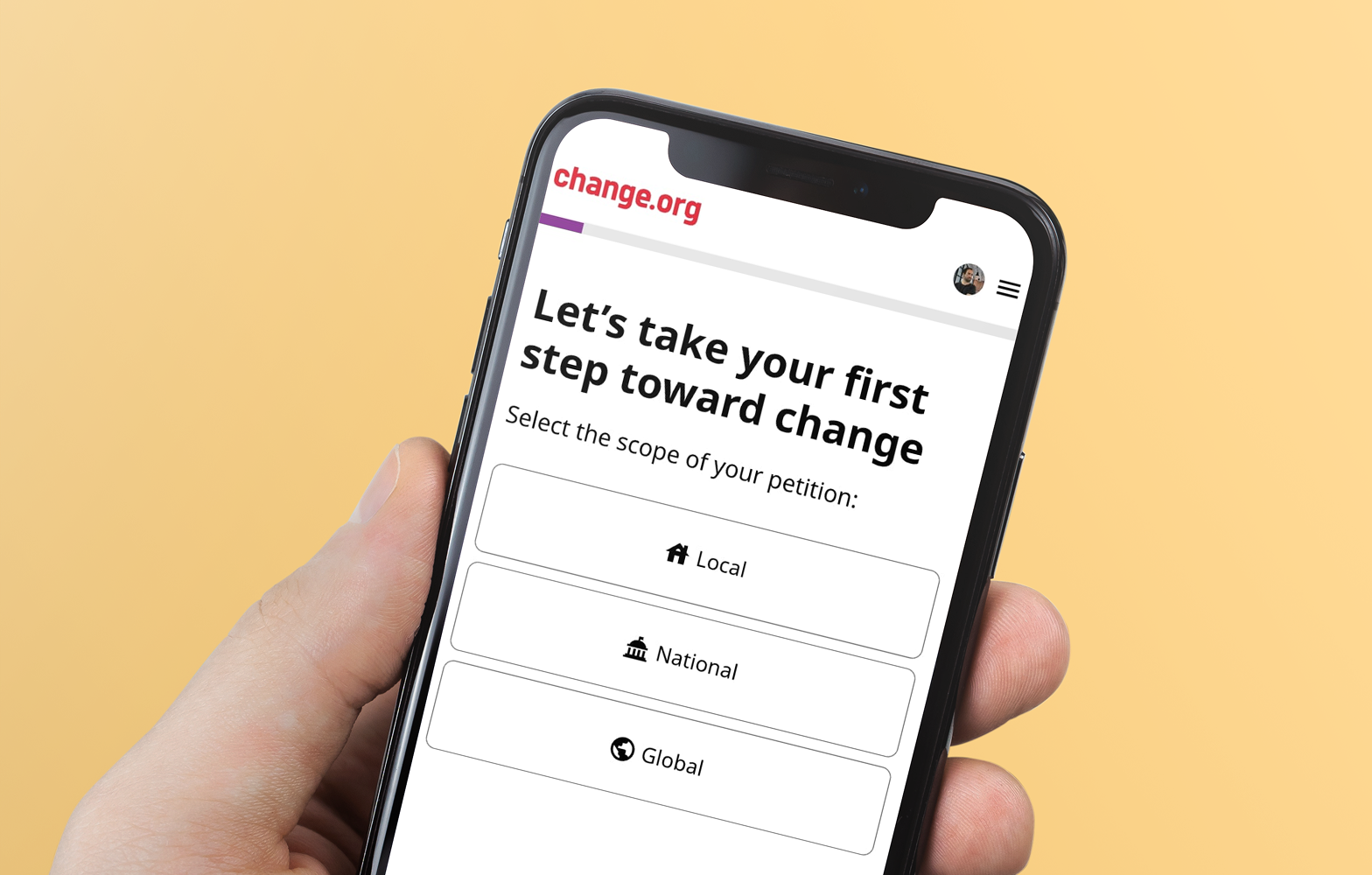
If you have something real at stake, that is enough to begin. Start your petition on Change.org — it's free, it takes minutes, and every signature you collect becomes documented proof that your issue matters.