

Stop Payment Processors from Dictating Legal Purchases
The Issue
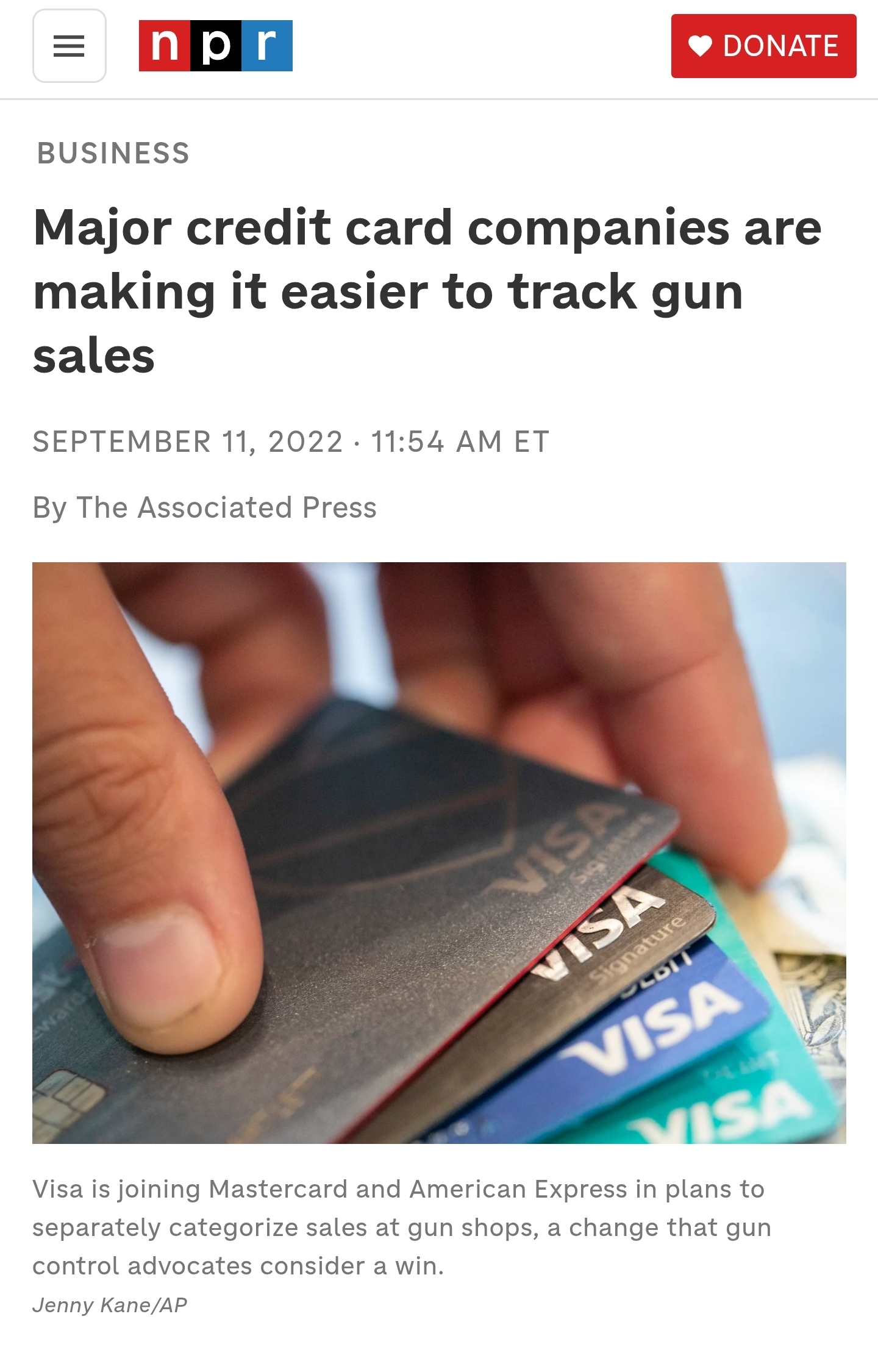
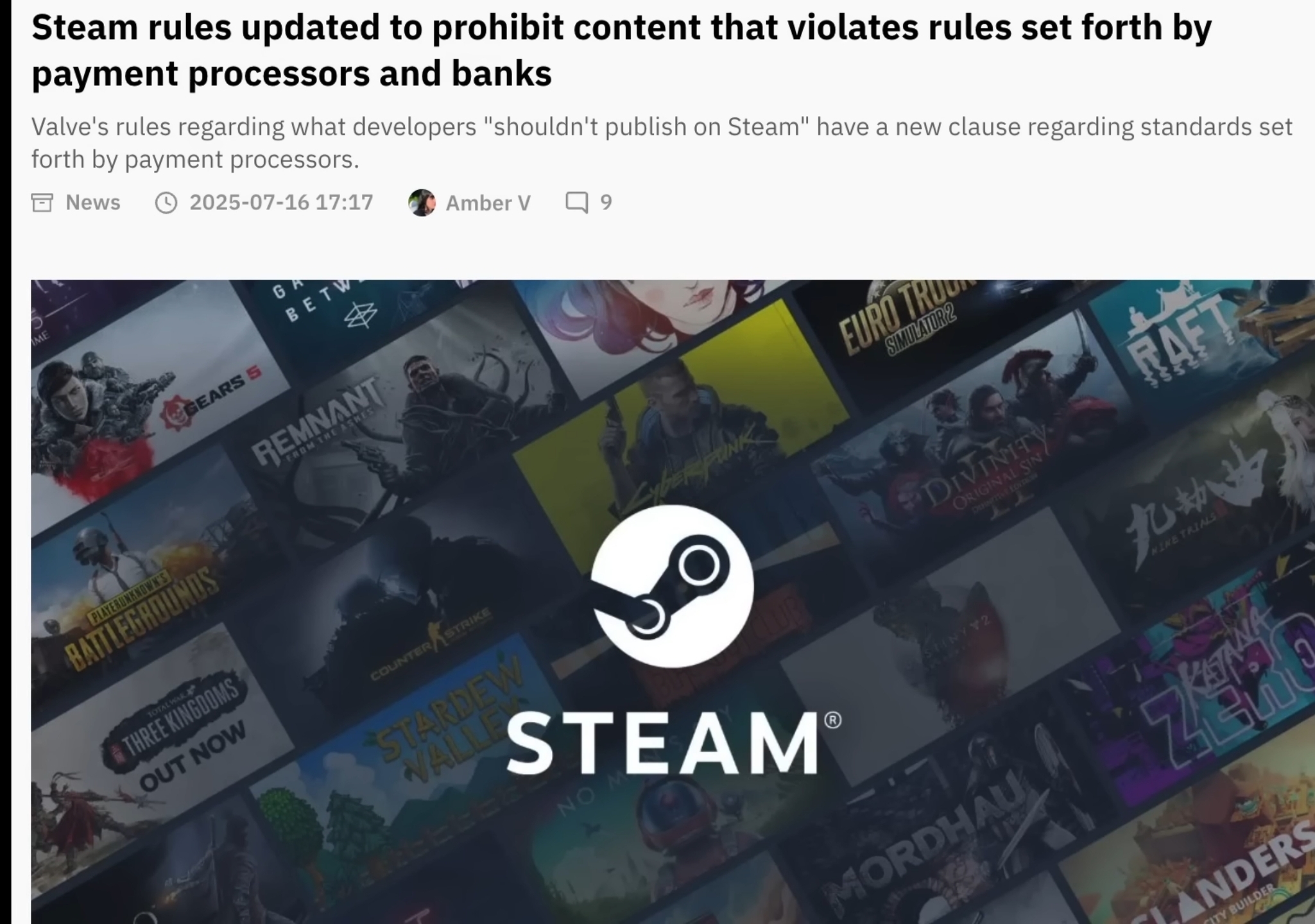
While I appreciate the many petitions calling on companies like Visa and PayPal to change their policies on censoring legal purchases, this one stands apart by demanding real, lasting reform through federal law. Instead of relying on corporate goodwill—which has failed time and again—we're urging Congress to pass the Fair Access to Payment Processing Services Act, ensuring processors and banks can't dictate or block lawful transactions, from guns to games, without loopholes or excuses. Join us in pushing for enforceable protections that put power back in the hands of consumers and businesses, not unelected gatekeepers.
Congress, governors, anyone with any amount of power—MAKE THIS KNOWN! Rep. Andy Barr has a bill similar to mine; make them pay attention. It's H.R. 987, the Fair Access to Banking Act. Tell your rep to support it, tell them about this petition as well. Let's be heard!
I took my original idea and merged it with HR 987 for the law at the bottom. Its strong and has almost no loopholes.
Dear Fellow Americans,
In today's digital world, payment processors like PayPal, Visa, and Mastercard—along with banks and other financial institutions—hold immense power over our economy. They act as gatekeepers, deciding what legal products we can buy and sell—not based on laws, but on their own moral or risk-based judgments. This isn't just inconvenient; it's a threat to our freedoms, free speech, and free markets.
Imagine trying to buy a legal firearm online, only to have your payment blocked because the processor or bank deems it "high-risk." Or registering for a website with adult content that's protected under the First Amendment, but your card or account is declined due to corporate policies. What about video games on platforms like Steam being censored because an Australian law influences global processors? Or a small business owner getting "debanked" by their bank for selling patriotic merchandise? These aren't hypotheticals—they're happening now.
Payment processors and banks aren't just refusing service; they're bullying companies into changing their offerings. They demand platforms remove certain products or face being cut off entirely, creating a chilling effect on innovation and choice. And with electronic payments essentially representing our legal tender (U.S. dollars in digital form), denying access to them for legal purchases feels like a violation of our right to spend our money freely.
Why This Matters:
- Erosion of Consumer Rights: In the U.S., if a product is legal, we should be able to buy it without corporate interference from processors or banks. But their opaque policies let them dictate terms, often under pressure from international laws or public opinion, overriding American freedoms.
- Slippery Slope to Censorship: It starts with adult content or guns, but where does it end? Bibles flagged for "hate speech"? Patriotic merchandise deemed "extremist"? Political donations blocked for "risky" views? We've seen echoes of this in past programs like Operation Choke Point, where legal industries were starved of banking and payment services.
- Lack of Alternatives: A few giants control 90% of digital payments and banking services, so when they "bully," there's no easy switch. Small businesses suffer, consumers lose options, and the market stagnates.
- Legal Tender in the Digital Age: Electronic payments access our banked dollars—legal tender under U.S. law. Processors and banks shouldn't be allowed to restrict this for lawful uses, just as stores can't refuse cash without good reason.
This overreach isn't about safety; it's about control. Processors and banks should either do business or walk away cleanly, letting competitors fill the void. Instead, they condition services on changes, stifling commerce.
What Japan Is Doing in Response to This
Recent actions in Japan underscore the growing international pushback against payment processors' overreach, particularly Visa's role in censoring legal manga and anime content. On July 22, 2025, the Japan Fair Trade Commission (JFTC) approved a commitment plan from Visa Worldwide Pte Limited to resolve an ongoing antitrust investigation into anticompetitive practices, including restrictions on preferential rates for credit information systems that unfairly limited competition from rivals like NTT Data. This development echoes broader concerns about processors dictating terms that enable censorship, as seen with manga platforms like DLSite and Manga Library Z, where Visa and Mastercard suspended services even after companies complied by removing or altering explicit content to meet "brand protection" demands. Such persistent blocks have sparked outrage, with Japanese lawmakers forming groups to combat this, highlighting why the U.S. needs legislative action like the Fair Access to Payment Processing Services Act to protect consumer freedoms from similar arbitrary censorship.
What We're Demanding:
We call on Congress to pass the Fair Access to Payment Processing Services Act, a straightforward law that prohibits payment processors, banks, and other financial institutions from dictating or conditioning services on what legal products companies sell or individuals buy. It treats electronic payments as extensions of legal tender, ensuring fair access. If a processor or bank doesn't like a business, they must simply terminate the contract—no bullying, no demands.
Sign this petition to urge your senators and representatives to introduce and support this bill. Together, we can protect free markets, prevent financial censorship, and ensure our digital economy serves us, not the other way around.
Updated and merged with HR 987.
Hypothetical Statute: Fair Access to Financial Services Act
Section 1. Short Title
This Act may be cited as the "Fair Access to Financial Services Act."
Section 2. Findings and Purpose
(a) **Findings**: Congress finds that—
(1) The ability to enact public policy through duly elected representatives is a protected constitutional right of the citizens of the United States.
(2) Operation Choke Point and similar programs represent an abuse of the Department of Justice’s authority.
(3) No Federal financial agency or authority has been granted statutory authority to prohibit financial institutions from providing services to lawful businesses based on subjective, category-based evaluations of risk or reputational harm.
(4) The exercise of such authority threatens the integrity and prospects of the United States economy and national security.
(5) Financial institutions that receive taxpayer support or access to Federal Reserve facilities have a responsibility to provide fair access to services using impartial, risk-based standards.
(6) Electronic payments constitute access to, and a digital representation of, legal tender, and restrictions on them for lawful transactions undermine consumer freedoms.
(7) Discriminatory practices by financial entities, including tracking or denying services for lawful firearm-related transactions, infringe on Second Amendment rights and free commerce.
(8) Payment processors and banks increasingly act as unelected gatekeepers, dictating business practices or censoring legal products (e.g., adult content, video games, or patriotic merchandise) under vague policies, often influenced by international pressures or moral judgments.
(9) Such overreach stifles innovation, creates market voids only for competitors to fill, and disproportionately affects niche industries like firearms, manga/anime, and political fundraising.
(10) Existing laws fail to adequately address digital tender equivalence, leading to de facto denials of legal tender for online transactions.
(11) Tracking mechanisms like unique Merchant Category Codes for guns enable surveillance and indirect discrimination, eroding privacy and constitutional rights.
(12) International examples, such as Japan's antitrust actions against Visa for censoring manga platforms even after compliance, highlight the need for U.S. protections against arbitrary corporate power.
(b) **Purpose**: The purpose of this Act is to—
(1) Ensure fair access to financial services for all lawful businesses and individuals.
(2) Ensure fair treatment of customers by financial service providers without discrimination based on lawful activities.
(3) Protect the safe and sound operations of financial institutions through objective risk assessments.
(4) Protect against the impeding of lawful commerce, including firearm-related transactions.
(5) Ensure that financial service providers make impartial, individualized risk-based decisions using empirical data, without reliance on reputational, political, or moral considerations.
(6) Treat electronic payments as extensions of legal tender to facilitate lawful transactions in the digital economy.
(7) Prohibit conditioning, dictating, or influencing lawful business practices, and prevent tracking or profiling based on gun ownership or similar protected activities.
(8) Provide strong enforcement mechanisms, including private rights of action, to deter violations and compensate victims.
(9) Promote transparency through reporting and audits to prevent abuses like those seen in international cases (e.g., Japan's actions against Visa for manga censorship).
(10) Preserve market competition by requiring clean refusals rather than coercive demands, allowing alternatives like cryptocurrency or niche processors to emerge.
Section 3. Definitions
For the purposes of this Act:
- (a) The term "covered financial entity" means any payment processor, bank, credit union, trust company, or other financial institution that facilitates the authorization, clearing, settlement, processing, or holding of financial transactions or accounts on behalf of merchants or individuals, whether through credit, debit, electronic transfer, deposit services, or other means. A covered financial entity is presumed if it has total assets of $50,000,000,000 or more (or $500,000,000,000 or more for insured depository institutions), rebuttable by demonstrating no market power to raise prices, restrict access, or impede business.
- (b) The term "payment processor" means any entity, including but not limited to a payment card network (e.g., Visa, Mastercard), electronic funds transfer system, or third-party payment service provider (e.g., PayPal, Stripe), that facilitates the authorization, clearing, settlement, or processing of financial transactions.
- (c) The term "bank" means any depository institution as defined under the Federal Deposit Insurance Act (12 U.S.C. § 1813(c)), including national banks, state-chartered banks, and trust companies.
- (d) The term "covered credit union" means any insured credit union or credit union eligible to make application to become an insured credit union under the Federal Credit Union Act (12 U.S.C. § 1781 et seq.).
- (e) The term "merchant" means any person, corporation, partnership, or other entity engaged in the sale of goods or services that are lawful under applicable Federal and State laws.
- (f) The term "individual" means a natural person engaging in lawful financial transactions.
- (g) The term "financial transaction" means any exchange of value involving the transfer of funds for the purchase or sale of lawful goods or services, or the maintenance of accounts for such purposes.
- (h) The term "deny" means to refuse to initiate, continue, or renew a contractual relationship for the provision of payment processing or banking services, or to terminate an existing such relationship.
- (i) The term "condition" means to impose any requirement, restriction, penalty, or alteration upon the provision of payment processing or banking services that is predicated upon the nature of the merchant's or individual's lawful business activities, products, services, or transactions, excluding those necessary to comply with anti-money laundering statutes, fraud prevention regulations, or other applicable Federal laws explicitly mandating such conditions.
- (j) The term "electronic payment" means any method of transferring funds electronically that accesses or represents United States dollars held in a financial institution, including but not limited to credit card transactions, debit card transactions, automated clearing house (ACH) transfers, wire transfers, digital wallets, and other forms of electronic funds transfer.
- (k) The term "firearm-related transaction" means any lawful purchase, sale, or transfer of firearms, ammunition, or related accessories conducted in compliance with all applicable Federal and State laws.
- (l) The term "fair access to financial services" means the right of a person to obtain financial services from a financial service provider without prejudice, and does not include a right to receive financial services if the person is rude or abusive to employees of the financial service provider or otherwise creates a hostile work environment for such employees.
- (m) The term "financial service" means any product or service offered by a financial service provider pursuant to any provision of law, including the Federal Reserve Act, the Federal Deposit Insurance Act, the Federal Credit Union Act, the Electronic Fund Transfer Act, or any similar statute.
- (n) The term "reputational risk" means any subjective evaluation of risk based on moral, political, or public perception factors, as opposed to objective, empirical data.
- (o) The term "lawful business" means any enterprise operating in compliance with all applicable Federal, State, and local laws, including those related to firearms, adult content, video games, or other protected activities.
Section 4. Treatment of Electronic Payments as Access to Legal Tender
(a) For the purposes of this Act, electronic payments shall be deemed to constitute access to, and a digital representation of, legal tender as defined under 31 U.S.C. § 5103, insofar as they facilitate the transfer of United States currency or its equivalent value.
(b) No covered financial entity shall deny or condition services in a manner that restricts access to legal tender through electronic payments for lawful transactions, except as explicitly permitted under Federal law for reasons of fraud prevention, national security, or compliance with sanctions.
(c) The prohibitions and requirements of this Act shall apply equally to electronic payments as they do to physical forms of legal tender, ensuring that merchants and individuals are not deprived of their ability to engage in lawful commerce due to the digital nature of the transaction medium.
(d) The Consumer Financial Protection Bureau shall issue rules within 180 days of enactment to implement this section, including standards for verifying electronic payments' equivalence to legal tender in all financial contexts.
Section 5. Fair Access to Financial Services and Prohibitions
(a) No covered financial entity shall condition the provision, continuation, or renewal of payment processing or banking services to any merchant or individual upon the restriction, prohibition, alteration, or cessation of any lawful financial transaction, business activity, product, or service conducted by such merchant or individual.
(b) A covered financial entity shall not, directly or indirectly through any agent, affiliate, or contractual provision, dictate, influence, or require changes to the lawful business practices, offerings, or transactions of a merchant or individual as a prerequisite for accessing or maintaining payment processing or banking services.
(c) In the event a covered financial entity elects to deny payment processing or banking services to a merchant or individual, such denial shall be effectuated solely through the termination of the existing contract or refusal to enter into a new contract, in accordance with the terms thereof, without any accompanying demands, conditions, or requirements for modifications to the merchant's or individual's lawful activities.
(d) Any denial under subsection (c) must be justified in writing to the affected merchant or individual within 5 business days, specifying the quantitative, impartial, risk-based criteria—established in advance and supported by empirical data—that form the basis for the denial, and shall not be predicated upon reputational risk, political considerations, moral judgments, or favoritism toward alternative market participants. The justification must include all underlying data and methodologies used, subject to redaction only for proprietary information.
(e) The justification required under subsection (d) shall not include conditions or recommendations for alterations to the merchant's or individual's business practices as a means to avoid or reverse the denial. Any attempt to do so shall be considered a separate violation.
(f) No covered financial entity shall assign, use, or require the use of a unique Merchant Category Code (MCC) or similar identifier specifically for firearm-related transactions, unless explicitly mandated by Federal law for purposes of anti-money laundering, fraud prevention, or national security. This prohibition extends to any equivalent categorization method, including AI-driven profiling.
(g) A covered financial entity shall not track, monitor, collect, store, or share data on firearm-related transactions in a manner that identifies or profiles individuals as gun owners, except as required by subpoena, court order, or applicable Federal regulations. Any such data collected incidentally must be anonymized immediately and not used for purposes of risk assessment, service denial, third-party disclosure, or any other discriminatory action related to gun ownership. Violations shall trigger mandatory data destruction and notification to affected individuals.
(h) It shall be unlawful for a covered financial entity to deny, condition, or discriminate against the provision of payment processing or banking services to any merchant or individual solely on the basis of lawful firearm-related transactions, lawful firearm ownership, or associations with firearm-related businesses or organizations, provided such activities comply with all applicable Federal and State laws. This includes indirect discrimination through increased fees, monitoring, or reporting requirements.
(i) Covered financial entities shall offer financial services on a proportional basis to the market share of the covered entity in the respective product line, and may not deny services based on political opinions or speech, or to persons engaged in lawful commerce, unless based on individualized, quantified risk evaluations using empirical data. Denials must be appealable through an independent process administered by the entity, with CFPB oversight.
(j) No covered financial entity shall engage in collusive practices with other entities, governments, or advocacy groups to deny services to lawful businesses, including through shared blacklists or coordinated policies.
Section 6. Amendments to Existing Laws
(a) **Advances to Individual Member Banks (Federal Reserve Act Amendment)**: Section 13(3) of the Federal Reserve Act (12 U.S.C. 347b) is amended to prohibit member banks with total assets exceeding $50,000,000,000, or their subsidiaries, from using discount window lending if they violate Section 5.
(b) **Insured Depository Institutions (Federal Deposit Insurance Act Amendment)**: Section 8 of the Federal Deposit Insurance Act (12 U.S.C. 1818) is amended to include violations of Section 5 as grounds for enforcement against insured depository institutions with total assets exceeding $500,000,000,000.
(c) **Nonmember Banks and Trust Companies (Federal Reserve Act Amendment)**: Section 9A of the Federal Reserve Act (12 U.S.C. 342) is amended similarly for nonmember banks or trust companies with total assets exceeding $50,000,000,000.
(d) **Credit Unions (Federal Credit Union Act Amendment)**: Section 206 of the Federal Credit Union Act (12 U.S.C. 1786) is amended to include violations of Section 5 as grounds for action against insured credit unions.
(e) **Use of Automated Clearing House Network**: Covered credit unions, member banks, and state-chartered non-member banks with total assets exceeding $50,000,000,000, or their subsidiaries, are prohibited from using the ACH network if they violate Section 5.
(f) **Electronic Fund Transfer Act Amendment**: The Electronic Fund Transfer Act (15 U.S.C. § 1693 et seq.) is amended to incorporate Section 4's tender treatment and prohibit processors from restricting lawful electronic transfers under Section 5.
(g) **Bank Secrecy Act Amendment**: The Bank Secrecy Act (31 U.S.C. § 5311 et seq.) is amended to clarify that gun-related tracking is not required unless explicitly for AML purposes, preventing misuse for discrimination.
Section 7. Transparency and Reporting Requirements
(a) Each covered financial entity shall submit an annual report to the Consumer Financial Protection Bureau detailing all denials under Section 5, including justifications, data used, and appeals outcomes. Reports shall be made public, redacted only for sensitive information.
(b) The CFPB shall conduct annual audits of a sample of covered entities to ensure compliance, with findings reported to Congress.
(c) Whistleblower protections: Any employee reporting violations shall be protected under the Sarbanes-Oxley Act, with rewards up to 30% of recovered penalties.
Section 8. Safe Harbor and Exceptions
(a) A covered financial entity shall be afforded a safe harbor from liability under this Act if the denial of services is strictly limited to circumstances where the merchant or individual has demonstrably failed to meet pre-established, quantitative risk-based standards related to financial solvency, fraud risk, or compliance with Federal anti-money laundering or sanctions laws, provided such standards are applied uniformly and without regard to the nature of the lawful business. Standards must be published annually and subject to CFPB approval.
(b) This Act shall not apply to denials necessitated by a court order, regulatory enforcement action, or explicit statutory prohibition under Federal law.
(c) This Act shall not apply to decisions by a covered financial entity regarding the extension, renewal, modification, or termination of a line of credit or credit card account that the entity itself owns, issues, or directly underwrites, provided such decisions are made in compliance with applicable Federal consumer credit laws, including but not limited to the Equal Credit Opportunity Act (15 U.S.C. § 1691 et seq.) and the Fair Credit Reporting Act (15 U.S.C. § 1681 et seq.). This exception does not extend to transaction processing services unrelated to the credit line and shall be construed narrowly.
(d) Safe harbors and exceptions do not apply if the entity has a pattern of violations, as determined by the CFPB.
Section 9. Enforcement and Penalties
(a) Any merchant or individual aggrieved by a violation of this Act may commence a civil action in an appropriate United States district court against the covered financial entity for injunctive relief, actual damages, reasonable attorney's fees, treble damages, and mandatory restitution. Class actions are authorized, with no requirement for exhaustion of administrative remedies.
(b) The Attorney General, the Consumer Financial Protection Bureau, or the appropriate Federal banking agency may bring an enforcement action against a covered financial entity for violations, imposing civil penalties not exceeding $50,000 per violation or 20 percent of the value of the affected transactions, whichever is greater.
(c) For violations involving firearm-related transactions, tracking, or discrimination against gun owners under Section 5(f)-(h), an additional civil penalty of up to $50,000 per affected transaction may be imposed for willful violations, with mandatory disgorgement of any profits gained from the violation.
(d) Willful violations may result in criminal penalties, including fines up to $1,000,000 and imprisonment for up to 5 years for responsible executives.
(e) Repeated violations may result in the suspension or revocation of the covered financial entity's access to Federal Reserve discount window programs, ACH networks, or other taxpayer-funded facilities, with a minimum 1-year ban for three or more violations in a 5-year period.
(f) The Comptroller of the Currency shall enforce provisions related to payment card networks, with civil penalties as described. Victims may recover costs of investigation and expert witnesses.
Section 10. Effective Date and Implementation
(a) This Act shall take effect 180 days after enactment.
(b) The Consumer Financial Protection Bureau, in consultation with the Federal Reserve Board, shall promulgate regulations to implement this Act within 120 days of enactment.
(c) Severability: If any provision is held invalid, the remainder shall remain in effect.

2,664
The Issue
While I appreciate the many petitions calling on companies like Visa and PayPal to change their policies on censoring legal purchases, this one stands apart by demanding real, lasting reform through federal law. Instead of relying on corporate goodwill—which has failed time and again—we're urging Congress to pass the Fair Access to Payment Processing Services Act, ensuring processors and banks can't dictate or block lawful transactions, from guns to games, without loopholes or excuses. Join us in pushing for enforceable protections that put power back in the hands of consumers and businesses, not unelected gatekeepers.
Congress, governors, anyone with any amount of power—MAKE THIS KNOWN! Rep. Andy Barr has a bill similar to mine; make them pay attention. It's H.R. 987, the Fair Access to Banking Act. Tell your rep to support it, tell them about this petition as well. Let's be heard!
I took my original idea and merged it with HR 987 for the law at the bottom. Its strong and has almost no loopholes.
Dear Fellow Americans,
In today's digital world, payment processors like PayPal, Visa, and Mastercard—along with banks and other financial institutions—hold immense power over our economy. They act as gatekeepers, deciding what legal products we can buy and sell—not based on laws, but on their own moral or risk-based judgments. This isn't just inconvenient; it's a threat to our freedoms, free speech, and free markets.
Imagine trying to buy a legal firearm online, only to have your payment blocked because the processor or bank deems it "high-risk." Or registering for a website with adult content that's protected under the First Amendment, but your card or account is declined due to corporate policies. What about video games on platforms like Steam being censored because an Australian law influences global processors? Or a small business owner getting "debanked" by their bank for selling patriotic merchandise? These aren't hypotheticals—they're happening now.
Payment processors and banks aren't just refusing service; they're bullying companies into changing their offerings. They demand platforms remove certain products or face being cut off entirely, creating a chilling effect on innovation and choice. And with electronic payments essentially representing our legal tender (U.S. dollars in digital form), denying access to them for legal purchases feels like a violation of our right to spend our money freely.
Why This Matters:
- Erosion of Consumer Rights: In the U.S., if a product is legal, we should be able to buy it without corporate interference from processors or banks. But their opaque policies let them dictate terms, often under pressure from international laws or public opinion, overriding American freedoms.
- Slippery Slope to Censorship: It starts with adult content or guns, but where does it end? Bibles flagged for "hate speech"? Patriotic merchandise deemed "extremist"? Political donations blocked for "risky" views? We've seen echoes of this in past programs like Operation Choke Point, where legal industries were starved of banking and payment services.
- Lack of Alternatives: A few giants control 90% of digital payments and banking services, so when they "bully," there's no easy switch. Small businesses suffer, consumers lose options, and the market stagnates.
- Legal Tender in the Digital Age: Electronic payments access our banked dollars—legal tender under U.S. law. Processors and banks shouldn't be allowed to restrict this for lawful uses, just as stores can't refuse cash without good reason.
This overreach isn't about safety; it's about control. Processors and banks should either do business or walk away cleanly, letting competitors fill the void. Instead, they condition services on changes, stifling commerce.
What Japan Is Doing in Response to This
Recent actions in Japan underscore the growing international pushback against payment processors' overreach, particularly Visa's role in censoring legal manga and anime content. On July 22, 2025, the Japan Fair Trade Commission (JFTC) approved a commitment plan from Visa Worldwide Pte Limited to resolve an ongoing antitrust investigation into anticompetitive practices, including restrictions on preferential rates for credit information systems that unfairly limited competition from rivals like NTT Data. This development echoes broader concerns about processors dictating terms that enable censorship, as seen with manga platforms like DLSite and Manga Library Z, where Visa and Mastercard suspended services even after companies complied by removing or altering explicit content to meet "brand protection" demands. Such persistent blocks have sparked outrage, with Japanese lawmakers forming groups to combat this, highlighting why the U.S. needs legislative action like the Fair Access to Payment Processing Services Act to protect consumer freedoms from similar arbitrary censorship.
What We're Demanding:
We call on Congress to pass the Fair Access to Payment Processing Services Act, a straightforward law that prohibits payment processors, banks, and other financial institutions from dictating or conditioning services on what legal products companies sell or individuals buy. It treats electronic payments as extensions of legal tender, ensuring fair access. If a processor or bank doesn't like a business, they must simply terminate the contract—no bullying, no demands.
Sign this petition to urge your senators and representatives to introduce and support this bill. Together, we can protect free markets, prevent financial censorship, and ensure our digital economy serves us, not the other way around.
Updated and merged with HR 987.
Hypothetical Statute: Fair Access to Financial Services Act
Section 1. Short Title
This Act may be cited as the "Fair Access to Financial Services Act."
Section 2. Findings and Purpose
(a) **Findings**: Congress finds that—
(1) The ability to enact public policy through duly elected representatives is a protected constitutional right of the citizens of the United States.
(2) Operation Choke Point and similar programs represent an abuse of the Department of Justice’s authority.
(3) No Federal financial agency or authority has been granted statutory authority to prohibit financial institutions from providing services to lawful businesses based on subjective, category-based evaluations of risk or reputational harm.
(4) The exercise of such authority threatens the integrity and prospects of the United States economy and national security.
(5) Financial institutions that receive taxpayer support or access to Federal Reserve facilities have a responsibility to provide fair access to services using impartial, risk-based standards.
(6) Electronic payments constitute access to, and a digital representation of, legal tender, and restrictions on them for lawful transactions undermine consumer freedoms.
(7) Discriminatory practices by financial entities, including tracking or denying services for lawful firearm-related transactions, infringe on Second Amendment rights and free commerce.
(8) Payment processors and banks increasingly act as unelected gatekeepers, dictating business practices or censoring legal products (e.g., adult content, video games, or patriotic merchandise) under vague policies, often influenced by international pressures or moral judgments.
(9) Such overreach stifles innovation, creates market voids only for competitors to fill, and disproportionately affects niche industries like firearms, manga/anime, and political fundraising.
(10) Existing laws fail to adequately address digital tender equivalence, leading to de facto denials of legal tender for online transactions.
(11) Tracking mechanisms like unique Merchant Category Codes for guns enable surveillance and indirect discrimination, eroding privacy and constitutional rights.
(12) International examples, such as Japan's antitrust actions against Visa for censoring manga platforms even after compliance, highlight the need for U.S. protections against arbitrary corporate power.
(b) **Purpose**: The purpose of this Act is to—
(1) Ensure fair access to financial services for all lawful businesses and individuals.
(2) Ensure fair treatment of customers by financial service providers without discrimination based on lawful activities.
(3) Protect the safe and sound operations of financial institutions through objective risk assessments.
(4) Protect against the impeding of lawful commerce, including firearm-related transactions.
(5) Ensure that financial service providers make impartial, individualized risk-based decisions using empirical data, without reliance on reputational, political, or moral considerations.
(6) Treat electronic payments as extensions of legal tender to facilitate lawful transactions in the digital economy.
(7) Prohibit conditioning, dictating, or influencing lawful business practices, and prevent tracking or profiling based on gun ownership or similar protected activities.
(8) Provide strong enforcement mechanisms, including private rights of action, to deter violations and compensate victims.
(9) Promote transparency through reporting and audits to prevent abuses like those seen in international cases (e.g., Japan's actions against Visa for manga censorship).
(10) Preserve market competition by requiring clean refusals rather than coercive demands, allowing alternatives like cryptocurrency or niche processors to emerge.
Section 3. Definitions
For the purposes of this Act:
- (a) The term "covered financial entity" means any payment processor, bank, credit union, trust company, or other financial institution that facilitates the authorization, clearing, settlement, processing, or holding of financial transactions or accounts on behalf of merchants or individuals, whether through credit, debit, electronic transfer, deposit services, or other means. A covered financial entity is presumed if it has total assets of $50,000,000,000 or more (or $500,000,000,000 or more for insured depository institutions), rebuttable by demonstrating no market power to raise prices, restrict access, or impede business.
- (b) The term "payment processor" means any entity, including but not limited to a payment card network (e.g., Visa, Mastercard), electronic funds transfer system, or third-party payment service provider (e.g., PayPal, Stripe), that facilitates the authorization, clearing, settlement, or processing of financial transactions.
- (c) The term "bank" means any depository institution as defined under the Federal Deposit Insurance Act (12 U.S.C. § 1813(c)), including national banks, state-chartered banks, and trust companies.
- (d) The term "covered credit union" means any insured credit union or credit union eligible to make application to become an insured credit union under the Federal Credit Union Act (12 U.S.C. § 1781 et seq.).
- (e) The term "merchant" means any person, corporation, partnership, or other entity engaged in the sale of goods or services that are lawful under applicable Federal and State laws.
- (f) The term "individual" means a natural person engaging in lawful financial transactions.
- (g) The term "financial transaction" means any exchange of value involving the transfer of funds for the purchase or sale of lawful goods or services, or the maintenance of accounts for such purposes.
- (h) The term "deny" means to refuse to initiate, continue, or renew a contractual relationship for the provision of payment processing or banking services, or to terminate an existing such relationship.
- (i) The term "condition" means to impose any requirement, restriction, penalty, or alteration upon the provision of payment processing or banking services that is predicated upon the nature of the merchant's or individual's lawful business activities, products, services, or transactions, excluding those necessary to comply with anti-money laundering statutes, fraud prevention regulations, or other applicable Federal laws explicitly mandating such conditions.
- (j) The term "electronic payment" means any method of transferring funds electronically that accesses or represents United States dollars held in a financial institution, including but not limited to credit card transactions, debit card transactions, automated clearing house (ACH) transfers, wire transfers, digital wallets, and other forms of electronic funds transfer.
- (k) The term "firearm-related transaction" means any lawful purchase, sale, or transfer of firearms, ammunition, or related accessories conducted in compliance with all applicable Federal and State laws.
- (l) The term "fair access to financial services" means the right of a person to obtain financial services from a financial service provider without prejudice, and does not include a right to receive financial services if the person is rude or abusive to employees of the financial service provider or otherwise creates a hostile work environment for such employees.
- (m) The term "financial service" means any product or service offered by a financial service provider pursuant to any provision of law, including the Federal Reserve Act, the Federal Deposit Insurance Act, the Federal Credit Union Act, the Electronic Fund Transfer Act, or any similar statute.
- (n) The term "reputational risk" means any subjective evaluation of risk based on moral, political, or public perception factors, as opposed to objective, empirical data.
- (o) The term "lawful business" means any enterprise operating in compliance with all applicable Federal, State, and local laws, including those related to firearms, adult content, video games, or other protected activities.
Section 4. Treatment of Electronic Payments as Access to Legal Tender
(a) For the purposes of this Act, electronic payments shall be deemed to constitute access to, and a digital representation of, legal tender as defined under 31 U.S.C. § 5103, insofar as they facilitate the transfer of United States currency or its equivalent value.
(b) No covered financial entity shall deny or condition services in a manner that restricts access to legal tender through electronic payments for lawful transactions, except as explicitly permitted under Federal law for reasons of fraud prevention, national security, or compliance with sanctions.
(c) The prohibitions and requirements of this Act shall apply equally to electronic payments as they do to physical forms of legal tender, ensuring that merchants and individuals are not deprived of their ability to engage in lawful commerce due to the digital nature of the transaction medium.
(d) The Consumer Financial Protection Bureau shall issue rules within 180 days of enactment to implement this section, including standards for verifying electronic payments' equivalence to legal tender in all financial contexts.
Section 5. Fair Access to Financial Services and Prohibitions
(a) No covered financial entity shall condition the provision, continuation, or renewal of payment processing or banking services to any merchant or individual upon the restriction, prohibition, alteration, or cessation of any lawful financial transaction, business activity, product, or service conducted by such merchant or individual.
(b) A covered financial entity shall not, directly or indirectly through any agent, affiliate, or contractual provision, dictate, influence, or require changes to the lawful business practices, offerings, or transactions of a merchant or individual as a prerequisite for accessing or maintaining payment processing or banking services.
(c) In the event a covered financial entity elects to deny payment processing or banking services to a merchant or individual, such denial shall be effectuated solely through the termination of the existing contract or refusal to enter into a new contract, in accordance with the terms thereof, without any accompanying demands, conditions, or requirements for modifications to the merchant's or individual's lawful activities.
(d) Any denial under subsection (c) must be justified in writing to the affected merchant or individual within 5 business days, specifying the quantitative, impartial, risk-based criteria—established in advance and supported by empirical data—that form the basis for the denial, and shall not be predicated upon reputational risk, political considerations, moral judgments, or favoritism toward alternative market participants. The justification must include all underlying data and methodologies used, subject to redaction only for proprietary information.
(e) The justification required under subsection (d) shall not include conditions or recommendations for alterations to the merchant's or individual's business practices as a means to avoid or reverse the denial. Any attempt to do so shall be considered a separate violation.
(f) No covered financial entity shall assign, use, or require the use of a unique Merchant Category Code (MCC) or similar identifier specifically for firearm-related transactions, unless explicitly mandated by Federal law for purposes of anti-money laundering, fraud prevention, or national security. This prohibition extends to any equivalent categorization method, including AI-driven profiling.
(g) A covered financial entity shall not track, monitor, collect, store, or share data on firearm-related transactions in a manner that identifies or profiles individuals as gun owners, except as required by subpoena, court order, or applicable Federal regulations. Any such data collected incidentally must be anonymized immediately and not used for purposes of risk assessment, service denial, third-party disclosure, or any other discriminatory action related to gun ownership. Violations shall trigger mandatory data destruction and notification to affected individuals.
(h) It shall be unlawful for a covered financial entity to deny, condition, or discriminate against the provision of payment processing or banking services to any merchant or individual solely on the basis of lawful firearm-related transactions, lawful firearm ownership, or associations with firearm-related businesses or organizations, provided such activities comply with all applicable Federal and State laws. This includes indirect discrimination through increased fees, monitoring, or reporting requirements.
(i) Covered financial entities shall offer financial services on a proportional basis to the market share of the covered entity in the respective product line, and may not deny services based on political opinions or speech, or to persons engaged in lawful commerce, unless based on individualized, quantified risk evaluations using empirical data. Denials must be appealable through an independent process administered by the entity, with CFPB oversight.
(j) No covered financial entity shall engage in collusive practices with other entities, governments, or advocacy groups to deny services to lawful businesses, including through shared blacklists or coordinated policies.
Section 6. Amendments to Existing Laws
(a) **Advances to Individual Member Banks (Federal Reserve Act Amendment)**: Section 13(3) of the Federal Reserve Act (12 U.S.C. 347b) is amended to prohibit member banks with total assets exceeding $50,000,000,000, or their subsidiaries, from using discount window lending if they violate Section 5.
(b) **Insured Depository Institutions (Federal Deposit Insurance Act Amendment)**: Section 8 of the Federal Deposit Insurance Act (12 U.S.C. 1818) is amended to include violations of Section 5 as grounds for enforcement against insured depository institutions with total assets exceeding $500,000,000,000.
(c) **Nonmember Banks and Trust Companies (Federal Reserve Act Amendment)**: Section 9A of the Federal Reserve Act (12 U.S.C. 342) is amended similarly for nonmember banks or trust companies with total assets exceeding $50,000,000,000.
(d) **Credit Unions (Federal Credit Union Act Amendment)**: Section 206 of the Federal Credit Union Act (12 U.S.C. 1786) is amended to include violations of Section 5 as grounds for action against insured credit unions.
(e) **Use of Automated Clearing House Network**: Covered credit unions, member banks, and state-chartered non-member banks with total assets exceeding $50,000,000,000, or their subsidiaries, are prohibited from using the ACH network if they violate Section 5.
(f) **Electronic Fund Transfer Act Amendment**: The Electronic Fund Transfer Act (15 U.S.C. § 1693 et seq.) is amended to incorporate Section 4's tender treatment and prohibit processors from restricting lawful electronic transfers under Section 5.
(g) **Bank Secrecy Act Amendment**: The Bank Secrecy Act (31 U.S.C. § 5311 et seq.) is amended to clarify that gun-related tracking is not required unless explicitly for AML purposes, preventing misuse for discrimination.
Section 7. Transparency and Reporting Requirements
(a) Each covered financial entity shall submit an annual report to the Consumer Financial Protection Bureau detailing all denials under Section 5, including justifications, data used, and appeals outcomes. Reports shall be made public, redacted only for sensitive information.
(b) The CFPB shall conduct annual audits of a sample of covered entities to ensure compliance, with findings reported to Congress.
(c) Whistleblower protections: Any employee reporting violations shall be protected under the Sarbanes-Oxley Act, with rewards up to 30% of recovered penalties.
Section 8. Safe Harbor and Exceptions
(a) A covered financial entity shall be afforded a safe harbor from liability under this Act if the denial of services is strictly limited to circumstances where the merchant or individual has demonstrably failed to meet pre-established, quantitative risk-based standards related to financial solvency, fraud risk, or compliance with Federal anti-money laundering or sanctions laws, provided such standards are applied uniformly and without regard to the nature of the lawful business. Standards must be published annually and subject to CFPB approval.
(b) This Act shall not apply to denials necessitated by a court order, regulatory enforcement action, or explicit statutory prohibition under Federal law.
(c) This Act shall not apply to decisions by a covered financial entity regarding the extension, renewal, modification, or termination of a line of credit or credit card account that the entity itself owns, issues, or directly underwrites, provided such decisions are made in compliance with applicable Federal consumer credit laws, including but not limited to the Equal Credit Opportunity Act (15 U.S.C. § 1691 et seq.) and the Fair Credit Reporting Act (15 U.S.C. § 1681 et seq.). This exception does not extend to transaction processing services unrelated to the credit line and shall be construed narrowly.
(d) Safe harbors and exceptions do not apply if the entity has a pattern of violations, as determined by the CFPB.
Section 9. Enforcement and Penalties
(a) Any merchant or individual aggrieved by a violation of this Act may commence a civil action in an appropriate United States district court against the covered financial entity for injunctive relief, actual damages, reasonable attorney's fees, treble damages, and mandatory restitution. Class actions are authorized, with no requirement for exhaustion of administrative remedies.
(b) The Attorney General, the Consumer Financial Protection Bureau, or the appropriate Federal banking agency may bring an enforcement action against a covered financial entity for violations, imposing civil penalties not exceeding $50,000 per violation or 20 percent of the value of the affected transactions, whichever is greater.
(c) For violations involving firearm-related transactions, tracking, or discrimination against gun owners under Section 5(f)-(h), an additional civil penalty of up to $50,000 per affected transaction may be imposed for willful violations, with mandatory disgorgement of any profits gained from the violation.
(d) Willful violations may result in criminal penalties, including fines up to $1,000,000 and imprisonment for up to 5 years for responsible executives.
(e) Repeated violations may result in the suspension or revocation of the covered financial entity's access to Federal Reserve discount window programs, ACH networks, or other taxpayer-funded facilities, with a minimum 1-year ban for three or more violations in a 5-year period.
(f) The Comptroller of the Currency shall enforce provisions related to payment card networks, with civil penalties as described. Victims may recover costs of investigation and expert witnesses.
Section 10. Effective Date and Implementation
(a) This Act shall take effect 180 days after enactment.
(b) The Consumer Financial Protection Bureau, in consultation with the Federal Reserve Board, shall promulgate regulations to implement this Act within 120 days of enactment.
(c) Severability: If any provision is held invalid, the remainder shall remain in effect.
The Decision Makers


Supporter Voices
Petition Updates
Share this petition
Petition created on July 18, 2025