Help Stop The Largest Wave of Preventable Animal Deaths in New York's History

Help Stop The Largest Wave of Preventable Animal Deaths in New York's History
The Issue
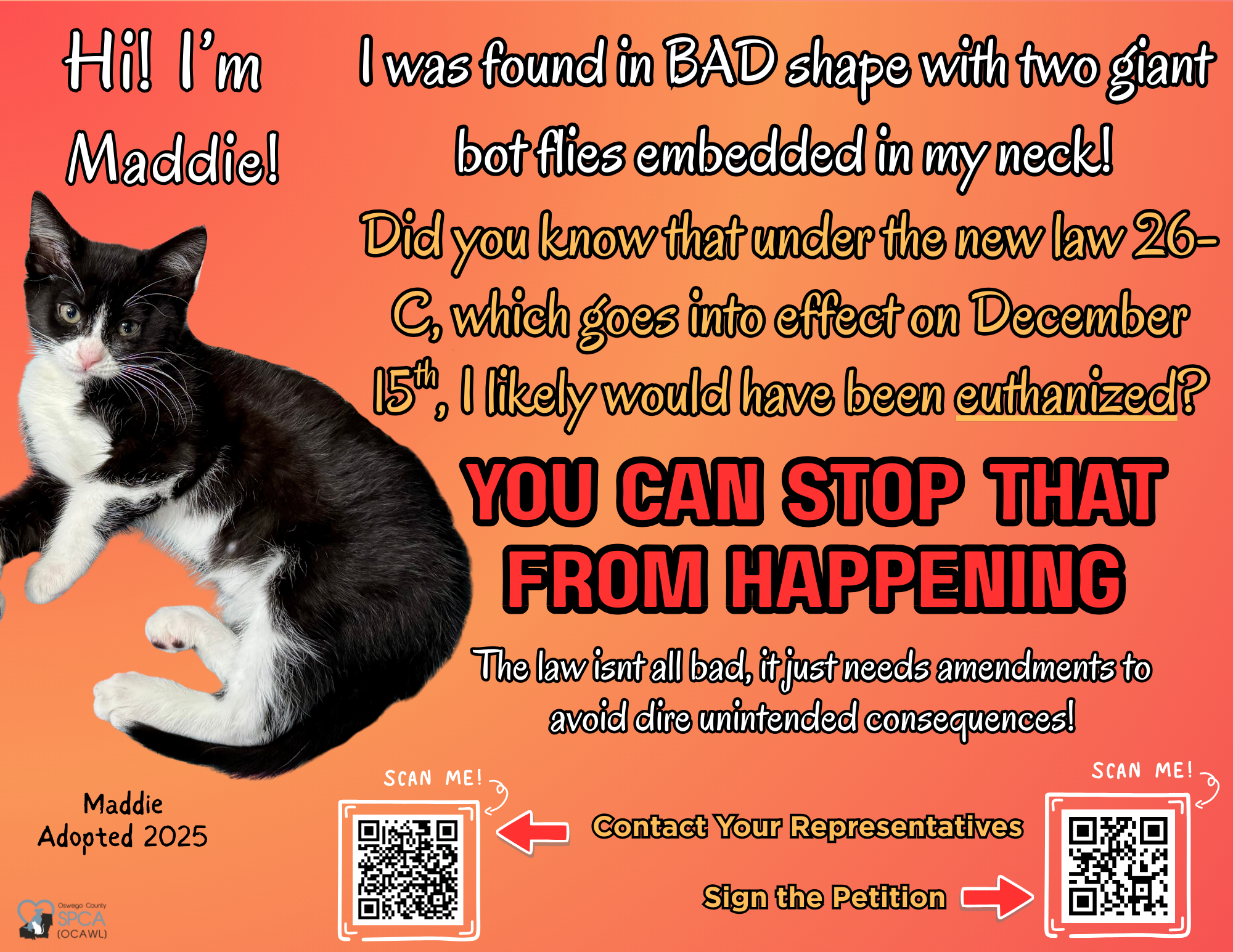
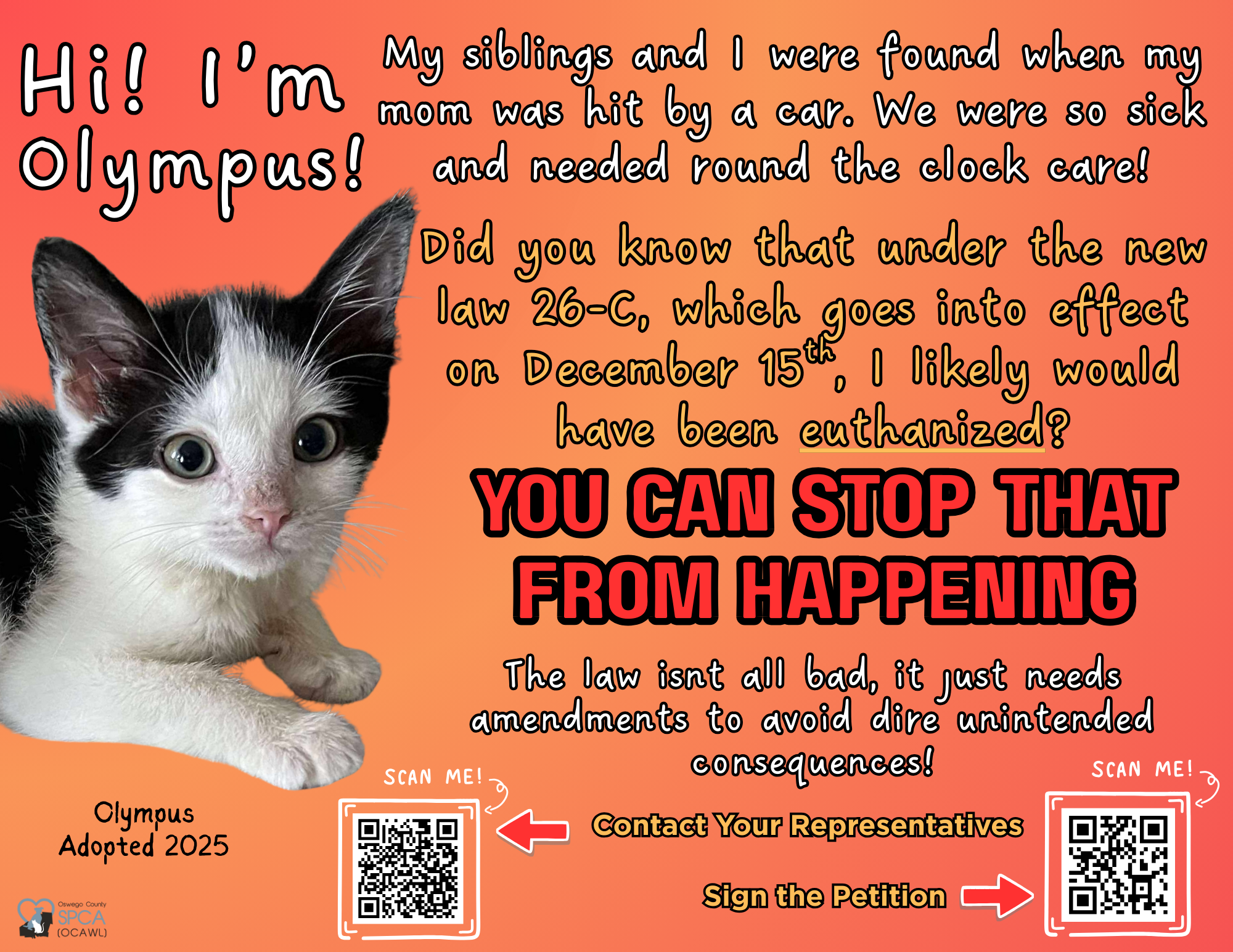
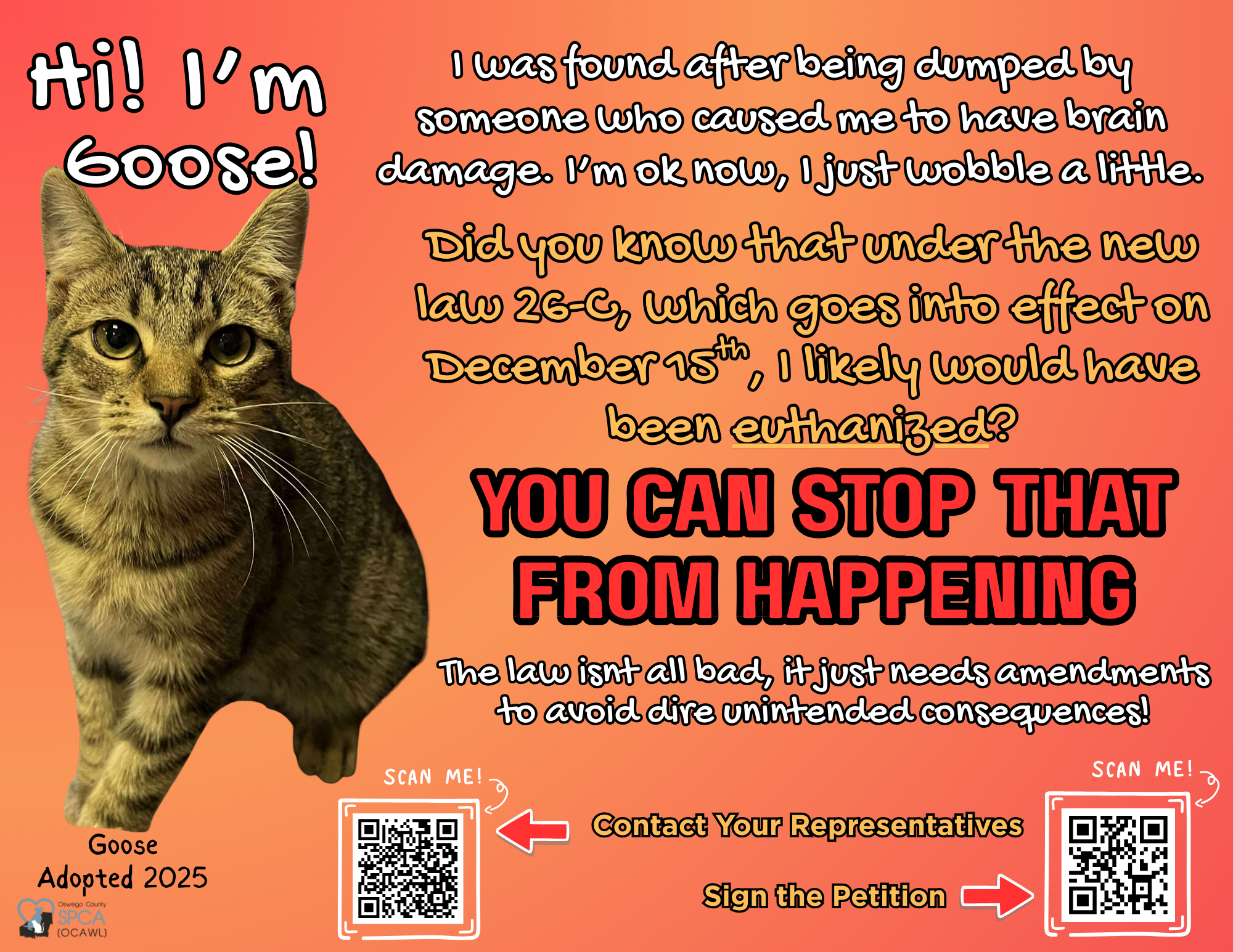
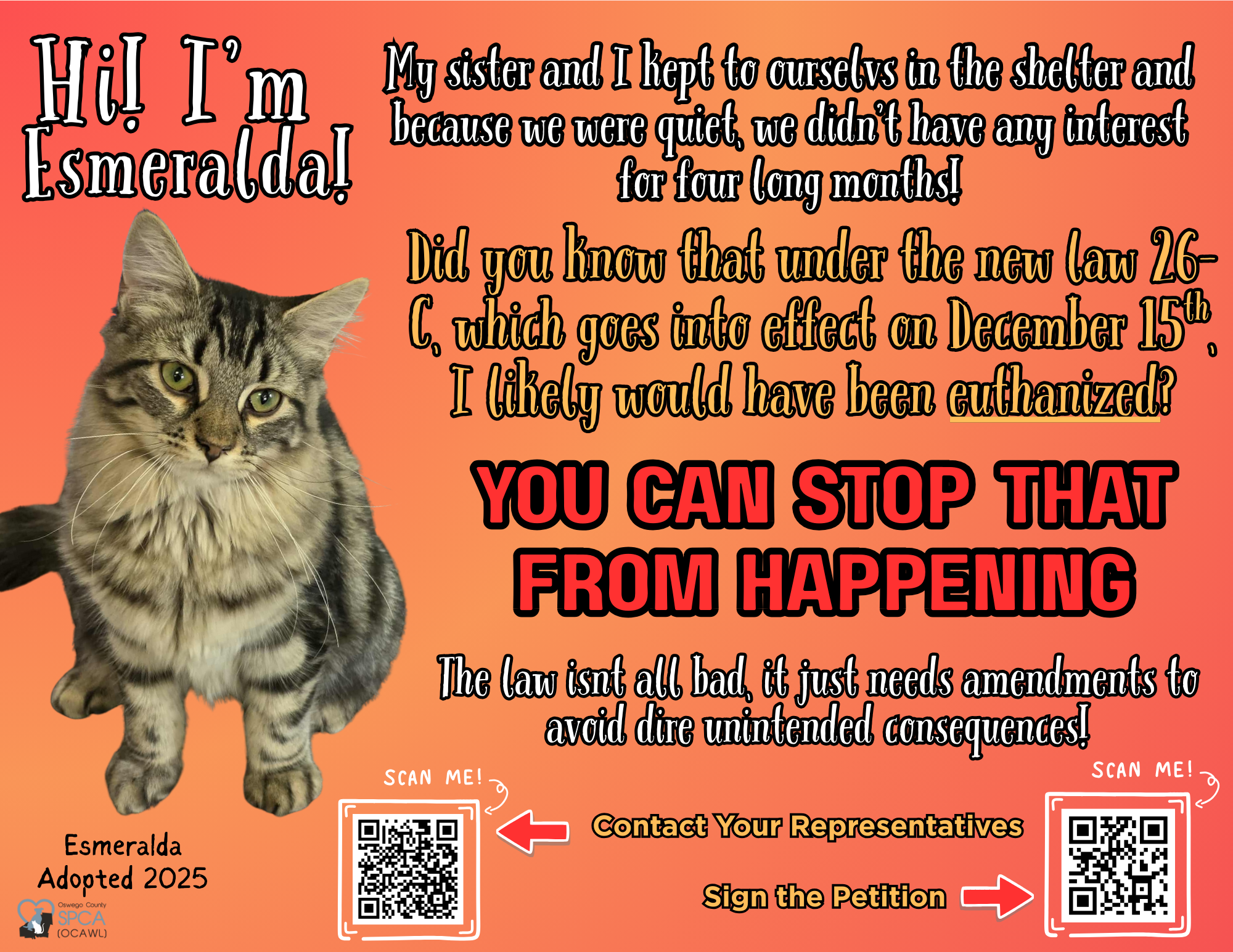
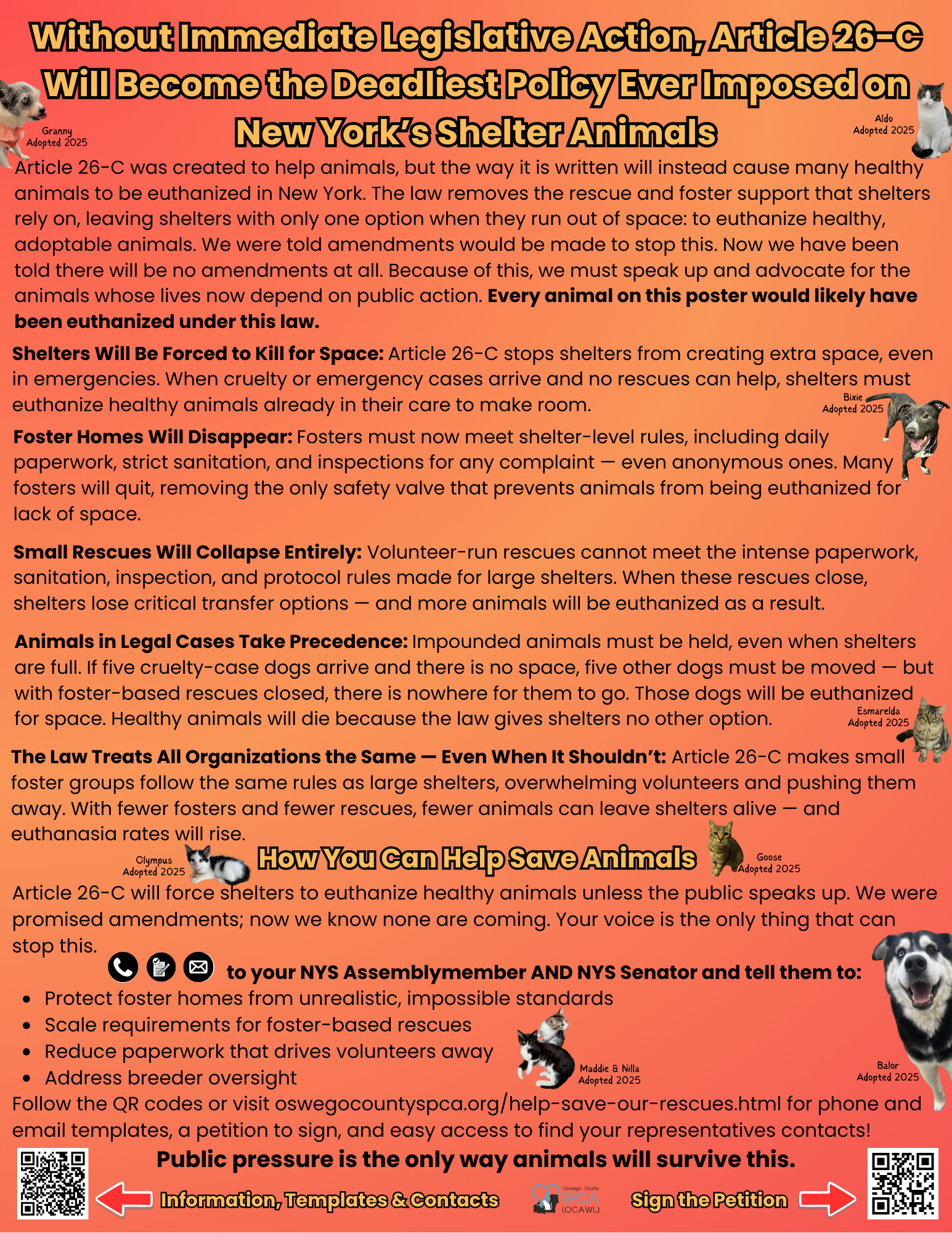
⚠️ Without Immediate Legislative Action, Article 26-C Will Become the Deadliest Policy Ever Imposed on New York’s Shelter Animals
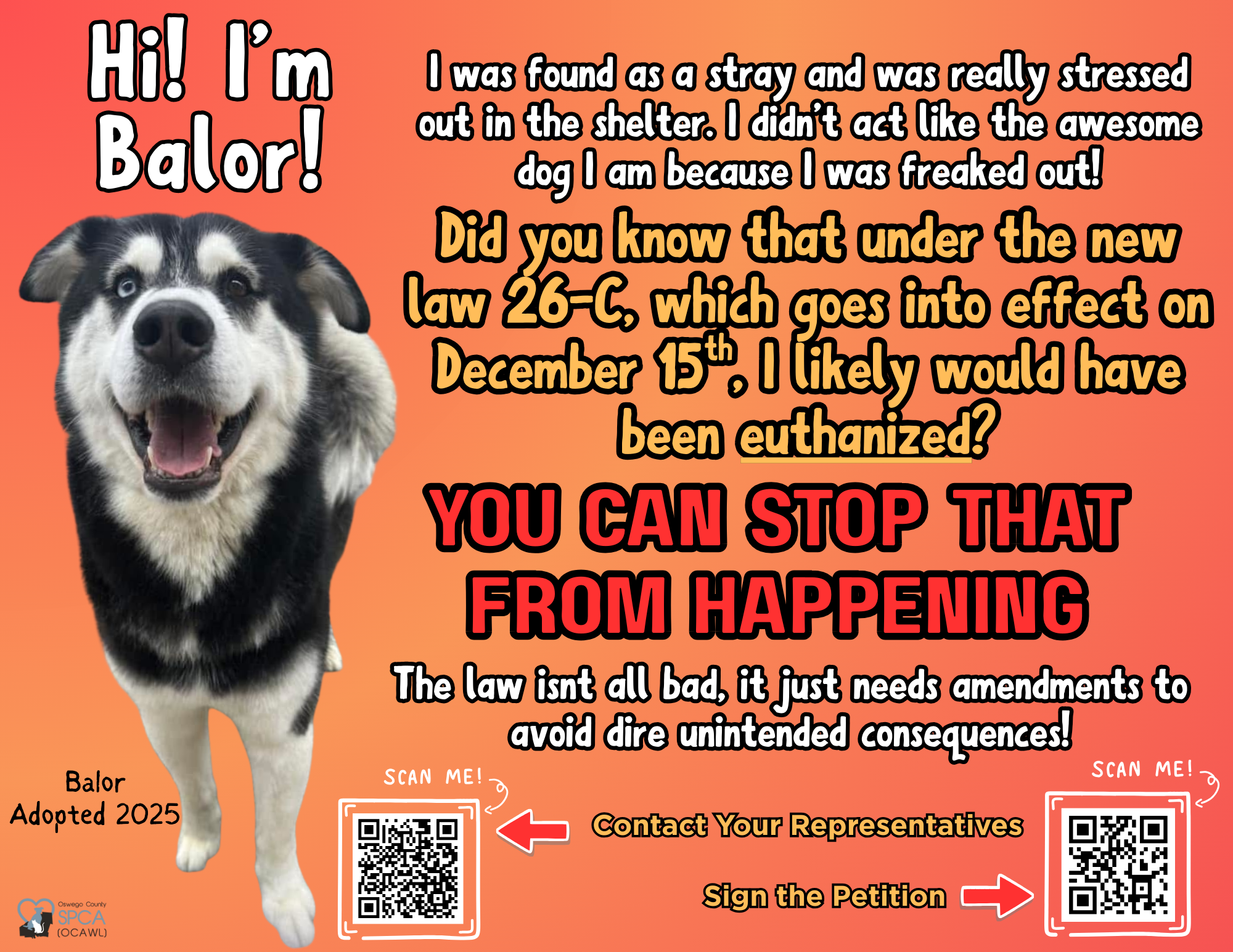
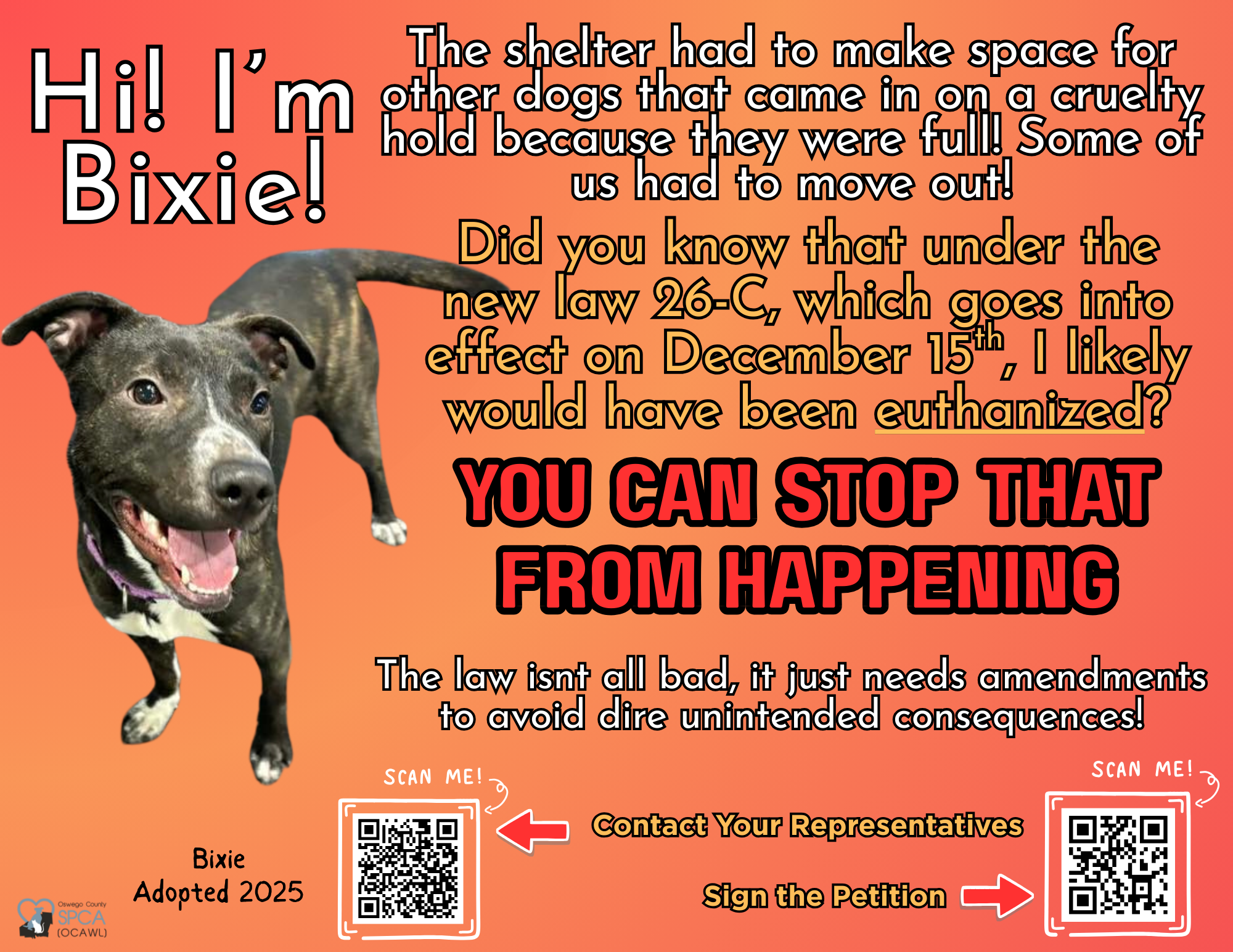
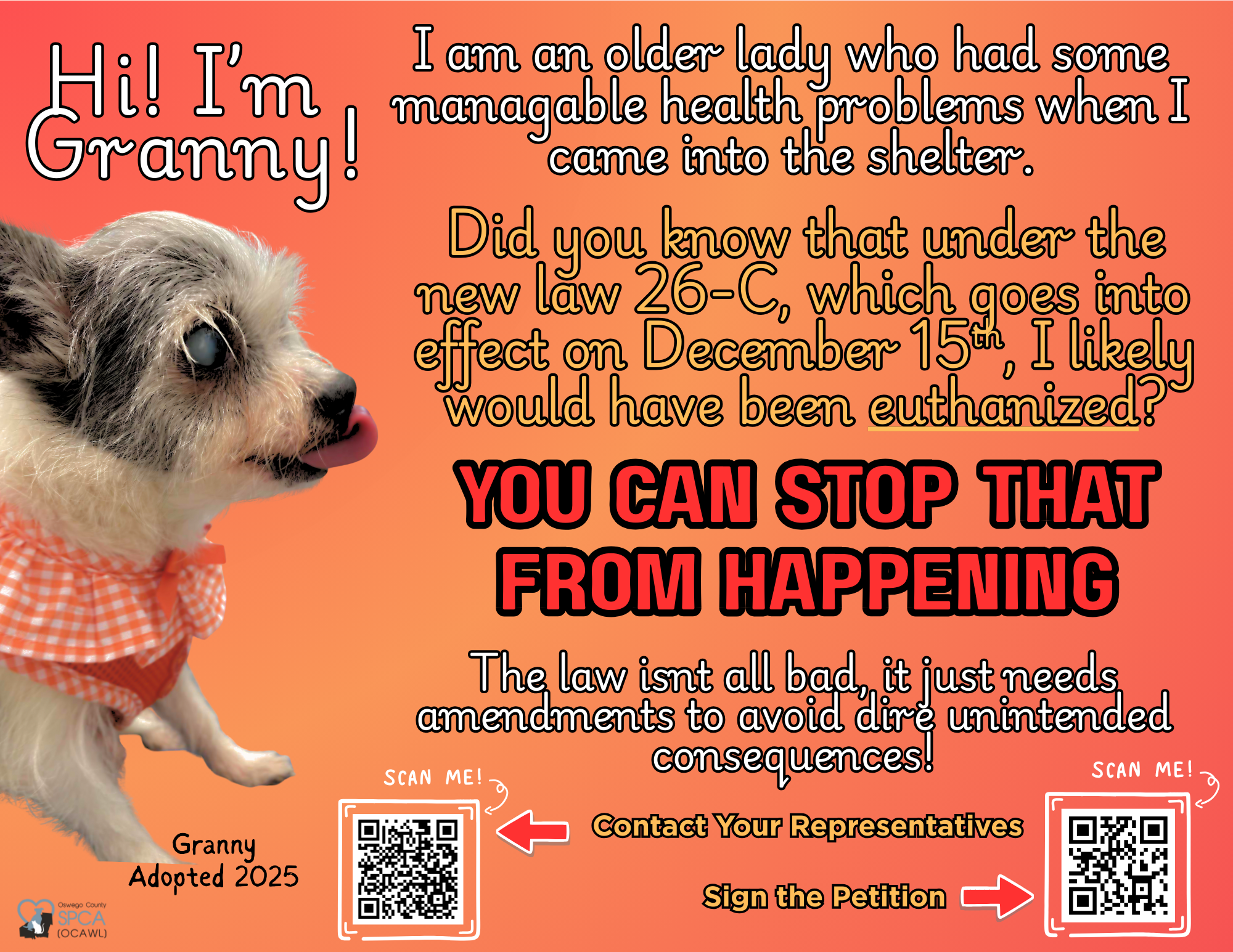
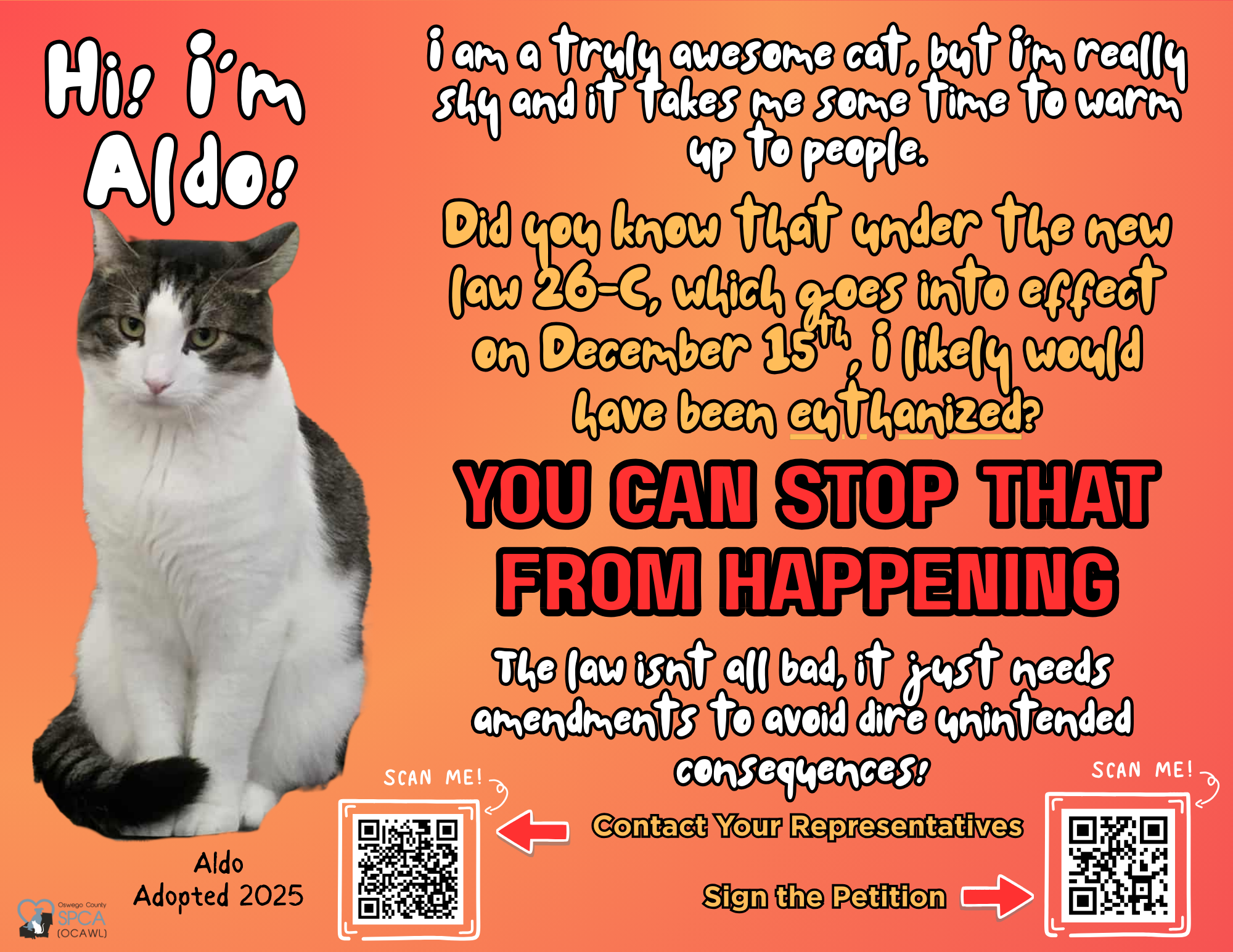
Article 26-C was intended to protect animals — but as written, it will instead cause the largest wave of preventable animal deaths in New York’s history. This law destroys the very rescue and foster infrastructure that keeps animals alive. If amendments are not made, healthy, adoptable animals will die — not because shelters want this, but because the law forces it.
Below are the Top 5 Catastrophic Failures that will directly result in mass euthanasia across the state.
1. Shelters Will Run Out of Space — and Euthanasia Will Become Mandatory
Article 26-C imposes rigid capacity rules, shelter-style housing standards, and eliminates all flexibility shelters once had to manage overflow animals. When cruelty cases, emergency intakes, or seized animals must legally be held, shelters cannot say no, cannot move them, and cannot create space. When no kennels are open, the law leaves shelters with only one legal option: Euthanize animals already in their care — even if they are healthy, friendly, and fully adoptable — simply to make room. This is not speculation. This is the mathematically inevitable outcome of this law.
2. Foster Homes Will Disappear — Eliminating the Only Lifeline Animals Have
Fosters are the pressure valve that prevents shelters from killing for space. Article 26-C destroys this entire system.
The law requires:
Foster homes to follow the same mandates of large brick and mortar shelters. Private homes will be required to do large shelter amounts of record keeping and documentation, they will be required to have the same isolation ability as large shelters and they will be required to be inspected for any complaint regardless of evidence every time.
Fosters will quit statewide. And when fosters disappear, animals die — because shelters have nowhere to send them when full.
3. Small, Volunteer-Run Rescues Will Collapse Completely
Rescues — especially foster-based ones — do not have the staff, funding, or facilities to comply with full shelter-level regulations.
Article 26-C requires them to adopt:
- Complex written protocols
- Strict record keeping
- Facility-style sanitation
- Nonstop inspection readiness
- Training and documentation designed for staffed organizations
- Mandatory agreements for every volunteer
Many rescues have already announced closure because they cannot meet these requirements.
Every rescue lost means:
- Fewer foster homes
- Fewer animals saved
- Fewer transfers from overcrowded shelters
- Fewer chances for at-risk animals
When rescues collapse, the entire system collapses with them.
4. Animals Impounded for Legal Cases Will Block Kennels for Indeterminate Amounts of Time- & Shelter Animals Don't Have Time.
In New York, animals seized in cruelty, eviction, domestic violence, or emergency cases must be held until ownership legally transfers.
Article 26-C prevents shelters from improvising safe overflow solutions.
If five dogs must be held and the shelter is already full, the five incoming dogs must stay, and five other dogs must be transferred out to make space. With no available fosters to take the, this means, they will be euthanized to create space. This is a numbers game, not an animal-welfare decision.
Healthy dogs will die because the law gives shelters no other choice.
5. The Law Treats Every Situation the Same — Even When It Shouldn’t
Article 26-C has no nuance. It treats tiny rural foster rescues the same as the fully funded and staffed mega shelters. Unfortunately, as is the case for most things, one size does not fit all!
The result?
- Overwhelmed rescues
- Terrified volunteers
- Skyrocketing foster burnout
- Fewer adoptable animals leaving shelters alive
When nuance disappears, animals die — because the system cannot tell the difference between organizations.
🔥 The Catastrophic Outcome
Rescue Collapse → Foster Loss → Shelter Overflow → Mandatory Euthanasia
Article 26-C collapses the entire rescue system:
- Fosters disappear.
- Rescues shut down.
- Shelters fill to capacity.
- Cruelty cases and emergency intakes keep coming.
- And healthy animals must be killed just to make room.
This is not a fear.
This is not a prediction.
This is the mathematically inevitable consequence of Article 26-C.
If nothing changes before December 15th:
More animals will be euthanized in New York than ever before.
We Were Promised Amendments — Now We’re Told There Will Be None
Despite repeated assurances from state officials, there is now no plan to amend Article 26-C before implementation.
Without intervention, New York will intentionally enact a law that destroys rescues and forces shelters into mass euthanasia of healthy animals.
What We Are Demanding
We call on the New York State Legislature to immediately amend Article 26-C to:
1. Protect Foster Homes
Stop the overwhelming demands and warrantless-style inspections triggered by frivolous complaints.
2. Scale Requirements
Create appropriate standards for foster-based rescues — not shelter-level mandates.
3. Simplify Compliance
Reduce paperwork and allow flexible training systems to prevent volunteer burnout.
4. Address the Real Source of Overpopulation
Regulate backyard and commercial breeders, who contribute directly to shelter crowding but remain untouched by this law.
Your Voice Can Stop Mass Euthanasia Before It Begins
Sign the petition.
Share widely.
Contact your legislators.
For scripts and email templates to contact your New York State Assemblymember AND New York State Senator, and more information, visit:
👉 https://www.oswegocountyspca.org/help-save-our-rescues.html

2,638
The Issue
⚠️ Without Immediate Legislative Action, Article 26-C Will Become the Deadliest Policy Ever Imposed on New York’s Shelter Animals
Article 26-C was intended to protect animals — but as written, it will instead cause the largest wave of preventable animal deaths in New York’s history. This law destroys the very rescue and foster infrastructure that keeps animals alive. If amendments are not made, healthy, adoptable animals will die — not because shelters want this, but because the law forces it.
Below are the Top 5 Catastrophic Failures that will directly result in mass euthanasia across the state.
1. Shelters Will Run Out of Space — and Euthanasia Will Become Mandatory
Article 26-C imposes rigid capacity rules, shelter-style housing standards, and eliminates all flexibility shelters once had to manage overflow animals. When cruelty cases, emergency intakes, or seized animals must legally be held, shelters cannot say no, cannot move them, and cannot create space. When no kennels are open, the law leaves shelters with only one legal option: Euthanize animals already in their care — even if they are healthy, friendly, and fully adoptable — simply to make room. This is not speculation. This is the mathematically inevitable outcome of this law.
2. Foster Homes Will Disappear — Eliminating the Only Lifeline Animals Have
Fosters are the pressure valve that prevents shelters from killing for space. Article 26-C destroys this entire system.
The law requires:
Foster homes to follow the same mandates of large brick and mortar shelters. Private homes will be required to do large shelter amounts of record keeping and documentation, they will be required to have the same isolation ability as large shelters and they will be required to be inspected for any complaint regardless of evidence every time.
Fosters will quit statewide. And when fosters disappear, animals die — because shelters have nowhere to send them when full.
3. Small, Volunteer-Run Rescues Will Collapse Completely
Rescues — especially foster-based ones — do not have the staff, funding, or facilities to comply with full shelter-level regulations.
Article 26-C requires them to adopt:
- Complex written protocols
- Strict record keeping
- Facility-style sanitation
- Nonstop inspection readiness
- Training and documentation designed for staffed organizations
- Mandatory agreements for every volunteer
Many rescues have already announced closure because they cannot meet these requirements.
Every rescue lost means:
- Fewer foster homes
- Fewer animals saved
- Fewer transfers from overcrowded shelters
- Fewer chances for at-risk animals
When rescues collapse, the entire system collapses with them.
4. Animals Impounded for Legal Cases Will Block Kennels for Indeterminate Amounts of Time- & Shelter Animals Don't Have Time.
In New York, animals seized in cruelty, eviction, domestic violence, or emergency cases must be held until ownership legally transfers.
Article 26-C prevents shelters from improvising safe overflow solutions.
If five dogs must be held and the shelter is already full, the five incoming dogs must stay, and five other dogs must be transferred out to make space. With no available fosters to take the, this means, they will be euthanized to create space. This is a numbers game, not an animal-welfare decision.
Healthy dogs will die because the law gives shelters no other choice.
5. The Law Treats Every Situation the Same — Even When It Shouldn’t
Article 26-C has no nuance. It treats tiny rural foster rescues the same as the fully funded and staffed mega shelters. Unfortunately, as is the case for most things, one size does not fit all!
The result?
- Overwhelmed rescues
- Terrified volunteers
- Skyrocketing foster burnout
- Fewer adoptable animals leaving shelters alive
When nuance disappears, animals die — because the system cannot tell the difference between organizations.
🔥 The Catastrophic Outcome
Rescue Collapse → Foster Loss → Shelter Overflow → Mandatory Euthanasia
Article 26-C collapses the entire rescue system:
- Fosters disappear.
- Rescues shut down.
- Shelters fill to capacity.
- Cruelty cases and emergency intakes keep coming.
- And healthy animals must be killed just to make room.
This is not a fear.
This is not a prediction.
This is the mathematically inevitable consequence of Article 26-C.
If nothing changes before December 15th:
More animals will be euthanized in New York than ever before.
We Were Promised Amendments — Now We’re Told There Will Be None
Despite repeated assurances from state officials, there is now no plan to amend Article 26-C before implementation.
Without intervention, New York will intentionally enact a law that destroys rescues and forces shelters into mass euthanasia of healthy animals.
What We Are Demanding
We call on the New York State Legislature to immediately amend Article 26-C to:
1. Protect Foster Homes
Stop the overwhelming demands and warrantless-style inspections triggered by frivolous complaints.
2. Scale Requirements
Create appropriate standards for foster-based rescues — not shelter-level mandates.
3. Simplify Compliance
Reduce paperwork and allow flexible training systems to prevent volunteer burnout.
4. Address the Real Source of Overpopulation
Regulate backyard and commercial breeders, who contribute directly to shelter crowding but remain untouched by this law.
Your Voice Can Stop Mass Euthanasia Before It Begins
Sign the petition.
Share widely.
Contact your legislators.
For scripts and email templates to contact your New York State Assemblymember AND New York State Senator, and more information, visit:
👉 https://www.oswegocountyspca.org/help-save-our-rescues.html
2,638
The Decision Makers


Supporter Voices
Petition created on November 25, 2025