WE THE PEOPLE: DEMAND A REFERENDUM TO PLACE A STANDING POWER ABOVE PARLIAMENT ITSELF
The Issue
Vox Populi est Sui Iuris — The Voice of the People is Sovereign
It’s the people’s house — but the tenant holds the keys. We demand the master key.
1. THE DEMAND, IN ONE LINE
We demand a binding referendum to put the standing power of the people above Parliament in constitutional law — so that those who govern answer to us at all times: steered when they stray and thrown out when they betray us.
Every petition before this one asked only to change the tenant — throw this lot out, let another lot in. But a new government under the same rules is just a new tenant with the same lease, and they retain free run of the house. We are not asking to swap the tenant. We are changing the terms of the lease — and putting the ultimate power back in the owner’s hand such that no government can ever vote it away or ignore it again.
A landlord can change the terms of a tenancy — within reason, and by proper process — even while the tenant is still living there. The people own this country. We should hold no less a power over those we let in to run it.
2. WHY THIS IS A LONG READ
This is not a thirty-second petition, and it was never meant to be. You are being asked to place a standing power above Parliament itself — the gravest thing a free people can lawfully do — and a demand that serious cannot be made in shorthand. Every claim here is shown, sourced, and reasoned, because a case this large has to be understood, not merely felt. Take your time with it. Here is the ground it covers:
- THE DEMAND, IN ONE LINE
- WHY THIS IS A LONG READ
- THIS IS A DEMAND, NOT A REQUEST
- THE IMBALANCE WE INTEND TO END
- WHAT WE DEMAND — THE NON-NEGOTIABLE TERMS
- NOT A LEAP — WHAT THE PEOPLE COULD BUILD
- WHY THE PEOPLE HOLD THIS RIGHT
- THIS RIGHT IS ANCIENT — AND IT IS OURS
- WHY WE DEMAND IT NOW — THE RECORD
- WHAT THIS PUTS BACK IN THE PEOPLE’S HANDS
- THE VEHICLE — AND WHY IT EXISTS TO END ITSELF
- WHAT SIGNING THIS PETITION DOES
- WHAT THE STAMP MEANS
- THE LINE WE HOLD
- AND WE WILL NOT BE THE LAST
3. THIS IS A DEMAND, NOT A REQUEST
Let there be no mistake about what this is. We the people are not asking. This is not a plea, a consultation, or an invitation to debate, and we are not seeking permission or waiting on agreement. A request can be weighed and set aside; this can be neither bargained down nor quietly shelved.
Parliament has no legitimate ground on which to refuse it. The only authority it could refuse with is authority lent to it by the very people now demanding its return — and no one holds the right to deny the owner the return of what was only ever theirs to lend. We are not interested in the government’s reasons, its objections, or its line to the press. The question is not whether the demand is permitted. It is whether it is met.
Parliament keeps the raw power to say no. What it does not have is any answer to the demand, or any mandate to deny it — and a refusal will not end the matter. It will be remembered, and it will be answered, by the people it ignored, at the next election, where the ignored have always held the last word. The choice put to every member is therefore plain: carry this, or be replaced by those who will.
4. THE IMBALANCE WE INTEND TO END
Lie on your CV to get a job, and the rule is simple: you are fired on discovery. You lose what the lie won you, and it voids what you have done; and if it put others at risk, you can be taken to court. Cheat your way into a job and you lose it. That is fair, right, and just — and we all know it.
Now look at those who govern us. A party lies its way into power — breaks the promises it ran on, scraps its pledges, forces through what it never campaigned on, lying by silence as much as by word. The consequence? Nothing. None. They keep the job, the salary, the perks, and the power they took by deceit — for the full five years. And the people they deceived can do nothing to remove, block, or redirect them.
Parliament did write itself one law to remove an MP — the Recall of MPs Act 2015. Look at the limitations on what triggers it: prison, a long suspension from the House, or fiddled expenses. Not one word about lying to the voters or betraying them. They built the only door to removal — and made sure it could never open on a lie.
Lying should cost a government what it costs everyone else: the job taken by deceit. We demand the right to remove any government that lied its way in and betrayed the trust that put it there — the moment the lie is proven. No such right exists today.
So we will build it.
5. WHAT WE DEMAND — THE NON-NEGOTIABLE TERMS
We demand a binding referendum to set up, in constitutional law, the House of the Electorate: the people’s political sovereignty — the authority A.V. Dicey said is ours back in 1885 — made into a standing power, to stop what is done in our name and to direct what is done on our behalf. Not a new set of politicians. The whole electorate, holding power directly over Parliament and Crown. At the very least, this means:
- The people are the ultimate sovereign. This is not a status we ask to be granted — it is already the root of the whole system: every government holds power only on loan from us. What has never followed is the force in law to act on it. So we demand the powers the role has always been denied — standing authority above Parliament and Crown, enforceable at all times, not limited to five-year intervals. Not in place of Parliament. Over it.
- The power to remove. A people’s vote of no confidence in the government of the day — dismiss the prime minister and ministers mid-term when they break the mandate they were elected on. The people then get a genuine say in who takes over — and the party cannot fence that choice between its favourite and a no-hoper: a slate the people judge a stitch-up can be rejected outright, and a rejected slate triggers the next rung — a full dissolution and general election. No replacement is ever set over the country until the people accept one. Try to rig the choice, and you simply hand the whole question to the ballot box.
- The power to block. Grave or irreversible measures cannot be forced through once the people have clearly refused them.
- The power to direct. Not just to block what we refuse, but to require what we decide — to tell the government to do a thing, or to drop it, through a settled process. The power to say, ‘do this,’ not only ‘stop.’
- The power to dissolve. By a set, verified threshold, the people can force the dissolution of Parliament and a general election — without waiting on the very government they want gone to ask for it. Dicey called dissolution ‘an appeal from the legal to the political sovereign’ — that is, from Parliament to the electorate. The verdict was always ours to give; only the power to call for it was kept from us. That is the power we demand.
- An independent guardian. A neutral office, outside party control: the people’s clerk and enforcer, never their ruler. It is where the people’s instructions are lodged, collated, and made ready to put before Parliament; it verifies that a vote is genuine and a threshold truly met; it presents the people’s certified verdict to Parliament as a binding instruction, on their behalf; and it holds the government to that instruction until it is carried out. Should a government stall, ignore, or defy a verified decision, the guardian certifies that failure — and that certificate is what arms the powers above: the right to overrule, to remove, and to dissolve. It decides nothing of its own — it cannot be petitioned for favours, cannot grant or refuse anything by its own judgement, cannot widen its remit by an inch, and may certify no verdict that crosses the floor set out in the Bill of Rights, which binds even the people’s own vote. Every verdict it carries is the people’s; its teeth are the people’s teeth. Answerable to the people alone and removable by them, it is placed beyond the reach of any government — for a government that could capture or quietly bin it could silence the people’s voice at will.
- The same standard for the Crown. The Crown’s authority is lent on terms, exactly as Parliament’s is. At every coronation the monarch swears the Coronation Oath — a promise still binding in law today — to govern the people according to their own laws and customs. So the standing power reaches the Crown too: where Royal Assent is given to what the people have clearly and repeatedly refused, that is answerable to the people — up to and including the people’s right to decide the Crown’s constitutional role, that the people might equally reaffirm the Crown as end it. We do not hold that power today. We demand it — so that government and Crown answer to one standard, not two.
These powers are supreme but bounded. Supreme over Parliament and Crown — but held beneath a fixed floor of basic rights that no government, and no passing majority, may cross, and that the people themselves may alter only by acting directly and in the open. Those rights are the ones set out in the Bill of Rights. The power to direct is bound as tightly as the power to refuse: the people may steer, but never below that floor, never toward the impossible, and never on grave or irreversible matters without higher thresholds and a pause for second thoughts. Unchecked power is dangerous in any hands, ours included. The floor is what stops this cure becoming the next disease.
The demand is absolute and not for watering down. How the people then choose to use these powers — directly, or through an accountable body that carries out their will — is for the empowered people to settle. We impose no blueprint. We hand back the choice — and so it is no blank cheque, we lay one worked-out option on the table, to take, change, or leave.
We set these terms out exactly for one reason: so any watered-down referendum the government offers can be held up against them, in plain sight. We are demanding a mile. We will know an inch when we see one.
6. NOT A LEAP INTO THE DARK — WHAT THE PEOPLE COULD BUILD
Handing back the choice does not mean handing the people a blank page and wishing them luck. A worked-out plan already exists — to adopt, change, or set aside. So the question is never “leap into the unknown.” It is “here is one way it could work; is this the one you want?”
That plan is the Civic-Crowd-Device: a standing system where the people set the agenda and take the decisions themselves, instead of waiting five years for the chance to change the tenant.
In plain terms: anyone can put a proposal forward. Related ones are gathered in the open, argued out, and sharpened into a clear question — built in full view, not buried in a feed. Then the people decide directly, on one rule: one verified person, one voice. Each citizen counts once. No one votes twice, or votes as someone they are not. How you vote stays yours alone. The day-to-day running of the country goes to an accountable executor that holds only the power the people lend it — and can be recalled the moment it oversteps.
Around all of it, the guardrails — because power is dangerous in any hands: the fixed floor of rights that no vote may cross; grave decisions held to higher thresholds and a pause for second thoughts; and every stage — proposing, counting, executing, auditing — kept in separate hands, so no part can swallow the whole.
The result is simple to say and hard to claw back: far more control over your own future than any system on offer now — such as the current one that asks your opinion once every five years and can ignore it in between.
The people stay free to take this whole, keep parts and change others, build a hybrid, or pick another road entirely. The one thing they will not be told is that no alternative exists. One does. Its full design — and the open questions left in it — is at the Phoenix Charter website, along with a proposed Declaration of Sovereignty and Bill of Rights.
7. WHY THE PEOPLE HOLD THIS RIGHT
From the very start, the people were brought in to consent, never to command. When the towns and shires were first summoned to Parliament in 1265, they came to give their consent and their counsel — to back the realm and have their say — not to hold power over the Crown. In the seven and a half centuries since, the people’s part has been widened vote by hard-won vote, but never lifted above the ceremonial. We choose who fills the seats. We have never held a lever over what they do once they are in them.
Two kinds of sovereignty. The man most tied to Parliament’s supremacy drew the line himself. A.V. Dicey, in his Introduction to the Study of the Law of the Constitution (1885), split sovereignty in two. There is legal sovereignty — the power to make and unmake any law, which sits with Parliament and which the courts obey. We do not dispute it. And political sovereignty: the body whose will, in Dicey’s words, “is ultimately obeyed by the citizens of the state.” That body, he wrote, is the electorate — “the true political sovereign.” Parliament is legally supreme, but politically below the people.
Read that again, because it names our authority and exposes their betrayal in the same breath. We are the body whose will is meant to be obeyed — yet time and again, we are the body whose will is ignored. The people are the landlord. Parliament is the tenant, holding the keys for the term of their lease. The tenant merely lives in the house and runs it day to day on behalf of the landlord. The tenant never owns it.
The ladder turned upside down. Put the powers of the state in their proper order and the people stand at the top: the people, the source all authority is said to flow from; the Crown, in whose name it is held; Parliament, through which it is used; the courts, by which it is applied. That is the order in principle. In practice it is all but flipped: Parliament makes what law it likes, the courts apply it, and the people — the supposed source of the whole thing — get one vote every few years and no lever in between. First in principle, last in power. No accident: it suited everyone who ever held the real grip to keep the ceremony at the top and the control at the bottom. This petition turns the ladder back the right way up.
Take the Crown, because few are ever taught how it really works. In ceremony the monarchy is the source of it all: it summons Parliament, dissolves it, and signs its laws. In practice it is bound — it dissolves Parliament only when the prime minister asks, and it has not refused to sign a law since 1708, by a convention it cannot break. The Crown’s great powers are real, but the elected government works them on the monarch’s behalf. And here is the absurdity, said plainly: the one lever that could throw a failed government out — dissolution — currently can be pulled only by that government itself. So, to be rid of a prime minister, you must first beg the very person you want gone to ask for their own removal. It is daft, and anyone can see it is daft. Dicey, the establishment’s own and most revered jurist, said dissolution is in essence an appeal from Parliament back to the electorate — the people’s own appeal. Yet the people cannot make it; only the government can. We hold the reason to act, yet we have never held the operative lever to act mid-five-year-cycle. Putting that lever in the people’s hand is exactly what this petition demands.
Sovereignty cannot be given away. It can never be handed over — not by Parliament, not even by the people. What can be lent, with consent, is the use of certain powers — and what is lent can be taken back. Brexit proved it. From the European Communities Act 1972, which took Britain into the EEC, to the Maastricht Treaty of 1993, which turned that common market into the European Union, the use of certain powers was lent out to Brussels — and in 2016 the people took it back. If sovereignty itself had really left in 1972, there would have been nothing in 2016 to reclaim. The keys had been lent. The freehold never left the people’s hands.
Even the establishment admits it. In the Commons in 2019, Jacob Rees-Mogg — then leader of the House of Commons — told Parliament that “the people are our masters,” and that Parliament’s authority comes "from the people" — not, in his words, "out of a void" (Hansard, 3 September 2019). Weeks later he said it again — the sovereignty of the House “did not fall upon us like a comet from heaven,” — "but came to it from the British people" (Hansard, 24 October 2019). Even those in power, pressed on it, admit the principle this petition stands on: authority flows from the people to Parliament, never the other way.
So let us name it without flinching. The people are the landlord. The country is ours. Those who govern are tenants — handed the keys for the term of a lease we call an election, to use the house and run it on our behalf only, never to own it. A tenant who keeps the terms serves out the lease. A tenant who breaks them can be evicted — for cause, by due process — and the keys go back to the owner. That is the ordinary law of every tenancy in the land. We demand only that it reach the most important tenancy of all. We are done asking for the keys to be handed back.
We demand the master keys to be held indefinitely in our hands — and the right of eviction every other owner holds.
8. THIS RIGHT IS ANCIENT — AND IT IS OURS
We are not inventing a new right. The power of a people to hold a ruler to account — and to remove one who breaks faith — is already written into the founding law of all four nations of these islands. It was never a gift from any government, which is exactly why no government can take it back or withhold it.
The British Isles
- Magna Carta — England, 1215. Its security clause (clause 61) empowered twenty-five barons, backed by “the whole community of the land,” to seize the king’s castles and possessions and force him to obey the charter. The sovereign was placed under the law, not above it.
(Still live in part: Magna Carta’s guarantee of due process — no free man imprisoned or stripped of his rights but by lawful judgement — remains on the statute book in England and Wales. But clause 61 itself was annulled within ten weeks in 1215 and entered no later version; it is cited here for the principle it founded, not as a power anyone can still invoke.) - The Declaration of Arbroath — Scotland, 1320. Scotland’s barons told the Pope that even their own king, Robert the Bruce, would be cast out if he betrayed them — they would “make some other man… our King”. The right to remove a faithless sovereign, set down in Scotland’s founding letter.
(Founding, not law: a letter to the Pope, never a statute, so its own force is moral. But the principle it set down — that a king rules only on the people’s sufferance — was reaffirmed in the 1948 Universal Declaration, which the United Kingdom stands behind to this day.) - The English Bill of Rights — 1689. Parliament removed James II, condemning him for endeavouring to “subvert and extirpate… the laws and liberties of this kingdom”. A king who breaks the constitution forfeits the Crown.
(Still live: in force today as a foundational statute of the British constitution, parts of it still argued in the courts. This one can be pointed to as present law.) - The Claim of Right — Scotland, 1689. The same year, Scotland’s Estates declared that the same king — James VII to the Scots, James II to the English — had “forfaulted the right to the Croune” by turning a limited monarchy into arbitrary, despotic power. One monarch, cast out by both his kingdoms at once, on the same principle, affirmed on both sides of the border in the same year.
(Still live: in force in Scots law to this day as a foundational statute — not a relic, but present law north of the border.) - The Brehon Laws — Ireland, from the 7th century. Ireland’s ancient native law stood above the ruler rather than flowing from him: rulers were bound by obligation to the community, and the judges who applied the law answered to no king. Older than Magna Carta.
(Lost to time: superseded by English law four centuries ago, so they bind no one now. But the principle they carried — authority answering to the community, not standing above it — was reaffirmed in the 1948 Universal Declaration, which Ireland stands behind today. The pedigree is ancient; the commitment is current.) - The Proclamation of the Irish Republic — 1916. Sustained usurpation, it declared, “has not extinguished the right, nor can it ever be extinguished” — a people’s sovereign right outlasts however long it is denied.
(Founding, not law in itself — but its claim is now live Irish law: the 1937 Constitution of Ireland declares that all powers of government derive from the people (Article 6), and Ireland stands behind the 1948 Universal Declaration besides. The right it asserted is enforceable ground today.) - The Laws of Hywel Dda — Wales, 10th century. The native Welsh legal code that governed Wales for centuries held law above ruler and ruled alike — binding the king as much as the subject.
(Lost to time: replaced by English law in the sixteenth century, so it is not the present law of Wales. But the principle — law standing above the ruler — was reaffirmed in the 1948 Universal Declaration, which the United Kingdom signed: conceded on paper for every reader here, even if, as this petition argues, it still wants force in law.)
This is no British invention, nor a modern one. Its earliest record reaches back over three thousand years, to China’s Mandate of Heaven. The same principle was reaffirmed by nearly every government on earth in 1948, in the Universal Declaration of Human Rights — “the will of the people shall be the basis of the authority of government.” It is a global doctrine and a global birth-right. To any reader beyond these shores: the case above is built on Britain’s evidence, but the right is yours too — and the world’s record, and your part in it, is set out at the close.
9. WHY WE DEMAND IT NOW — THE RECORD
The people have no enforceable hold on a government that breaks faith between elections. The record of the last fifty years in the UK alone shows exactly why that gap has to be closed. Our counterparts around the world will have similar grievances.
- They knew before we voted. FCO Briefing Paper 30/1048, written in 1971 and released only in 2002 under the thirty-year rule, is the government’s own assessment that entry into the European Communities would progressively erode British sovereignty — and that, in time, the ‘political practicability of withdrawal’ would itself become ‘doubtful.’ That assessment stayed confidential through the 1975 referendum: the public voting on membership never saw their own government’s verdict on what it would cost them.
- Taken to war on a case that did not stand up. Britain joined the 2003 invasion of Iraq before peaceful options had been exhausted — not a last resort, the Chilcot Inquiry found, on intelligence “presented with a certainty that was not justified.” 179 British service members died. The biggest public protest in the country’s history had failed to stop it — and no one was ever held to account.
- Mandates are broken without consequence. In 2005 a government won power on a clear manifesto promise: a referendum on the EU Constitution. In 2007 it signed the near-identical Lisbon Treaty — no referendum. The people could do nothing.
- Prime ministers no one chose. Six prime ministers in the last fifty years — John Major, Gordon Brown, Theresa May, Boris Johnson, Liz Truss and Rishi Sunak — took office without first facing a general election, handed the country by an internal party vote the public was never part of. The office that governs everyone changed hands, and no one was asked.
- The biggest vote in our history, reversed by the back door. In 2016, 17.4 million people voted to leave the EU — the largest vote for anything in British history. Yet under the 2025 ‘reset’ the government agreed to ‘dynamic alignment’: following EU rules again on food, farming, energy and carbon — rules Britain no longer gets a vote on — and is legislating to bind us to them. The clearest instruction the people ever gave, being unwound without anyone being asked.
- Manifestos are dumped within weeks. Three weeks after the 2024 election, the new government means-tested the Winter Fuel Payment, stripping it from around ten million pensioners — a cut in no manifesto, walked back a year later only under party pressure, never by any power the people held.
- The watching grows with no mandate. Digital ID is the clearest case, and the oldest. Tony Blair’s government legislated a national identity card in 2006, scrapped in 2010 over fierce public opposition — and Blair has since campaigned through his institute to bring it back. It has returned not as one card to be voted down again, but in smaller pieces, each modest enough to pass on its own and together amounting to the same thing. The newest, in no manifesto anyone voted on, was pushed as compulsory and pared back only after nearly three million signed against it; they dropped the card, not the demand behind it. A law badged as child protection already makes age checks a condition of using social media and much of the web, and the accepted proofs include ID documents and the government’s own digital ID, built to be the key that fits a lock already installed. Refused as a single scheme for twenty years, the same checkpoint is assembled around the people piece by piece, under names no one would dare oppose. Around it spreads more that no one was asked to approve: live facial-recognition cameras in public, number-plate networks logging where you drive, low-emission and charging zones brought in without a public vote, and plans for a central-bank digital currency. All decided for the people, never by them.
- Now they reach inside the device itself. Presented as child protection, the government is backing a bill to build scanning software into every phone and tablet, unlocked only by age and ID checks — which Signal and Big Brother Watch warn would force ‘population-wide ID checks’ just to use your own devices. The scan and the ID that unlocks it are one machine: surveillance and Digital ID, arriving together under another name.
- And when the people speak, they are ignored. Over four million signatures across petitions for a general election in 2024 got one sentence back and no action. A petition against Digital ID drew nearly three million — among the biggest in our history — and the government said it would carry on regardless.
- What they allow themselves, they deny to us. When the facts change or lies are exposed, those who govern may unmake their decisions and take that right for granted — and whichever party is in power treats its own right to think again as beyond question. Edward Heath's Conservative government tore up its own manifesto and reversed Britain's entire economic course mid-term — the original "U-turn." A Labour Prime Minister can tell the nation he would never have appointed Mandelson had he known the full Epstein links, and no one disputes his right to reverse course. The people reason in exactly the same way: they would never have elected this government had they known what it was like and what it would do. Yet when they ask to reverse their decision and change their vote, they are refused and told to wait their turn. Parliamentary change of mind is accepted as the responsible thing, whilst the electorate is refused the same courtesy. The right to think again, once the truth is known, is owed to the governed as much as to those who govern.
The pattern is plain: power is taken or kept without real consent, it is used against the people’s clear wishes, with no lawful way for the people to step in between elections. The House of the Electorate is that way, to bring an end to their abuse of our trust.
10. WHAT THIS PUTS BACK IN THE PEOPLE’S HANDS
It is fair to ask what changes the day this power exists — not in theory, in practice. Here is what a standing power above Parliament actually hands back to the people.
- The power to refuse. No grave or irreversible step — a treaty, a surveillance system, a transfer of authority abroad — can be forced through once the people have clearly said no. Refusal stops being a feeling and becomes both a shield and a lever.
- The power to repeal. A law passed without consent, or against the people’s settled will, can be undone by the people themselves — not left to wait on the government that passed it, or rely on the slim chance the next one bothers to reverse it.
- The power to make your rights real. A proposed Declaration of Sovereignty and Bill of Rights are set out at the Phoenix Charter website, but as things stand they are only words — written, with no force in law. The standing power this petition demands lets the people enact them as a true written constitution: one the courts must uphold and no government may cross. What has only ever been promised in principle is, for the first time, given teeth.
- The power to keep authority from draining away. For decades, power has flowed upward to bodies no one ever elected — binding rules, treaties and alignments agreed over the people’s heads. Senior figures across recent governments have themselves been selected for transnational programmes such as the World Economic Forum’s Young Global Leaders. We name no plot — we name a gap: decisions that bind the nation are routinely taken without the people’s specific consent, and the people have no means to refuse them. A standing power closes that gap — no authority leaves these shores without the people’s explicit say-so, and none stays gone without it.
Together, these are the "Phoenix Kill Switch" — the people's power to halt what is done in their name the moment it turns against them.
And mark how this is done. Not by force, not by storming anything — but by the plain, lawful act of a people refusing to be bound by what they never agreed to. Britain sits inside a web of supranational bodies and binding commitments — trade regimes, treaties, health and climate agreements, military alliances — most entered into by governments and never once put to the people. No such body holds power over Britain by right; it holds it only on loan from a British government. A standing power lets the people call that loan in — to refuse to enter, or to withdraw from, any of them, each judged on its own merits, by the people’s verdict and not a minister’s signature. The body itself does not fall; its power over us does — declined lawfully, at home, without a shot fired. Which ties to keep and which to cut is then the people’s choice, one by one — and never again made for them behind their backs.
11. THE VEHICLE — AND WHY IT EXISTS TO END ITSELF
A demand needs hands to carry it, and the parties currently in power will never bind themselves. So the Phoenix Party is being formed for this one primary purpose: to win the mandate to make this change, and then to dissolve — handing the keys and new powers back to those they rightfully belong to, the people, then standing down.
And the path from here is plain — every step of it lawful. The electorate votes the Party in. The Party, as the government, legislates the binding referendum this petition demands. The people, asked directly, authorise the standing power — and that direct mandate is what lifts it beyond any ordinary Parliament's reach. From that moment the power is the people's own, held by them and lent to no one; and what the people hold directly, only the people can lay down. A future government cannot quietly repeal it, because it was never theirs to repeal — it belongs to the body that put them in their seats. The old objection — that no Parliament can bind the next — falls away the instant sovereignty is handed back to its source: the people are not binding a successor, they are simply keeping what is theirs. Its one task done, the Party dissolves as its own constitution compels. Party politics gives way to people politics — and the keys stay in the owner's hand, for good.
This is not the usual “power returned later” that history teaches us to distrust. The party’s dissolution is to be written into its own founding constitution and tied to the transition being finished — so it is forced to end, not merely expected to. It seeks the last mandate party politics should ever need before people politics takes over.
If you want to support the party, or sign the Phoenix Charter’s Declaration of Sovereignty and Bill of Rights, you can do that separately at the Charter site. Your signature here commits you to none of it. It stands only for the demand itself.
12. WHAT SIGNING THIS PETITION DOES
Let us be plain, because the honesty is part of the case.
By signing, you add your name to a formal demand that the government call a binding referendum on the terms above, and you back putting a constitutionally protected standing power in the people’s hands. You are not casting a binding vote. You are not enacting anything. Nothing changes in law the moment you sign.
What you are doing is older, and in numbers stronger than that: adding your voice to a demand specific enough that it cannot be quietly brushed off, and big enough that refusing it carries a cost. That is how a people moves a government that would rather not be moved.
13. WHAT THE STAMP MEANS
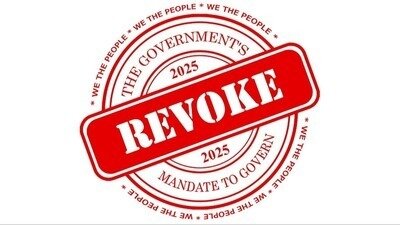
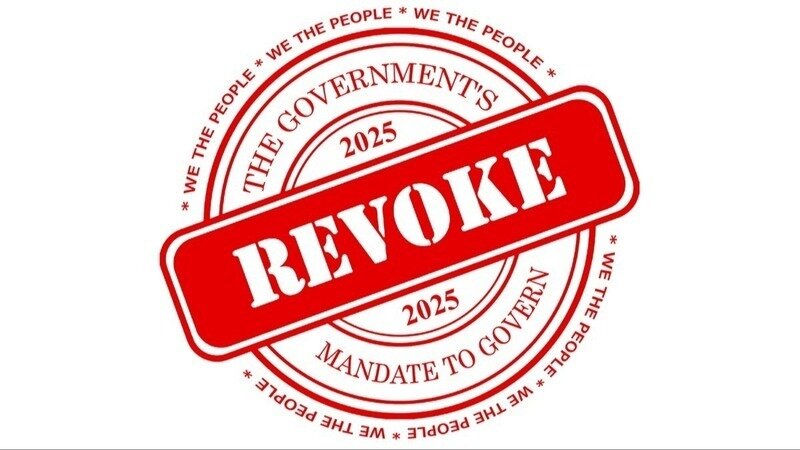
The image on this petition reads:
“We the People REVOKE the Government’s Mandate to Govern.”
Read it for what it is — a statement of intent, not a claim that the deed is already done.
We are not pretending the government has fallen. We are not declaring it void by our own word. We are calling for nothing outside the law. We are stating what we intend — and the lawful road we will take to it: a binding referendum, a standing power placed by the people into the people’s hands, a party raised to win the mandate and then bound to dissolve itself as soon as those objectives are completed.
The mandate to govern is not the governments to keep. It is lent — by the people, at an election. What the people lend, the people may declare withdrawn, and then demand, by lawful means, the power to make that withdrawal real. That is the whole of what the stamp says. Anyone who tells you it says more — that it is a coup, a fantasy, a grab at powers we do not hold — is reaching for a stick we have not handed them. The stamp names the destination. Everything above it is the lawful map.
14. THE LINE WE HOLD
We do not want a new government. We want no government — of any party — ever again free to act against the people who lent it power while those people stand by, unable to stop it from following or imposing their own agenda upon them.
So we take back the consent we lent. This petition makes a single ask, held in constitutional law: a standing power over Parliament — to overrule it, remove it, and dissolve it at our word. Not a better tenant. The keys, in the owner’s hand, for good.
That power has a range, and the range is ours to set. Used lightly, it holds Parliament to the mandate it was elected on — and the knowledge that it can go further is what keeps it there. Used to the full, should they go on acting against us in our own name, it reaches as far as casting them out and running the house ourselves. A tenant who knows the owner can take the keys back keeps the house in good order; one who believes they never can, does not.
So it is one ask, not two. We demand the power — and with it the standing right to decide, from this day on, how far to turn it: the lightest touch that holds a government to its word, or the full reach that ends it and puts the house in our own hands. Both live in the same hand. And the hand is ours.
We demand the master keys.
15. AND WE WILL NOT BE THE LAST
This begins in Britain, because this is where we stand and where the evidence is plainest. But nothing in it is uniquely British. The same captured politics, the same decisions taken without consent, the same gulf between the governed and the governing — they are the common complaint of peoples the world over.
So take this as a template as much as a demand. To any people anywhere who know their own version of this story, the method is the same: set your own evidence where ours stands — your own broken promises, your own unaccountable powers. You need not start from nothing. The same right — to make, reform, or unmake a government — is carved into the founding documents of nations on every inhabited continent, and we have made a start on yours:
North America
- Declaration of Independence — 1776. Not merely a right but a duty: in the words of the Declaration, “it is their right, it is their duty, to throw off such Government.”
(Founding, not law: a declaration, not a statute — the 1787 Constitution is the operative law and carries no express right to alter or abolish government. But the principle lives in the nation’s conscience, and the United States stands behind the 1948 Universal Declaration that reaffirmed it.) - Virginia Declaration of Rights — 1776. George Mason’s text holds that the people have an “indubitable, inalienable, and indefeasible right to reform, alter, or abolish” a government that fails them.
(Still live: in force today as Article I of the Constitution of Virginia — living law, not relic.) - Massachusetts Constitution — 1780. John Adams wrote that the people may “reform, alter, or totally change” their government — in the oldest functioning written constitution in the world, in force to this day.
(Still live: in force to this day — the oldest functioning written constitution in the world — and the people’s power to reform or wholly change their government remains its own text.) - Canada — 1848. Canadians won responsible government — the principle that those who govern must answer to the people, not to the Crown or an appointed governor, and must fall when they lose the people’s confidence. They won it without revolution, and without ending the Crown. The accountability this petition demands is Canada’s own founding principle — Canadians need only hold their leaders to it.
(Still live: the working principle of Canadian government to this day — a ministry must hold the people’s confidence or fall. Canadians need only hold their leaders to it.)
Europe
- France — 1789. The Declaration of the Rights of Man names “resistance to oppression” among the natural and inalienable rights of every citizen.
(Still live: it carries full constitutional value in France today, written into the 1958 Constitution’s preamble and enforced by the Constitutional Council — laws are still struck down for breaching it.) - Hungary — the Golden Bull, 1222. Seven years after Magna Carta, Hungary’s charter gave a right of resistance (jus resistendi) against a king who broke its terms — without it counting as treason.
(Lost to time: the right of resistance was surrendered to the Habsburgs in 1687. But the principle returned, reaffirmed in the 1948 Universal Declaration, which Hungary stands behind today — the antiquity is real, a resistance right seven years after Magna Carta, and so is the present commitment.) - Poland–Lithuania — 1791. The Constitution of 3 May — Europe’s first codified national constitution — was a nation remaking its own government by its own authority.
(Lost to time: it lived barely twenty months before the partitions swept it away, and Poland’s present constitution dates from 1997. But the principle outlived the document, reaffirmed in the 1948 Universal Declaration, which Poland stands behind today.) - Norway — 1814. The Norwegian Constitution, among the oldest still in force, is founded on popular sovereignty — its framers holding that if the ruler broke the covenant, sovereignty returned to the people.
(Still live: in force today, among the oldest written constitutions still standing, and founded on popular sovereignty.) - Germany — 1949. Written by a nation that had seen where unchecked power leads, the Basic Law guarantees every citizen the right “to resist any person seeking to abolish this constitutional order.”
(Still live: in force today, and the citizen’s right to resist anyone abolishing the constitutional order is express constitutional law.)
Latin America
- Venezuela — 1811. The first republic of Spanish America declared its independence, asserting the people’s right to cast off a Crown that ruled them without consent.
(Founding, not law: that first republic fell within a year, and Venezuela’s present constitution dates from 1999. But the principle endures, reaffirmed in the 1948 Universal Declaration, which Venezuela stands behind today.) - Mexico — 1917. Article 39 of the Mexican Constitution: the people hold “the inalienable right to alter or modify the form of their Government.”
(Still live: Article 39 is present constitutional law in Mexico — the people’s inalienable right to alter their government, still on the books.) - Argentina — 1816. The Declaration of Independence at Tucumán affirmed the people’s right to throw off imperial rule and govern themselves.
(Founding, not law: the operative constitution dates from 1853. But the right it proclaimed was reaffirmed in the 1948 Universal Declaration, which Argentina stands behind today.)
China & East Asia
- China — the Mandate of Heaven. For three thousand years, the oldest of these doctrines held that a ruler who turned tyrant forfeited the right to rule and could rightly be removed — conditional authority, two millennia before Magna Carta.
(Founding principle, not law: never a written code, it binds no one in China today. But the idea did not die with it — that authority rests on the people’s consent was reaffirmed in the 1948 Universal Declaration, which China, like nearly every nation, stands behind. Three thousand years old and still conceded on paper; what it has never had is force in law — which is what this petition sets out to win.) - Japan — 1947. Article 15 of the Constitution of Japan: the people hold “the inalienable right to choose their public officials and to dismiss them.”
(Still live: Article 15 is present constitutional law in Japan — the people’s right to choose their officials and to dismiss them.)
Beyond
- India — 1950. The Constitution of the world’s largest democracy opens “WE, THE PEOPLE OF INDIA” — placing all authority, originally, in the people.
(Still live: the Constitution that opens “WE, THE PEOPLE OF INDIA” is in force today, the working law of the world’s largest democracy.) - South Africa — 1996. Forged by a people who had reclaimed their own government, its Constitution founds the state on “the will of the people.”
(Still live: in force today, the state founded in law on “the will of the people.”) - The United Nations — 1948. The Universal Declaration of Human Rights, signed by nearly every government on earth, rests the whole edifice on one line: “the will of the people shall be the basis of the authority of government.”
(Live in principle, limited as law: nearly every government still stands behind it, and its core is carried into binding treaties many have signed — but the Declaration itself is not an enforceable treaty. That gap is exactly what this petition sets out to close.)
These documents span three thousand years and every inhabited continent. They are the common inheritance of all humanity — because the principle they carry is recognised independently by every civilisation that has ever grappled with the question of who holds the right to govern. And it is no relic. The oldest of these doctrines, the Mandate of Heaven, was reaffirmed in the newest — the 1948 Declaration that nearly every government on earth now stands behind. On paper they have already conceded the right. What no people has yet been handed is the force in law to hold a government to it. So this right is not lost, not foreign, and not new: it is held, in principle, by all of us, and honoured, in practice, by almost none. We mean to be the first to pick it up again — and to give it teeth.
A path lit, then, for any people willing to walk it: if ordinary people in one country can place a standing power above their own Parliament — lawfully, peacefully, in the open — then so can any people anywhere, by the same demands and the same methods, fitted to their own situation. We are not asking the world to follow. We are going first, and leaving the door open behind us. What one people proves possible, every people can claim.
And there is a further reckoning in it, beyond any one nation. The supranational bodies that bind us — the trade regimes, the treaty organisations, the alliances — stand only on the membership of nations, and nations stand, or ought to, on the consent of their people. Let this template spread, people after people reclaiming the same standing power, and each of those bodies meets the test it has never once had to pass: to command the real consent of the peoples it claims to serve, or watch its members fall away one by one. The ones that have earned that consent will endure on it. The ones that never had it — grown fat on the signatures of governments while the peoples were never asked and suffered in consequence — would simply run out of nations to rule. Not torn down. Left standing in an empty room.
Published by the Phoenix Charter — thephoenixcharter.com
Declaration of Sovereignty · Bill of Rights · The full evidence · The Phoenix Party — each available at the Charter site.

1
The Issue
Vox Populi est Sui Iuris — The Voice of the People is Sovereign
It’s the people’s house — but the tenant holds the keys. We demand the master key.
1. THE DEMAND, IN ONE LINE
We demand a binding referendum to put the standing power of the people above Parliament in constitutional law — so that those who govern answer to us at all times: steered when they stray and thrown out when they betray us.
Every petition before this one asked only to change the tenant — throw this lot out, let another lot in. But a new government under the same rules is just a new tenant with the same lease, and they retain free run of the house. We are not asking to swap the tenant. We are changing the terms of the lease — and putting the ultimate power back in the owner’s hand such that no government can ever vote it away or ignore it again.
A landlord can change the terms of a tenancy — within reason, and by proper process — even while the tenant is still living there. The people own this country. We should hold no less a power over those we let in to run it.
2. WHY THIS IS A LONG READ
This is not a thirty-second petition, and it was never meant to be. You are being asked to place a standing power above Parliament itself — the gravest thing a free people can lawfully do — and a demand that serious cannot be made in shorthand. Every claim here is shown, sourced, and reasoned, because a case this large has to be understood, not merely felt. Take your time with it. Here is the ground it covers:
- THE DEMAND, IN ONE LINE
- WHY THIS IS A LONG READ
- THIS IS A DEMAND, NOT A REQUEST
- THE IMBALANCE WE INTEND TO END
- WHAT WE DEMAND — THE NON-NEGOTIABLE TERMS
- NOT A LEAP — WHAT THE PEOPLE COULD BUILD
- WHY THE PEOPLE HOLD THIS RIGHT
- THIS RIGHT IS ANCIENT — AND IT IS OURS
- WHY WE DEMAND IT NOW — THE RECORD
- WHAT THIS PUTS BACK IN THE PEOPLE’S HANDS
- THE VEHICLE — AND WHY IT EXISTS TO END ITSELF
- WHAT SIGNING THIS PETITION DOES
- WHAT THE STAMP MEANS
- THE LINE WE HOLD
- AND WE WILL NOT BE THE LAST
3. THIS IS A DEMAND, NOT A REQUEST
Let there be no mistake about what this is. We the people are not asking. This is not a plea, a consultation, or an invitation to debate, and we are not seeking permission or waiting on agreement. A request can be weighed and set aside; this can be neither bargained down nor quietly shelved.
Parliament has no legitimate ground on which to refuse it. The only authority it could refuse with is authority lent to it by the very people now demanding its return — and no one holds the right to deny the owner the return of what was only ever theirs to lend. We are not interested in the government’s reasons, its objections, or its line to the press. The question is not whether the demand is permitted. It is whether it is met.
Parliament keeps the raw power to say no. What it does not have is any answer to the demand, or any mandate to deny it — and a refusal will not end the matter. It will be remembered, and it will be answered, by the people it ignored, at the next election, where the ignored have always held the last word. The choice put to every member is therefore plain: carry this, or be replaced by those who will.
4. THE IMBALANCE WE INTEND TO END
Lie on your CV to get a job, and the rule is simple: you are fired on discovery. You lose what the lie won you, and it voids what you have done; and if it put others at risk, you can be taken to court. Cheat your way into a job and you lose it. That is fair, right, and just — and we all know it.
Now look at those who govern us. A party lies its way into power — breaks the promises it ran on, scraps its pledges, forces through what it never campaigned on, lying by silence as much as by word. The consequence? Nothing. None. They keep the job, the salary, the perks, and the power they took by deceit — for the full five years. And the people they deceived can do nothing to remove, block, or redirect them.
Parliament did write itself one law to remove an MP — the Recall of MPs Act 2015. Look at the limitations on what triggers it: prison, a long suspension from the House, or fiddled expenses. Not one word about lying to the voters or betraying them. They built the only door to removal — and made sure it could never open on a lie.
Lying should cost a government what it costs everyone else: the job taken by deceit. We demand the right to remove any government that lied its way in and betrayed the trust that put it there — the moment the lie is proven. No such right exists today.
So we will build it.
5. WHAT WE DEMAND — THE NON-NEGOTIABLE TERMS
We demand a binding referendum to set up, in constitutional law, the House of the Electorate: the people’s political sovereignty — the authority A.V. Dicey said is ours back in 1885 — made into a standing power, to stop what is done in our name and to direct what is done on our behalf. Not a new set of politicians. The whole electorate, holding power directly over Parliament and Crown. At the very least, this means:
- The people are the ultimate sovereign. This is not a status we ask to be granted — it is already the root of the whole system: every government holds power only on loan from us. What has never followed is the force in law to act on it. So we demand the powers the role has always been denied — standing authority above Parliament and Crown, enforceable at all times, not limited to five-year intervals. Not in place of Parliament. Over it.
- The power to remove. A people’s vote of no confidence in the government of the day — dismiss the prime minister and ministers mid-term when they break the mandate they were elected on. The people then get a genuine say in who takes over — and the party cannot fence that choice between its favourite and a no-hoper: a slate the people judge a stitch-up can be rejected outright, and a rejected slate triggers the next rung — a full dissolution and general election. No replacement is ever set over the country until the people accept one. Try to rig the choice, and you simply hand the whole question to the ballot box.
- The power to block. Grave or irreversible measures cannot be forced through once the people have clearly refused them.
- The power to direct. Not just to block what we refuse, but to require what we decide — to tell the government to do a thing, or to drop it, through a settled process. The power to say, ‘do this,’ not only ‘stop.’
- The power to dissolve. By a set, verified threshold, the people can force the dissolution of Parliament and a general election — without waiting on the very government they want gone to ask for it. Dicey called dissolution ‘an appeal from the legal to the political sovereign’ — that is, from Parliament to the electorate. The verdict was always ours to give; only the power to call for it was kept from us. That is the power we demand.
- An independent guardian. A neutral office, outside party control: the people’s clerk and enforcer, never their ruler. It is where the people’s instructions are lodged, collated, and made ready to put before Parliament; it verifies that a vote is genuine and a threshold truly met; it presents the people’s certified verdict to Parliament as a binding instruction, on their behalf; and it holds the government to that instruction until it is carried out. Should a government stall, ignore, or defy a verified decision, the guardian certifies that failure — and that certificate is what arms the powers above: the right to overrule, to remove, and to dissolve. It decides nothing of its own — it cannot be petitioned for favours, cannot grant or refuse anything by its own judgement, cannot widen its remit by an inch, and may certify no verdict that crosses the floor set out in the Bill of Rights, which binds even the people’s own vote. Every verdict it carries is the people’s; its teeth are the people’s teeth. Answerable to the people alone and removable by them, it is placed beyond the reach of any government — for a government that could capture or quietly bin it could silence the people’s voice at will.
- The same standard for the Crown. The Crown’s authority is lent on terms, exactly as Parliament’s is. At every coronation the monarch swears the Coronation Oath — a promise still binding in law today — to govern the people according to their own laws and customs. So the standing power reaches the Crown too: where Royal Assent is given to what the people have clearly and repeatedly refused, that is answerable to the people — up to and including the people’s right to decide the Crown’s constitutional role, that the people might equally reaffirm the Crown as end it. We do not hold that power today. We demand it — so that government and Crown answer to one standard, not two.
These powers are supreme but bounded. Supreme over Parliament and Crown — but held beneath a fixed floor of basic rights that no government, and no passing majority, may cross, and that the people themselves may alter only by acting directly and in the open. Those rights are the ones set out in the Bill of Rights. The power to direct is bound as tightly as the power to refuse: the people may steer, but never below that floor, never toward the impossible, and never on grave or irreversible matters without higher thresholds and a pause for second thoughts. Unchecked power is dangerous in any hands, ours included. The floor is what stops this cure becoming the next disease.
The demand is absolute and not for watering down. How the people then choose to use these powers — directly, or through an accountable body that carries out their will — is for the empowered people to settle. We impose no blueprint. We hand back the choice — and so it is no blank cheque, we lay one worked-out option on the table, to take, change, or leave.
We set these terms out exactly for one reason: so any watered-down referendum the government offers can be held up against them, in plain sight. We are demanding a mile. We will know an inch when we see one.
6. NOT A LEAP INTO THE DARK — WHAT THE PEOPLE COULD BUILD
Handing back the choice does not mean handing the people a blank page and wishing them luck. A worked-out plan already exists — to adopt, change, or set aside. So the question is never “leap into the unknown.” It is “here is one way it could work; is this the one you want?”
That plan is the Civic-Crowd-Device: a standing system where the people set the agenda and take the decisions themselves, instead of waiting five years for the chance to change the tenant.
In plain terms: anyone can put a proposal forward. Related ones are gathered in the open, argued out, and sharpened into a clear question — built in full view, not buried in a feed. Then the people decide directly, on one rule: one verified person, one voice. Each citizen counts once. No one votes twice, or votes as someone they are not. How you vote stays yours alone. The day-to-day running of the country goes to an accountable executor that holds only the power the people lend it — and can be recalled the moment it oversteps.
Around all of it, the guardrails — because power is dangerous in any hands: the fixed floor of rights that no vote may cross; grave decisions held to higher thresholds and a pause for second thoughts; and every stage — proposing, counting, executing, auditing — kept in separate hands, so no part can swallow the whole.
The result is simple to say and hard to claw back: far more control over your own future than any system on offer now — such as the current one that asks your opinion once every five years and can ignore it in between.
The people stay free to take this whole, keep parts and change others, build a hybrid, or pick another road entirely. The one thing they will not be told is that no alternative exists. One does. Its full design — and the open questions left in it — is at the Phoenix Charter website, along with a proposed Declaration of Sovereignty and Bill of Rights.
7. WHY THE PEOPLE HOLD THIS RIGHT
From the very start, the people were brought in to consent, never to command. When the towns and shires were first summoned to Parliament in 1265, they came to give their consent and their counsel — to back the realm and have their say — not to hold power over the Crown. In the seven and a half centuries since, the people’s part has been widened vote by hard-won vote, but never lifted above the ceremonial. We choose who fills the seats. We have never held a lever over what they do once they are in them.
Two kinds of sovereignty. The man most tied to Parliament’s supremacy drew the line himself. A.V. Dicey, in his Introduction to the Study of the Law of the Constitution (1885), split sovereignty in two. There is legal sovereignty — the power to make and unmake any law, which sits with Parliament and which the courts obey. We do not dispute it. And political sovereignty: the body whose will, in Dicey’s words, “is ultimately obeyed by the citizens of the state.” That body, he wrote, is the electorate — “the true political sovereign.” Parliament is legally supreme, but politically below the people.
Read that again, because it names our authority and exposes their betrayal in the same breath. We are the body whose will is meant to be obeyed — yet time and again, we are the body whose will is ignored. The people are the landlord. Parliament is the tenant, holding the keys for the term of their lease. The tenant merely lives in the house and runs it day to day on behalf of the landlord. The tenant never owns it.
The ladder turned upside down. Put the powers of the state in their proper order and the people stand at the top: the people, the source all authority is said to flow from; the Crown, in whose name it is held; Parliament, through which it is used; the courts, by which it is applied. That is the order in principle. In practice it is all but flipped: Parliament makes what law it likes, the courts apply it, and the people — the supposed source of the whole thing — get one vote every few years and no lever in between. First in principle, last in power. No accident: it suited everyone who ever held the real grip to keep the ceremony at the top and the control at the bottom. This petition turns the ladder back the right way up.
Take the Crown, because few are ever taught how it really works. In ceremony the monarchy is the source of it all: it summons Parliament, dissolves it, and signs its laws. In practice it is bound — it dissolves Parliament only when the prime minister asks, and it has not refused to sign a law since 1708, by a convention it cannot break. The Crown’s great powers are real, but the elected government works them on the monarch’s behalf. And here is the absurdity, said plainly: the one lever that could throw a failed government out — dissolution — currently can be pulled only by that government itself. So, to be rid of a prime minister, you must first beg the very person you want gone to ask for their own removal. It is daft, and anyone can see it is daft. Dicey, the establishment’s own and most revered jurist, said dissolution is in essence an appeal from Parliament back to the electorate — the people’s own appeal. Yet the people cannot make it; only the government can. We hold the reason to act, yet we have never held the operative lever to act mid-five-year-cycle. Putting that lever in the people’s hand is exactly what this petition demands.
Sovereignty cannot be given away. It can never be handed over — not by Parliament, not even by the people. What can be lent, with consent, is the use of certain powers — and what is lent can be taken back. Brexit proved it. From the European Communities Act 1972, which took Britain into the EEC, to the Maastricht Treaty of 1993, which turned that common market into the European Union, the use of certain powers was lent out to Brussels — and in 2016 the people took it back. If sovereignty itself had really left in 1972, there would have been nothing in 2016 to reclaim. The keys had been lent. The freehold never left the people’s hands.
Even the establishment admits it. In the Commons in 2019, Jacob Rees-Mogg — then leader of the House of Commons — told Parliament that “the people are our masters,” and that Parliament’s authority comes "from the people" — not, in his words, "out of a void" (Hansard, 3 September 2019). Weeks later he said it again — the sovereignty of the House “did not fall upon us like a comet from heaven,” — "but came to it from the British people" (Hansard, 24 October 2019). Even those in power, pressed on it, admit the principle this petition stands on: authority flows from the people to Parliament, never the other way.
So let us name it without flinching. The people are the landlord. The country is ours. Those who govern are tenants — handed the keys for the term of a lease we call an election, to use the house and run it on our behalf only, never to own it. A tenant who keeps the terms serves out the lease. A tenant who breaks them can be evicted — for cause, by due process — and the keys go back to the owner. That is the ordinary law of every tenancy in the land. We demand only that it reach the most important tenancy of all. We are done asking for the keys to be handed back.
We demand the master keys to be held indefinitely in our hands — and the right of eviction every other owner holds.
8. THIS RIGHT IS ANCIENT — AND IT IS OURS
We are not inventing a new right. The power of a people to hold a ruler to account — and to remove one who breaks faith — is already written into the founding law of all four nations of these islands. It was never a gift from any government, which is exactly why no government can take it back or withhold it.
The British Isles
- Magna Carta — England, 1215. Its security clause (clause 61) empowered twenty-five barons, backed by “the whole community of the land,” to seize the king’s castles and possessions and force him to obey the charter. The sovereign was placed under the law, not above it.
(Still live in part: Magna Carta’s guarantee of due process — no free man imprisoned or stripped of his rights but by lawful judgement — remains on the statute book in England and Wales. But clause 61 itself was annulled within ten weeks in 1215 and entered no later version; it is cited here for the principle it founded, not as a power anyone can still invoke.) - The Declaration of Arbroath — Scotland, 1320. Scotland’s barons told the Pope that even their own king, Robert the Bruce, would be cast out if he betrayed them — they would “make some other man… our King”. The right to remove a faithless sovereign, set down in Scotland’s founding letter.
(Founding, not law: a letter to the Pope, never a statute, so its own force is moral. But the principle it set down — that a king rules only on the people’s sufferance — was reaffirmed in the 1948 Universal Declaration, which the United Kingdom stands behind to this day.) - The English Bill of Rights — 1689. Parliament removed James II, condemning him for endeavouring to “subvert and extirpate… the laws and liberties of this kingdom”. A king who breaks the constitution forfeits the Crown.
(Still live: in force today as a foundational statute of the British constitution, parts of it still argued in the courts. This one can be pointed to as present law.) - The Claim of Right — Scotland, 1689. The same year, Scotland’s Estates declared that the same king — James VII to the Scots, James II to the English — had “forfaulted the right to the Croune” by turning a limited monarchy into arbitrary, despotic power. One monarch, cast out by both his kingdoms at once, on the same principle, affirmed on both sides of the border in the same year.
(Still live: in force in Scots law to this day as a foundational statute — not a relic, but present law north of the border.) - The Brehon Laws — Ireland, from the 7th century. Ireland’s ancient native law stood above the ruler rather than flowing from him: rulers were bound by obligation to the community, and the judges who applied the law answered to no king. Older than Magna Carta.
(Lost to time: superseded by English law four centuries ago, so they bind no one now. But the principle they carried — authority answering to the community, not standing above it — was reaffirmed in the 1948 Universal Declaration, which Ireland stands behind today. The pedigree is ancient; the commitment is current.) - The Proclamation of the Irish Republic — 1916. Sustained usurpation, it declared, “has not extinguished the right, nor can it ever be extinguished” — a people’s sovereign right outlasts however long it is denied.
(Founding, not law in itself — but its claim is now live Irish law: the 1937 Constitution of Ireland declares that all powers of government derive from the people (Article 6), and Ireland stands behind the 1948 Universal Declaration besides. The right it asserted is enforceable ground today.) - The Laws of Hywel Dda — Wales, 10th century. The native Welsh legal code that governed Wales for centuries held law above ruler and ruled alike — binding the king as much as the subject.
(Lost to time: replaced by English law in the sixteenth century, so it is not the present law of Wales. But the principle — law standing above the ruler — was reaffirmed in the 1948 Universal Declaration, which the United Kingdom signed: conceded on paper for every reader here, even if, as this petition argues, it still wants force in law.)
This is no British invention, nor a modern one. Its earliest record reaches back over three thousand years, to China’s Mandate of Heaven. The same principle was reaffirmed by nearly every government on earth in 1948, in the Universal Declaration of Human Rights — “the will of the people shall be the basis of the authority of government.” It is a global doctrine and a global birth-right. To any reader beyond these shores: the case above is built on Britain’s evidence, but the right is yours too — and the world’s record, and your part in it, is set out at the close.
9. WHY WE DEMAND IT NOW — THE RECORD
The people have no enforceable hold on a government that breaks faith between elections. The record of the last fifty years in the UK alone shows exactly why that gap has to be closed. Our counterparts around the world will have similar grievances.
- They knew before we voted. FCO Briefing Paper 30/1048, written in 1971 and released only in 2002 under the thirty-year rule, is the government’s own assessment that entry into the European Communities would progressively erode British sovereignty — and that, in time, the ‘political practicability of withdrawal’ would itself become ‘doubtful.’ That assessment stayed confidential through the 1975 referendum: the public voting on membership never saw their own government’s verdict on what it would cost them.
- Taken to war on a case that did not stand up. Britain joined the 2003 invasion of Iraq before peaceful options had been exhausted — not a last resort, the Chilcot Inquiry found, on intelligence “presented with a certainty that was not justified.” 179 British service members died. The biggest public protest in the country’s history had failed to stop it — and no one was ever held to account.
- Mandates are broken without consequence. In 2005 a government won power on a clear manifesto promise: a referendum on the EU Constitution. In 2007 it signed the near-identical Lisbon Treaty — no referendum. The people could do nothing.
- Prime ministers no one chose. Six prime ministers in the last fifty years — John Major, Gordon Brown, Theresa May, Boris Johnson, Liz Truss and Rishi Sunak — took office without first facing a general election, handed the country by an internal party vote the public was never part of. The office that governs everyone changed hands, and no one was asked.
- The biggest vote in our history, reversed by the back door. In 2016, 17.4 million people voted to leave the EU — the largest vote for anything in British history. Yet under the 2025 ‘reset’ the government agreed to ‘dynamic alignment’: following EU rules again on food, farming, energy and carbon — rules Britain no longer gets a vote on — and is legislating to bind us to them. The clearest instruction the people ever gave, being unwound without anyone being asked.
- Manifestos are dumped within weeks. Three weeks after the 2024 election, the new government means-tested the Winter Fuel Payment, stripping it from around ten million pensioners — a cut in no manifesto, walked back a year later only under party pressure, never by any power the people held.
- The watching grows with no mandate. Digital ID is the clearest case, and the oldest. Tony Blair’s government legislated a national identity card in 2006, scrapped in 2010 over fierce public opposition — and Blair has since campaigned through his institute to bring it back. It has returned not as one card to be voted down again, but in smaller pieces, each modest enough to pass on its own and together amounting to the same thing. The newest, in no manifesto anyone voted on, was pushed as compulsory and pared back only after nearly three million signed against it; they dropped the card, not the demand behind it. A law badged as child protection already makes age checks a condition of using social media and much of the web, and the accepted proofs include ID documents and the government’s own digital ID, built to be the key that fits a lock already installed. Refused as a single scheme for twenty years, the same checkpoint is assembled around the people piece by piece, under names no one would dare oppose. Around it spreads more that no one was asked to approve: live facial-recognition cameras in public, number-plate networks logging where you drive, low-emission and charging zones brought in without a public vote, and plans for a central-bank digital currency. All decided for the people, never by them.
- Now they reach inside the device itself. Presented as child protection, the government is backing a bill to build scanning software into every phone and tablet, unlocked only by age and ID checks — which Signal and Big Brother Watch warn would force ‘population-wide ID checks’ just to use your own devices. The scan and the ID that unlocks it are one machine: surveillance and Digital ID, arriving together under another name.
- And when the people speak, they are ignored. Over four million signatures across petitions for a general election in 2024 got one sentence back and no action. A petition against Digital ID drew nearly three million — among the biggest in our history — and the government said it would carry on regardless.
- What they allow themselves, they deny to us. When the facts change or lies are exposed, those who govern may unmake their decisions and take that right for granted — and whichever party is in power treats its own right to think again as beyond question. Edward Heath's Conservative government tore up its own manifesto and reversed Britain's entire economic course mid-term — the original "U-turn." A Labour Prime Minister can tell the nation he would never have appointed Mandelson had he known the full Epstein links, and no one disputes his right to reverse course. The people reason in exactly the same way: they would never have elected this government had they known what it was like and what it would do. Yet when they ask to reverse their decision and change their vote, they are refused and told to wait their turn. Parliamentary change of mind is accepted as the responsible thing, whilst the electorate is refused the same courtesy. The right to think again, once the truth is known, is owed to the governed as much as to those who govern.
The pattern is plain: power is taken or kept without real consent, it is used against the people’s clear wishes, with no lawful way for the people to step in between elections. The House of the Electorate is that way, to bring an end to their abuse of our trust.
10. WHAT THIS PUTS BACK IN THE PEOPLE’S HANDS
It is fair to ask what changes the day this power exists — not in theory, in practice. Here is what a standing power above Parliament actually hands back to the people.
- The power to refuse. No grave or irreversible step — a treaty, a surveillance system, a transfer of authority abroad — can be forced through once the people have clearly said no. Refusal stops being a feeling and becomes both a shield and a lever.
- The power to repeal. A law passed without consent, or against the people’s settled will, can be undone by the people themselves — not left to wait on the government that passed it, or rely on the slim chance the next one bothers to reverse it.
- The power to make your rights real. A proposed Declaration of Sovereignty and Bill of Rights are set out at the Phoenix Charter website, but as things stand they are only words — written, with no force in law. The standing power this petition demands lets the people enact them as a true written constitution: one the courts must uphold and no government may cross. What has only ever been promised in principle is, for the first time, given teeth.
- The power to keep authority from draining away. For decades, power has flowed upward to bodies no one ever elected — binding rules, treaties and alignments agreed over the people’s heads. Senior figures across recent governments have themselves been selected for transnational programmes such as the World Economic Forum’s Young Global Leaders. We name no plot — we name a gap: decisions that bind the nation are routinely taken without the people’s specific consent, and the people have no means to refuse them. A standing power closes that gap — no authority leaves these shores without the people’s explicit say-so, and none stays gone without it.
Together, these are the "Phoenix Kill Switch" — the people's power to halt what is done in their name the moment it turns against them.
And mark how this is done. Not by force, not by storming anything — but by the plain, lawful act of a people refusing to be bound by what they never agreed to. Britain sits inside a web of supranational bodies and binding commitments — trade regimes, treaties, health and climate agreements, military alliances — most entered into by governments and never once put to the people. No such body holds power over Britain by right; it holds it only on loan from a British government. A standing power lets the people call that loan in — to refuse to enter, or to withdraw from, any of them, each judged on its own merits, by the people’s verdict and not a minister’s signature. The body itself does not fall; its power over us does — declined lawfully, at home, without a shot fired. Which ties to keep and which to cut is then the people’s choice, one by one — and never again made for them behind their backs.
11. THE VEHICLE — AND WHY IT EXISTS TO END ITSELF
A demand needs hands to carry it, and the parties currently in power will never bind themselves. So the Phoenix Party is being formed for this one primary purpose: to win the mandate to make this change, and then to dissolve — handing the keys and new powers back to those they rightfully belong to, the people, then standing down.
And the path from here is plain — every step of it lawful. The electorate votes the Party in. The Party, as the government, legislates the binding referendum this petition demands. The people, asked directly, authorise the standing power — and that direct mandate is what lifts it beyond any ordinary Parliament's reach. From that moment the power is the people's own, held by them and lent to no one; and what the people hold directly, only the people can lay down. A future government cannot quietly repeal it, because it was never theirs to repeal — it belongs to the body that put them in their seats. The old objection — that no Parliament can bind the next — falls away the instant sovereignty is handed back to its source: the people are not binding a successor, they are simply keeping what is theirs. Its one task done, the Party dissolves as its own constitution compels. Party politics gives way to people politics — and the keys stay in the owner's hand, for good.
This is not the usual “power returned later” that history teaches us to distrust. The party’s dissolution is to be written into its own founding constitution and tied to the transition being finished — so it is forced to end, not merely expected to. It seeks the last mandate party politics should ever need before people politics takes over.
If you want to support the party, or sign the Phoenix Charter’s Declaration of Sovereignty and Bill of Rights, you can do that separately at the Charter site. Your signature here commits you to none of it. It stands only for the demand itself.
12. WHAT SIGNING THIS PETITION DOES
Let us be plain, because the honesty is part of the case.
By signing, you add your name to a formal demand that the government call a binding referendum on the terms above, and you back putting a constitutionally protected standing power in the people’s hands. You are not casting a binding vote. You are not enacting anything. Nothing changes in law the moment you sign.
What you are doing is older, and in numbers stronger than that: adding your voice to a demand specific enough that it cannot be quietly brushed off, and big enough that refusing it carries a cost. That is how a people moves a government that would rather not be moved.
13. WHAT THE STAMP MEANS
The image on this petition reads:
“We the People REVOKE the Government’s Mandate to Govern.”
Read it for what it is — a statement of intent, not a claim that the deed is already done.
We are not pretending the government has fallen. We are not declaring it void by our own word. We are calling for nothing outside the law. We are stating what we intend — and the lawful road we will take to it: a binding referendum, a standing power placed by the people into the people’s hands, a party raised to win the mandate and then bound to dissolve itself as soon as those objectives are completed.
The mandate to govern is not the governments to keep. It is lent — by the people, at an election. What the people lend, the people may declare withdrawn, and then demand, by lawful means, the power to make that withdrawal real. That is the whole of what the stamp says. Anyone who tells you it says more — that it is a coup, a fantasy, a grab at powers we do not hold — is reaching for a stick we have not handed them. The stamp names the destination. Everything above it is the lawful map.
14. THE LINE WE HOLD
We do not want a new government. We want no government — of any party — ever again free to act against the people who lent it power while those people stand by, unable to stop it from following or imposing their own agenda upon them.
So we take back the consent we lent. This petition makes a single ask, held in constitutional law: a standing power over Parliament — to overrule it, remove it, and dissolve it at our word. Not a better tenant. The keys, in the owner’s hand, for good.
That power has a range, and the range is ours to set. Used lightly, it holds Parliament to the mandate it was elected on — and the knowledge that it can go further is what keeps it there. Used to the full, should they go on acting against us in our own name, it reaches as far as casting them out and running the house ourselves. A tenant who knows the owner can take the keys back keeps the house in good order; one who believes they never can, does not.
So it is one ask, not two. We demand the power — and with it the standing right to decide, from this day on, how far to turn it: the lightest touch that holds a government to its word, or the full reach that ends it and puts the house in our own hands. Both live in the same hand. And the hand is ours.
We demand the master keys.
15. AND WE WILL NOT BE THE LAST
This begins in Britain, because this is where we stand and where the evidence is plainest. But nothing in it is uniquely British. The same captured politics, the same decisions taken without consent, the same gulf between the governed and the governing — they are the common complaint of peoples the world over.
So take this as a template as much as a demand. To any people anywhere who know their own version of this story, the method is the same: set your own evidence where ours stands — your own broken promises, your own unaccountable powers. You need not start from nothing. The same right — to make, reform, or unmake a government — is carved into the founding documents of nations on every inhabited continent, and we have made a start on yours:
North America
- Declaration of Independence — 1776. Not merely a right but a duty: in the words of the Declaration, “it is their right, it is their duty, to throw off such Government.”
(Founding, not law: a declaration, not a statute — the 1787 Constitution is the operative law and carries no express right to alter or abolish government. But the principle lives in the nation’s conscience, and the United States stands behind the 1948 Universal Declaration that reaffirmed it.) - Virginia Declaration of Rights — 1776. George Mason’s text holds that the people have an “indubitable, inalienable, and indefeasible right to reform, alter, or abolish” a government that fails them.
(Still live: in force today as Article I of the Constitution of Virginia — living law, not relic.) - Massachusetts Constitution — 1780. John Adams wrote that the people may “reform, alter, or totally change” their government — in the oldest functioning written constitution in the world, in force to this day.
(Still live: in force to this day — the oldest functioning written constitution in the world — and the people’s power to reform or wholly change their government remains its own text.) - Canada — 1848. Canadians won responsible government — the principle that those who govern must answer to the people, not to the Crown or an appointed governor, and must fall when they lose the people’s confidence. They won it without revolution, and without ending the Crown. The accountability this petition demands is Canada’s own founding principle — Canadians need only hold their leaders to it.
(Still live: the working principle of Canadian government to this day — a ministry must hold the people’s confidence or fall. Canadians need only hold their leaders to it.)
Europe
- France — 1789. The Declaration of the Rights of Man names “resistance to oppression” among the natural and inalienable rights of every citizen.
(Still live: it carries full constitutional value in France today, written into the 1958 Constitution’s preamble and enforced by the Constitutional Council — laws are still struck down for breaching it.) - Hungary — the Golden Bull, 1222. Seven years after Magna Carta, Hungary’s charter gave a right of resistance (jus resistendi) against a king who broke its terms — without it counting as treason.
(Lost to time: the right of resistance was surrendered to the Habsburgs in 1687. But the principle returned, reaffirmed in the 1948 Universal Declaration, which Hungary stands behind today — the antiquity is real, a resistance right seven years after Magna Carta, and so is the present commitment.) - Poland–Lithuania — 1791. The Constitution of 3 May — Europe’s first codified national constitution — was a nation remaking its own government by its own authority.
(Lost to time: it lived barely twenty months before the partitions swept it away, and Poland’s present constitution dates from 1997. But the principle outlived the document, reaffirmed in the 1948 Universal Declaration, which Poland stands behind today.) - Norway — 1814. The Norwegian Constitution, among the oldest still in force, is founded on popular sovereignty — its framers holding that if the ruler broke the covenant, sovereignty returned to the people.
(Still live: in force today, among the oldest written constitutions still standing, and founded on popular sovereignty.) - Germany — 1949. Written by a nation that had seen where unchecked power leads, the Basic Law guarantees every citizen the right “to resist any person seeking to abolish this constitutional order.”
(Still live: in force today, and the citizen’s right to resist anyone abolishing the constitutional order is express constitutional law.)
Latin America
- Venezuela — 1811. The first republic of Spanish America declared its independence, asserting the people’s right to cast off a Crown that ruled them without consent.
(Founding, not law: that first republic fell within a year, and Venezuela’s present constitution dates from 1999. But the principle endures, reaffirmed in the 1948 Universal Declaration, which Venezuela stands behind today.) - Mexico — 1917. Article 39 of the Mexican Constitution: the people hold “the inalienable right to alter or modify the form of their Government.”
(Still live: Article 39 is present constitutional law in Mexico — the people’s inalienable right to alter their government, still on the books.) - Argentina — 1816. The Declaration of Independence at Tucumán affirmed the people’s right to throw off imperial rule and govern themselves.
(Founding, not law: the operative constitution dates from 1853. But the right it proclaimed was reaffirmed in the 1948 Universal Declaration, which Argentina stands behind today.)
China & East Asia
- China — the Mandate of Heaven. For three thousand years, the oldest of these doctrines held that a ruler who turned tyrant forfeited the right to rule and could rightly be removed — conditional authority, two millennia before Magna Carta.
(Founding principle, not law: never a written code, it binds no one in China today. But the idea did not die with it — that authority rests on the people’s consent was reaffirmed in the 1948 Universal Declaration, which China, like nearly every nation, stands behind. Three thousand years old and still conceded on paper; what it has never had is force in law — which is what this petition sets out to win.) - Japan — 1947. Article 15 of the Constitution of Japan: the people hold “the inalienable right to choose their public officials and to dismiss them.”
(Still live: Article 15 is present constitutional law in Japan — the people’s right to choose their officials and to dismiss them.)
Beyond
- India — 1950. The Constitution of the world’s largest democracy opens “WE, THE PEOPLE OF INDIA” — placing all authority, originally, in the people.
(Still live: the Constitution that opens “WE, THE PEOPLE OF INDIA” is in force today, the working law of the world’s largest democracy.) - South Africa — 1996. Forged by a people who had reclaimed their own government, its Constitution founds the state on “the will of the people.”
(Still live: in force today, the state founded in law on “the will of the people.”) - The United Nations — 1948. The Universal Declaration of Human Rights, signed by nearly every government on earth, rests the whole edifice on one line: “the will of the people shall be the basis of the authority of government.”
(Live in principle, limited as law: nearly every government still stands behind it, and its core is carried into binding treaties many have signed — but the Declaration itself is not an enforceable treaty. That gap is exactly what this petition sets out to close.)
These documents span three thousand years and every inhabited continent. They are the common inheritance of all humanity — because the principle they carry is recognised independently by every civilisation that has ever grappled with the question of who holds the right to govern. And it is no relic. The oldest of these doctrines, the Mandate of Heaven, was reaffirmed in the newest — the 1948 Declaration that nearly every government on earth now stands behind. On paper they have already conceded the right. What no people has yet been handed is the force in law to hold a government to it. So this right is not lost, not foreign, and not new: it is held, in principle, by all of us, and honoured, in practice, by almost none. We mean to be the first to pick it up again — and to give it teeth.
A path lit, then, for any people willing to walk it: if ordinary people in one country can place a standing power above their own Parliament — lawfully, peacefully, in the open — then so can any people anywhere, by the same demands and the same methods, fitted to their own situation. We are not asking the world to follow. We are going first, and leaving the door open behind us. What one people proves possible, every people can claim.
And there is a further reckoning in it, beyond any one nation. The supranational bodies that bind us — the trade regimes, the treaty organisations, the alliances — stand only on the membership of nations, and nations stand, or ought to, on the consent of their people. Let this template spread, people after people reclaiming the same standing power, and each of those bodies meets the test it has never once had to pass: to command the real consent of the peoples it claims to serve, or watch its members fall away one by one. The ones that have earned that consent will endure on it. The ones that never had it — grown fat on the signatures of governments while the peoples were never asked and suffered in consequence — would simply run out of nations to rule. Not torn down. Left standing in an empty room.
Published by the Phoenix Charter — thephoenixcharter.com
Declaration of Sovereignty · Bill of Rights · The full evidence · The Phoenix Party — each available at the Charter site.
The Decision Makers

Petition Updates
Share this petition
Petition created on 20 May 2026