SUPPORT AFRICAN REPARATIONS MOVEMENT × BLACK HISTORY WALKS
The Issue
#BlackHistoryWalks #BlackHistory #ReparationTakeover #BernieGrant #AntiRacism #AfricanReparationsMovement #ARM #ReparationsNow #BernieGrantArtsCentre #BGAC #Tottenham #Haringey
https://ic3csi.com/black-justice-v2/arm-library.html
https://blackhistorywalks.co.uk/
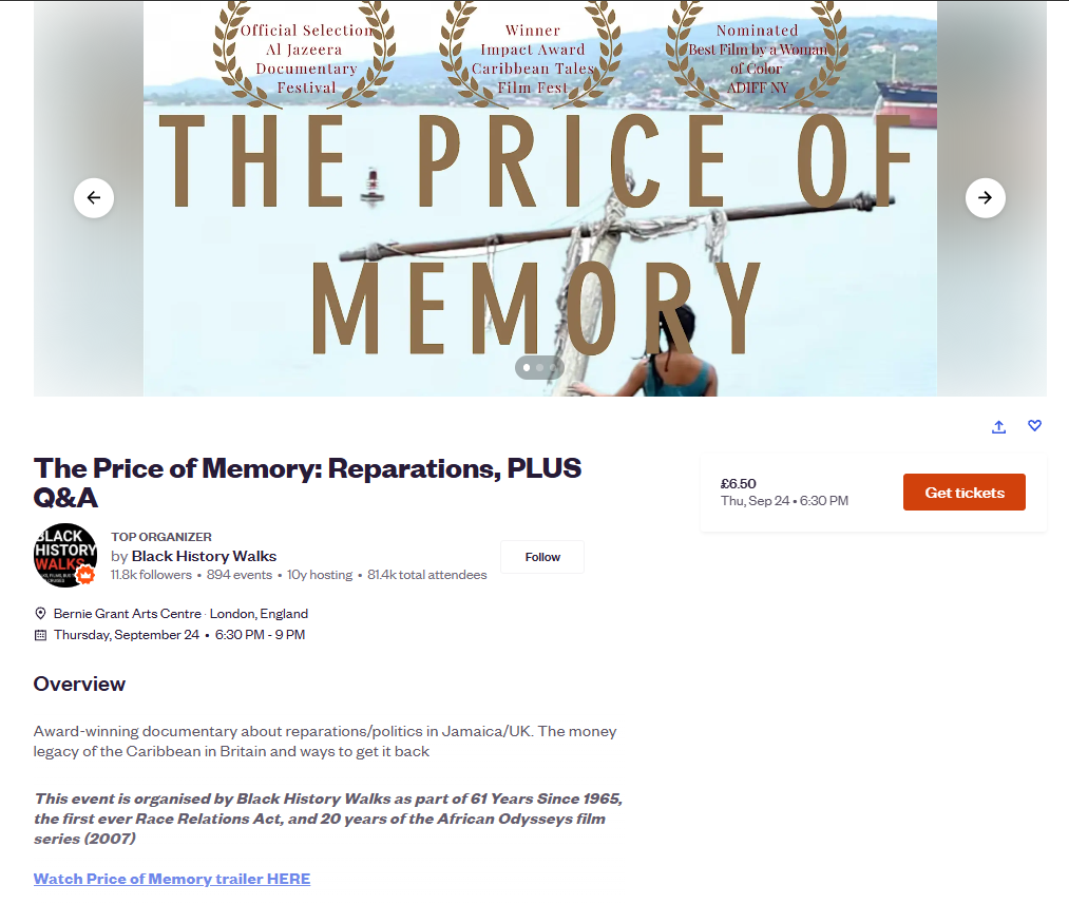
https://www.eventbrite.co.uk/e/the-price-of-memory-reparations-plus-qa-tickets-1993430119148
AFRICAN REPARATIONS MOVEMENT × BLACK HISTORY WALKS
PUBLIC PETITION TO SUPPORT EXPLORATION OF A STRATEGIC PARTNERSHIP
THE PETITION
We, the undersigned, support the proposal that the African Reparations Movement (ARM) and Black History Walks should explore the possibility of developing a strategic partnership.
This proposal is not based merely upon the fact that both organisations have interests concerning African and Black history.
There is a substantially more direct connection.
Black History Walks is actively engaged in public education and cultural programming concerning reparations.
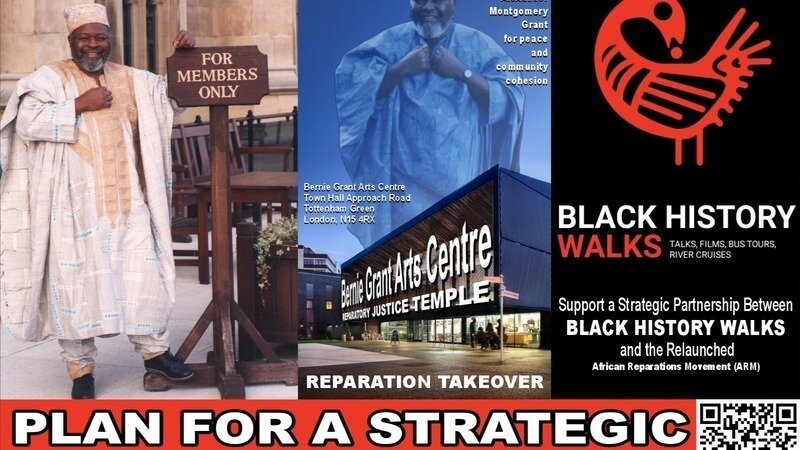
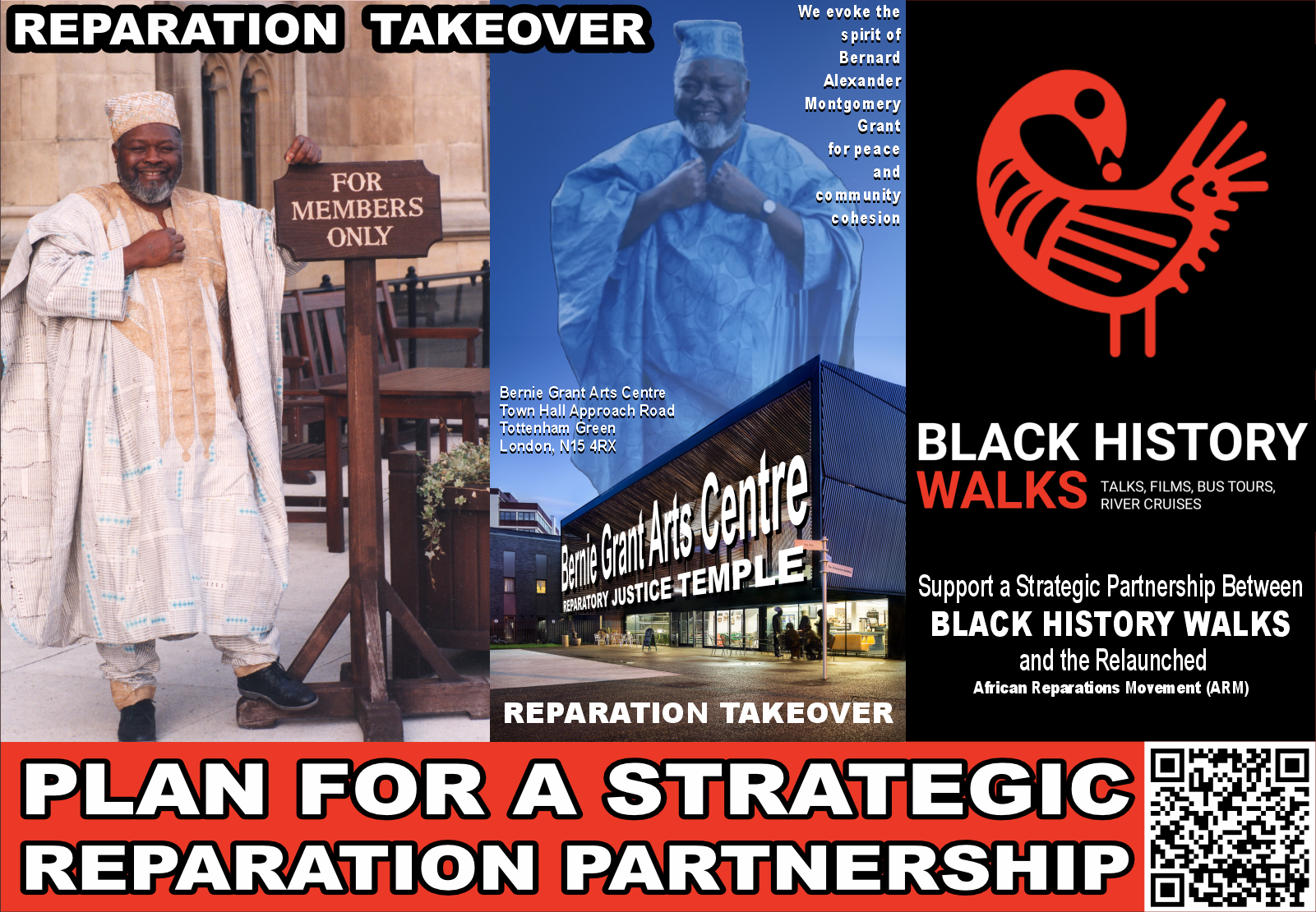
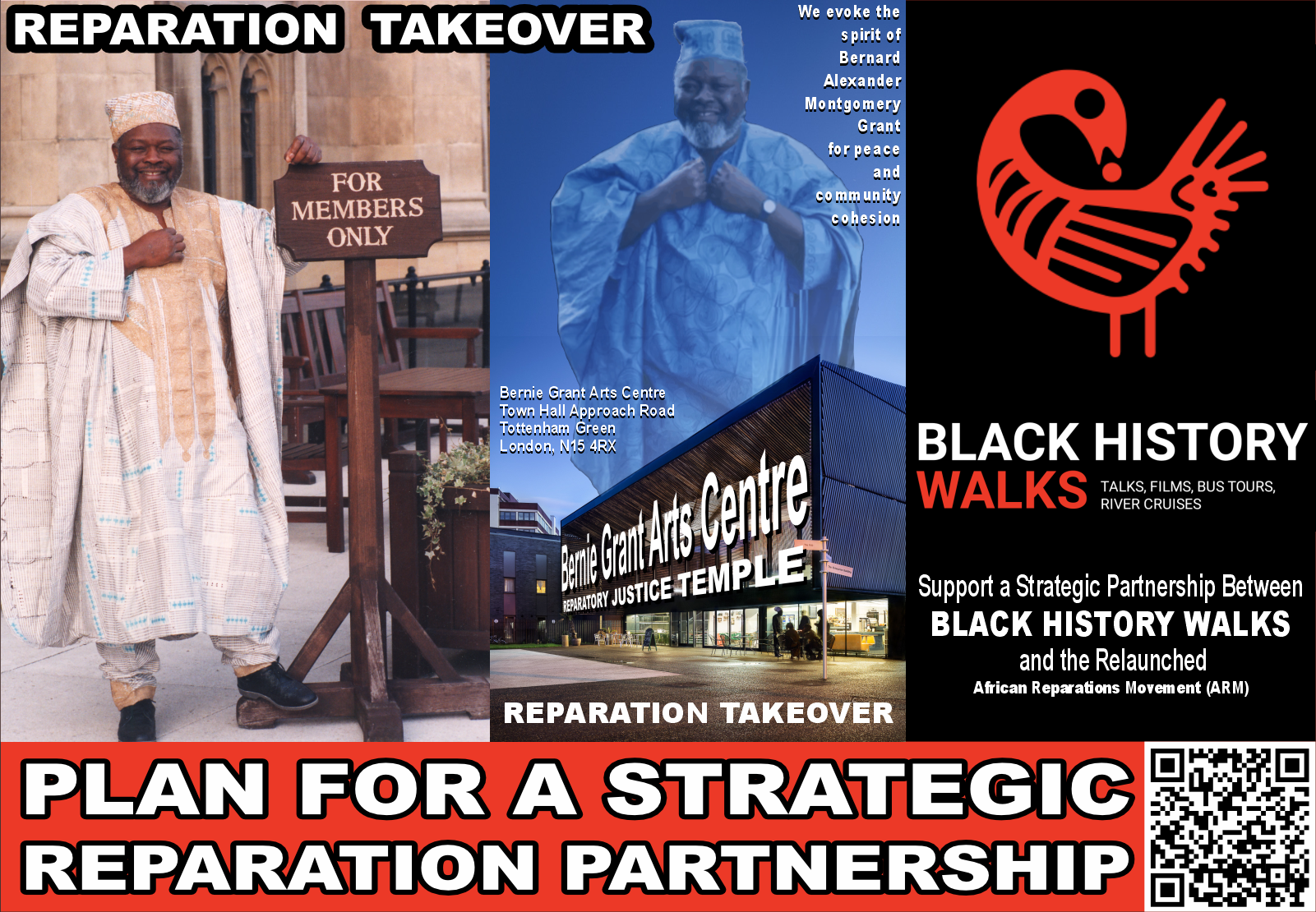
Its current programme includes The Price of Memory: Reparations, PLUS Q&A, scheduled at the Bernie Grant Arts Centre, Town Hall Approach Road, Tottenham Green, London N15 4RX, on 24 September 2026.
The documentary directly examines slavery, Britain, Jamaica and the continuing question of reparations.
The event therefore provides contemporary and publicly documented evidence of a significant area of common interest between Black History Walks and the African Reparations Movement.
BLACK HISTORY WALKS
Black History Walks was established in London in 2007 by Tony Warner.
Its work concerns the recovery, interpretation and communication of African and Caribbean history and the presence and contribution of Black people within British history.
Its activities have included:
historical walking tours;
bus and river tours;
lectures and presentations;
educational programmes;
film screenings;
Black-history resources;
engagement with schools and educational institutions;
cultural and historical projects;
public discussion of institutional racism;
slavery and colonial history;
Black British civil-rights history; and
reparations.
Black History Walks has therefore developed knowledge, educational experience, public engagement capacity and cultural infrastructure that could be highly relevant to the continuing development of the reparations movement.
THE PRICE OF MEMORY: REPARATIONS
The relevance of Black History Walks to reparations is not hypothetical.
Black History Walks is presenting:
The Price of Memory: Reparations, PLUS Q&A
The documentary examines the continuing consequences of slavery and the question of reparations through the historical relationship between Britain and Jamaica.
One of its central historical reference points is the 2002 visit of Queen Elizabeth II to Jamaica, during which Rastafari presented a petition seeking reparations for slavery.
The documentary subsequently follows the reparations question, including legal and political attempts to address the historical consequences of slavery.
It brings together perspectives involving Rastafari, lawyers, academics, politicians, campaigners and members of the Jamaican public.
The subject therefore sits directly within the historical and contemporary field in which the African Reparations Movement operates.
THE ECONOMIC QUESTION
Reparations are also inseparable from questions concerning the economic consequences of slavery.
Following abolition, the British state provided approximately £20 million in compensation to slave owners.
Formerly enslaved people did not receive equivalent compensation for their enslavement.
The historical transfer and accumulation of wealth arising from slavery, colonialism and their aftermath remain central subjects within contemporary reparations research.
These questions require historical research, public education, documentary evidence, legal analysis, economic analysis and community engagement.
A movement concerned with reparatory justice therefore has substantial reason to engage with organisations capable of bringing Black historical knowledge into public discussion.
BERNIE GRANT AND REPARATIONS
There is an additional connection.
Bernie Grant MP was himself involved in the development of the modern reparations movement in Britain.
Bernie Grant appears in The Price of Memory.
The screening is taking place at the institution carrying his name:
Bernie Grant Arts Centre
Town Hall Approach Road
Tottenham Green
London N15 4RX
United Kingdom
This creates an important historical intersection between:
Black history;
reparations;
public education;
Bernie Grant's political legacy;
Black History Walks;
and
the continuing development of the African reparations movement.
This intersection deserves serious exploration.
PROFESSOR STEPHEN SMALL AND THE BERNIE GRANT CONNECTION
The relationship between the current Black History Walks programme and Bernie Grant's historical reparations work extends further.
Black History Walks is also presenting programming involving Professor Stephen Small, who worked with Bernie Grant during the 1990s on matters concerning Black history, reparations and collective mobilisation.
This demonstrates continuity between historical reparations organising and contemporary Black-history education.
That continuity may provide valuable knowledge for a relaunched African Reparations Movement.
AFRICAN ODYSSEYS
Black History Walks is also associated with African Odysseys, the longstanding Black film programme co-founded by Tony Warner.
Film is particularly important to public historical education because documentary material can communicate historical evidence beyond academic publications and specialist audiences.
The reparations movement requires not merely research but mechanisms through which that research can reach communities.
Film, public screenings, historical tours, lectures, archives, websites, publications and public discussions can operate together as educational infrastructure.
Black History Walks has practical experience within several of these areas.
THE AFRICAN REPARATIONS MOVEMENT
The African Reparations Movement is being relaunched with an ambition extending beyond conventional campaigning.
Its long-term objective is to contribute to the development of practical infrastructure supporting reparatory justice.
That infrastructure may involve organisations and specialists working across:
reparatory justice;
African and Caribbean history;
Black British history;
slavery;
colonialism;
economics;
law;
human rights;
institutional racism;
education;
archives;
museums;
cultural heritage;
universities;
community development;
public policy;
technology;
artificial intelligence;
international cooperation; and
public mobilisation.
No single organisation can reasonably be expected to possess all of this expertise.
Strategic cooperation therefore becomes important.
#BlackHistoryWalks #BlackHistory #ReparationTakeover #BernieGrant #AntiRacism #AfricanReparationsMovement #ARM #ReparationsNow #BernieGrantArtsCentre #BGAC #Tottenham #Haringey
https://ic3csi.com/black-justice-v2/arm-library.html
https://blackhistorywalks.co.uk/
https://www.eventbrite.co.uk/e/the-price-of-memory-reparations-plus-qa-tickets-1993430119148
WHY ARM × BLACK HISTORY WALKS?
There are identifiable areas of potential common interest.
Black History Walks possesses substantial experience in communicating Black history to the public.
ARM is concerned with developing infrastructure around reparatory justice.
Reparations cannot properly be separated from history.
Historical evidence helps establish:
what happened;
who was involved;
what institutions existed;
how wealth was generated;
how wealth was transferred;
what laws operated;
what political decisions were made;
how colonial systems functioned;
what resistance occurred;
what consequences continued; and
how previous generations pursued reparatory justice.
Historical education can therefore form part of the intellectual infrastructure upon which reparations arguments are developed and understood.
POSSIBLE AREAS FOR EXPLORATORY DISCUSSION
Without presuming the position of either organisation, possible subjects for exploratory discussions could include:
reparations education;
Black British history;
African and Caribbean history;
Bernie Grant's reparations legacy;
slavery and colonialism;
Britain's historical relationship with Africa and the Caribbean;
historical evidence relevant to reparations;
Black British civil-rights history;
institutional racism;
historical walking tours;
documentary screenings;
public lectures;
educational programmes;
schools and universities;
historical archives;
museums;
cultural heritage;
publications;
conferences;
community education;
public engagement;
research;
preservation of historical material;
digital historical resources; and
appropriate collaborative projects.
These are subjects that could be explored.
They are not proposed commitments.
INDEPENDENCE MUST BE PRESERVED
A strategic partnership does not mean a merger.
Black History Walks should remain Black History Walks.
The African Reparations Movement should remain the African Reparations Movement.
Neither organisation should surrender its:
identity;
governance;
intellectual independence;
operational independence;
existing relationships;
programmes; or
decision-making authority.
Cooperation should occur only where both organisations independently determine that cooperation is appropriate.
WHAT THIS PETITION IS ACTUALLY ASKING FOR
This petition is deliberately limited.
It does not ask Black History Walks to join ARM.
It does not ask ARM to take control of Black History Walks.
It does not ask Black History Walks to endorse every policy or position of ARM.
It does not claim that discussions have already occurred.
It does not claim that Black History Walks has agreed to cooperate.
It does not claim that any partnership presently exists.
Instead, the petition asks the public one straightforward question:
SHOULD ARM AND BLACK HISTORY WALKS EXPLORE WHAT THEY COULD ACHIEVE TOGETHER?
If sufficient members of the public answer yes, that public support can provide a legitimate basis for ARM to approach Black History Walks and invite a conversation.
THE ROLE OF PUBLIC SUPPORT
The signatures gathered through this petition become evidence of public interest in the proposition.
ARM can therefore approach Black History Walks not simply saying:
“Would you work with us?”
but instead:
“Members of the public have supported the proposal that our organisations explore whether there are useful areas in which we could work together.”
Black History Walks would remain entirely free to accept or decline that invitation.
If discussions occur and produce no agreement, neither organisation loses its independence.
If discussions identify useful areas of cooperation, the organisations themselves can determine what happens next.
NO ALLEGATIONS, ACCUSATIONS, ASSERTIONS, ASSUMPTIONS OR CONCLUSIONS
For the avoidance of doubt, this petition makes:
no allegations;
no accusations;
no assertions concerning any unverified agreement;
no assumptions; and
no conclusions
concerning Black History Walks, the African Reparations Movement, their respective personnel or any other person or organisation.
Nothing within this petition represents or implies that Black History Walks:
has endorsed ARM;
has agreed to become an ARM partner;
has authorised this petition;
has entered negotiations with ARM; or
has agreed to any proposed activity described above.
The petition records a proposal being placed before the public.
THE PUBLIC PLEDGE
BY SIGNING THIS PETITION, I PLEDGE:
I support the proposal that the African Reparations Movement should approach Black History Walks with evidence of public support and invite Black History Walks to explore, without obligation, whether a strategic partnership or other constructive forms of cooperation could advance reparatory justice, Black historical education, research, cultural understanding and community development while preserving the complete independence of both organisations.
WHY SIGN?
The history already exists.
The knowledge already exists.
The organisations already exist.
The reparations debate already exists.
The question is whether greater cooperation can make these existing resources more effective.
The public should have an opportunity to say:
Explore the possibility.
SIGN THE PETITION
If you believe that Black History Walks and the African Reparations Movement should explore what they might achieve together, sign this petition.
Your signature does not create a partnership.
Your signature does not bind either organisation.
Your signature supports opening the conversation.
ARM × BLACK HISTORY WALKS
Explore cooperation.
Connect history to reparatory justice.
Preserve knowledge.
Educate communities.
Build infrastructure.
Advance the reparations movement.
#BlackHistoryWalks #BlackHistory #ReparationTakeover #BernieGrant #AntiRacism #AfricanReparationsMovement #ARM #ReparationsNow #BernieGrantArtsCentre #BGAC #Tottenham #Haringey
https://ic3csi.com/black-justice-v2/arm-library.html
https://blackhistorywalks.co.uk/
https://www.eventbrite.co.uk/e/the-price-of-memory-reparations-plus-qa-tickets-1993430119148

Victory
The Issue
#BlackHistoryWalks #BlackHistory #ReparationTakeover #BernieGrant #AntiRacism #AfricanReparationsMovement #ARM #ReparationsNow #BernieGrantArtsCentre #BGAC #Tottenham #Haringey
https://ic3csi.com/black-justice-v2/arm-library.html
https://blackhistorywalks.co.uk/
https://www.eventbrite.co.uk/e/the-price-of-memory-reparations-plus-qa-tickets-1993430119148
AFRICAN REPARATIONS MOVEMENT × BLACK HISTORY WALKS
PUBLIC PETITION TO SUPPORT EXPLORATION OF A STRATEGIC PARTNERSHIP
THE PETITION
We, the undersigned, support the proposal that the African Reparations Movement (ARM) and Black History Walks should explore the possibility of developing a strategic partnership.
This proposal is not based merely upon the fact that both organisations have interests concerning African and Black history.
There is a substantially more direct connection.
Black History Walks is actively engaged in public education and cultural programming concerning reparations.
Its current programme includes The Price of Memory: Reparations, PLUS Q&A, scheduled at the Bernie Grant Arts Centre, Town Hall Approach Road, Tottenham Green, London N15 4RX, on 24 September 2026.
The documentary directly examines slavery, Britain, Jamaica and the continuing question of reparations.
The event therefore provides contemporary and publicly documented evidence of a significant area of common interest between Black History Walks and the African Reparations Movement.
BLACK HISTORY WALKS
Black History Walks was established in London in 2007 by Tony Warner.
Its work concerns the recovery, interpretation and communication of African and Caribbean history and the presence and contribution of Black people within British history.
Its activities have included:
historical walking tours;
bus and river tours;
lectures and presentations;
educational programmes;
film screenings;
Black-history resources;
engagement with schools and educational institutions;
cultural and historical projects;
public discussion of institutional racism;
slavery and colonial history;
Black British civil-rights history; and
reparations.
Black History Walks has therefore developed knowledge, educational experience, public engagement capacity and cultural infrastructure that could be highly relevant to the continuing development of the reparations movement.
THE PRICE OF MEMORY: REPARATIONS
The relevance of Black History Walks to reparations is not hypothetical.
Black History Walks is presenting:
The Price of Memory: Reparations, PLUS Q&A
The documentary examines the continuing consequences of slavery and the question of reparations through the historical relationship between Britain and Jamaica.
One of its central historical reference points is the 2002 visit of Queen Elizabeth II to Jamaica, during which Rastafari presented a petition seeking reparations for slavery.
The documentary subsequently follows the reparations question, including legal and political attempts to address the historical consequences of slavery.
It brings together perspectives involving Rastafari, lawyers, academics, politicians, campaigners and members of the Jamaican public.
The subject therefore sits directly within the historical and contemporary field in which the African Reparations Movement operates.
THE ECONOMIC QUESTION
Reparations are also inseparable from questions concerning the economic consequences of slavery.
Following abolition, the British state provided approximately £20 million in compensation to slave owners.
Formerly enslaved people did not receive equivalent compensation for their enslavement.
The historical transfer and accumulation of wealth arising from slavery, colonialism and their aftermath remain central subjects within contemporary reparations research.
These questions require historical research, public education, documentary evidence, legal analysis, economic analysis and community engagement.
A movement concerned with reparatory justice therefore has substantial reason to engage with organisations capable of bringing Black historical knowledge into public discussion.
BERNIE GRANT AND REPARATIONS
There is an additional connection.
Bernie Grant MP was himself involved in the development of the modern reparations movement in Britain.
Bernie Grant appears in The Price of Memory.
The screening is taking place at the institution carrying his name:
Bernie Grant Arts Centre
Town Hall Approach Road
Tottenham Green
London N15 4RX
United Kingdom
This creates an important historical intersection between:
Black history;
reparations;
public education;
Bernie Grant's political legacy;
Black History Walks;
and
the continuing development of the African reparations movement.
This intersection deserves serious exploration.
PROFESSOR STEPHEN SMALL AND THE BERNIE GRANT CONNECTION
The relationship between the current Black History Walks programme and Bernie Grant's historical reparations work extends further.
Black History Walks is also presenting programming involving Professor Stephen Small, who worked with Bernie Grant during the 1990s on matters concerning Black history, reparations and collective mobilisation.
This demonstrates continuity between historical reparations organising and contemporary Black-history education.
That continuity may provide valuable knowledge for a relaunched African Reparations Movement.
AFRICAN ODYSSEYS
Black History Walks is also associated with African Odysseys, the longstanding Black film programme co-founded by Tony Warner.
Film is particularly important to public historical education because documentary material can communicate historical evidence beyond academic publications and specialist audiences.
The reparations movement requires not merely research but mechanisms through which that research can reach communities.
Film, public screenings, historical tours, lectures, archives, websites, publications and public discussions can operate together as educational infrastructure.
Black History Walks has practical experience within several of these areas.
THE AFRICAN REPARATIONS MOVEMENT
The African Reparations Movement is being relaunched with an ambition extending beyond conventional campaigning.
Its long-term objective is to contribute to the development of practical infrastructure supporting reparatory justice.
That infrastructure may involve organisations and specialists working across:
reparatory justice;
African and Caribbean history;
Black British history;
slavery;
colonialism;
economics;
law;
human rights;
institutional racism;
education;
archives;
museums;
cultural heritage;
universities;
community development;
public policy;
technology;
artificial intelligence;
international cooperation; and
public mobilisation.
No single organisation can reasonably be expected to possess all of this expertise.
Strategic cooperation therefore becomes important.
#BlackHistoryWalks #BlackHistory #ReparationTakeover #BernieGrant #AntiRacism #AfricanReparationsMovement #ARM #ReparationsNow #BernieGrantArtsCentre #BGAC #Tottenham #Haringey
https://ic3csi.com/black-justice-v2/arm-library.html
https://blackhistorywalks.co.uk/
https://www.eventbrite.co.uk/e/the-price-of-memory-reparations-plus-qa-tickets-1993430119148
WHY ARM × BLACK HISTORY WALKS?
There are identifiable areas of potential common interest.
Black History Walks possesses substantial experience in communicating Black history to the public.
ARM is concerned with developing infrastructure around reparatory justice.
Reparations cannot properly be separated from history.
Historical evidence helps establish:
what happened;
who was involved;
what institutions existed;
how wealth was generated;
how wealth was transferred;
what laws operated;
what political decisions were made;
how colonial systems functioned;
what resistance occurred;
what consequences continued; and
how previous generations pursued reparatory justice.
Historical education can therefore form part of the intellectual infrastructure upon which reparations arguments are developed and understood.
POSSIBLE AREAS FOR EXPLORATORY DISCUSSION
Without presuming the position of either organisation, possible subjects for exploratory discussions could include:
reparations education;
Black British history;
African and Caribbean history;
Bernie Grant's reparations legacy;
slavery and colonialism;
Britain's historical relationship with Africa and the Caribbean;
historical evidence relevant to reparations;
Black British civil-rights history;
institutional racism;
historical walking tours;
documentary screenings;
public lectures;
educational programmes;
schools and universities;
historical archives;
museums;
cultural heritage;
publications;
conferences;
community education;
public engagement;
research;
preservation of historical material;
digital historical resources; and
appropriate collaborative projects.
These are subjects that could be explored.
They are not proposed commitments.
INDEPENDENCE MUST BE PRESERVED
A strategic partnership does not mean a merger.
Black History Walks should remain Black History Walks.
The African Reparations Movement should remain the African Reparations Movement.
Neither organisation should surrender its:
identity;
governance;
intellectual independence;
operational independence;
existing relationships;
programmes; or
decision-making authority.
Cooperation should occur only where both organisations independently determine that cooperation is appropriate.
WHAT THIS PETITION IS ACTUALLY ASKING FOR
This petition is deliberately limited.
It does not ask Black History Walks to join ARM.
It does not ask ARM to take control of Black History Walks.
It does not ask Black History Walks to endorse every policy or position of ARM.
It does not claim that discussions have already occurred.
It does not claim that Black History Walks has agreed to cooperate.
It does not claim that any partnership presently exists.
Instead, the petition asks the public one straightforward question:
SHOULD ARM AND BLACK HISTORY WALKS EXPLORE WHAT THEY COULD ACHIEVE TOGETHER?
If sufficient members of the public answer yes, that public support can provide a legitimate basis for ARM to approach Black History Walks and invite a conversation.
THE ROLE OF PUBLIC SUPPORT
The signatures gathered through this petition become evidence of public interest in the proposition.
ARM can therefore approach Black History Walks not simply saying:
“Would you work with us?”
but instead:
“Members of the public have supported the proposal that our organisations explore whether there are useful areas in which we could work together.”
Black History Walks would remain entirely free to accept or decline that invitation.
If discussions occur and produce no agreement, neither organisation loses its independence.
If discussions identify useful areas of cooperation, the organisations themselves can determine what happens next.
NO ALLEGATIONS, ACCUSATIONS, ASSERTIONS, ASSUMPTIONS OR CONCLUSIONS
For the avoidance of doubt, this petition makes:
no allegations;
no accusations;
no assertions concerning any unverified agreement;
no assumptions; and
no conclusions
concerning Black History Walks, the African Reparations Movement, their respective personnel or any other person or organisation.
Nothing within this petition represents or implies that Black History Walks:
has endorsed ARM;
has agreed to become an ARM partner;
has authorised this petition;
has entered negotiations with ARM; or
has agreed to any proposed activity described above.
The petition records a proposal being placed before the public.
THE PUBLIC PLEDGE
BY SIGNING THIS PETITION, I PLEDGE:
I support the proposal that the African Reparations Movement should approach Black History Walks with evidence of public support and invite Black History Walks to explore, without obligation, whether a strategic partnership or other constructive forms of cooperation could advance reparatory justice, Black historical education, research, cultural understanding and community development while preserving the complete independence of both organisations.
WHY SIGN?
The history already exists.
The knowledge already exists.
The organisations already exist.
The reparations debate already exists.
The question is whether greater cooperation can make these existing resources more effective.
The public should have an opportunity to say:
Explore the possibility.
SIGN THE PETITION
If you believe that Black History Walks and the African Reparations Movement should explore what they might achieve together, sign this petition.
Your signature does not create a partnership.
Your signature does not bind either organisation.
Your signature supports opening the conversation.
ARM × BLACK HISTORY WALKS
Explore cooperation.
Connect history to reparatory justice.
Preserve knowledge.
Educate communities.
Build infrastructure.
Advance the reparations movement.
#BlackHistoryWalks #BlackHistory #ReparationTakeover #BernieGrant #AntiRacism #AfricanReparationsMovement #ARM #ReparationsNow #BernieGrantArtsCentre #BGAC #Tottenham #Haringey
https://ic3csi.com/black-justice-v2/arm-library.html
https://blackhistorywalks.co.uk/
https://www.eventbrite.co.uk/e/the-price-of-memory-reparations-plus-qa-tickets-1993430119148
Petition Updates
Share this petition
Petition created on 9 September 2026