
Support a Democratic and Peaceful Solution to Kashmir Conflict
Support a Democratic and Peaceful Solution to Kashmir Conflict
The Issue
📌 Executive Summary:
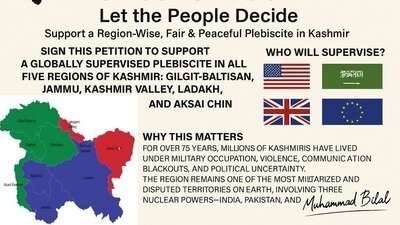
This petition urges the international community to support a region-wise plebiscite in the Kashmir region — namely Gilgit-Baltistan, Jammu, Kashmir Valley, and Ladakh — under the supervision of trusted neutral powers. The proposal ensures each area’s population exercises its right to self-determination with dignity, transparency, and peace, resolving one of the longest unresolved disputes in the modern world. This conflict has geopolitical ramifications beyond South Asia — impacting global peace, trade, security, and nuclear stability.
---
📍1. Who is Affected and How?
Kashmiris (in all regions) suffer daily from:
Military presence and violence
Human rights violations
Curfews, communication blackouts
No political control over their future
Pakistanis are affected by:
Cross-border skirmishes and loss of civilian/military lives
National economic resources diverted to conflict zones
A region of their claimed territory caught in dispute and violence
Indians are affected by:
Ongoing insurgencies and militarization of the region
Social and political polarization
Civil and human rights criticisms on global platforms
Chinese are affected by:
Ongoing border tensions and standoffs
Development of disputed regions delayed due to instability
Diplomatic relations with both neighbors strained by the dispute
The world is affected by:
Three nuclear-armed neighbors in prolonged tension
Global security risks from escalation
Limited regional cooperation in South Asia (a region with 3.135+ billion people)
---
🌍2. What is at Stake?
If left unresolved:
Nuclear escalation remains a real threat between India and Pakistan also Between India and China.
Radicalization can rise due to unresolved injustices and lack of voice.
Millions remain in limbo, deprived of stability, security, and identity.
South Asia’s development potential remains trapped, affecting global trade, energy corridors, and economic integration.
If resolved fairly:
Peace in South Asia becomes possible — opening up trade, tourism, and regional development.
Human rights of millions are restored.
India and Pakistan can refocus on development, not defense.
Global powers can remove one of the most dangerous geopolitical flashpoints from the map.
---
⏳3. Why Now?
The conflict has remained unresolved for over 75 years.
Youth in the region demand a peaceful future.
Digital awareness, diplomatic reforms, and global pressure make 2025 a viable turning point.
UN Resolutions 47 and others remain unfulfilled. This proposal envisions a modern, enforceable interpretation in today’s context.
Technology and global diplomacy now enable fair supervision, digital verification, and peaceful migrations.
---
✅ 4. Our Proposed Solution:
✳️ Regional Breakdown:
Kashmir is divided into five key administrative and cultural zones:
1. Gilgit-Baltistan
2. Jammu
3. Kashmir Valley
4. Ladakh
5. Aksai chin
Each of these regions will undergo a separate plebiscite.
---
✳️ Conditions for the Plebiscite:
Only real residents (whose families resided there at independence in 1947) will be eligible to vote.
A neutral voter registry verified through international observers, digital ID, and local testimonials.
---
✳️ Who Will Supervise?
A Five-member international coalition will be entrusted with the administration of the plebiscite and peacekeeping:
United Nations
United States
Saudi Arabia
United Kingdom
European Union
---
Their Roles Will Include:
Managing a safe and secure voting environment for all eligible residents.
Ensuring complete freedom of expression and the absence of coercion, influence, or fear.
Monitoring migration and citizenship transfers peacefully, fairly, and transparently after the plebiscite.
Overseeing equal housing and rehabilitation packages for those who wish to relocate.
Temporarily assuming administrative control of all four regions of Kashmir — Gilgit-Baltistan, Jammu, Kashmir Valley, and Ladakh — during the referendum period.
India , Pakistan and China will withdraw their military forces from the entire region for the duration of this process. The international coalition will deploy peacekeepers and observers to maintain law, order, and neutrality until the conclusion and implementation of the plebiscite.
Upon completion of the plebiscite and peaceful implementation of the results, control will be handed over to the designated country or autonomous governance as decided by the will of the people in each region.
---
✳️ Voting Options:
Each region’s voters will choose:
To accede to India
To accede to Pakistan
To accede to China
To become an independent or autonomous region
---
✳️ Outcome Implementation:
If a region votes more than 50% to join one side, it will legally merge with that country.
Peaceful migration will be ensured for residents wishing to move to the other country.
Fair compensation and equal housing will be provided.
All resettlement efforts will be supervised and funded internationally, under a UN peacekeeping guarantee.
---
🔄 5. What Needs to Happen Now?
The UN General Assembly and UN Security Council must urgently take up the issue.
India , Pakistan and China must be pressured to accept international mediation, in the interest of their people’s long-term peace and prosperity.
Civil society, influencers, and major media must support the demand for a peaceful referendum.
---
📣 6. Why the Public Should Sign This Petition
To save lives in one of the most militarized zones on Earth.
To end a conflict that costs billions annually in defense, lost trade, and civilian disruption.
To promote the UN Charter's principle of self-determination.
To reduce nuclear risks that affect everyone globally.
To enable peaceful development and cooperation in South Asia — a region home to a quarter of the world’s population.
---
🖊️ Signed,
Muhammad Bilal
Pakistan,India,China,USA,UN,EU,Britain And Saudi Arabia
Email: JusticeForKashmir@Gmail.com

1
The Issue
📌 Executive Summary:
This petition urges the international community to support a region-wise plebiscite in the Kashmir region — namely Gilgit-Baltistan, Jammu, Kashmir Valley, and Ladakh — under the supervision of trusted neutral powers. The proposal ensures each area’s population exercises its right to self-determination with dignity, transparency, and peace, resolving one of the longest unresolved disputes in the modern world. This conflict has geopolitical ramifications beyond South Asia — impacting global peace, trade, security, and nuclear stability.
---
📍1. Who is Affected and How?
Kashmiris (in all regions) suffer daily from:
Military presence and violence
Human rights violations
Curfews, communication blackouts
No political control over their future
Pakistanis are affected by:
Cross-border skirmishes and loss of civilian/military lives
National economic resources diverted to conflict zones
A region of their claimed territory caught in dispute and violence
Indians are affected by:
Ongoing insurgencies and militarization of the region
Social and political polarization
Civil and human rights criticisms on global platforms
Chinese are affected by:
Ongoing border tensions and standoffs
Development of disputed regions delayed due to instability
Diplomatic relations with both neighbors strained by the dispute
The world is affected by:
Three nuclear-armed neighbors in prolonged tension
Global security risks from escalation
Limited regional cooperation in South Asia (a region with 3.135+ billion people)
---
🌍2. What is at Stake?
If left unresolved:
Nuclear escalation remains a real threat between India and Pakistan also Between India and China.
Radicalization can rise due to unresolved injustices and lack of voice.
Millions remain in limbo, deprived of stability, security, and identity.
South Asia’s development potential remains trapped, affecting global trade, energy corridors, and economic integration.
If resolved fairly:
Peace in South Asia becomes possible — opening up trade, tourism, and regional development.
Human rights of millions are restored.
India and Pakistan can refocus on development, not defense.
Global powers can remove one of the most dangerous geopolitical flashpoints from the map.
---
⏳3. Why Now?
The conflict has remained unresolved for over 75 years.
Youth in the region demand a peaceful future.
Digital awareness, diplomatic reforms, and global pressure make 2025 a viable turning point.
UN Resolutions 47 and others remain unfulfilled. This proposal envisions a modern, enforceable interpretation in today’s context.
Technology and global diplomacy now enable fair supervision, digital verification, and peaceful migrations.
---
✅ 4. Our Proposed Solution:
✳️ Regional Breakdown:
Kashmir is divided into five key administrative and cultural zones:
1. Gilgit-Baltistan
2. Jammu
3. Kashmir Valley
4. Ladakh
5. Aksai chin
Each of these regions will undergo a separate plebiscite.
---
✳️ Conditions for the Plebiscite:
Only real residents (whose families resided there at independence in 1947) will be eligible to vote.
A neutral voter registry verified through international observers, digital ID, and local testimonials.
---
✳️ Who Will Supervise?
A Five-member international coalition will be entrusted with the administration of the plebiscite and peacekeeping:
United Nations
United States
Saudi Arabia
United Kingdom
European Union
---
Their Roles Will Include:
Managing a safe and secure voting environment for all eligible residents.
Ensuring complete freedom of expression and the absence of coercion, influence, or fear.
Monitoring migration and citizenship transfers peacefully, fairly, and transparently after the plebiscite.
Overseeing equal housing and rehabilitation packages for those who wish to relocate.
Temporarily assuming administrative control of all four regions of Kashmir — Gilgit-Baltistan, Jammu, Kashmir Valley, and Ladakh — during the referendum period.
India , Pakistan and China will withdraw their military forces from the entire region for the duration of this process. The international coalition will deploy peacekeepers and observers to maintain law, order, and neutrality until the conclusion and implementation of the plebiscite.
Upon completion of the plebiscite and peaceful implementation of the results, control will be handed over to the designated country or autonomous governance as decided by the will of the people in each region.
---
✳️ Voting Options:
Each region’s voters will choose:
To accede to India
To accede to Pakistan
To accede to China
To become an independent or autonomous region
---
✳️ Outcome Implementation:
If a region votes more than 50% to join one side, it will legally merge with that country.
Peaceful migration will be ensured for residents wishing to move to the other country.
Fair compensation and equal housing will be provided.
All resettlement efforts will be supervised and funded internationally, under a UN peacekeeping guarantee.
---
🔄 5. What Needs to Happen Now?
The UN General Assembly and UN Security Council must urgently take up the issue.
India , Pakistan and China must be pressured to accept international mediation, in the interest of their people’s long-term peace and prosperity.
Civil society, influencers, and major media must support the demand for a peaceful referendum.
---
📣 6. Why the Public Should Sign This Petition
To save lives in one of the most militarized zones on Earth.
To end a conflict that costs billions annually in defense, lost trade, and civilian disruption.
To promote the UN Charter's principle of self-determination.
To reduce nuclear risks that affect everyone globally.
To enable peaceful development and cooperation in South Asia — a region home to a quarter of the world’s population.
---
🖊️ Signed,
Muhammad Bilal
Pakistan,India,China,USA,UN,EU,Britain And Saudi Arabia
Email: JusticeForKashmir@Gmail.com
1
The Decision Makers


Petition Updates
Share this petition
Petition created on 2 June 2025