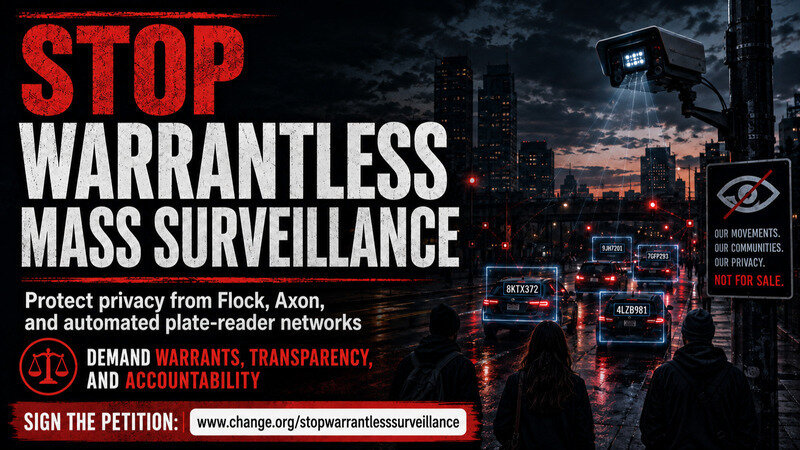
Stop Flock, Axon, and Warrantless Mass Surveillance of Americans
The Issue
STOP FLOCK, AXON, AND WARRANTLESS MASS SURVEILLANCE OF AMERICANS
Require warrants, strict limits, transparency, technical competence, independent auditing, and meaningful accountability before our roads become a permanent nationwide surveillance network.
TL;DR
Automated license plate readers and interconnected surveillance platforms from companies such as Flock Safety, Axon, and other vendors are rapidly creating an infrastructure capable of recording where millions of Americans travel and making those observations searchable across jurisdictions. These systems do not only watch suspected criminals. THEY WATCH EVERYONE.
A person driving to work, a hospital, a religious service, a political meeting, a protest, a gun store, an immigration attorney, a union meeting, an LGBTQ+ organization, an addiction treatment center, a domestic violence shelter, a friend's home, or simply the grocery store can have their vehicle photographed, categorized, timestamped, geolocated, stored, and potentially made searchable.
That is fundamentally different from a police officer seeing a license plate while standing beside a road. The issue is not that license plates are visible in public. THE ISSUE IS THE CREATION OF A PERSISTENT, AUTOMATED, INTERCONNECTED DATABASE CAPABLE OF RECONSTRUCTING PEOPLE'S MOVEMENTS AT A SCALE THAT WOULD HAVE BEEN PRACTICALLY IMPOSSIBLE ONLY A GENERATION AGO.
This technology has legitimate uses. Automated license plate readers can help locate stolen vehicles, missing persons, kidnapping suspects, violent offenders, and vehicles connected to serious crimes. But useful technology still needs limits. Wiretaps, cell phone location records, financial records, DNA databases, and other powerful investigative tools can all be useful, yet we do not therefore give government unlimited access whenever it wants. The same principle must apply to automated location surveillance.
Recent events demonstrate why voluntary vendor policies and internal police rules are not enough. Flock Safety announced major new safeguards in August 2026 after growing national backlash and documented misuse, including stronger auditing, case-code requirements, tighter sharing controls, and shorter default retention.
Those changes may be improvements, but they raise a much bigger question: WHY WERE PROTECTIONS THIS IMPORTANT LEFT TO THE SETTINGS AND POLICIES OF A PRIVATE SURVEILLANCE COMPANY IN THE FIRST PLACE?
Civil liberties should not depend on a software checkbox. Constitutional protections should not change because a vendor updates its terms of service.
We therefore call on Congress, state legislatures, governors, attorneys general, mayors, city councils, county governments, police commissions, sheriffs, law enforcement agencies, and other public bodies to impose a moratorium on unchecked expansion of automated license plate readers and interconnected persistent-surveillance networks until enforceable legal protections are established.
This petition is not aimed only at Flock Safety or Axon. Those companies are prominent examples of a much larger issue. WE NEED LAWS GOVERNING THE CAPABILITY, NOT MERELY ONE CORPORATE LOGO.
A CAMERA IS NOT THE SAME THING AS A SURVEILLANCE NETWORK
A common response to concerns about automated license plate readers is: "Your license plate is already visible in public." That statement misses the entire issue.
There is an enormous difference between an individual police officer seeing one vehicle drive past at 4:17 PM and a computerized network recording that same vehicle at dozens or hundreds of locations over time. Human observation is temporary, expensive, geographically limited, and difficult to aggregate. Digital surveillance is none of those things.
A police officer cannot personally stand on every major road in the country, remember every vehicle that passes, accurately record each plate, identify vehicle characteristics, timestamp every encounter, attach GPS coordinates, place the information in a searchable database, compare it with observations from thousands of other cameras, and later reconstruct where that vehicle traveled. A computer network can.
That difference in SCALE, PERSISTENCE, AGGREGATION, SEARCHABILITY, AND AUTOMATION matters. When enough cameras exist, the question stops being "Did police see this vehicle?" and becomes: Where has this vehicle been? Where does it usually go? Where does the owner probably live or work? Which locations do they repeatedly visit? Which other vehicles regularly appear near them? Were they near this event or this person's house?
The privacy issue is not the photograph by itself. THE PRIVACY ISSUE IS WHAT THE DATABASE MAKES POSSIBLE.
THESE SYSTEMS PHOTOGRAPH INNOCENT PEOPLE BY DESIGN
Traditional criminal investigations ordinarily begin with some reason to investigate a person, vehicle, location, or event. Mass automated surveillance reverses that process. First, information about everyone is collected. Then, sometime later, the database may be searched to determine whether someone becomes interesting to investigators.
That means the system's usefulness is directly connected to how comprehensively it observes people who are not suspected of committing crimes. If a camera only photographed known criminals, it would have very little investigative value. Its value comes from recording ordinary traffic so police can retrospectively search those records later.
That is precisely why democratic oversight is necessary. The innocent people appearing in these databases are not incidental. THEY ARE THE DATABASE.
THIS IS BIGGER THAN FLOCK
Flock has become one of the most visible names in automated license plate surveillance, but this petition is intentionally broader. Axon has expanded well beyond body cameras and Tasers into automated license plate recognition, fixed cameras, drones, real-time crime center technology, sensor integration, and software designed to combine different forms of public-safety information.
Axon's Fusus platform is designed to combine camera feeds, officer and dispatch information, ALPR data, drones, and other inputs into shared operational views. Its ALPR systems can support searches using multiple characteristics and can integrate data from different camera networks.
This technological convergence should concern lawmakers.
A license plate reader by itself is one thing. A body camera is another. A drone is another. A fixed security camera is another. A private business camera is another. Computer-aided dispatch data is another. Real-time officer location information is another.
When all of those systems become interoperable, the result can become much more powerful than any individual component. That is why laws must regulate AGGREGATION AND INTEGRATION, not merely individual camera models.
A city should not be able to avoid public scrutiny by approving each surveillance technology separately while gradually assembling an integrated surveillance system greater than the sum of its parts.
BODY CAMERAS AND MASS SURVEILLANCE ARE NOT THE SAME THING
This distinction matters.
Body cameras can provide accountability during police encounters. They can preserve evidence of what officers and civilians did, protect citizens from misconduct, protect officers from false allegations, and provide useful evidence in criminal cases.
Persistent automated surveillance is fundamentally different. It observes people who have had no interaction with police at all. A person does not have to call 911, be stopped, witness a crime, or be suspected of anything. They merely have to drive down a road.
Calling both technologies "cameras" ignores the difference in purpose and scale.
We can support police accountability technology while opposing indiscriminate location databases. Those positions are entirely compatible.
WHERE YOU TRAVEL CAN REVEAL WHO YOU ARE
A vehicle's location history can reveal far more than transportation.
Repeated observations can suggest where someone lives, where they work, which doctor they see, which religious institution they attend, whether they go to union meetings, whether they visit political campaign offices, whether they visit a gun store or shooting range, whether they see an immigration attorney, whether they visit an LGBTQ+ organization, whether they enter a substance-abuse treatment facility, whether they visit a domestic violence shelter, and whose private homes they frequent.
No single camera photograph necessarily reveals those things. PATTERNS DO.
Location information can reveal sensitive associations without ever reading the contents of someone's communications. That makes the ability to aggregate large numbers of observations extraordinarily powerful.
SCALE CHANGES THE CONSTITUTIONAL QUESTION
The law around modern location surveillance is still developing. Automated license plate reader networks have not simply been declared categorically unconstitutional nationwide, but that uncertainty is exactly why legislators need to act instead of waiting decades for technology-specific cases to work their way through courts.
In Carpenter v. United States, the Supreme Court recognized that large-scale historical location information can create privacy concerns fundamentally different from limited observation in public. The Court understood that modern technology can make comprehensive tracking possible in ways traditional human surveillance could not.
That does not automatically mean every ALPR search violates the Fourth Amendment under current law. It does mean lawmakers should recognize the constitutional importance of SCALE, AGGREGATION, AND RETROSPECTIVE TRACKING.
Cities are installing infrastructure now. Databases are being created now. Integrations are being built now. Contracts are being signed now. Norms are being established now.
WE SHOULD DEFINE THE RULES BEFORE UBIQUITOUS TRACKING BECOMES THE DEFAULT CONDITION OF AMERICAN LIFE.
ACCURACY PROBLEMS ARE NOT ABSTRACT WHEN POLICE ARE CARRYING GUNS
Supporters sometimes describe ALPR alerts as merely investigative leads. That description does not capture what can happen when those leads are wrong.
A false match on a shopping website is annoying. A bad recommendation from a streaming service is inconvenient. A false vehicle identification transmitted to an armed police officer can produce a felony stop involving multiple officers, weapons drawn, shouted commands, handcuffs, detention, frightened children, and people who have no idea why they are suddenly being treated as dangerous suspects.
Real-world deployments have demonstrated several ways these systems can fail. A camera can misread a character. Software can identify the wrong issuing state. A hot list can contain obsolete information. A recovered stolen vehicle can remain incorrectly flagged. An integration can return stale data. An officer can misunderstand what an alert means or fail to verify it before taking action.
A camera can even read the plate perfectly and still produce a bad alert if the database behind it is wrong.
BAD SURVEILLANCE DATA DOES NOT MERELY CREATE A PRIVACY PROBLEM. IT CAN CREATE A PHYSICAL SAFETY PROBLEM.
POLICE ARE NOT INFALLIBLE TECHNOLOGISTS, AND NEITHER IS AI
There is another uncomfortable reality that needs to be part of this discussion: POLICE OFFICERS ARE NOT GENERALLY HIRED BECAUSE THEY ARE MACHINE-LEARNING ENGINEERS, COMPUTER-VISION RESEARCHERS, STATISTICIANS, DATABASE ADMINISTRATORS, OR CYBERSECURITY PROFESSIONALS.
That is not an insult to individual officers. Police are trained primarily to perform police work.
Yet increasingly, officers are being handed systems whose outputs may depend on optical character recognition, computer vision, probabilistic matching, massive databases, third-party integrations, confidence thresholds, hot-list quality, software configuration, and algorithms that the officer standing beside the road may have little ability to independently evaluate.
Buying sophisticated technology does not automatically create sophisticated users.
That creates an enormous risk of AUTOMATION BIAS, the human tendency to put too much trust in a computerized recommendation or assume that because software produced an answer, the answer must be correct.
We see the same mistake across society with modern AI. A system responds confidently, so people assume it must know what it is talking about. But confident output is not the same thing as correct output.
AI can be wrong. Computer vision can be wrong. Optical character recognition can be wrong. Databases can be wrong. Hot lists can be outdated, data can be entered incorrectly, integrations can return bad information, cameras can confuse characters, and humans can misunderstand what the software is actually telling them.
The words "AI detected," "computer match," or "Flock alert" DO NOT MEAN "FACT." They mean a computer system generated information that requires human verification.
That distinction becomes extraordinarily important when the person receiving the computer's conclusion carries a badge, has authority to detain or arrest, and may be carrying a firearm.
TECHNOLOGY MUST NOT REVERSE THE PRESUMPTION OF INNOCENCE
One of the most dangerous consequences of automated surveillance is psychological rather than technical.
When a computer tells an officer that a vehicle is associated with a crime, the officer may naturally approach that vehicle believing the system has already established something about the people inside it. That can subtly reverse the traditional presumption of innocence.
Instead of "I need evidence showing this person committed a crime," the process can become "the computer says this person may be involved, now they need to convince me the computer is wrong."
That is backwards.
Americans do not have a responsibility to prove that an algorithm made a mistake. Government has the responsibility to establish that its information is accurate before depriving someone of liberty.
An automated alert is not a conviction. It is not proof. It is not automatically probable cause. Depending on the circumstances, it may not establish reasonable suspicion by itself.
IT IS A LEAD. NOTHING MORE.
Imagine being pulled over because an automated system says your car is stolen. You know it is not stolen. The title is yours, the registration is yours, and you drove it to work yesterday. But the officer approaching your vehicle has already been told by a computer that they may be confronting someone in a stolen car.
Suddenly you are trying to disprove an accusation you did nothing to create.
Technology should help police develop evidence. TECHNOLOGY SHOULD NOT MANUFACTURE A PRESUMPTION OF GUILT.
"THE COMPUTER SAID SO" CANNOT BECOME PROBABLE CAUSE
No police department should train officers to treat an automated alert as inherently trustworthy simply because it came from sophisticated software.
Before initiating a high-risk stop based substantially on an ALPR alert, officers should be required whenever circumstances reasonably permit to independently verify the actual plate characters, issuing state, vehicle make and model, vehicle color, distinctive characteristics, the current status of the underlying stolen-vehicle report or warrant, the age of the alert, and whether the information might concern a stolen or duplicated plate rather than the vehicle itself.
A computer saying "match" should never end the reasoning process. IT SHOULD BEGIN IT.
POLICE DEPARTMENTS NEED TECHNICAL COMPETENCE BEFORE PURCHASING TECHNICAL POWER
Cities should ask a basic question before approving advanced surveillance technology: DOES THE AGENCY PURCHASING THIS SYSTEM ACTUALLY HAVE THE TECHNICAL EXPERTISE NECESSARY TO OPERATE IT RESPONSIBLY?
Before deploying AI-assisted or algorithmic surveillance, an agency should be able to demonstrate that relevant personnel understand what the system actually detects, what it does not detect, its documented error modes, the difference between a possible match and confirmed identification, confidence thresholds where applicable, false positives and false negatives, stale database records, appropriate corroboration procedures, retention rules, interstate sharing, constitutional restrictions, cybersecurity risks, and audit requirements.
If a department cannot explain those concepts, it should not be operating technology capable of tracking thousands or millions of people.
A police department would not hand specialized forensic laboratory equipment to an untrained employee and tell them to figure it out. AI-assisted surveillance should not receive a lower standard simply because the vendor created an attractive user interface.
VENDORS HAVE AN INCENTIVE TO MAKE COMPLICATED TECHNOLOGY LOOK SIMPLE
Modern software often compresses a complicated technical process into a few words: MATCH. ALERT. SEARCH. SUSPECT VEHICLE.
The simpler the interface appears, the easier it is for the user to forget the uncertainty underneath it.
Behind one apparently definitive alert may be camera placement, image quality, OCR probabilities, plate databases, state identification, vehicle classification, network connections, third-party records, database freshness, and software rules.
A giant red alert on a screen can communicate certainty even when the underlying data does not justify certainty.
That is a human-factors problem. When the result could lead to someone being detained at gunpoint, human-factors engineering becomes a civil-rights issue.
Training cannot consist of "click here to search." Officers should specifically be trained that THE MACHINE CAN BE WRONG, THE DATABASE CAN BE WRONG, THE ALERT CAN BE WRONG, AND THE PERSON THEY ARE APPROACHING IS STILL PRESUMED INNOCENT.
LAW-ENFORCEMENT ABUSE IS NOT HYPOTHETICAL
Perhaps the strongest argument against unrestricted surveillance databases is that we no longer have to imagine whether someone might misuse them. It has happened.
Recent cases have involved law-enforcement officers accused of using ALPR systems to track romantic partners, former partners, coworkers, acquaintances, or family members for personal reasons.
These are not merely scenarios involving sophisticated foreign hackers. They demonstrate the INSIDER THREAT problem.
An authorized user can be the threat.
Cybersecurity professionals have understood this for decades. We do not protect sensitive systems merely by asking employees to behave. We implement least privilege, log access, monitor anomalous behavior, require business justification, audit privileged activity, revoke unnecessary access, and investigate misuse.
We assume that eventually someone with legitimate credentials may attempt something illegitimate.
Surveillance systems deserve at least the same level of seriousness.
INTERNAL POLICY IS NOT ENOUGH
When surveillance proponents respond that unauthorized searches violate department policy, they inadvertently reinforce the argument for stronger safeguards.
Policies are useful. Policies are not enough.
An officer willing to stalk someone is not going to stop because a PDF says "authorized law-enforcement purposes only."
Technical and legal controls should make misuse difficult, obvious, punishable, and discoverable. That means authenticated individual accounts, no shared credentials, multi-factor authentication, case numbers, tamper-resistant logs, anomaly detection, supervisor review, independent audits, random sampling, immediate lockout for suspicious activity, meaningful discipline, and criminal penalties where intentional misuse violates the law.
Victims of intentional misuse should also have a meaningful path to seek redress.
VENDOR PROMISES ARE NOT CIVIL-RIGHTS PROTECTIONS
Recent changes announced by Flock, including stronger auditing, case-code requirements, tighter sharing controls, and shorter retention, may reduce some risks. But they reveal a deeper governance problem.
THESE PROTECTIONS EXISTED AS VENDOR CHOICES.
A shorter retention period is better than a longer one. Mandatory auditing is better than optional auditing. Better sharing controls are better than unrestricted sharing.
But a default is not a right.
Who can change that default? Can an administrator extend retention? Under what circumstances? Who approves it? Can outside agencies search extended data? What happens when a criminal case ends? What happens when a contract terminates? What backups exist? Can exported records survive indefinitely outside the primary platform?
Civil liberties should not depend on a company's current defaults.
A vendor can change policy. A company can be acquired. A city can change providers. A future product may have different capabilities.
VENDOR POLICY SHOULD EXCEED THE LAW, NOT SUBSTITUTE FOR IT.
INTERSTATE DATA SHARING CAN UNDERMINE STATE LAW AND LOCAL DEMOCRACY
Controversies involving reproductive-health investigations and immigration enforcement have shown how local ALPR data can become part of investigations initiated elsewhere.
Whatever a person's political views on abortion or immigration, the structural problem should concern everyone.
A state can enact privacy protections. A city can adopt a policy. Voters can choose limits. But an interconnected surveillance network can create technical pathways through which another jurisdiction attempts to obtain information anyway.
Today the disputed issue may be abortion. Tomorrow it could be firearms. Another administration could prioritize immigration, protests, or political organizations.
Political power changes hands. SURVEILLANCE INFRASTRUCTURE SURVIVES ELECTIONS.
Suppose a city council says its police department will not use ALPR data for immigration enforcement. Residents might reasonably believe the matter is settled. But what happens if another department searches the city's data? What happens if an officer performs a search for an outside agency? What happens if a broad interstate sharing relationship is enabled?
If a city prohibits a category of use, its system should technically enforce that rule wherever practical.
PRIVACY SHOULD NOT BE PARTISAN
Imagine one administration aggressively seeking information identifying undocumented immigrants, abortion providers, protesters, environmental activists, or people connected to unpopular political movements.
Many Americans would be horrified.
Now imagine another administration using the same infrastructure to identify people attending gun shows, purchasing lawful firearms, attending conservative political meetings, participating in religious events, or associating with organizations officials dislike.
A different group of Americans would be horrified.
The correct response is not: "I trust the government when my side controls it."
The correct response is: NO GOVERNMENT SHOULD HAVE UNCHECKED POWER TO PERFORM THIS SURVEILLANCE.
If you would not give the tool to your political opponent, think carefully before giving it to your political ally.
MISSION CREEP IS PREDICTABLE
Surveillance technologies are often introduced using the most emotionally compelling examples: kidnapped children, murder suspects, carjackings, human trafficking, dangerous fugitives.
Those examples are persuasive because almost everyone wants police to solve those cases quickly.
Then the acceptable-use definition expands. Serious felonies become ordinary felonies. Felonies become misdemeanors. Then warrants, "investigative purposes," officer safety, suspicious behavior, outside-agency requests, or administrative use.
Eventually an exceptional tool becomes ordinary infrastructure.
The question citizens should ask is not merely, "Can you describe one good use?" Almost every surveillance technology has a good use.
The real questions are: WHAT ARE ITS LIMITS? WHO ENFORCES THOSE LIMITS? CAN THOSE LIMITS BE CHANGED WITHOUT PUBLIC APPROVAL? WHAT HAPPENS WHEN SOMEONE BREAKS THE RULES?
AI INCREASES THE NEED FOR OVERSIGHT, NOT THE CASE FOR BLIND TRUST
Modern ALPR systems increasingly do more than read complete license plates. Investigators may be able to search by partial plate, vehicle type, color, make, body style, decals, racks, and other characteristics.
Some of that can be genuinely useful when witnesses did not obtain a complete plate. But the less specific a search becomes, the greater the risk of generating large numbers of possible matches involving innocent people.
"Find Ohio plate ABC1234" is fundamentally different from "find every dark SUV with a roof rack seen near this neighborhood."
As AI capabilities improve, systems may become capable of increasingly sophisticated pattern searches. The fact that a human investigator could theoretically spend thousands of hours watching footage does not mean an automated system should be allowed to perform equivalent surveillance over millions of records without restrictions.
Automation changes what is practically possible.
PATTERN-OF-LIFE ANALYSIS DESERVES THE HIGHEST SCRUTINY
A particularly dangerous progression occurs when surveillance moves from searching for known facts to identifying behavioral patterns.
Instead of "Where was vehicle ABC123?" systems may increasingly support questions such as: Which vehicles repeatedly appear near these locations? Which vehicles traveled from City A to City B during this period? Which vehicles were near both events? Which vehicles regularly arrive around this time? Which vehicles repeatedly appear with another vehicle?
Those capabilities transform surveillance from retrieving evidence into discovering people.
That is a profound shift.
Advanced pattern-of-life analytics should require separate legislative authorization, independent validation, public disclosure, and substantially stronger judicial oversight.
CYBERSECURITY IS A CIVIL-LIBERTIES ISSUE
Surveillance databases create extraordinarily valuable targets. They can contain location information, vehicle images, license plates, search histories, case identifiers, user accounts, interagency relationships, investigative information, exports, and derived data.
A breach is therefore not merely an IT incident. It can expose where people travel, what police are investigating, crime victims, witnesses, officers, sensitive government activity, and information useful to stalkers, criminals, or foreign governments.
The more centralized and interconnected these systems become, the greater the potential consequences of compromise.
Security failures involving automated license plate reader systems have occurred across the broader industry. No company gets a permanent pass.
FLOCK SHOULD BE AUDITED. AXON SHOULD BE AUDITED. MOTOROLA SHOULD BE AUDITED. ANY FUTURE COMPETITOR SHOULD BE AUDITED.
Government surveillance technology should be held to exceptionally high cybersecurity standards because failure harms the public.
SECURITY CANNOT RELY ON "TRUST ME"
Every surveillance procurement should answer basic security questions before a contract is signed.
Is multi-factor authentication mandatory? Is access role-based? Can administrators see every search? Are logs tamper-resistant? How long are logs retained? Can vendor employees access customer information? Is that access logged? Are external penetration tests performed? Is there a vulnerability disclosure program? How are APIs secured? How are software updates protected? How are credentials rotated? What happens when an employee leaves? How quickly must breaches be disclosed? What subcontractors have access? How are backups protected? What happens when a contract ends?
For infrastructure this sensitive, "we are secure" is not an acceptable answer.
PUBLIC MONEY DESERVES PUBLIC SCRUTINY
Surveillance systems also create recurring costs and vendor lock-in.
Cities may begin with a limited number of cameras, then build investigations, staffing, training, real-time crime centers, software integrations, and interagency workflows around one vendor's platform.
Eventually the question is no longer "Should we purchase this?" It becomes "Can we afford to stop using this?"
That is how temporary pilot programs become permanent infrastructure.
Before approving these systems, governments should disclose the full cost of ownership, including annual subscriptions, connectivity, maintenance, integration, staffing, training, upgrades, cybersecurity, and future renewal costs.
EFFECTIVENESS CLAIMS NEED INDEPENDENT VERIFICATION
Law-enforcement agencies report real benefits from automated license plate readers. These systems can help recover stolen vehicles, locate missing people, identify vehicles connected to serious crimes, and develop investigative leads.
This petition does not claim the technology has zero value.
The argument is stronger than that: EVEN EFFECTIVE SURVEILLANCE NEEDS BOUNDARIES.
Cities spending public money should demand independent evidence showing which uses actually work, how often the system produces actionable results, how often those results are wrong, what crimes are affected, and whether less intrusive alternatives could accomplish the same goal.
Success stories cannot be the only metric.
If a department announces that ALPR helped solve a homicide, the public should also know how many searches were performed, how many vehicles were photographed, how many alerts were generated, how many were false, how many stops resulted, how many searches involved serious crimes versus minor offenses, how many searches came from outside agencies, how many users violated policy, and how many records were exported.
Without those numbers, governments are evaluating surveillance technology using anecdotes rather than evidence.
A FREE SOCIETY SHOULD NOT NORMALIZE RETROSPECTIVE TRACKING
One of the most consequential features of persistent surveillance is that government does not need to know in advance whom it wants to watch.
Imagine a protest today. Nothing illegal occurs. Thousands attend peacefully. Two years later, a different administration becomes interested in who participated.
With traditional surveillance, investigators would have had to decide at the time whether to dedicate people and resources to monitoring attendance. With persistent digital surveillance, information may already exist.
The same concern applies to political rallies, religious events, campaign headquarters, union meetings, medical facilities, gun shows, advocacy organizations, journalists meeting sources, attorneys' offices, and support groups.
The problem is not necessarily that someone is actively abusing the database today.
THE PROBLEM IS BUILDING THE CAPABILITY FOR SOMEONE TO ABUSE TOMORROW.
"IF YOU HAVE NOTHING TO HIDE, YOU HAVE NOTHING TO FEAR" IS NOT A DEMOCRATIC PRINCIPLE
People close curtains even though being at home is legal. They use passwords even though their messages are legal. They expect medical privacy, attorney-client confidentiality, voting privacy, and private conversations.
Privacy is not evidence of wrongdoing.
Privacy is part of autonomy.
The purpose of constitutional protections is not to hide crimes. It is to place limits on government power.
WE DEMAND ENFORCEABLE PROTECTIONS
Before the continued expansion of Flock, Axon ALPR, automated vehicle surveillance, real-time crime center integrations, and comparable systems from other vendors, we call for the following minimum protections:
DEMAND 01: A TEMPORARY MORATORIUM ON MAJOR NEW PERSISTENT-SURVEILLANCE DEPLOYMENTS UNTIL COMPREHENSIVE RULES ARE ENACTED. Existing systems should be reviewed rather than automatically renewed.
DEMAND 02: A WARRANT REQUIREMENT FOR HISTORICAL MOVEMENT TRACKING. When police seek to reconstruct a person's or vehicle's movements over time, they should generally obtain a warrant supported by probable cause, subject to narrow emergency exceptions.
DEMAND 03: A NARROWLY DEFINED EMERGENCY EXCEPTION. Genuine imminent threats such as kidnappings, endangered missing persons, active violent threats, or comparable emergencies may justify immediate searches, but those searches should receive mandatory post-use review.
DEMAND 04: STRICT DATA-RETENTION LIMITS. Information concerning vehicles not connected to an investigation should be deleted rapidly. Longer preservation should require a documented case-specific reason.
DEMAND 05: AUTOMATIC DELETION WHEN AN INVESTIGATIVE NEED EXPIRES. Preserved data should not become permanent simply because it was once connected to a case.
DEMAND 06: MANDATORY INDIVIDUAL ACCOUNTS, MULTI-FACTOR AUTHENTICATION, AND LEAST-PRIVILEGE ACCESS. Shared credentials and unnecessary nationwide access should be prohibited.
DEMAND 07: MANDATORY CASE NUMBERS OR DOCUMENTED EMERGENCY JUSTIFICATIONS FOR SEARCHES.
DEMAND 08: TAMPER-RESISTANT AUDIT LOGGING. Every search should record the user, date, time, search criteria, agency, case number, legal purpose, systems queried, information accessed, and exports performed.
DEMAND 09: AUTOMATED ABUSE DETECTION AND TEMPORARY LOCKOUT FOR SERIOUS ANOMALOUS ACTIVITY, followed by documented review.
DEMAND 10: INDEPENDENT AND RANDOM AUDITS. Surveillance programs should be reviewed by entities independent of both the police department and the vendor.
DEMAND 11: MEANINGFUL PENALTIES FOR INTENTIONAL MISUSE, including discipline and, where applicable, civil or criminal consequences.
DEMAND 12: A MEANINGFUL REMEDY FOR PEOPLE HARMED BY UNLAWFUL SURVEILLANCE.
DEMAND 13: MANDATORY HUMAN VERIFICATION BEFORE ENFORCEMENT. An automated alert alone should not justify arrest, search, or a high-risk vehicle stop when officers reasonably have time to verify the plate, vehicle, and underlying record.
DEMAND 14: MANDATORY AUTOMATION-BIAS AND AI-LITERACY TRAINING. Users should be trained on false positives, false negatives, database errors, algorithmic uncertainty, confidence thresholds, appropriate corroboration, and the principle that automated output is an investigative lead rather than proof of guilt.
DEMAND 15: NO ADVERSE INFERENCE FROM A CITIZEN'S INABILITY TO EXPLAIN AN AUTOMATED ALERT. People should not bear the burden of disproving a computer-generated accusation.
DEMAND 16: AGENCIES MUST DEMONSTRATE TECHNICAL COMPETENCE BEFORE DEPLOYMENT. Governments should identify who is responsible for administration, cybersecurity, accuracy validation, auditing, training, and incident response instead of relying entirely on the vendor.
DEMAND 17: INDEPENDENT REAL-WORLD ACCURACY TESTING AND PUBLIC FALSE-POSITIVE REPORTING. Governments should measure performance under actual deployment conditions and disclose material errors and wrongful stops.
DEMAND 18: MINIMUM PERFORMANCE STANDARDS. Systems that repeatedly fail accuracy requirements should be corrected or removed.
DEMAND 19: NO UNRESTRICTED INTERSTATE SHARING. Agencies should affirmatively approve specific sharing relationships instead of participating in massive default networks.
DEMAND 20: NO SIDE-DOOR SEARCHING. An outside agency should not evade its own legal restrictions by asking another department to perform a search on its behalf.
DEMAND 21: NO CIRCUMVENTION OF STATE PRIVACY LAWS. Systems should technically enforce restrictions concerning protected activities or investigations wherever practical.
DEMAND 22: MANDATORY DISCLOSURE OF OUTSIDE-AGENCY REQUESTS IN AGGREGATE TRANSPARENCY REPORTS.
DEMAND 23: NO FEDERAL ACCESS THROUGH LOCAL AGENCIES THAT CIRCUMVENTS LEGAL PROCESS OTHERWISE REQUIRED OF THE FEDERAL AGENCY.
DEMAND 24: NO WARRANTLESS PATTERN-OF-LIFE ANALYSIS. Broad searches intended to reconstruct associations, routines, travel patterns, or relationships between vehicles should require heightened judicial oversight.
DEMAND 25: NO AI-GENERATED SUSPICION STANDING ALONE AS JUSTIFICATION FOR ENFORCEMENT. Algorithmic pattern detection should generate investigative hypotheses, not guilt.
DEMAND 26: SEPARATE PUBLIC APPROVAL FOR MAJOR NEW ANALYTICS OR INTEGRATIONS. A contract for plate recognition should not automatically authorize facial recognition, behavioral analytics, drones, private-camera integration, or other surveillance simply because a software update adds the feature.
DEMAND 27: MANDATORY PUBLIC HEARINGS AND SURVEILLANCE IMPACT ASSESSMENTS BEFORE PROCUREMENT OR MAJOR EXPANSION. Residents should be told what is collected, why, how long it is kept, who can search it, who can receive it, what systems it connects to, and what happens when the contract ends.
DEMAND 28: PUBLIC DISCLOSURE OF CONTRACTS, AMENDMENTS, TOTAL COSTS, AND RENEWAL TERMS, except for narrowly defined legitimate security information.
DEMAND 29: NO AUTOMATIC RENEWALS AND MANDATORY SUNSET CLAUSES. Surveillance programs should periodically expire unless elected officials affirmatively renew them after reviewing effectiveness, accuracy, misuse, costs, civil-rights impacts, and public testimony.
DEMAND 30: INDEPENDENT EFFECTIVENESS STUDIES AND ANNUAL PUBLIC REPORTS showing searches, alerts, false alerts, investigative uses, arrests, recoveries, outside-agency requests, policy violations, and other meaningful metrics.
DEMAND 31: REPORTING BY OFFENSE CATEGORY. Residents deserve to know whether systems sold using murder and kidnapping examples are primarily being used for serious crimes or routine offenses.
DEMAND 32: NO USE TO IDENTIFY OR TRACK PEOPLE MERELY BECAUSE THEY ENGAGE IN FIRST AMENDMENT-PROTECTED ACTIVITY, including protests, religious services, political meetings, journalism, union activity, or lawful advocacy.
DEMAND 33: HEIGHTENED PROTECTION FOR SENSITIVE LOCATIONS, including medical facilities, religious institutions, shelters, legal offices, and similar locations where surveillance can reveal highly sensitive associations.
DEMAND 34: STRONG CYBERSECURITY REQUIREMENTS WRITTEN INTO LAW AND PROCUREMENT STANDARDS, including encryption, access controls, secure APIs, breach notification, third-party testing, and vulnerability disclosure programs.
DEMAND 35: STRICT VENDOR-ACCESS CONTROLS. Vendor employees should not access sensitive government surveillance information without necessity, authorization, and logging.
DEMAND 36: DATA-DELETION REQUIREMENTS WHEN CONTRACTS TERMINATE, including defined treatment of backups and derived copies.
DEMAND 37: EXPORT CONTROLS. Agencies should track when records leave the primary platform and ensure exported data remains subject to retention and access rules.
DEMAND 38: NO INDEFINITE PRESERVATION THROUGH ANOTHER SYSTEM. Agencies should not evade deletion rules by exporting everything into an evidence platform, intelligence database, or real-time crime center.
DEMAND 39: CLEAR RULES FOR PRIVATE CAMERAS AND PRIVATELY FUNDED SURVEILLANCE ENTERING GOVERNMENT SYSTEMS. A business, HOA, donor, or private network should not be able to bypass democratic oversight by purchasing surveillance for police.
DEMAND 40: NO COMMERCIAL RESALE OR SECONDARY MONETIZATION OF GOVERNMENT ALPR DATA.
DEMAND 41: NO SECRET WATCH LISTS. Agencies should document who placed a plate on a list, the legal authority, the reason, and when the entry expires.
DEMAND 42: A CORRECTION PROCESS FOR INACCURATE RECORDS so people and agencies can address vehicles wrongly associated with criminal activity.
DEMAND 43: WHISTLEBLOWER PROTECTIONS for employees who report unlawful surveillance practices.
DEMAND 44: NOTIFICATION AFTER PROVEN INTENTIONAL MISUSE when doing so would not compromise an active investigation or safety.
DEMAND 45: STATES AND MUNICIPALITIES MUST REMAIN FREE TO IMPOSE STRONGER RULES OR PROHIBIT PARTICULAR TECHNOLOGIES ENTIRELY.
These protections should be a floor, not a ceiling.
CITIES SHOULD KNOW EXACTLY WHAT THEY ARE BUYING
Before approving any surveillance contract, elected officials should be required to answer basic questions publicly.
What exact information does the system collect? Does it photograph every passing vehicle? Does it analyze vehicle characteristics? Can it search partial plates? Can it search by description? Can it track historical travel? How many cameras will exist? Where will they be located? How many private cameras are integrated? What is the retention period? Can it be changed? Who can search the system? How many outside agencies can search it? Can federal agencies request searches? Can officers search nationwide? Can data be exported? Can it be integrated with drones, body cameras, facial recognition, or other systems? Who audits employees? What happens if an employee stalks someone? What is the five-year cost? What is the local false-alert rate?
If officials cannot answer those questions, they are not ready to vote on the contract.
SURVEILLANCE SHOULD NOT BE BURIED IN ROUTINE PROCUREMENT
Persistent surveillance should not be approved as if it were an ordinary equipment purchase.
Buying office chairs does not fundamentally change the relationship between citizen and government. Building a searchable location surveillance network can.
Surveillance technology deserves separate public debate, written policy, technical review, cybersecurity review, civil-liberties review, financial review, and a recorded vote.
Residents should not discover cameras across their city and then have to ask, "Who approved these?"
COMMUNITIES SHOULD HAVE THE RIGHT TO SAY NO
Local governments should not treat opposition to ALPR systems as ignorance of technology or hostility toward law enforcement.
Communities across the country are already debating, pausing, limiting, or ending deployments because residents have concluded that the privacy costs require greater scrutiny.
Those debates are democracy working as intended.
A surveillance company may believe its product is beneficial. A police chief may believe it is beneficial. Some residents may agree. Others may conclude the privacy cost is too high.
Ultimately, the people living under the surveillance should have meaningful input.
OPPOSITION TO MASS SURVEILLANCE IS NOT OPPOSITION TO POLICE
Police need tools. They need modern technology, functioning radios, reliable evidence systems, body cameras, cybersecurity, digital forensics, training, vehicles, staffing, and investigative resources.
Technology that helps investigate serious crimes can absolutely have a place in modern policing.
But support for law enforcement cannot mean unlimited surveillance authority.
Power should be accompanied by oversight. Access should be accompanied by auditing. Technology should be accompanied by training. Errors should be accompanied by review. Misuse should be accompanied by consequences.
Public safety and civil liberties should reinforce each other.
THE BURDEN SHOULD BE ON GOVERNMENT TO JUSTIFY SURVEILLANCE
Citizens should not have to prove that they have a sufficiently important reason to avoid being tracked.
Government should have to prove that it has a sufficiently important reason to track them.
Instead of "collect everything because someone might someday become relevant," we should return to a more traditional principle: INVESTIGATE PEOPLE WHEN THERE IS A LAWFUL REASON TO INVESTIGATE THEM.
This is not radical. It is the logic behind warrants.
TECHNOLOGY CHANGES FASTER THAN LAW, WHICH IS EXACTLY WHY LAWMAKERS MUST ACT NOW
The cameras being debated today will become better. Computer vision will improve. Storage will become cheaper. Networks will become denser. AI searches will become more sophisticated. Drones will become more autonomous. Real-time crime centers will integrate more sensors. Data correlation will improve. The cost of tracking one person will continue approaching zero.
We cannot create policy based only on what a surveillance platform can do today.
We must regulate what this infrastructure is becoming capable of doing.
THE DANGER IS NOT ONE EVIL COMPANY
It would be easy to make this petition exclusively about Flock Safety. That would be a mistake.
If every Flock camera disappeared tomorrow, the market opportunity would remain. Axon could expand. Motorola could expand. Another startup could appear. Governments could build different networks.
The underlying capability would remain.
This is not fundamentally about whether one CEO, one company, or one police chief is trustworthy.
GOOD SECURITY POLICY DOES NOT DEPEND ON TRUST. IT DEPENDS ON ENFORCEABLE CONTROLS.
THIS SHOULD BE COMMON GROUND ACROSS THE POLITICAL SPECTRUM
You do not have to agree on abortion, immigration, firearms, policing, protests, labor unions, religion, LGBTQ+ rights, federal power, state power, or any particular political party.
You only have to answer one question:
SHOULD THE GOVERNMENT BE ABLE TO CREATE A SEARCHABLE RECORD OF WHERE MILLIONS OF INNOCENT AMERICANS TRAVEL WITHOUT FIRST ESTABLISHING STRONG LEGAL LIMITS ON HOW THAT POWER MAY BE USED?
We say no.
A conservative should not have to fear that a future government can easily identify everyone attending a gun show. A progressive should not have to fear that a future government can easily identify everyone visiting a reproductive-health clinic. A religious person should not have to fear that attendance at a place of worship is transformed into a government-searchable location record. An activist should not have to wonder whether driving to a peaceful protest creates an entry in a political dossier. A journalist should not have to wonder whether meeting a source can later be reconstructed from vehicle data. A domestic violence survivor should not have to wonder whether an abusive government employee can misuse surveillance technology to locate them.
An ordinary person should not have to worry about any of this simply because they drove down a public road.
OUR MESSAGE TO LAWMAKERS
Do not wait for the next wrongful arrest, stalking scandal, database abuse case, interstate controversy, data breach, or AI-driven expansion of pattern-of-life surveillance.
Do not wait until every major roadway is covered.
Do not wait until cities are financially and operationally dependent on these platforms.
Do not wait for courts to spend the next decade deciding how old constitutional principles apply to rapidly evolving surveillance technology.
LEGISLATE NOW.
OUR MESSAGE TO LAW ENFORCEMENT
We recognize that these systems can provide valuable investigative leads.
This petition is not claiming otherwise.
But tools powerful enough to track dangerous suspects are powerful enough to track innocent people. Powerful enough to locate a kidnapping suspect is powerful enough to locate an ex-partner. Powerful enough to find a stolen vehicle is powerful enough to identify someone attending a political event. Powerful enough to reconstruct a suspect's movements is powerful enough to reconstruct yours.
Strong safeguards protect ethical officers from the misconduct of the few who abuse access. They also protect officers from bad information.
A machine-generated alert should never put an officer into a dangerous confrontation under a false assumption of certainty.
THE MACHINE CAN BE WRONG. THE DATABASE CAN BE WRONG. THE ALERT CAN BE WRONG. THE PERSON IN FRONT OF YOU IS STILL PRESUMED INNOCENT.
OUR MESSAGE TO FLOCK, AXON, AND THE SURVEILLANCE INDUSTRY
If your products genuinely improve public safety, they should survive transparency, independent audits, accuracy testing, cybersecurity requirements, warrant requirements for highly invasive searches, and meaningful restrictions on misuse.
If a business model requires mass collection with weak oversight, the business model is the problem.
Privacy should not be treated as an obstacle a sales department needs to overcome.
It should be treated as a design requirement.
WE THEREFORE CALL FOR IMMEDIATE ACTION
We call on Congress to establish a nationwide baseline for automated location-surveillance privacy. We call on state legislatures to enact stronger protections where federal law falls short. We call on governors and attorneys general to investigate whether existing ALPR sharing practices comply with state law. We call on municipalities to pause new deployments until transparent local policies are enacted.
We call on police departments to audit historical access for signs of misuse, publish their data-sharing relationships, report false alerts and wrongful stops, and require real technical and AI-literacy training before giving personnel access to these systems.
We call on vendors to make strong privacy and security controls technically mandatory rather than optional.
We call on courts and lawmakers to recognize that the SCALE of modern digital surveillance matters.
And we call on Americans of every political persuasion to reject the idea that participation in modern society requires silently accepting government tracking.
PUBLIC SAFETY MATTERS
Public safety matters. So do privacy, due process, freedom of association, freedom of religion, freedom of speech, the right to protest, the right to seek medical care, the right to speak privately with an attorney, the presumption of innocence, and the Fourth Amendment.
Ordinary Americans should be treated as citizens, NOT POTENTIAL SUSPECTS WAITING TO BE SEARCHED LATER.
We do not need to abolish every investigative technology. We need rules, warrants, oversight, cybersecurity, technical competence, skepticism of algorithmic output, human verification, transparency, accountability, and consequences for abuse.
And we need those protections established in law rather than entrusted to a private company's current settings.
INVESTIGATE SUSPECTS. FIND MISSING CHILDREN. RECOVER STOLEN VEHICLES. SOLVE VIOLENT CRIMES.
But do not build an unrestricted surveillance network that records everyone simply because someday their movements might become useful.
"AI DETECTED" IS NOT THE SAME THING AS "PROVEN."
A COMPUTER MATCH IS NOT A CONVICTION.
AN ALERT IS NOT GUILT.
The government should not have to watch all of us to protect any of us.
STOP WARRANTLESS MASS SURVEILLANCE BEFORE IT BECOMES PERMANENT INFRASTRUCTURE.
SELECTED SOURCES AND FURTHER READING
Associated Press reporting on Flock's national network, misuse concerns, policy changes, auditing, and retention safeguards:
https://apnews.com/article/2a93bc075e2f7ffcca9e04a35d75a3fe
U.S. Supreme Court, Carpenter v. United States:
https://www.supremecourt.gov/opinions/17pdf/16-402_h315.pdf
Axon Fusus product information:
https://www.axon.com/products/axon-fusus
Axon ALPR documentation:
https://www.axon.com/help/fusus/software/fusus/alpr/alpr-search-interface.htm
Electronic Frontier Foundation reporting and analysis on ALPR errors and surveillance:
https://www.eff.org/deeplinks/2024/11/human-toll-alpr-errors
Institute for Justice reporting on wrongful stops involving ALPR errors:
https://ij.org/dozens-of-innocent-motorists-have-been-pulled-over-detained-at-gunpoint-or-jailed-due-to-ai-license-plate-camera-errors/
Flock Safety's description of its 2026 privacy and accountability guardrails:
https://www.flocksafety.com/blog/flock-guardrails-address-lpr-privacy-concerns-and-police-transparency

57
The Issue
STOP FLOCK, AXON, AND WARRANTLESS MASS SURVEILLANCE OF AMERICANS
Require warrants, strict limits, transparency, technical competence, independent auditing, and meaningful accountability before our roads become a permanent nationwide surveillance network.
TL;DR
Automated license plate readers and interconnected surveillance platforms from companies such as Flock Safety, Axon, and other vendors are rapidly creating an infrastructure capable of recording where millions of Americans travel and making those observations searchable across jurisdictions. These systems do not only watch suspected criminals. THEY WATCH EVERYONE.
A person driving to work, a hospital, a religious service, a political meeting, a protest, a gun store, an immigration attorney, a union meeting, an LGBTQ+ organization, an addiction treatment center, a domestic violence shelter, a friend's home, or simply the grocery store can have their vehicle photographed, categorized, timestamped, geolocated, stored, and potentially made searchable.
That is fundamentally different from a police officer seeing a license plate while standing beside a road. The issue is not that license plates are visible in public. THE ISSUE IS THE CREATION OF A PERSISTENT, AUTOMATED, INTERCONNECTED DATABASE CAPABLE OF RECONSTRUCTING PEOPLE'S MOVEMENTS AT A SCALE THAT WOULD HAVE BEEN PRACTICALLY IMPOSSIBLE ONLY A GENERATION AGO.
This technology has legitimate uses. Automated license plate readers can help locate stolen vehicles, missing persons, kidnapping suspects, violent offenders, and vehicles connected to serious crimes. But useful technology still needs limits. Wiretaps, cell phone location records, financial records, DNA databases, and other powerful investigative tools can all be useful, yet we do not therefore give government unlimited access whenever it wants. The same principle must apply to automated location surveillance.
Recent events demonstrate why voluntary vendor policies and internal police rules are not enough. Flock Safety announced major new safeguards in August 2026 after growing national backlash and documented misuse, including stronger auditing, case-code requirements, tighter sharing controls, and shorter default retention.
Those changes may be improvements, but they raise a much bigger question: WHY WERE PROTECTIONS THIS IMPORTANT LEFT TO THE SETTINGS AND POLICIES OF A PRIVATE SURVEILLANCE COMPANY IN THE FIRST PLACE?
Civil liberties should not depend on a software checkbox. Constitutional protections should not change because a vendor updates its terms of service.
We therefore call on Congress, state legislatures, governors, attorneys general, mayors, city councils, county governments, police commissions, sheriffs, law enforcement agencies, and other public bodies to impose a moratorium on unchecked expansion of automated license plate readers and interconnected persistent-surveillance networks until enforceable legal protections are established.
This petition is not aimed only at Flock Safety or Axon. Those companies are prominent examples of a much larger issue. WE NEED LAWS GOVERNING THE CAPABILITY, NOT MERELY ONE CORPORATE LOGO.
A CAMERA IS NOT THE SAME THING AS A SURVEILLANCE NETWORK
A common response to concerns about automated license plate readers is: "Your license plate is already visible in public." That statement misses the entire issue.
There is an enormous difference between an individual police officer seeing one vehicle drive past at 4:17 PM and a computerized network recording that same vehicle at dozens or hundreds of locations over time. Human observation is temporary, expensive, geographically limited, and difficult to aggregate. Digital surveillance is none of those things.
A police officer cannot personally stand on every major road in the country, remember every vehicle that passes, accurately record each plate, identify vehicle characteristics, timestamp every encounter, attach GPS coordinates, place the information in a searchable database, compare it with observations from thousands of other cameras, and later reconstruct where that vehicle traveled. A computer network can.
That difference in SCALE, PERSISTENCE, AGGREGATION, SEARCHABILITY, AND AUTOMATION matters. When enough cameras exist, the question stops being "Did police see this vehicle?" and becomes: Where has this vehicle been? Where does it usually go? Where does the owner probably live or work? Which locations do they repeatedly visit? Which other vehicles regularly appear near them? Were they near this event or this person's house?
The privacy issue is not the photograph by itself. THE PRIVACY ISSUE IS WHAT THE DATABASE MAKES POSSIBLE.
THESE SYSTEMS PHOTOGRAPH INNOCENT PEOPLE BY DESIGN
Traditional criminal investigations ordinarily begin with some reason to investigate a person, vehicle, location, or event. Mass automated surveillance reverses that process. First, information about everyone is collected. Then, sometime later, the database may be searched to determine whether someone becomes interesting to investigators.
That means the system's usefulness is directly connected to how comprehensively it observes people who are not suspected of committing crimes. If a camera only photographed known criminals, it would have very little investigative value. Its value comes from recording ordinary traffic so police can retrospectively search those records later.
That is precisely why democratic oversight is necessary. The innocent people appearing in these databases are not incidental. THEY ARE THE DATABASE.
THIS IS BIGGER THAN FLOCK
Flock has become one of the most visible names in automated license plate surveillance, but this petition is intentionally broader. Axon has expanded well beyond body cameras and Tasers into automated license plate recognition, fixed cameras, drones, real-time crime center technology, sensor integration, and software designed to combine different forms of public-safety information.
Axon's Fusus platform is designed to combine camera feeds, officer and dispatch information, ALPR data, drones, and other inputs into shared operational views. Its ALPR systems can support searches using multiple characteristics and can integrate data from different camera networks.
This technological convergence should concern lawmakers.
A license plate reader by itself is one thing. A body camera is another. A drone is another. A fixed security camera is another. A private business camera is another. Computer-aided dispatch data is another. Real-time officer location information is another.
When all of those systems become interoperable, the result can become much more powerful than any individual component. That is why laws must regulate AGGREGATION AND INTEGRATION, not merely individual camera models.
A city should not be able to avoid public scrutiny by approving each surveillance technology separately while gradually assembling an integrated surveillance system greater than the sum of its parts.
BODY CAMERAS AND MASS SURVEILLANCE ARE NOT THE SAME THING
This distinction matters.
Body cameras can provide accountability during police encounters. They can preserve evidence of what officers and civilians did, protect citizens from misconduct, protect officers from false allegations, and provide useful evidence in criminal cases.
Persistent automated surveillance is fundamentally different. It observes people who have had no interaction with police at all. A person does not have to call 911, be stopped, witness a crime, or be suspected of anything. They merely have to drive down a road.
Calling both technologies "cameras" ignores the difference in purpose and scale.
We can support police accountability technology while opposing indiscriminate location databases. Those positions are entirely compatible.
WHERE YOU TRAVEL CAN REVEAL WHO YOU ARE
A vehicle's location history can reveal far more than transportation.
Repeated observations can suggest where someone lives, where they work, which doctor they see, which religious institution they attend, whether they go to union meetings, whether they visit political campaign offices, whether they visit a gun store or shooting range, whether they see an immigration attorney, whether they visit an LGBTQ+ organization, whether they enter a substance-abuse treatment facility, whether they visit a domestic violence shelter, and whose private homes they frequent.
No single camera photograph necessarily reveals those things. PATTERNS DO.
Location information can reveal sensitive associations without ever reading the contents of someone's communications. That makes the ability to aggregate large numbers of observations extraordinarily powerful.
SCALE CHANGES THE CONSTITUTIONAL QUESTION
The law around modern location surveillance is still developing. Automated license plate reader networks have not simply been declared categorically unconstitutional nationwide, but that uncertainty is exactly why legislators need to act instead of waiting decades for technology-specific cases to work their way through courts.
In Carpenter v. United States, the Supreme Court recognized that large-scale historical location information can create privacy concerns fundamentally different from limited observation in public. The Court understood that modern technology can make comprehensive tracking possible in ways traditional human surveillance could not.
That does not automatically mean every ALPR search violates the Fourth Amendment under current law. It does mean lawmakers should recognize the constitutional importance of SCALE, AGGREGATION, AND RETROSPECTIVE TRACKING.
Cities are installing infrastructure now. Databases are being created now. Integrations are being built now. Contracts are being signed now. Norms are being established now.
WE SHOULD DEFINE THE RULES BEFORE UBIQUITOUS TRACKING BECOMES THE DEFAULT CONDITION OF AMERICAN LIFE.
ACCURACY PROBLEMS ARE NOT ABSTRACT WHEN POLICE ARE CARRYING GUNS
Supporters sometimes describe ALPR alerts as merely investigative leads. That description does not capture what can happen when those leads are wrong.
A false match on a shopping website is annoying. A bad recommendation from a streaming service is inconvenient. A false vehicle identification transmitted to an armed police officer can produce a felony stop involving multiple officers, weapons drawn, shouted commands, handcuffs, detention, frightened children, and people who have no idea why they are suddenly being treated as dangerous suspects.
Real-world deployments have demonstrated several ways these systems can fail. A camera can misread a character. Software can identify the wrong issuing state. A hot list can contain obsolete information. A recovered stolen vehicle can remain incorrectly flagged. An integration can return stale data. An officer can misunderstand what an alert means or fail to verify it before taking action.
A camera can even read the plate perfectly and still produce a bad alert if the database behind it is wrong.
BAD SURVEILLANCE DATA DOES NOT MERELY CREATE A PRIVACY PROBLEM. IT CAN CREATE A PHYSICAL SAFETY PROBLEM.
POLICE ARE NOT INFALLIBLE TECHNOLOGISTS, AND NEITHER IS AI
There is another uncomfortable reality that needs to be part of this discussion: POLICE OFFICERS ARE NOT GENERALLY HIRED BECAUSE THEY ARE MACHINE-LEARNING ENGINEERS, COMPUTER-VISION RESEARCHERS, STATISTICIANS, DATABASE ADMINISTRATORS, OR CYBERSECURITY PROFESSIONALS.
That is not an insult to individual officers. Police are trained primarily to perform police work.
Yet increasingly, officers are being handed systems whose outputs may depend on optical character recognition, computer vision, probabilistic matching, massive databases, third-party integrations, confidence thresholds, hot-list quality, software configuration, and algorithms that the officer standing beside the road may have little ability to independently evaluate.
Buying sophisticated technology does not automatically create sophisticated users.
That creates an enormous risk of AUTOMATION BIAS, the human tendency to put too much trust in a computerized recommendation or assume that because software produced an answer, the answer must be correct.
We see the same mistake across society with modern AI. A system responds confidently, so people assume it must know what it is talking about. But confident output is not the same thing as correct output.
AI can be wrong. Computer vision can be wrong. Optical character recognition can be wrong. Databases can be wrong. Hot lists can be outdated, data can be entered incorrectly, integrations can return bad information, cameras can confuse characters, and humans can misunderstand what the software is actually telling them.
The words "AI detected," "computer match," or "Flock alert" DO NOT MEAN "FACT." They mean a computer system generated information that requires human verification.
That distinction becomes extraordinarily important when the person receiving the computer's conclusion carries a badge, has authority to detain or arrest, and may be carrying a firearm.
TECHNOLOGY MUST NOT REVERSE THE PRESUMPTION OF INNOCENCE
One of the most dangerous consequences of automated surveillance is psychological rather than technical.
When a computer tells an officer that a vehicle is associated with a crime, the officer may naturally approach that vehicle believing the system has already established something about the people inside it. That can subtly reverse the traditional presumption of innocence.
Instead of "I need evidence showing this person committed a crime," the process can become "the computer says this person may be involved, now they need to convince me the computer is wrong."
That is backwards.
Americans do not have a responsibility to prove that an algorithm made a mistake. Government has the responsibility to establish that its information is accurate before depriving someone of liberty.
An automated alert is not a conviction. It is not proof. It is not automatically probable cause. Depending on the circumstances, it may not establish reasonable suspicion by itself.
IT IS A LEAD. NOTHING MORE.
Imagine being pulled over because an automated system says your car is stolen. You know it is not stolen. The title is yours, the registration is yours, and you drove it to work yesterday. But the officer approaching your vehicle has already been told by a computer that they may be confronting someone in a stolen car.
Suddenly you are trying to disprove an accusation you did nothing to create.
Technology should help police develop evidence. TECHNOLOGY SHOULD NOT MANUFACTURE A PRESUMPTION OF GUILT.
"THE COMPUTER SAID SO" CANNOT BECOME PROBABLE CAUSE
No police department should train officers to treat an automated alert as inherently trustworthy simply because it came from sophisticated software.
Before initiating a high-risk stop based substantially on an ALPR alert, officers should be required whenever circumstances reasonably permit to independently verify the actual plate characters, issuing state, vehicle make and model, vehicle color, distinctive characteristics, the current status of the underlying stolen-vehicle report or warrant, the age of the alert, and whether the information might concern a stolen or duplicated plate rather than the vehicle itself.
A computer saying "match" should never end the reasoning process. IT SHOULD BEGIN IT.
POLICE DEPARTMENTS NEED TECHNICAL COMPETENCE BEFORE PURCHASING TECHNICAL POWER
Cities should ask a basic question before approving advanced surveillance technology: DOES THE AGENCY PURCHASING THIS SYSTEM ACTUALLY HAVE THE TECHNICAL EXPERTISE NECESSARY TO OPERATE IT RESPONSIBLY?
Before deploying AI-assisted or algorithmic surveillance, an agency should be able to demonstrate that relevant personnel understand what the system actually detects, what it does not detect, its documented error modes, the difference between a possible match and confirmed identification, confidence thresholds where applicable, false positives and false negatives, stale database records, appropriate corroboration procedures, retention rules, interstate sharing, constitutional restrictions, cybersecurity risks, and audit requirements.
If a department cannot explain those concepts, it should not be operating technology capable of tracking thousands or millions of people.
A police department would not hand specialized forensic laboratory equipment to an untrained employee and tell them to figure it out. AI-assisted surveillance should not receive a lower standard simply because the vendor created an attractive user interface.
VENDORS HAVE AN INCENTIVE TO MAKE COMPLICATED TECHNOLOGY LOOK SIMPLE
Modern software often compresses a complicated technical process into a few words: MATCH. ALERT. SEARCH. SUSPECT VEHICLE.
The simpler the interface appears, the easier it is for the user to forget the uncertainty underneath it.
Behind one apparently definitive alert may be camera placement, image quality, OCR probabilities, plate databases, state identification, vehicle classification, network connections, third-party records, database freshness, and software rules.
A giant red alert on a screen can communicate certainty even when the underlying data does not justify certainty.
That is a human-factors problem. When the result could lead to someone being detained at gunpoint, human-factors engineering becomes a civil-rights issue.
Training cannot consist of "click here to search." Officers should specifically be trained that THE MACHINE CAN BE WRONG, THE DATABASE CAN BE WRONG, THE ALERT CAN BE WRONG, AND THE PERSON THEY ARE APPROACHING IS STILL PRESUMED INNOCENT.
LAW-ENFORCEMENT ABUSE IS NOT HYPOTHETICAL
Perhaps the strongest argument against unrestricted surveillance databases is that we no longer have to imagine whether someone might misuse them. It has happened.
Recent cases have involved law-enforcement officers accused of using ALPR systems to track romantic partners, former partners, coworkers, acquaintances, or family members for personal reasons.
These are not merely scenarios involving sophisticated foreign hackers. They demonstrate the INSIDER THREAT problem.
An authorized user can be the threat.
Cybersecurity professionals have understood this for decades. We do not protect sensitive systems merely by asking employees to behave. We implement least privilege, log access, monitor anomalous behavior, require business justification, audit privileged activity, revoke unnecessary access, and investigate misuse.
We assume that eventually someone with legitimate credentials may attempt something illegitimate.
Surveillance systems deserve at least the same level of seriousness.
INTERNAL POLICY IS NOT ENOUGH
When surveillance proponents respond that unauthorized searches violate department policy, they inadvertently reinforce the argument for stronger safeguards.
Policies are useful. Policies are not enough.
An officer willing to stalk someone is not going to stop because a PDF says "authorized law-enforcement purposes only."
Technical and legal controls should make misuse difficult, obvious, punishable, and discoverable. That means authenticated individual accounts, no shared credentials, multi-factor authentication, case numbers, tamper-resistant logs, anomaly detection, supervisor review, independent audits, random sampling, immediate lockout for suspicious activity, meaningful discipline, and criminal penalties where intentional misuse violates the law.
Victims of intentional misuse should also have a meaningful path to seek redress.
VENDOR PROMISES ARE NOT CIVIL-RIGHTS PROTECTIONS
Recent changes announced by Flock, including stronger auditing, case-code requirements, tighter sharing controls, and shorter retention, may reduce some risks. But they reveal a deeper governance problem.
THESE PROTECTIONS EXISTED AS VENDOR CHOICES.
A shorter retention period is better than a longer one. Mandatory auditing is better than optional auditing. Better sharing controls are better than unrestricted sharing.
But a default is not a right.
Who can change that default? Can an administrator extend retention? Under what circumstances? Who approves it? Can outside agencies search extended data? What happens when a criminal case ends? What happens when a contract terminates? What backups exist? Can exported records survive indefinitely outside the primary platform?
Civil liberties should not depend on a company's current defaults.
A vendor can change policy. A company can be acquired. A city can change providers. A future product may have different capabilities.
VENDOR POLICY SHOULD EXCEED THE LAW, NOT SUBSTITUTE FOR IT.
INTERSTATE DATA SHARING CAN UNDERMINE STATE LAW AND LOCAL DEMOCRACY
Controversies involving reproductive-health investigations and immigration enforcement have shown how local ALPR data can become part of investigations initiated elsewhere.
Whatever a person's political views on abortion or immigration, the structural problem should concern everyone.
A state can enact privacy protections. A city can adopt a policy. Voters can choose limits. But an interconnected surveillance network can create technical pathways through which another jurisdiction attempts to obtain information anyway.
Today the disputed issue may be abortion. Tomorrow it could be firearms. Another administration could prioritize immigration, protests, or political organizations.
Political power changes hands. SURVEILLANCE INFRASTRUCTURE SURVIVES ELECTIONS.
Suppose a city council says its police department will not use ALPR data for immigration enforcement. Residents might reasonably believe the matter is settled. But what happens if another department searches the city's data? What happens if an officer performs a search for an outside agency? What happens if a broad interstate sharing relationship is enabled?
If a city prohibits a category of use, its system should technically enforce that rule wherever practical.
PRIVACY SHOULD NOT BE PARTISAN
Imagine one administration aggressively seeking information identifying undocumented immigrants, abortion providers, protesters, environmental activists, or people connected to unpopular political movements.
Many Americans would be horrified.
Now imagine another administration using the same infrastructure to identify people attending gun shows, purchasing lawful firearms, attending conservative political meetings, participating in religious events, or associating with organizations officials dislike.
A different group of Americans would be horrified.
The correct response is not: "I trust the government when my side controls it."
The correct response is: NO GOVERNMENT SHOULD HAVE UNCHECKED POWER TO PERFORM THIS SURVEILLANCE.
If you would not give the tool to your political opponent, think carefully before giving it to your political ally.
MISSION CREEP IS PREDICTABLE
Surveillance technologies are often introduced using the most emotionally compelling examples: kidnapped children, murder suspects, carjackings, human trafficking, dangerous fugitives.
Those examples are persuasive because almost everyone wants police to solve those cases quickly.
Then the acceptable-use definition expands. Serious felonies become ordinary felonies. Felonies become misdemeanors. Then warrants, "investigative purposes," officer safety, suspicious behavior, outside-agency requests, or administrative use.
Eventually an exceptional tool becomes ordinary infrastructure.
The question citizens should ask is not merely, "Can you describe one good use?" Almost every surveillance technology has a good use.
The real questions are: WHAT ARE ITS LIMITS? WHO ENFORCES THOSE LIMITS? CAN THOSE LIMITS BE CHANGED WITHOUT PUBLIC APPROVAL? WHAT HAPPENS WHEN SOMEONE BREAKS THE RULES?
AI INCREASES THE NEED FOR OVERSIGHT, NOT THE CASE FOR BLIND TRUST
Modern ALPR systems increasingly do more than read complete license plates. Investigators may be able to search by partial plate, vehicle type, color, make, body style, decals, racks, and other characteristics.
Some of that can be genuinely useful when witnesses did not obtain a complete plate. But the less specific a search becomes, the greater the risk of generating large numbers of possible matches involving innocent people.
"Find Ohio plate ABC1234" is fundamentally different from "find every dark SUV with a roof rack seen near this neighborhood."
As AI capabilities improve, systems may become capable of increasingly sophisticated pattern searches. The fact that a human investigator could theoretically spend thousands of hours watching footage does not mean an automated system should be allowed to perform equivalent surveillance over millions of records without restrictions.
Automation changes what is practically possible.
PATTERN-OF-LIFE ANALYSIS DESERVES THE HIGHEST SCRUTINY
A particularly dangerous progression occurs when surveillance moves from searching for known facts to identifying behavioral patterns.
Instead of "Where was vehicle ABC123?" systems may increasingly support questions such as: Which vehicles repeatedly appear near these locations? Which vehicles traveled from City A to City B during this period? Which vehicles were near both events? Which vehicles regularly arrive around this time? Which vehicles repeatedly appear with another vehicle?
Those capabilities transform surveillance from retrieving evidence into discovering people.
That is a profound shift.
Advanced pattern-of-life analytics should require separate legislative authorization, independent validation, public disclosure, and substantially stronger judicial oversight.
CYBERSECURITY IS A CIVIL-LIBERTIES ISSUE
Surveillance databases create extraordinarily valuable targets. They can contain location information, vehicle images, license plates, search histories, case identifiers, user accounts, interagency relationships, investigative information, exports, and derived data.
A breach is therefore not merely an IT incident. It can expose where people travel, what police are investigating, crime victims, witnesses, officers, sensitive government activity, and information useful to stalkers, criminals, or foreign governments.
The more centralized and interconnected these systems become, the greater the potential consequences of compromise.
Security failures involving automated license plate reader systems have occurred across the broader industry. No company gets a permanent pass.
FLOCK SHOULD BE AUDITED. AXON SHOULD BE AUDITED. MOTOROLA SHOULD BE AUDITED. ANY FUTURE COMPETITOR SHOULD BE AUDITED.
Government surveillance technology should be held to exceptionally high cybersecurity standards because failure harms the public.
SECURITY CANNOT RELY ON "TRUST ME"
Every surveillance procurement should answer basic security questions before a contract is signed.
Is multi-factor authentication mandatory? Is access role-based? Can administrators see every search? Are logs tamper-resistant? How long are logs retained? Can vendor employees access customer information? Is that access logged? Are external penetration tests performed? Is there a vulnerability disclosure program? How are APIs secured? How are software updates protected? How are credentials rotated? What happens when an employee leaves? How quickly must breaches be disclosed? What subcontractors have access? How are backups protected? What happens when a contract ends?
For infrastructure this sensitive, "we are secure" is not an acceptable answer.
PUBLIC MONEY DESERVES PUBLIC SCRUTINY
Surveillance systems also create recurring costs and vendor lock-in.
Cities may begin with a limited number of cameras, then build investigations, staffing, training, real-time crime centers, software integrations, and interagency workflows around one vendor's platform.
Eventually the question is no longer "Should we purchase this?" It becomes "Can we afford to stop using this?"
That is how temporary pilot programs become permanent infrastructure.
Before approving these systems, governments should disclose the full cost of ownership, including annual subscriptions, connectivity, maintenance, integration, staffing, training, upgrades, cybersecurity, and future renewal costs.
EFFECTIVENESS CLAIMS NEED INDEPENDENT VERIFICATION
Law-enforcement agencies report real benefits from automated license plate readers. These systems can help recover stolen vehicles, locate missing people, identify vehicles connected to serious crimes, and develop investigative leads.
This petition does not claim the technology has zero value.
The argument is stronger than that: EVEN EFFECTIVE SURVEILLANCE NEEDS BOUNDARIES.
Cities spending public money should demand independent evidence showing which uses actually work, how often the system produces actionable results, how often those results are wrong, what crimes are affected, and whether less intrusive alternatives could accomplish the same goal.
Success stories cannot be the only metric.
If a department announces that ALPR helped solve a homicide, the public should also know how many searches were performed, how many vehicles were photographed, how many alerts were generated, how many were false, how many stops resulted, how many searches involved serious crimes versus minor offenses, how many searches came from outside agencies, how many users violated policy, and how many records were exported.
Without those numbers, governments are evaluating surveillance technology using anecdotes rather than evidence.
A FREE SOCIETY SHOULD NOT NORMALIZE RETROSPECTIVE TRACKING
One of the most consequential features of persistent surveillance is that government does not need to know in advance whom it wants to watch.
Imagine a protest today. Nothing illegal occurs. Thousands attend peacefully. Two years later, a different administration becomes interested in who participated.
With traditional surveillance, investigators would have had to decide at the time whether to dedicate people and resources to monitoring attendance. With persistent digital surveillance, information may already exist.
The same concern applies to political rallies, religious events, campaign headquarters, union meetings, medical facilities, gun shows, advocacy organizations, journalists meeting sources, attorneys' offices, and support groups.
The problem is not necessarily that someone is actively abusing the database today.
THE PROBLEM IS BUILDING THE CAPABILITY FOR SOMEONE TO ABUSE TOMORROW.
"IF YOU HAVE NOTHING TO HIDE, YOU HAVE NOTHING TO FEAR" IS NOT A DEMOCRATIC PRINCIPLE
People close curtains even though being at home is legal. They use passwords even though their messages are legal. They expect medical privacy, attorney-client confidentiality, voting privacy, and private conversations.
Privacy is not evidence of wrongdoing.
Privacy is part of autonomy.
The purpose of constitutional protections is not to hide crimes. It is to place limits on government power.
WE DEMAND ENFORCEABLE PROTECTIONS
Before the continued expansion of Flock, Axon ALPR, automated vehicle surveillance, real-time crime center integrations, and comparable systems from other vendors, we call for the following minimum protections:
DEMAND 01: A TEMPORARY MORATORIUM ON MAJOR NEW PERSISTENT-SURVEILLANCE DEPLOYMENTS UNTIL COMPREHENSIVE RULES ARE ENACTED. Existing systems should be reviewed rather than automatically renewed.
DEMAND 02: A WARRANT REQUIREMENT FOR HISTORICAL MOVEMENT TRACKING. When police seek to reconstruct a person's or vehicle's movements over time, they should generally obtain a warrant supported by probable cause, subject to narrow emergency exceptions.
DEMAND 03: A NARROWLY DEFINED EMERGENCY EXCEPTION. Genuine imminent threats such as kidnappings, endangered missing persons, active violent threats, or comparable emergencies may justify immediate searches, but those searches should receive mandatory post-use review.
DEMAND 04: STRICT DATA-RETENTION LIMITS. Information concerning vehicles not connected to an investigation should be deleted rapidly. Longer preservation should require a documented case-specific reason.
DEMAND 05: AUTOMATIC DELETION WHEN AN INVESTIGATIVE NEED EXPIRES. Preserved data should not become permanent simply because it was once connected to a case.
DEMAND 06: MANDATORY INDIVIDUAL ACCOUNTS, MULTI-FACTOR AUTHENTICATION, AND LEAST-PRIVILEGE ACCESS. Shared credentials and unnecessary nationwide access should be prohibited.
DEMAND 07: MANDATORY CASE NUMBERS OR DOCUMENTED EMERGENCY JUSTIFICATIONS FOR SEARCHES.
DEMAND 08: TAMPER-RESISTANT AUDIT LOGGING. Every search should record the user, date, time, search criteria, agency, case number, legal purpose, systems queried, information accessed, and exports performed.
DEMAND 09: AUTOMATED ABUSE DETECTION AND TEMPORARY LOCKOUT FOR SERIOUS ANOMALOUS ACTIVITY, followed by documented review.
DEMAND 10: INDEPENDENT AND RANDOM AUDITS. Surveillance programs should be reviewed by entities independent of both the police department and the vendor.
DEMAND 11: MEANINGFUL PENALTIES FOR INTENTIONAL MISUSE, including discipline and, where applicable, civil or criminal consequences.
DEMAND 12: A MEANINGFUL REMEDY FOR PEOPLE HARMED BY UNLAWFUL SURVEILLANCE.
DEMAND 13: MANDATORY HUMAN VERIFICATION BEFORE ENFORCEMENT. An automated alert alone should not justify arrest, search, or a high-risk vehicle stop when officers reasonably have time to verify the plate, vehicle, and underlying record.
DEMAND 14: MANDATORY AUTOMATION-BIAS AND AI-LITERACY TRAINING. Users should be trained on false positives, false negatives, database errors, algorithmic uncertainty, confidence thresholds, appropriate corroboration, and the principle that automated output is an investigative lead rather than proof of guilt.
DEMAND 15: NO ADVERSE INFERENCE FROM A CITIZEN'S INABILITY TO EXPLAIN AN AUTOMATED ALERT. People should not bear the burden of disproving a computer-generated accusation.
DEMAND 16: AGENCIES MUST DEMONSTRATE TECHNICAL COMPETENCE BEFORE DEPLOYMENT. Governments should identify who is responsible for administration, cybersecurity, accuracy validation, auditing, training, and incident response instead of relying entirely on the vendor.
DEMAND 17: INDEPENDENT REAL-WORLD ACCURACY TESTING AND PUBLIC FALSE-POSITIVE REPORTING. Governments should measure performance under actual deployment conditions and disclose material errors and wrongful stops.
DEMAND 18: MINIMUM PERFORMANCE STANDARDS. Systems that repeatedly fail accuracy requirements should be corrected or removed.
DEMAND 19: NO UNRESTRICTED INTERSTATE SHARING. Agencies should affirmatively approve specific sharing relationships instead of participating in massive default networks.
DEMAND 20: NO SIDE-DOOR SEARCHING. An outside agency should not evade its own legal restrictions by asking another department to perform a search on its behalf.
DEMAND 21: NO CIRCUMVENTION OF STATE PRIVACY LAWS. Systems should technically enforce restrictions concerning protected activities or investigations wherever practical.
DEMAND 22: MANDATORY DISCLOSURE OF OUTSIDE-AGENCY REQUESTS IN AGGREGATE TRANSPARENCY REPORTS.
DEMAND 23: NO FEDERAL ACCESS THROUGH LOCAL AGENCIES THAT CIRCUMVENTS LEGAL PROCESS OTHERWISE REQUIRED OF THE FEDERAL AGENCY.
DEMAND 24: NO WARRANTLESS PATTERN-OF-LIFE ANALYSIS. Broad searches intended to reconstruct associations, routines, travel patterns, or relationships between vehicles should require heightened judicial oversight.
DEMAND 25: NO AI-GENERATED SUSPICION STANDING ALONE AS JUSTIFICATION FOR ENFORCEMENT. Algorithmic pattern detection should generate investigative hypotheses, not guilt.
DEMAND 26: SEPARATE PUBLIC APPROVAL FOR MAJOR NEW ANALYTICS OR INTEGRATIONS. A contract for plate recognition should not automatically authorize facial recognition, behavioral analytics, drones, private-camera integration, or other surveillance simply because a software update adds the feature.
DEMAND 27: MANDATORY PUBLIC HEARINGS AND SURVEILLANCE IMPACT ASSESSMENTS BEFORE PROCUREMENT OR MAJOR EXPANSION. Residents should be told what is collected, why, how long it is kept, who can search it, who can receive it, what systems it connects to, and what happens when the contract ends.
DEMAND 28: PUBLIC DISCLOSURE OF CONTRACTS, AMENDMENTS, TOTAL COSTS, AND RENEWAL TERMS, except for narrowly defined legitimate security information.
DEMAND 29: NO AUTOMATIC RENEWALS AND MANDATORY SUNSET CLAUSES. Surveillance programs should periodically expire unless elected officials affirmatively renew them after reviewing effectiveness, accuracy, misuse, costs, civil-rights impacts, and public testimony.
DEMAND 30: INDEPENDENT EFFECTIVENESS STUDIES AND ANNUAL PUBLIC REPORTS showing searches, alerts, false alerts, investigative uses, arrests, recoveries, outside-agency requests, policy violations, and other meaningful metrics.
DEMAND 31: REPORTING BY OFFENSE CATEGORY. Residents deserve to know whether systems sold using murder and kidnapping examples are primarily being used for serious crimes or routine offenses.
DEMAND 32: NO USE TO IDENTIFY OR TRACK PEOPLE MERELY BECAUSE THEY ENGAGE IN FIRST AMENDMENT-PROTECTED ACTIVITY, including protests, religious services, political meetings, journalism, union activity, or lawful advocacy.
DEMAND 33: HEIGHTENED PROTECTION FOR SENSITIVE LOCATIONS, including medical facilities, religious institutions, shelters, legal offices, and similar locations where surveillance can reveal highly sensitive associations.
DEMAND 34: STRONG CYBERSECURITY REQUIREMENTS WRITTEN INTO LAW AND PROCUREMENT STANDARDS, including encryption, access controls, secure APIs, breach notification, third-party testing, and vulnerability disclosure programs.
DEMAND 35: STRICT VENDOR-ACCESS CONTROLS. Vendor employees should not access sensitive government surveillance information without necessity, authorization, and logging.
DEMAND 36: DATA-DELETION REQUIREMENTS WHEN CONTRACTS TERMINATE, including defined treatment of backups and derived copies.
DEMAND 37: EXPORT CONTROLS. Agencies should track when records leave the primary platform and ensure exported data remains subject to retention and access rules.
DEMAND 38: NO INDEFINITE PRESERVATION THROUGH ANOTHER SYSTEM. Agencies should not evade deletion rules by exporting everything into an evidence platform, intelligence database, or real-time crime center.
DEMAND 39: CLEAR RULES FOR PRIVATE CAMERAS AND PRIVATELY FUNDED SURVEILLANCE ENTERING GOVERNMENT SYSTEMS. A business, HOA, donor, or private network should not be able to bypass democratic oversight by purchasing surveillance for police.
DEMAND 40: NO COMMERCIAL RESALE OR SECONDARY MONETIZATION OF GOVERNMENT ALPR DATA.
DEMAND 41: NO SECRET WATCH LISTS. Agencies should document who placed a plate on a list, the legal authority, the reason, and when the entry expires.
DEMAND 42: A CORRECTION PROCESS FOR INACCURATE RECORDS so people and agencies can address vehicles wrongly associated with criminal activity.
DEMAND 43: WHISTLEBLOWER PROTECTIONS for employees who report unlawful surveillance practices.
DEMAND 44: NOTIFICATION AFTER PROVEN INTENTIONAL MISUSE when doing so would not compromise an active investigation or safety.
DEMAND 45: STATES AND MUNICIPALITIES MUST REMAIN FREE TO IMPOSE STRONGER RULES OR PROHIBIT PARTICULAR TECHNOLOGIES ENTIRELY.
These protections should be a floor, not a ceiling.
CITIES SHOULD KNOW EXACTLY WHAT THEY ARE BUYING
Before approving any surveillance contract, elected officials should be required to answer basic questions publicly.
What exact information does the system collect? Does it photograph every passing vehicle? Does it analyze vehicle characteristics? Can it search partial plates? Can it search by description? Can it track historical travel? How many cameras will exist? Where will they be located? How many private cameras are integrated? What is the retention period? Can it be changed? Who can search the system? How many outside agencies can search it? Can federal agencies request searches? Can officers search nationwide? Can data be exported? Can it be integrated with drones, body cameras, facial recognition, or other systems? Who audits employees? What happens if an employee stalks someone? What is the five-year cost? What is the local false-alert rate?
If officials cannot answer those questions, they are not ready to vote on the contract.
SURVEILLANCE SHOULD NOT BE BURIED IN ROUTINE PROCUREMENT
Persistent surveillance should not be approved as if it were an ordinary equipment purchase.
Buying office chairs does not fundamentally change the relationship between citizen and government. Building a searchable location surveillance network can.
Surveillance technology deserves separate public debate, written policy, technical review, cybersecurity review, civil-liberties review, financial review, and a recorded vote.
Residents should not discover cameras across their city and then have to ask, "Who approved these?"
COMMUNITIES SHOULD HAVE THE RIGHT TO SAY NO
Local governments should not treat opposition to ALPR systems as ignorance of technology or hostility toward law enforcement.
Communities across the country are already debating, pausing, limiting, or ending deployments because residents have concluded that the privacy costs require greater scrutiny.
Those debates are democracy working as intended.
A surveillance company may believe its product is beneficial. A police chief may believe it is beneficial. Some residents may agree. Others may conclude the privacy cost is too high.
Ultimately, the people living under the surveillance should have meaningful input.
OPPOSITION TO MASS SURVEILLANCE IS NOT OPPOSITION TO POLICE
Police need tools. They need modern technology, functioning radios, reliable evidence systems, body cameras, cybersecurity, digital forensics, training, vehicles, staffing, and investigative resources.
Technology that helps investigate serious crimes can absolutely have a place in modern policing.
But support for law enforcement cannot mean unlimited surveillance authority.
Power should be accompanied by oversight. Access should be accompanied by auditing. Technology should be accompanied by training. Errors should be accompanied by review. Misuse should be accompanied by consequences.
Public safety and civil liberties should reinforce each other.
THE BURDEN SHOULD BE ON GOVERNMENT TO JUSTIFY SURVEILLANCE
Citizens should not have to prove that they have a sufficiently important reason to avoid being tracked.
Government should have to prove that it has a sufficiently important reason to track them.
Instead of "collect everything because someone might someday become relevant," we should return to a more traditional principle: INVESTIGATE PEOPLE WHEN THERE IS A LAWFUL REASON TO INVESTIGATE THEM.
This is not radical. It is the logic behind warrants.
TECHNOLOGY CHANGES FASTER THAN LAW, WHICH IS EXACTLY WHY LAWMAKERS MUST ACT NOW
The cameras being debated today will become better. Computer vision will improve. Storage will become cheaper. Networks will become denser. AI searches will become more sophisticated. Drones will become more autonomous. Real-time crime centers will integrate more sensors. Data correlation will improve. The cost of tracking one person will continue approaching zero.
We cannot create policy based only on what a surveillance platform can do today.
We must regulate what this infrastructure is becoming capable of doing.
THE DANGER IS NOT ONE EVIL COMPANY
It would be easy to make this petition exclusively about Flock Safety. That would be a mistake.
If every Flock camera disappeared tomorrow, the market opportunity would remain. Axon could expand. Motorola could expand. Another startup could appear. Governments could build different networks.
The underlying capability would remain.
This is not fundamentally about whether one CEO, one company, or one police chief is trustworthy.
GOOD SECURITY POLICY DOES NOT DEPEND ON TRUST. IT DEPENDS ON ENFORCEABLE CONTROLS.
THIS SHOULD BE COMMON GROUND ACROSS THE POLITICAL SPECTRUM
You do not have to agree on abortion, immigration, firearms, policing, protests, labor unions, religion, LGBTQ+ rights, federal power, state power, or any particular political party.
You only have to answer one question:
SHOULD THE GOVERNMENT BE ABLE TO CREATE A SEARCHABLE RECORD OF WHERE MILLIONS OF INNOCENT AMERICANS TRAVEL WITHOUT FIRST ESTABLISHING STRONG LEGAL LIMITS ON HOW THAT POWER MAY BE USED?
We say no.
A conservative should not have to fear that a future government can easily identify everyone attending a gun show. A progressive should not have to fear that a future government can easily identify everyone visiting a reproductive-health clinic. A religious person should not have to fear that attendance at a place of worship is transformed into a government-searchable location record. An activist should not have to wonder whether driving to a peaceful protest creates an entry in a political dossier. A journalist should not have to wonder whether meeting a source can later be reconstructed from vehicle data. A domestic violence survivor should not have to wonder whether an abusive government employee can misuse surveillance technology to locate them.
An ordinary person should not have to worry about any of this simply because they drove down a public road.
OUR MESSAGE TO LAWMAKERS
Do not wait for the next wrongful arrest, stalking scandal, database abuse case, interstate controversy, data breach, or AI-driven expansion of pattern-of-life surveillance.
Do not wait until every major roadway is covered.
Do not wait until cities are financially and operationally dependent on these platforms.
Do not wait for courts to spend the next decade deciding how old constitutional principles apply to rapidly evolving surveillance technology.
LEGISLATE NOW.
OUR MESSAGE TO LAW ENFORCEMENT
We recognize that these systems can provide valuable investigative leads.
This petition is not claiming otherwise.
But tools powerful enough to track dangerous suspects are powerful enough to track innocent people. Powerful enough to locate a kidnapping suspect is powerful enough to locate an ex-partner. Powerful enough to find a stolen vehicle is powerful enough to identify someone attending a political event. Powerful enough to reconstruct a suspect's movements is powerful enough to reconstruct yours.
Strong safeguards protect ethical officers from the misconduct of the few who abuse access. They also protect officers from bad information.
A machine-generated alert should never put an officer into a dangerous confrontation under a false assumption of certainty.
THE MACHINE CAN BE WRONG. THE DATABASE CAN BE WRONG. THE ALERT CAN BE WRONG. THE PERSON IN FRONT OF YOU IS STILL PRESUMED INNOCENT.
OUR MESSAGE TO FLOCK, AXON, AND THE SURVEILLANCE INDUSTRY
If your products genuinely improve public safety, they should survive transparency, independent audits, accuracy testing, cybersecurity requirements, warrant requirements for highly invasive searches, and meaningful restrictions on misuse.
If a business model requires mass collection with weak oversight, the business model is the problem.
Privacy should not be treated as an obstacle a sales department needs to overcome.
It should be treated as a design requirement.
WE THEREFORE CALL FOR IMMEDIATE ACTION
We call on Congress to establish a nationwide baseline for automated location-surveillance privacy. We call on state legislatures to enact stronger protections where federal law falls short. We call on governors and attorneys general to investigate whether existing ALPR sharing practices comply with state law. We call on municipalities to pause new deployments until transparent local policies are enacted.
We call on police departments to audit historical access for signs of misuse, publish their data-sharing relationships, report false alerts and wrongful stops, and require real technical and AI-literacy training before giving personnel access to these systems.
We call on vendors to make strong privacy and security controls technically mandatory rather than optional.
We call on courts and lawmakers to recognize that the SCALE of modern digital surveillance matters.
And we call on Americans of every political persuasion to reject the idea that participation in modern society requires silently accepting government tracking.
PUBLIC SAFETY MATTERS
Public safety matters. So do privacy, due process, freedom of association, freedom of religion, freedom of speech, the right to protest, the right to seek medical care, the right to speak privately with an attorney, the presumption of innocence, and the Fourth Amendment.
Ordinary Americans should be treated as citizens, NOT POTENTIAL SUSPECTS WAITING TO BE SEARCHED LATER.
We do not need to abolish every investigative technology. We need rules, warrants, oversight, cybersecurity, technical competence, skepticism of algorithmic output, human verification, transparency, accountability, and consequences for abuse.
And we need those protections established in law rather than entrusted to a private company's current settings.
INVESTIGATE SUSPECTS. FIND MISSING CHILDREN. RECOVER STOLEN VEHICLES. SOLVE VIOLENT CRIMES.
But do not build an unrestricted surveillance network that records everyone simply because someday their movements might become useful.
"AI DETECTED" IS NOT THE SAME THING AS "PROVEN."
A COMPUTER MATCH IS NOT A CONVICTION.
AN ALERT IS NOT GUILT.
The government should not have to watch all of us to protect any of us.
STOP WARRANTLESS MASS SURVEILLANCE BEFORE IT BECOMES PERMANENT INFRASTRUCTURE.
SELECTED SOURCES AND FURTHER READING
Associated Press reporting on Flock's national network, misuse concerns, policy changes, auditing, and retention safeguards:
https://apnews.com/article/2a93bc075e2f7ffcca9e04a35d75a3fe
U.S. Supreme Court, Carpenter v. United States:
https://www.supremecourt.gov/opinions/17pdf/16-402_h315.pdf
Axon Fusus product information:
https://www.axon.com/products/axon-fusus
Axon ALPR documentation:
https://www.axon.com/help/fusus/software/fusus/alpr/alpr-search-interface.htm
Electronic Frontier Foundation reporting and analysis on ALPR errors and surveillance:
https://www.eff.org/deeplinks/2024/11/human-toll-alpr-errors
Institute for Justice reporting on wrongful stops involving ALPR errors:
https://ij.org/dozens-of-innocent-motorists-have-been-pulled-over-detained-at-gunpoint-or-jailed-due-to-ai-license-plate-camera-errors/
Flock Safety's description of its 2026 privacy and accountability guardrails:
https://www.flocksafety.com/blog/flock-guardrails-address-lpr-privacy-concerns-and-police-transparency
The Decision Makers





Supporter Voices
Petition Updates
Share this petition
Petition created on August 16, 2026