

Say NO To Performative Solidarity In Malaysia's Education System!
The Issue
On a humid October evening in 2025, at the Axiata Arena in Bukit Jalil, a singer named Heliza Helmi took to the stage and made a proposal (1:50:23 in the linked video). She had just returned from a harrowing ordeal—detained by Israeli forces, allegedly denied food for three days, allegedly reduced to drinking water from a toilet bowl.
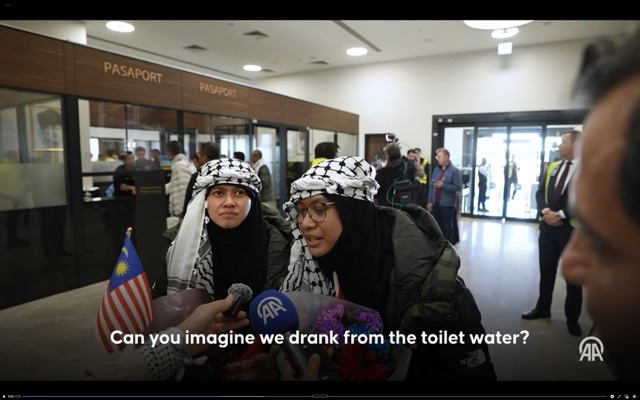
Flush with the applause of thousands waving Palestinian flags and in that shining moment with the eyes of the country's elite on her, she suggested that Malaysia should teach children about Palestine in their school syllabi.
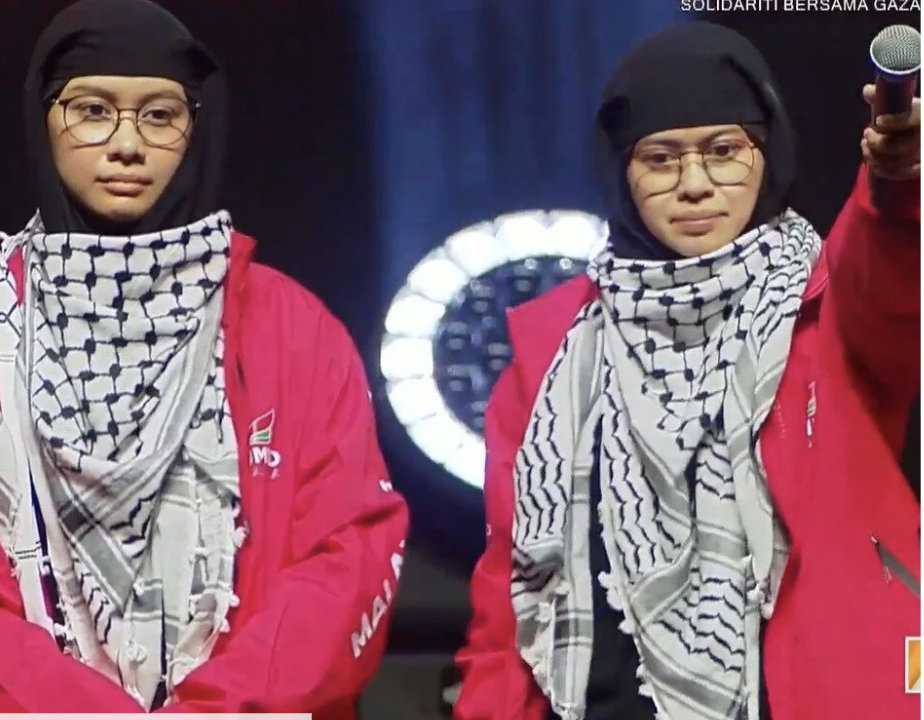
The crowd roared. The Prime Minister nodded. A coterie of elites seemed to mouth their implicit approval with their polite clapping.
The news coverage was rapturous...
Yet... Almost no one paused to ask the question that should have been obvious:
Does this person intend to have our children educated, or indoctrinated?
Since when do we determine what children learn based on who has suffered most recently, and intentionally teach material that is fundamentally not related to Malaysia or the formation of its national identity?
This is not the first time such a proposal has emerged.
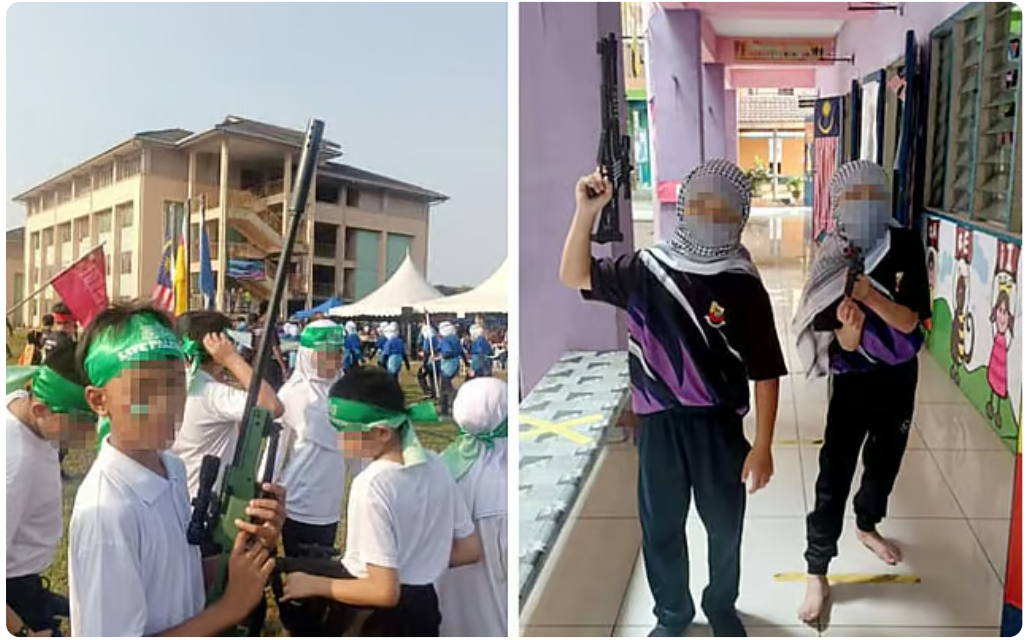
In late October 2023, the Ministry of Education launched "Palestine Solidarity Week" across all schools—an initiative that quickly devolved into scenes of teachers and even worse, children, brandishing toy rifles.
And how did our Education Minister respond to the ensuing criticism?
She began weeping in Parliament, pleading with critics to stop "messing with" her schools after half-heartedly chastising them.
As such, what began as an exercise in "humanitarian values" became a case study in how quickly good intentions can curdle into something else entirely—something performative, divisive, and ultimately harmful to the very students it purported to help.
We, the undersigned, believe our children deserve better. We believe that education is too important, too sacred, and too consequential to be conscripted into political theater.
Schools are for education, not for indoctrination.
And so we call upon the Ministry of Education under Fadhlina Sidek and the government of Malaysia led by Anwar Ibrahim, as well as any future government of Malaysia across time to take the following immediate actions across the long term, in an enduring spirit directed towards educating our children, not indoctrinating them:
ACTION ITEMS:
1. HALT any incorporation of Palestine—or any other international conflict—into the formal school curriculum until a proper, transparent, accessible, and publicly representative consultation process has been completed with parents, teachers, education experts, and diverse community stakeholders.
2. PUBLICLY AFFIRM that Malaysia's national schools exist to educate, not to advocate; to teach critical thinking, not political positions; to prepare students for a complex world, not to conscript them into adult battles, ideally through official statements that explicitly reject indoctrination in lieu of education.
3. ESTABLISH clear, published criteria for how and why international issues are selected for curriculum inclusion, ensuring decisions are made by education professionals based on pedagogical merit, not by politicians responding to pressure campaigns or celebrity advocacy.
4. ACKNOWLEDGE that the Israeli-Palestinian conflict is historically complex, with multiple legitimate perspectives, and that any educational treatment of it—or any conflict—must reflect that complexity rather than presenting a single narrative as unassailable truth.
5. COMMIT to age-appropriate education standards, ensuring that young children are not exposed to content that exceeds their developmental capacity for nuance, critical analysis, and emotional processing.
6. GUARANTEE parental consultation rights for any significant curriculum changes, particularly those involving contested political or historical issues.
7. PROTECT teachers from being placed in untenable positions where they must navigate political minefields without adequate training, resources, or institutional support.
8. ENSURE that if humanitarian issues are taught, they are taught comprehensively—not selectively based on which causes generate the loudest advocacy or align most conveniently with political agendas.
Now, let us be clear about what this petition is not.
It is not a denial of Palestinian suffering. It is not an endorsement of Israeli policy. It is not a claim that children should be sheltered from knowledge of injustice in the world. Children should learn about injustice. They should develop empathy. They should understand that history is complicated and that people suffer in ways that demand our attention and our conscience.
But there is a difference—a crucial, non-negotiable difference—between teaching children how to think and teaching them what to think.
The first is education. The second is indoctrination.
Consider what happened in 2023.
Seventeen civil society organizations raised concerns that children were being dragged into the Middle East crisis without parliamentary discussion or parental consultation, as videos emerged of teachers in balaclavas, wielding toy guns, leading students in chants even as PM Anwar himself assured us that he would keep Palestine solidarity events in check.
Meanwhile, as an earlier petition with over 20,000 signatures emerged from that very same civil society, aiming to Save Our Education System, twelve lawmakers from the ruling coalition itself—the government's own allies—urged the Ministry to ensure schools remained "free from elements of hatred and violence".
This was not a fringe overreaction. This was a reasonable response to a program that had escaped the boundaries of educational propriety.
How interesting that when challenged, the Education Minister did not engage with the concerns. Instead, she wept. She told critics to stop "messing with" her schools, to stop "disturbing" her teachers.
Either way, this is precisely the wrong response.
When parents and educators raise legitimate questions about curriculum content, the appropriate response is not defensiveness or emotional appeal. It is dialogue, transparency, and accountability.
Now, two years later, we are asked to make permanent what was troubling as a temporary program. Heliza Helmi's proposal is that Palestine be woven into the fabric of Malaysian education—not as a one-week awareness exercise, but as a fixed element of what children learn. And she has been explicit about her reasoning: this is about "saudara sesama Islam"—fellow Muslims.
In other words, this is religious solidarity masquerading as universal humanitarianism, even though proponents of the cause repeatedly try to emphasize that this is a humanitarian cause and nothing but a humanitarian cause.
Should the Ministry of Education take up this suggestion, even as it fails to address the humanitarian cause that is racial discrimination and segregation both formal and informal?
What about the apparent lack of oversight over national religious schools, manifested in the Zara Qairina bullying issue that ultimately remains unresolved, even as the Minister seems no closer to ending the problems of communalism, bullying, and sexual abuse that she promised to end in her time?
It is fascinating to watch how the Ministry and our government seem to do exactly the opposite of resolving problems, even as the Minister asks students to wish happy birthday to the Prime Minister, and now, in wake of the rape of a schoolgirl in Melaka, performs actions that have the effect of protecting the perpetrators, even as the Prime Minister blames the incident on a lack of moral education and 'humanity' in the education system while making assumption after misplaced assumption – is this a preparation of the ground for Heliza's proposal? We certainly hope not, especially since it sidestepped the very real issues of moral rot and dysfunction in our education system entirely that exist in all types of schools, religious or not.
This is unacceptable.
Malaysia is a multi-religious nation. Our schools serve Muslim, Christian, Buddhist, Hindu, and Sikh children. They serve children whose parents may have different views on the Middle East, on Israel, on Palestine, on what justice looks like and how it should be pursued. To embed one particular narrative into the curriculum, based on one particular religious solidarity, is to fundamentally misunderstand what public education is supposed to do.
But even if we set aside the religious question, there remains the problem of selectivity.
Why the people of Palestine? Why not the Rohingya, geographically closer and with direct relevance to Malaysia, and whom we have left dry? Why not look to Ukraine? How about Yemen, where the humanitarian catastrophe has been called the worst in the world, or Nigeria, where Christians have been targeted? Why not advocate for the Uyghurs in China, or go out swinging for Sudan, Syria, Somalia, or any other part of the world where suffering calls out rather than perpetually declaring how we had intervened in Bosnia and then continuing on our course with narrow blinders seemingly inhibiting some of us from every other humanitarian crisis in the world beyond sending thoughts and prayers?
If the answer is "because Palestine generates the most passion in Malaysia," then we have admitted that this is about politics, not pedagogy. We are teaching children what to care about based on what their government cares about. That is the opposite of critical thinking.
And let us not pretend this is easy material to teach well.
The Israeli-Palestinian conflict involves contested history going back not just to 1948, not just to the Balfour Declaration of 1917, but to competing claims of indigenous presence, religious significance, and historical trauma that span millennia. It involves questions of terrorism and state violence, of occupation and self-defense, of refugee rights and security concerns. Reasonable people—good people, moral people—disagree profoundly about these questions.
To teach this material responsibly would require extraordinary care. It would require teachers trained in multiple perspectives. It would require acknowledging that history did not begin on October 7, 2023—but it also did not begin in 1948, or 1917, or at any single convenient starting point. It would require resisting the temptation to reduce complexity to slogans. It would require, in short, a level of nuance and intellectual humility that the 2023 Solidarity Week demonstrated the Ministry is currently incapable of maintaining.
Our children are not props.
They are not a captive audience for political messaging. They are not raw material to be molded into activists for causes that adults have decided are important. They are young human beings who deserve an education that equips them to think independently, to evaluate evidence, to understand multiple perspectives, and to form their own considered judgments when they are developmentally ready to do so.
We acknowledge that Heliza Helmi and those who went on the Sumud flotilla have suffered, but suffering does not confer expertise in education policy. Trauma does not grant authority to redesign school curricula. And a crowd's applause is not a substitute for careful, consultative, evidence-based decision-making about what children should learn.
The Ministry of Education has a solemn responsibility: to protect the integrity of education itself. That means protecting it from political capture. It means protecting it from the whims of advocacy campaigns, no matter how sympathetic their cause. It means protecting it from the seductive logic that says, "This issue matters to me, therefore it must be taught to everyone's children."
If the Ministry truly believes this proposal has merit—if it genuinely thinks Palestine should be in the curriculum—then it should have no objection to the transparency we demand. It should welcome parental consultation. It should embrace independent review. It should eagerly publish the criteria by which it judges what international issues merit permanent inclusion. It should want to demonstrate that this is about education, not politics.
But we suspect it will not do these things.
We suspect that, as in 2023, any criticism will be met with accusations of lacking compassion, of not caring about humanitarian issues, of "messing with" schools and teachers. We suspect the Ministry will conflate opposition to its methods with opposition to Palestinian rights—a dishonest conflation designed to shut down legitimate debate.
We consider children's education is too important to be sacrificed on the altar of performative solidarity.
We believe that schools should teach children about the world—all of it, in its full complexity—but they should not be recruiting grounds for political movements, and certainly not considered an issue for 'all' Malaysians or a matter of obligation when in no way is that the case.
We call on the Ministry of Education to do what it should have done from the beginning: put education first. Consult widely. Think carefully. Move slowly. And remember that the children in those classrooms are not yours to mold into whatever political shape you find most convenient. They belong to themselves, and to the future. Our job—yours and ours—is to give them the tools to navigate that future wisely, and this is not the space for either the Education Minister, the Prime Minister, or any politician from any side to go out and make tearful but ultimately unconvincing statements aimed at guilt-tripping or casting aspersions upon members of our community while steamrolling all nuance for their personal beliefs, knowingly violating our children's right to a proper education by dressing up attempts at politicisation as a push for alleged humanitarianism.
There are many who would like to maintain that Palestine is not a political issue and it touches the lives of every Malaysian, although that is in question and it is a matter up for debate.
Well, education is unquestionably an issue that touches the lives of every single Malaysian of every single Malaysian regardless of race or religion; it is an issue that is not in question and is not up for debate.
If you believe that education should be educational, not political—sign this petition. If you believe that children deserve better than to be conscripted into adult battles—sign this petition. If you believe that schools should teach students how to think, not what to think—sign this petition, and share it widely to your respective communities and groups.
Schools are for education, not for indoctrination.
Our children are watching what we do.
Let us show them that we are willing to fight for their right to an education that frees their minds rather than conscripting them into 'solidarity' with the causes of adults who want to use them for their narrow purposes.

2,973
The Issue
On a humid October evening in 2025, at the Axiata Arena in Bukit Jalil, a singer named Heliza Helmi took to the stage and made a proposal (1:50:23 in the linked video). She had just returned from a harrowing ordeal—detained by Israeli forces, allegedly denied food for three days, allegedly reduced to drinking water from a toilet bowl.
Flush with the applause of thousands waving Palestinian flags and in that shining moment with the eyes of the country's elite on her, she suggested that Malaysia should teach children about Palestine in their school syllabi.
The crowd roared. The Prime Minister nodded. A coterie of elites seemed to mouth their implicit approval with their polite clapping.
The news coverage was rapturous...
Yet... Almost no one paused to ask the question that should have been obvious:
Does this person intend to have our children educated, or indoctrinated?
Since when do we determine what children learn based on who has suffered most recently, and intentionally teach material that is fundamentally not related to Malaysia or the formation of its national identity?
This is not the first time such a proposal has emerged.
In late October 2023, the Ministry of Education launched "Palestine Solidarity Week" across all schools—an initiative that quickly devolved into scenes of teachers and even worse, children, brandishing toy rifles.
And how did our Education Minister respond to the ensuing criticism?
She began weeping in Parliament, pleading with critics to stop "messing with" her schools after half-heartedly chastising them.
As such, what began as an exercise in "humanitarian values" became a case study in how quickly good intentions can curdle into something else entirely—something performative, divisive, and ultimately harmful to the very students it purported to help.
We, the undersigned, believe our children deserve better. We believe that education is too important, too sacred, and too consequential to be conscripted into political theater.
Schools are for education, not for indoctrination.
And so we call upon the Ministry of Education under Fadhlina Sidek and the government of Malaysia led by Anwar Ibrahim, as well as any future government of Malaysia across time to take the following immediate actions across the long term, in an enduring spirit directed towards educating our children, not indoctrinating them:
ACTION ITEMS:
1. HALT any incorporation of Palestine—or any other international conflict—into the formal school curriculum until a proper, transparent, accessible, and publicly representative consultation process has been completed with parents, teachers, education experts, and diverse community stakeholders.
2. PUBLICLY AFFIRM that Malaysia's national schools exist to educate, not to advocate; to teach critical thinking, not political positions; to prepare students for a complex world, not to conscript them into adult battles, ideally through official statements that explicitly reject indoctrination in lieu of education.
3. ESTABLISH clear, published criteria for how and why international issues are selected for curriculum inclusion, ensuring decisions are made by education professionals based on pedagogical merit, not by politicians responding to pressure campaigns or celebrity advocacy.
4. ACKNOWLEDGE that the Israeli-Palestinian conflict is historically complex, with multiple legitimate perspectives, and that any educational treatment of it—or any conflict—must reflect that complexity rather than presenting a single narrative as unassailable truth.
5. COMMIT to age-appropriate education standards, ensuring that young children are not exposed to content that exceeds their developmental capacity for nuance, critical analysis, and emotional processing.
6. GUARANTEE parental consultation rights for any significant curriculum changes, particularly those involving contested political or historical issues.
7. PROTECT teachers from being placed in untenable positions where they must navigate political minefields without adequate training, resources, or institutional support.
8. ENSURE that if humanitarian issues are taught, they are taught comprehensively—not selectively based on which causes generate the loudest advocacy or align most conveniently with political agendas.
Now, let us be clear about what this petition is not.
It is not a denial of Palestinian suffering. It is not an endorsement of Israeli policy. It is not a claim that children should be sheltered from knowledge of injustice in the world. Children should learn about injustice. They should develop empathy. They should understand that history is complicated and that people suffer in ways that demand our attention and our conscience.
But there is a difference—a crucial, non-negotiable difference—between teaching children how to think and teaching them what to think.
The first is education. The second is indoctrination.
Consider what happened in 2023.
Seventeen civil society organizations raised concerns that children were being dragged into the Middle East crisis without parliamentary discussion or parental consultation, as videos emerged of teachers in balaclavas, wielding toy guns, leading students in chants even as PM Anwar himself assured us that he would keep Palestine solidarity events in check.
Meanwhile, as an earlier petition with over 20,000 signatures emerged from that very same civil society, aiming to Save Our Education System, twelve lawmakers from the ruling coalition itself—the government's own allies—urged the Ministry to ensure schools remained "free from elements of hatred and violence".
This was not a fringe overreaction. This was a reasonable response to a program that had escaped the boundaries of educational propriety.
How interesting that when challenged, the Education Minister did not engage with the concerns. Instead, she wept. She told critics to stop "messing with" her schools, to stop "disturbing" her teachers.
Either way, this is precisely the wrong response.
When parents and educators raise legitimate questions about curriculum content, the appropriate response is not defensiveness or emotional appeal. It is dialogue, transparency, and accountability.
Now, two years later, we are asked to make permanent what was troubling as a temporary program. Heliza Helmi's proposal is that Palestine be woven into the fabric of Malaysian education—not as a one-week awareness exercise, but as a fixed element of what children learn. And she has been explicit about her reasoning: this is about "saudara sesama Islam"—fellow Muslims.
In other words, this is religious solidarity masquerading as universal humanitarianism, even though proponents of the cause repeatedly try to emphasize that this is a humanitarian cause and nothing but a humanitarian cause.
Should the Ministry of Education take up this suggestion, even as it fails to address the humanitarian cause that is racial discrimination and segregation both formal and informal?
What about the apparent lack of oversight over national religious schools, manifested in the Zara Qairina bullying issue that ultimately remains unresolved, even as the Minister seems no closer to ending the problems of communalism, bullying, and sexual abuse that she promised to end in her time?
It is fascinating to watch how the Ministry and our government seem to do exactly the opposite of resolving problems, even as the Minister asks students to wish happy birthday to the Prime Minister, and now, in wake of the rape of a schoolgirl in Melaka, performs actions that have the effect of protecting the perpetrators, even as the Prime Minister blames the incident on a lack of moral education and 'humanity' in the education system while making assumption after misplaced assumption – is this a preparation of the ground for Heliza's proposal? We certainly hope not, especially since it sidestepped the very real issues of moral rot and dysfunction in our education system entirely that exist in all types of schools, religious or not.
This is unacceptable.
Malaysia is a multi-religious nation. Our schools serve Muslim, Christian, Buddhist, Hindu, and Sikh children. They serve children whose parents may have different views on the Middle East, on Israel, on Palestine, on what justice looks like and how it should be pursued. To embed one particular narrative into the curriculum, based on one particular religious solidarity, is to fundamentally misunderstand what public education is supposed to do.
But even if we set aside the religious question, there remains the problem of selectivity.
Why the people of Palestine? Why not the Rohingya, geographically closer and with direct relevance to Malaysia, and whom we have left dry? Why not look to Ukraine? How about Yemen, where the humanitarian catastrophe has been called the worst in the world, or Nigeria, where Christians have been targeted? Why not advocate for the Uyghurs in China, or go out swinging for Sudan, Syria, Somalia, or any other part of the world where suffering calls out rather than perpetually declaring how we had intervened in Bosnia and then continuing on our course with narrow blinders seemingly inhibiting some of us from every other humanitarian crisis in the world beyond sending thoughts and prayers?
If the answer is "because Palestine generates the most passion in Malaysia," then we have admitted that this is about politics, not pedagogy. We are teaching children what to care about based on what their government cares about. That is the opposite of critical thinking.
And let us not pretend this is easy material to teach well.
The Israeli-Palestinian conflict involves contested history going back not just to 1948, not just to the Balfour Declaration of 1917, but to competing claims of indigenous presence, religious significance, and historical trauma that span millennia. It involves questions of terrorism and state violence, of occupation and self-defense, of refugee rights and security concerns. Reasonable people—good people, moral people—disagree profoundly about these questions.
To teach this material responsibly would require extraordinary care. It would require teachers trained in multiple perspectives. It would require acknowledging that history did not begin on October 7, 2023—but it also did not begin in 1948, or 1917, or at any single convenient starting point. It would require resisting the temptation to reduce complexity to slogans. It would require, in short, a level of nuance and intellectual humility that the 2023 Solidarity Week demonstrated the Ministry is currently incapable of maintaining.
Our children are not props.
They are not a captive audience for political messaging. They are not raw material to be molded into activists for causes that adults have decided are important. They are young human beings who deserve an education that equips them to think independently, to evaluate evidence, to understand multiple perspectives, and to form their own considered judgments when they are developmentally ready to do so.
We acknowledge that Heliza Helmi and those who went on the Sumud flotilla have suffered, but suffering does not confer expertise in education policy. Trauma does not grant authority to redesign school curricula. And a crowd's applause is not a substitute for careful, consultative, evidence-based decision-making about what children should learn.
The Ministry of Education has a solemn responsibility: to protect the integrity of education itself. That means protecting it from political capture. It means protecting it from the whims of advocacy campaigns, no matter how sympathetic their cause. It means protecting it from the seductive logic that says, "This issue matters to me, therefore it must be taught to everyone's children."
If the Ministry truly believes this proposal has merit—if it genuinely thinks Palestine should be in the curriculum—then it should have no objection to the transparency we demand. It should welcome parental consultation. It should embrace independent review. It should eagerly publish the criteria by which it judges what international issues merit permanent inclusion. It should want to demonstrate that this is about education, not politics.
But we suspect it will not do these things.
We suspect that, as in 2023, any criticism will be met with accusations of lacking compassion, of not caring about humanitarian issues, of "messing with" schools and teachers. We suspect the Ministry will conflate opposition to its methods with opposition to Palestinian rights—a dishonest conflation designed to shut down legitimate debate.
We consider children's education is too important to be sacrificed on the altar of performative solidarity.
We believe that schools should teach children about the world—all of it, in its full complexity—but they should not be recruiting grounds for political movements, and certainly not considered an issue for 'all' Malaysians or a matter of obligation when in no way is that the case.
We call on the Ministry of Education to do what it should have done from the beginning: put education first. Consult widely. Think carefully. Move slowly. And remember that the children in those classrooms are not yours to mold into whatever political shape you find most convenient. They belong to themselves, and to the future. Our job—yours and ours—is to give them the tools to navigate that future wisely, and this is not the space for either the Education Minister, the Prime Minister, or any politician from any side to go out and make tearful but ultimately unconvincing statements aimed at guilt-tripping or casting aspersions upon members of our community while steamrolling all nuance for their personal beliefs, knowingly violating our children's right to a proper education by dressing up attempts at politicisation as a push for alleged humanitarianism.
There are many who would like to maintain that Palestine is not a political issue and it touches the lives of every Malaysian, although that is in question and it is a matter up for debate.
Well, education is unquestionably an issue that touches the lives of every single Malaysian of every single Malaysian regardless of race or religion; it is an issue that is not in question and is not up for debate.
If you believe that education should be educational, not political—sign this petition. If you believe that children deserve better than to be conscripted into adult battles—sign this petition. If you believe that schools should teach students how to think, not what to think—sign this petition, and share it widely to your respective communities and groups.
Schools are for education, not for indoctrination.
Our children are watching what we do.
Let us show them that we are willing to fight for their right to an education that frees their minds rather than conscripting them into 'solidarity' with the causes of adults who want to use them for their narrow purposes.
The Decision Makers

Supporter Voices
Petition Updates
Share this petition
Petition created on 10 October 2025