
Royal Commission into AHPRA/National Boards; No-Fault Support for Patients Harmed by Care
The issue
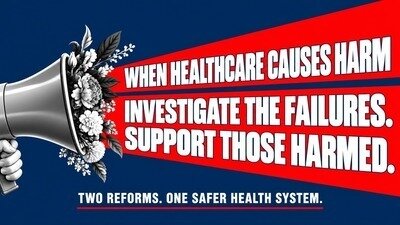
When healthcare causes serious harm, patients and families should not be forced to fight the very systems intended to protect them.
The human cost of regulatory failure.
Behind every notification of medical harm is a patient, a family and a life that may have been permanently changed. Some families have lost loved ones. Others are living with permanent disability, chronic pain, trauma, lost income and lifelong costs after unsafe, negligent or preventable healthcare harm.
When serious concerns are not properly investigated, evidence is overlooked or repeated warnings are treated as isolated events, the risk remains in the healthcare system. Another patient can then experience the same harm.
This is the cycle Australia must break: harm occurs, concerns are reported, meaningful action is not taken, warning signs are missed and another patient suffers. Regulatory failure is not merely an administrative problem. It can mean another permanent disability, another family left searching for answers or another preventable death.
This petition makes two separate but connected requests.
Request 1: Establish an independent Royal Commission into AHPRA, the National Boards and Australia’s broader health-practitioner regulation, patient-safety and regulatory oversight systems.
Request 2: Develop a national, no-fault treatment-injury support and compensation pathway, informed by New Zealand’s ACC model, for patients who suffer qualifying injuries caused by healthcare.
These reforms have different purposes.
The Royal Commission would investigate regulatory failures, determine why they occurred and identify who was responsible.
The no-fault system would provide practical, needed support to injured patients without requiring them to first prove negligence through lengthy and expensive litigation. Australia needs both accountability and support. An injured patient should not have to win a years-long legal contest about fault before receiving essential help—especially when timely treatment and support may determine their best chance of recovery, independence and quality of life.
Patients depend on health regulators to act appropriately when serious harm, misconduct or unsafe practice is reported. Practitioners depend on the same system to make competent, fair, timely and evidence-based decisions that can profoundly affect their careers, livelihoods and reputations.
Both patients and practitioners have raised repeated and ongoing concerns about Australia’s health-practitioner regulatory system. This should not be patients against practitioners. Both groups deserve a regulator worthy of their trust.
Why a Royal Commission is needed:
Patients who report serious healthcare harm can face a confusing “complaints merry-go-round” involving AHPRA, the National Boards, health complaints bodies, hospitals, insurers, employers and legal processes.
Each organisation may address only one part of the problem. Responsibility can be redirected between agencies, evidence may not be shared effectively and patients are left without a clear explanation of what occurred or why action wasn't taken to prevent further harm.
Many patients enter these processes while injured, traumatised, unable to work or experiencing financial hardship. They may be required to recount the same events repeatedly while attempting to understand complex regulatory thresholds without independent assistance. Some patients eventually disengage.
Others never report what happened because they anticipate further trauma and have little confidence that the process will be fair.
The scale and cost of patient harm research published in BMJ Open in 2024 estimated that patient-safety incidents are associated with at least 10% of Australian hospital admissions and cost approximately $4.1 billion annually—around 8.9% of hospital expenditure. The research reported that more than half of adverse events may be preventable.
The Medical Board of Australia’s 2023–24 annual summary reported that 61.3% of notifications concerning medical practitioners were finalised with no further regulatory action, including matters where the practitioner had already taken steps to address the concerns.
A decision to take no further regulatory action does not necessarily establish that no harm occurred, that the patient’s concerns lacked merit, or that the underlying safety issue has been identified and corrected.
Who independently investigates the regulator?
AHPRA is not a Commonwealth government department, and neither AHPRA nor the National Boards were established under Commonwealth legislation. They were created under the Health Practitioner Regulation National Law, which is not Commonwealth law but legislation enacted in each state and territory through a national adoption-of-laws model. This structure distributes authority and responsibility across AHPRA, numerous National Boards and multiple governments. A Royal Commission should examine whether this fragmentation has created accountability gaps, enabled responsibility to be shifted between bodies and left serious regulatory failures without a clear, effective remedy.
The National Health Practitioner Ombudsman cannot simply overturn an AHPRA regulatory decision or substitute the outcome sought by a patient. When patients cannot independently verify what evidence was reviewed, including through Freedom of Information requests, how conflicting accounts were assessed or why a matter did not progress, referring them between existing bodies does not necessarily provide independent scrutiny of the original decision.
Australians should be able to answer a simple question: Who independently investigates the regulator?
Who is handling notifications and assessing evidence?
The level of qualification, experience, training and clinical understanding required of people involved in regulatory processes should be independently examined. AHPRA’s own recruitment material has advertised certain roles involved in regulatory processes without making qualifications or previous experience mandatory. This does not mean that every AHPRA employee is unqualified. It raises a legitimate question about whether appropriate minimum standards exist for every role that handles notifications, assesses evidence or influences regulatory outcomes.
A Royal Commission should examine:
Who receives and triages notifications.
Who selects, reviews and assesses evidence.
What qualifications, experience and training each role requires.
What authority different staff members exercise.
What clinical and legal supervision is provided.
How errors, misunderstandings and incomplete evidence assessments are identified and corrected.
Is patient evidence being properly considered?
Patients have raised concerns that evidence may not always be fully reviewed or independently verified before decisions are made. Practitioner responses are an essential part of procedural fairness. However, where facts are disputed, those responses should be tested against clinical records, documentation, independent expertise and other available evidence. A practitioner’s explanation should not automatically outweigh documented evidence merely because it comes from a registered professional.
Patients should receive meaningful reasons explaining:
What evidence was reviewed.
What investigative steps were undertaken.
What evidentiary threshold was applied.
How conflicting evidence was assessed.
Why one account was preferred over another.
What determined regulatory action or no action.
How the patient’s submitted evidence affected the final decision.
Are patterns and warning signs being connected?
The regulatory system must be capable of identifying patterns before more patients are harmed.
A Royal Commission should investigate whether regulators adequately connect and act upon:
Repeated notifications involving the same practitioner or organisation.
Repeated allegations of serious injury, misconduct or unsafe practice.
Coronial findings, recommendations and other formal warnings.
Information held by hospitals, employers, insurers and complaints bodies.
Previous regulatory outcomes and emerging patterns of risk.
Evidence suggesting systemic rather than isolated failures.
Serious concerns should not be considered only as disconnected individual events when the combined information may reveal an ongoing risk to the public.
Structural conflicts, governance and independence:
AHPRA’s regulatory activities are funded primarily through fees paid by registered health practitioners. That fact does not itself prove improper decision-making. However, where the regulated professions provide the principal funding for their regulator, perceived or potential institutional conflicts and their effect on public confidence are legitimate matters for independent examination. A Royal Commission should examine funding, governance, professional representation, National Board decision-making and whether actual, perceived or potential bias, institutional incentives, professional loyalty or inadequate separation of functions could influence regulatory outcomes. Clinical practitioners can provide necessary expert knowledge without being placed in a position where professional bias or peer protection could affect final decision-making.
AHPRA recently invited patients and practitioners to complete a five-minute survey asking about “safe care, compassion, respect?” These are not optional preferences that require a survey. They should be basic expectations of every healthcare and regulatory system.
When patients and practitioners responded with critical written feedback on AHPRA’s social-media posts, comments that had been publicly visible were subsequently hidden and deleted by the regulator. Evidence of these removals has been retained.
A regulator cannot credibly claim to seek public feedback while removing critical responses from public view. Deleting criticism does not address the experiences being reported. It raises serious questions about transparency, institutional defensiveness, moderation practices and whether public consultation is being used to identify failures or manage public perception. It further demonstrates why AHPRA and the National Boards cannot be left to assess their own performance without genuinely independent scrutiny.
Existing reforms are not enough.
Reform and accountability are not the same thing. Existing reforms may improve parts of the National Scheme and administrative hurdles like lengthy wait-times, but changing future processes does not establish whether serious failures occurred previously, why they occurred, whether warning signs were missed, whether people were harmed as a result, or whether existing oversight failed to detect those problems. Reforms focused on efficiency, practitioner wellbeing, workforce pressures or reducing regulatory burden must not come at the expense of investigating patient harm, dismissed complaints, repeated safety concerns and failures to act.
Only a genuinely independent inquiry can examine the system as a whole, compel relevant evidence, hear from affected people and create an authoritative public record. Its work must not be limited to recommending further adjustments to the existing system. The Royal Commission should determine whether AHPRA, the National Boards and the current National Scheme are fit for purpose. If they are not, it should recommend dismantling and replacing the existing regulatory model with a more effective and efficient national regulator with qualified decision-makers, clear lines of accountability, transparent evidence handling, enforceable duties and genuinely independent oversight. Efficiency must never come at the expense of thorough investigation, practitioner fairness or patient safety.
Practitioners and regulatory staff must also be able to speak safely.
Patient safety depends upon healthcare practitioners and regulatory staff being able to report unsafe care, institutional failures and regulatory wrongdoing. AHPRA’s Public Interest Disclosure Policy allows anonymous reports through an external hotline and offers certain protections against detrimental action. However, AHPRA acknowledges that public-interest disclosure legislation does not apply to AHPRA and the National Boards consistently across every state and territory and that some legal protections may therefore be unavailable. An internal policy does not provide a nationally enforceable guarantee that:
A person’s identity will remain protected.
Their employer will not infer who made the disclosure.
They will not be dismissed, demoted, isolated or professionally disadvantaged.
Their reputation or future employment will not be harmed.
They will have effective remedies if retaliation occurs.
Practitioners should not have to choose between protecting patients and protecting their own careers.
Proposed Royal Commission Terms of Reference.
The Royal Commission should examine:
Patient safety and practitioner fairness.
AHPRA, National Board and broader National Scheme governance.
Notification and complaint handling.
Serious and repeated healthcare harm.
Evidence selection, handling, assessment and independent verification.
Evidentiary thresholds for regulatory action and no action.
Transparency and adequacy of reasons for decisions.
Staff qualifications, experience, competency, training and supervision.
Identification of repeat-practitioner and systemic risks.
Treatment of coronial findings and other formal warnings.
Actual, perceived and potential bias or conflicts of interest.
Funding structures and institutional incentives.
Professional influence within regulatory decision-making.
The effectiveness and independence of existing oversight bodies.
Trauma-informed complaint handling.
Barriers preventing traumatised, disabled or vulnerable patients from participating.
National data collection and public reporting of serious healthcare harm.
Whether the existing regulatory model is fit for purpose and, if it is not, options for its abolition and replacement with a more effective, efficient, independent and publicly accountable national regulator.
Nationally consistent and legally enforceable whistle-blower protections.
Accountability for regulatory and systemic failures.
REQUEST 2: A NO-FAULT TREATMENT-INJURY SUPPORT SYSTEM
Regulatory reform alone will not provide practical assistance to people already living with the consequences of healthcare-related injury. Under the current system, injured patients may have to prove negligence through expensive and adversarial legal proceedings before receiving compensation. Many cannot access representation where legal costs are high, causation is medically complex or the potential damages are considered insufficient to justify litigation. This can leave patients and families carrying the costs of treatment, rehabilitation, disability, lost income, home assistance and psychological harm—even where an injury arose during healthcare.
Australia should establish a nationally consistent treatment-injury pathway informed by New Zealand’s ACC model and designed for Australia’s healthcare, disability, legal and compensation systems. Eligibility should focus on whether healthcare caused a qualifying injury under clear statutory criteria, rather than requiring every injured patient to prove that an individual practitioner was negligent.
This would not mean that every poor outcome, known risk or progression of an underlying condition would automatically qualify. Fair eligibility requirements and exclusions would need to be established through legislation, independent expert advice and meaningful public consultation. Depending on the nature and severity of an injury, support could include:
Necessary treatment and rehabilitation.
Psychological support.
Income assistance.
Disability and home-support services.
Assistance with injury-related expenses.
Long-term support for permanent impairment.
Support for families and dependants following death or catastrophic injury.
Support must not replace accountability
A no-fault pathway must not prevent the investigation of unsafe practice, professional misconduct, reckless conduct, concealment or systemic failure. Providing support to an injured patient and determining whether regulatory action is necessary are different functions. Australia must be capable of doing both.
De-identified information from treatment-injury claims should contribute to national patient-safety data so recurring problems can be recognised and prevented, with safeguards for privacy and procedural fairness.
We call upon the Australian Government and all state and territory governments to:
Request 1 — Royal Commission
Establish an independent Royal Commission into AHPRA, the National Boards and Australia’s health-practitioner regulatory, oversight and patient-safety systems, with sufficiently broad Terms of Reference to examine the concerns identified in this petition.
Request 2 — No-fault patient support
Make a firm public commitment to design and establish a nationally consistent, no-fault treatment-injury support and compensation pathway, informed by New Zealand’s ACC model.
We also ask governments to:
Consult patients, families, practitioners, whistle-blowers, advocates, researchers and independent clinical and legal experts.
Protect meaningful patient participation through accessible and trauma-informed processes.
Ensure that receiving no-fault support does not prevent regulatory investigation or accountability.
Publish clear development and implementation timetables.
Respond publicly to the Royal Commission’s findings and recommendations.
Patients should not have to become investigators, lawyers and campaigners simply to understand what happened to them. Practitioners should not have to risk their livelihoods to protect patients. People injured through healthcare should not be left without assistance because they cannot afford to prove negligence in court.
Australia can create a system that learns from harm, supports injured people, protects those who speak up and holds institutions to account.
Please sign and share this petition calling for both an independent Royal Commission and an Australian no-fault treatment-injury support and compensation pathway.
Read the complete supporting proposal, evidence and proposed reforms here:
https://drive.google.com/file/d/1gfr-jJQYk7v-14wicZu5mTtCONneH9mE/view?usp=drive_link
Prepared and lodged by Maddison Teigan.
Patient advocate

210
The issue
When healthcare causes serious harm, patients and families should not be forced to fight the very systems intended to protect them.
The human cost of regulatory failure.
Behind every notification of medical harm is a patient, a family and a life that may have been permanently changed. Some families have lost loved ones. Others are living with permanent disability, chronic pain, trauma, lost income and lifelong costs after unsafe, negligent or preventable healthcare harm.
When serious concerns are not properly investigated, evidence is overlooked or repeated warnings are treated as isolated events, the risk remains in the healthcare system. Another patient can then experience the same harm.
This is the cycle Australia must break: harm occurs, concerns are reported, meaningful action is not taken, warning signs are missed and another patient suffers. Regulatory failure is not merely an administrative problem. It can mean another permanent disability, another family left searching for answers or another preventable death.
This petition makes two separate but connected requests.
Request 1: Establish an independent Royal Commission into AHPRA, the National Boards and Australia’s broader health-practitioner regulation, patient-safety and regulatory oversight systems.
Request 2: Develop a national, no-fault treatment-injury support and compensation pathway, informed by New Zealand’s ACC model, for patients who suffer qualifying injuries caused by healthcare.
These reforms have different purposes.
The Royal Commission would investigate regulatory failures, determine why they occurred and identify who was responsible.
The no-fault system would provide practical, needed support to injured patients without requiring them to first prove negligence through lengthy and expensive litigation. Australia needs both accountability and support. An injured patient should not have to win a years-long legal contest about fault before receiving essential help—especially when timely treatment and support may determine their best chance of recovery, independence and quality of life.
Patients depend on health regulators to act appropriately when serious harm, misconduct or unsafe practice is reported. Practitioners depend on the same system to make competent, fair, timely and evidence-based decisions that can profoundly affect their careers, livelihoods and reputations.
Both patients and practitioners have raised repeated and ongoing concerns about Australia’s health-practitioner regulatory system. This should not be patients against practitioners. Both groups deserve a regulator worthy of their trust.
Why a Royal Commission is needed:
Patients who report serious healthcare harm can face a confusing “complaints merry-go-round” involving AHPRA, the National Boards, health complaints bodies, hospitals, insurers, employers and legal processes.
Each organisation may address only one part of the problem. Responsibility can be redirected between agencies, evidence may not be shared effectively and patients are left without a clear explanation of what occurred or why action wasn't taken to prevent further harm.
Many patients enter these processes while injured, traumatised, unable to work or experiencing financial hardship. They may be required to recount the same events repeatedly while attempting to understand complex regulatory thresholds without independent assistance. Some patients eventually disengage.
Others never report what happened because they anticipate further trauma and have little confidence that the process will be fair.
The scale and cost of patient harm research published in BMJ Open in 2024 estimated that patient-safety incidents are associated with at least 10% of Australian hospital admissions and cost approximately $4.1 billion annually—around 8.9% of hospital expenditure. The research reported that more than half of adverse events may be preventable.
The Medical Board of Australia’s 2023–24 annual summary reported that 61.3% of notifications concerning medical practitioners were finalised with no further regulatory action, including matters where the practitioner had already taken steps to address the concerns.
A decision to take no further regulatory action does not necessarily establish that no harm occurred, that the patient’s concerns lacked merit, or that the underlying safety issue has been identified and corrected.
Who independently investigates the regulator?
AHPRA is not a Commonwealth government department, and neither AHPRA nor the National Boards were established under Commonwealth legislation. They were created under the Health Practitioner Regulation National Law, which is not Commonwealth law but legislation enacted in each state and territory through a national adoption-of-laws model. This structure distributes authority and responsibility across AHPRA, numerous National Boards and multiple governments. A Royal Commission should examine whether this fragmentation has created accountability gaps, enabled responsibility to be shifted between bodies and left serious regulatory failures without a clear, effective remedy.
The National Health Practitioner Ombudsman cannot simply overturn an AHPRA regulatory decision or substitute the outcome sought by a patient. When patients cannot independently verify what evidence was reviewed, including through Freedom of Information requests, how conflicting accounts were assessed or why a matter did not progress, referring them between existing bodies does not necessarily provide independent scrutiny of the original decision.
Australians should be able to answer a simple question: Who independently investigates the regulator?
Who is handling notifications and assessing evidence?
The level of qualification, experience, training and clinical understanding required of people involved in regulatory processes should be independently examined. AHPRA’s own recruitment material has advertised certain roles involved in regulatory processes without making qualifications or previous experience mandatory. This does not mean that every AHPRA employee is unqualified. It raises a legitimate question about whether appropriate minimum standards exist for every role that handles notifications, assesses evidence or influences regulatory outcomes.
A Royal Commission should examine:
Who receives and triages notifications.
Who selects, reviews and assesses evidence.
What qualifications, experience and training each role requires.
What authority different staff members exercise.
What clinical and legal supervision is provided.
How errors, misunderstandings and incomplete evidence assessments are identified and corrected.
Is patient evidence being properly considered?
Patients have raised concerns that evidence may not always be fully reviewed or independently verified before decisions are made. Practitioner responses are an essential part of procedural fairness. However, where facts are disputed, those responses should be tested against clinical records, documentation, independent expertise and other available evidence. A practitioner’s explanation should not automatically outweigh documented evidence merely because it comes from a registered professional.
Patients should receive meaningful reasons explaining:
What evidence was reviewed.
What investigative steps were undertaken.
What evidentiary threshold was applied.
How conflicting evidence was assessed.
Why one account was preferred over another.
What determined regulatory action or no action.
How the patient’s submitted evidence affected the final decision.
Are patterns and warning signs being connected?
The regulatory system must be capable of identifying patterns before more patients are harmed.
A Royal Commission should investigate whether regulators adequately connect and act upon:
Repeated notifications involving the same practitioner or organisation.
Repeated allegations of serious injury, misconduct or unsafe practice.
Coronial findings, recommendations and other formal warnings.
Information held by hospitals, employers, insurers and complaints bodies.
Previous regulatory outcomes and emerging patterns of risk.
Evidence suggesting systemic rather than isolated failures.
Serious concerns should not be considered only as disconnected individual events when the combined information may reveal an ongoing risk to the public.
Structural conflicts, governance and independence:
AHPRA’s regulatory activities are funded primarily through fees paid by registered health practitioners. That fact does not itself prove improper decision-making. However, where the regulated professions provide the principal funding for their regulator, perceived or potential institutional conflicts and their effect on public confidence are legitimate matters for independent examination. A Royal Commission should examine funding, governance, professional representation, National Board decision-making and whether actual, perceived or potential bias, institutional incentives, professional loyalty or inadequate separation of functions could influence regulatory outcomes. Clinical practitioners can provide necessary expert knowledge without being placed in a position where professional bias or peer protection could affect final decision-making.
AHPRA recently invited patients and practitioners to complete a five-minute survey asking about “safe care, compassion, respect?” These are not optional preferences that require a survey. They should be basic expectations of every healthcare and regulatory system.
When patients and practitioners responded with critical written feedback on AHPRA’s social-media posts, comments that had been publicly visible were subsequently hidden and deleted by the regulator. Evidence of these removals has been retained.
A regulator cannot credibly claim to seek public feedback while removing critical responses from public view. Deleting criticism does not address the experiences being reported. It raises serious questions about transparency, institutional defensiveness, moderation practices and whether public consultation is being used to identify failures or manage public perception. It further demonstrates why AHPRA and the National Boards cannot be left to assess their own performance without genuinely independent scrutiny.
Existing reforms are not enough.
Reform and accountability are not the same thing. Existing reforms may improve parts of the National Scheme and administrative hurdles like lengthy wait-times, but changing future processes does not establish whether serious failures occurred previously, why they occurred, whether warning signs were missed, whether people were harmed as a result, or whether existing oversight failed to detect those problems. Reforms focused on efficiency, practitioner wellbeing, workforce pressures or reducing regulatory burden must not come at the expense of investigating patient harm, dismissed complaints, repeated safety concerns and failures to act.
Only a genuinely independent inquiry can examine the system as a whole, compel relevant evidence, hear from affected people and create an authoritative public record. Its work must not be limited to recommending further adjustments to the existing system. The Royal Commission should determine whether AHPRA, the National Boards and the current National Scheme are fit for purpose. If they are not, it should recommend dismantling and replacing the existing regulatory model with a more effective and efficient national regulator with qualified decision-makers, clear lines of accountability, transparent evidence handling, enforceable duties and genuinely independent oversight. Efficiency must never come at the expense of thorough investigation, practitioner fairness or patient safety.
Practitioners and regulatory staff must also be able to speak safely.
Patient safety depends upon healthcare practitioners and regulatory staff being able to report unsafe care, institutional failures and regulatory wrongdoing. AHPRA’s Public Interest Disclosure Policy allows anonymous reports through an external hotline and offers certain protections against detrimental action. However, AHPRA acknowledges that public-interest disclosure legislation does not apply to AHPRA and the National Boards consistently across every state and territory and that some legal protections may therefore be unavailable. An internal policy does not provide a nationally enforceable guarantee that:
A person’s identity will remain protected.
Their employer will not infer who made the disclosure.
They will not be dismissed, demoted, isolated or professionally disadvantaged.
Their reputation or future employment will not be harmed.
They will have effective remedies if retaliation occurs.
Practitioners should not have to choose between protecting patients and protecting their own careers.
Proposed Royal Commission Terms of Reference.
The Royal Commission should examine:
Patient safety and practitioner fairness.
AHPRA, National Board and broader National Scheme governance.
Notification and complaint handling.
Serious and repeated healthcare harm.
Evidence selection, handling, assessment and independent verification.
Evidentiary thresholds for regulatory action and no action.
Transparency and adequacy of reasons for decisions.
Staff qualifications, experience, competency, training and supervision.
Identification of repeat-practitioner and systemic risks.
Treatment of coronial findings and other formal warnings.
Actual, perceived and potential bias or conflicts of interest.
Funding structures and institutional incentives.
Professional influence within regulatory decision-making.
The effectiveness and independence of existing oversight bodies.
Trauma-informed complaint handling.
Barriers preventing traumatised, disabled or vulnerable patients from participating.
National data collection and public reporting of serious healthcare harm.
Whether the existing regulatory model is fit for purpose and, if it is not, options for its abolition and replacement with a more effective, efficient, independent and publicly accountable national regulator.
Nationally consistent and legally enforceable whistle-blower protections.
Accountability for regulatory and systemic failures.
REQUEST 2: A NO-FAULT TREATMENT-INJURY SUPPORT SYSTEM
Regulatory reform alone will not provide practical assistance to people already living with the consequences of healthcare-related injury. Under the current system, injured patients may have to prove negligence through expensive and adversarial legal proceedings before receiving compensation. Many cannot access representation where legal costs are high, causation is medically complex or the potential damages are considered insufficient to justify litigation. This can leave patients and families carrying the costs of treatment, rehabilitation, disability, lost income, home assistance and psychological harm—even where an injury arose during healthcare.
Australia should establish a nationally consistent treatment-injury pathway informed by New Zealand’s ACC model and designed for Australia’s healthcare, disability, legal and compensation systems. Eligibility should focus on whether healthcare caused a qualifying injury under clear statutory criteria, rather than requiring every injured patient to prove that an individual practitioner was negligent.
This would not mean that every poor outcome, known risk or progression of an underlying condition would automatically qualify. Fair eligibility requirements and exclusions would need to be established through legislation, independent expert advice and meaningful public consultation. Depending on the nature and severity of an injury, support could include:
Necessary treatment and rehabilitation.
Psychological support.
Income assistance.
Disability and home-support services.
Assistance with injury-related expenses.
Long-term support for permanent impairment.
Support for families and dependants following death or catastrophic injury.
Support must not replace accountability
A no-fault pathway must not prevent the investigation of unsafe practice, professional misconduct, reckless conduct, concealment or systemic failure. Providing support to an injured patient and determining whether regulatory action is necessary are different functions. Australia must be capable of doing both.
De-identified information from treatment-injury claims should contribute to national patient-safety data so recurring problems can be recognised and prevented, with safeguards for privacy and procedural fairness.
We call upon the Australian Government and all state and territory governments to:
Request 1 — Royal Commission
Establish an independent Royal Commission into AHPRA, the National Boards and Australia’s health-practitioner regulatory, oversight and patient-safety systems, with sufficiently broad Terms of Reference to examine the concerns identified in this petition.
Request 2 — No-fault patient support
Make a firm public commitment to design and establish a nationally consistent, no-fault treatment-injury support and compensation pathway, informed by New Zealand’s ACC model.
We also ask governments to:
Consult patients, families, practitioners, whistle-blowers, advocates, researchers and independent clinical and legal experts.
Protect meaningful patient participation through accessible and trauma-informed processes.
Ensure that receiving no-fault support does not prevent regulatory investigation or accountability.
Publish clear development and implementation timetables.
Respond publicly to the Royal Commission’s findings and recommendations.
Patients should not have to become investigators, lawyers and campaigners simply to understand what happened to them. Practitioners should not have to risk their livelihoods to protect patients. People injured through healthcare should not be left without assistance because they cannot afford to prove negligence in court.
Australia can create a system that learns from harm, supports injured people, protects those who speak up and holds institutions to account.
Please sign and share this petition calling for both an independent Royal Commission and an Australian no-fault treatment-injury support and compensation pathway.
Read the complete supporting proposal, evidence and proposed reforms here:
https://drive.google.com/file/d/1gfr-jJQYk7v-14wicZu5mTtCONneH9mE/view?usp=drive_link
Prepared and lodged by Maddison Teigan.
Patient advocate
Supporter voices
Petition Updates
Share this petition
Petition created on 20 September 2026