

Reject and Stop the Signing of the Pax Silica Treaty in November
The Issue
STOP THE PAX SILICA SIGNING: Protect Filipino Communities, Water, and Health
Our government is about to sign away our water, our air, and our electric bills — without asking us first.
Before the year ends, the Philippine government intends to sign the Pax Silica framework agreement, greenlighting a massive AI and semiconductor data center hub in New Clark City. We are told this is "progress." What we are not being told is what similar projects have already done to communities around the world — and what they will do to ours.
We, the undersigned, call on the Philippine government to halt the signing of the Pax Silica agreement until a full, independent, and public environmental, health, and economic impact review is conducted — with real consultation with the communities who will live next to this hub.
Here is what the evidence shows, from countries who already have these facilities:
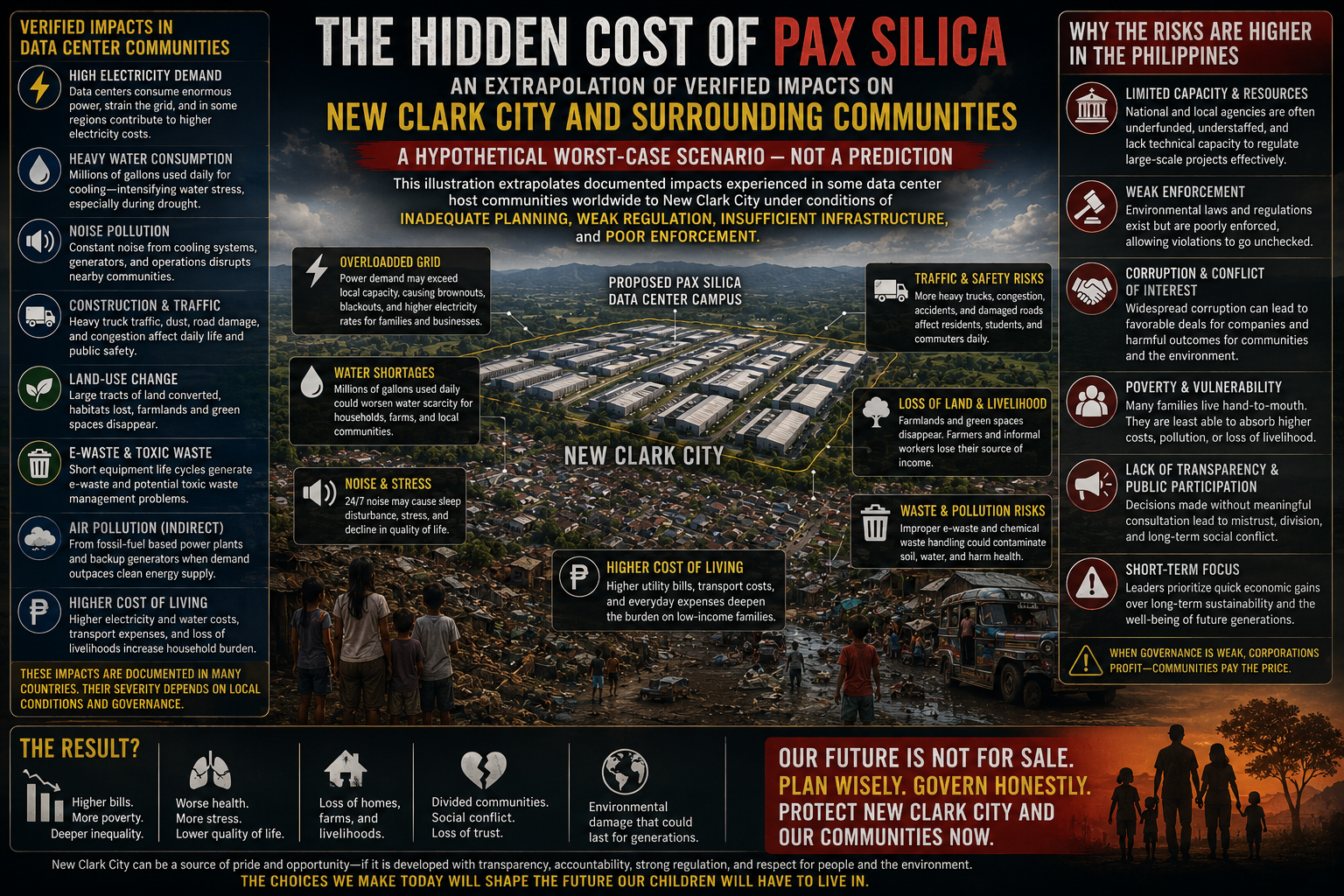
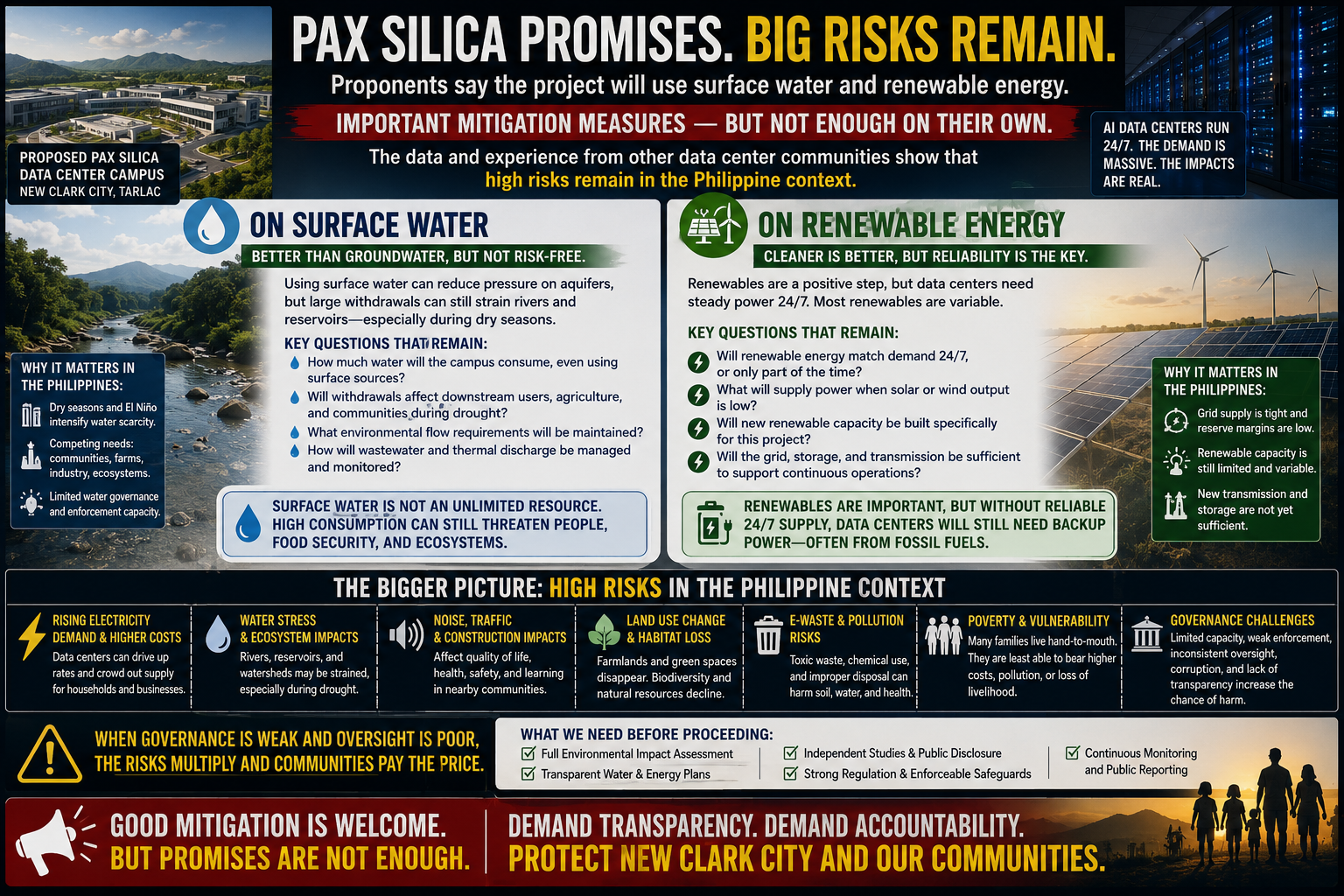
1. Our electric bills will rise — and we will be paying for someone else's AI boom. In areas with high concentrations of data centers, electricity rates have jumped by as much as 267% over five years, with typical household increases estimated at 20%. In the United States, data centers now draw roughly 6% of the entire national electricity supply; in some regions, that figure approaches a quarter of all power generated. The pattern is consistent: when data centers move in, ordinary families' power bills go up to subsidize industrial-scale computing.
2. Our water will be taken from us. A single large AI facility can consume as much water in a day as 6,500 households — up to 5 million gallons daily for cooling alone. Nearly two-thirds of new data centers built worldwide since 2022 sit in areas already under water stress. In Chile, public protest forced the government to revoke authorization for a major facility over water concerns. In Spain's Aragón region, farmers are in open conflict with developers over water rights as their land faces desertification. The Philippines is not water-rich in every province — and New Clark City sits in a region where agriculture and household water needs already compete for supply.
3. Our air and our health will suffer. These facilities are overwhelmingly powered by fossil-fuel-backed grids. Projections in the U.S. link data center pollution to as many as 600,000 additional asthma cases and 1,300 premature deaths annually by 2028. There is no reason to believe a facility of this scale in the Philippines will be cleaner.
4. Our communities will be physically altered — heat, noise, and light, day and night. Data centers generate "heat island" effects that can raise surrounding land temperature by up to 16°F, and operate around the clock with noise levels exceeding 90 decibels and constant light pollution — disrupting sleep, raising stress, and displacing wildlife. This is not a neighbor. It is an industrial presence that never turns off.
5. This is happening without the consultation Filipino communities deserve. Pax Silica has already drawn criticism over land use, sovereignty, and foreign involvement in strategic industries. Reports have raised concerns about the hub operating with extraordinary legal privileges, including diplomatic immunity, arrangements that would be unprecedented in the Philippines and whose legality under Philippine law remains unresolved. A deal of this magnitude — reshaping land, water, power, and legal jurisdiction in Luzon — should never be finalized in a rush to meet a year-end deadline, without the public having a real say.
Where is the rest of government?
Before this deal is signed, the public deserves answers:
- What is the DENR (Department of Environment and Natural Resources) doing to require a full Environmental Impact Assessment before the hub breaks ground?
- What is the NWRB (National Water Resources Board) doing to guarantee this project will not divert water away from farming and household use in Tarlac and neighboring provinces?
- What is the DOE (Department of Energy) doing to ensure this facility's power demand will not raise electricity rates for ordinary Filipino households?
- What are the LGUs (Local Government Units) of New Clark City and surrounding communities doing to secure real consultation, not just notification, before this project proceeds?
- What is the BCDA (Bases Conversion and Development Authority) doing to protect the terms under which this land is being made available?
- What is the CHR (Commission on Human Rights) doing to review the reported immunity and jurisdictional provisions and their impact on Filipino workers' legal protections?
Silence from these agencies is not neutrality. It is a choice to let this deal move forward unexamined.
What we are asking for
We do not oppose economic development. We oppose being asked to bear the water shortages, the higher power bills, the polluted air, and the noise — while the benefits flow elsewhere and the terms are decided without us.
We call on the Department of Finance, the Department of Trade and Industry, Department of Environment and Natural Resources, National Water Resources Board, Department of Energy, Local Government Units, Bases Conversion and Development Authority, Commission on Human Rights, and the Office of the President to:
- Do not sign the agreement until every major environmental, economic, and legal question has been independently answered and made public.
- Require an independent panel of Filipino and international experts to review all environmental, water, energy, economic, and public health studies before any approval.
- Require a cumulative impact assessment covering the entire Pax Silica development—not just individual facilities—so the combined effects on water, electricity, traffic, land use, and surrounding communities are evaluated.
- Require legally binding guarantees that households, farmers, and local businesses will have priority access to water and electricity during shortages.
- Require companies to post environmental performance bonds so taxpayers are not left paying for cleanup, restoration, or infrastructure upgrades if problems occur.
- Create an independent citizen oversight commission with representatives from affected communities, academia, civil society, and local governments to monitor compliance throughout the project's life.
- Require continuous public disclosure of water withdrawals, electricity consumption, emissions, wastewater quality, and environmental monitoring through an online public dashboard.
- Require enforceable penalties, suspension provisions, and project revocation if environmental commitments, water protections, or community safeguards are violated.
- Require periodic congressional oversight and independent audits throughout the life of the agreement—not just before it is signed.
- If these safeguards cannot be guaranteed, the Pax Silica agreement should be postponed—or not proceed—until they can.
Progress that costs Filipino families their water, their health, and their savings is not progress. Sign this petition to demand transparency, safeguards, and accountability before Pax Silica is signed.
- - - - - - - - - - - - - - - - - - - - - - - - - - - - - - - - - - - - - - - - - -
Sources on data center environmental and community impacts: Environmental Health Project, Consumer Reports, East-West Gateway Council of Governments, Stax Engineering, The Invading Sea, Pew Research Center.

86,421
The Issue
STOP THE PAX SILICA SIGNING: Protect Filipino Communities, Water, and Health
Our government is about to sign away our water, our air, and our electric bills — without asking us first.
Before the year ends, the Philippine government intends to sign the Pax Silica framework agreement, greenlighting a massive AI and semiconductor data center hub in New Clark City. We are told this is "progress." What we are not being told is what similar projects have already done to communities around the world — and what they will do to ours.
We, the undersigned, call on the Philippine government to halt the signing of the Pax Silica agreement until a full, independent, and public environmental, health, and economic impact review is conducted — with real consultation with the communities who will live next to this hub.
Here is what the evidence shows, from countries who already have these facilities:
1. Our electric bills will rise — and we will be paying for someone else's AI boom. In areas with high concentrations of data centers, electricity rates have jumped by as much as 267% over five years, with typical household increases estimated at 20%. In the United States, data centers now draw roughly 6% of the entire national electricity supply; in some regions, that figure approaches a quarter of all power generated. The pattern is consistent: when data centers move in, ordinary families' power bills go up to subsidize industrial-scale computing.
2. Our water will be taken from us. A single large AI facility can consume as much water in a day as 6,500 households — up to 5 million gallons daily for cooling alone. Nearly two-thirds of new data centers built worldwide since 2022 sit in areas already under water stress. In Chile, public protest forced the government to revoke authorization for a major facility over water concerns. In Spain's Aragón region, farmers are in open conflict with developers over water rights as their land faces desertification. The Philippines is not water-rich in every province — and New Clark City sits in a region where agriculture and household water needs already compete for supply.
3. Our air and our health will suffer. These facilities are overwhelmingly powered by fossil-fuel-backed grids. Projections in the U.S. link data center pollution to as many as 600,000 additional asthma cases and 1,300 premature deaths annually by 2028. There is no reason to believe a facility of this scale in the Philippines will be cleaner.
4. Our communities will be physically altered — heat, noise, and light, day and night. Data centers generate "heat island" effects that can raise surrounding land temperature by up to 16°F, and operate around the clock with noise levels exceeding 90 decibels and constant light pollution — disrupting sleep, raising stress, and displacing wildlife. This is not a neighbor. It is an industrial presence that never turns off.
5. This is happening without the consultation Filipino communities deserve. Pax Silica has already drawn criticism over land use, sovereignty, and foreign involvement in strategic industries. Reports have raised concerns about the hub operating with extraordinary legal privileges, including diplomatic immunity, arrangements that would be unprecedented in the Philippines and whose legality under Philippine law remains unresolved. A deal of this magnitude — reshaping land, water, power, and legal jurisdiction in Luzon — should never be finalized in a rush to meet a year-end deadline, without the public having a real say.
Where is the rest of government?
Before this deal is signed, the public deserves answers:
- What is the DENR (Department of Environment and Natural Resources) doing to require a full Environmental Impact Assessment before the hub breaks ground?
- What is the NWRB (National Water Resources Board) doing to guarantee this project will not divert water away from farming and household use in Tarlac and neighboring provinces?
- What is the DOE (Department of Energy) doing to ensure this facility's power demand will not raise electricity rates for ordinary Filipino households?
- What are the LGUs (Local Government Units) of New Clark City and surrounding communities doing to secure real consultation, not just notification, before this project proceeds?
- What is the BCDA (Bases Conversion and Development Authority) doing to protect the terms under which this land is being made available?
- What is the CHR (Commission on Human Rights) doing to review the reported immunity and jurisdictional provisions and their impact on Filipino workers' legal protections?
Silence from these agencies is not neutrality. It is a choice to let this deal move forward unexamined.
What we are asking for
We do not oppose economic development. We oppose being asked to bear the water shortages, the higher power bills, the polluted air, and the noise — while the benefits flow elsewhere and the terms are decided without us.
We call on the Department of Finance, the Department of Trade and Industry, Department of Environment and Natural Resources, National Water Resources Board, Department of Energy, Local Government Units, Bases Conversion and Development Authority, Commission on Human Rights, and the Office of the President to:
- Do not sign the agreement until every major environmental, economic, and legal question has been independently answered and made public.
- Require an independent panel of Filipino and international experts to review all environmental, water, energy, economic, and public health studies before any approval.
- Require a cumulative impact assessment covering the entire Pax Silica development—not just individual facilities—so the combined effects on water, electricity, traffic, land use, and surrounding communities are evaluated.
- Require legally binding guarantees that households, farmers, and local businesses will have priority access to water and electricity during shortages.
- Require companies to post environmental performance bonds so taxpayers are not left paying for cleanup, restoration, or infrastructure upgrades if problems occur.
- Create an independent citizen oversight commission with representatives from affected communities, academia, civil society, and local governments to monitor compliance throughout the project's life.
- Require continuous public disclosure of water withdrawals, electricity consumption, emissions, wastewater quality, and environmental monitoring through an online public dashboard.
- Require enforceable penalties, suspension provisions, and project revocation if environmental commitments, water protections, or community safeguards are violated.
- Require periodic congressional oversight and independent audits throughout the life of the agreement—not just before it is signed.
- If these safeguards cannot be guaranteed, the Pax Silica agreement should be postponed—or not proceed—until they can.
Progress that costs Filipino families their water, their health, and their savings is not progress. Sign this petition to demand transparency, safeguards, and accountability before Pax Silica is signed.
- - - - - - - - - - - - - - - - - - - - - - - - - - - - - - - - - - - - - - - - - -
Sources on data center environmental and community impacts: Environmental Health Project, Consumer Reports, East-West Gateway Council of Governments, Stax Engineering, The Invading Sea, Pew Research Center.
The Decision Makers


Supporter Voices
Petition Updates
Share this petition
Petition created on July 19, 2026