

Petition for an Independent Review of the Utah Department of Corrections and it's Leaders
The Issue
Is Jared Garcia the Right Person to Lead the Utah Department of Corrections?
Is Utah Receiving the Leadership, Accountability and Results Its Correctional System Requires?
Petition to Governor Spencer Cox and the Utah Legislature
We are asking Governor Spencer Cox and the Utah Legislature to commission an independent, transparent review of Commissioner Jared Garcia's fitness to continue leading the Utah Department of Corrections and of whether UDC's current leadership structure is delivering measurable public-safety results for Utah taxpayers.
This is not about one disagreement, one public-records request, one advocate or one legislative hearing.
It is about whether the person leading one of Utah's largest and most consequential state agencies has the executive-management experience, transparency, accountability, data discipline and rehabilitative vision necessary for the job.
Jared Garcia has extensive experience in law enforcement and public safety. That experience should be acknowledged. But operating a modern statewide correctional system requires a much broader executive skill set than custody and security alone.
UDC is simultaneously a public-safety organization, healthcare and behavioral-health system, substance-use-treatment provider, education and vocational system, housing and food-service operation, transportation network, employer, contract-management organization and reentry system.
Leading an organization of that complexity requires the ability to:
- Establish meaningful performance measures and report reliable outcomes.
- Plan treatment capacity and manage operational backlogs.
- Oversee healthcare and behavioral-health systems.
- Address staffing shortages and workforce instability.
- Measure the performance of contractors and service providers.
- Manage public funds responsibly.
- Reduce recidivism through evidence-based rehabilitation and reentry.
- Answer legislators and the public with complete, verifiable information.
- Welcome lawful oversight rather than redirect attention toward the people asking questions.
The overwhelming majority of incarcerated people will eventually return to Utah communities. A successful correctional system must therefore maintain security while also preparing people to return healthier, more stable, employable and less likely to commit another crime.
That is not being soft on crime. It is responsible government and long-term public safety.
Why This Matters to Every Utah Taxpayer
These concerns are not limited to incarcerated people or their families. They concern how effectively Utah manages public resources and whether residents are receiving measurable public-safety results from that investment.
When treatment needs are identified but capacity is insufficient, people may remain incarcerated longer without receiving programming necessary for release or successful reentry. That can increase incarceration costs without producing a corresponding public-safety benefit.
When healthcare, behavioral-health care or medication continuity is delayed or poorly coordinated, manageable conditions can become more serious, more dangerous and more expensive.
When programs are understaffed, Utah may be paying for positions, contracts or facilities that cannot deliver their intended capacity.
When referral times, treatment-list removals, completion rates, provider outcomes and other key measures are unknown or inconsistently tracked, legislators and taxpayers cannot determine whether public money is producing results.
When outdated technology and unreliable data prevent UDC from answering basic operational questions, lawmakers cannot make informed funding decisions or effectively hold programs and contractors accountable.
When rehabilitation and reentry systems fail, the consequences extend beyond prison walls. Utah residents bear the financial and human costs of repeated incarceration, avoidable instability and future victimization.
Taxpayer accountability is not simply about spending less. It is about knowing what Utah is paying for, whether it works and whether Department leadership can provide reliable evidence of the results.
This Concern Did Not Begin With One Hearing
Utah Corrections Watch maintains a documentation log that has grown to approximately 257 pages and continues to grow.
It includes public records, correspondence, GRAMA responses, legislative and stakeholder testimony, and reports received from incarcerated individuals, family members, employees and other sources. The documented concerns span treatment and programming, medical and behavioral-health access, staffing, medication continuity, property, grievances, disciplinary processes, accessibility, conditions of confinement, communication, contracts and providers, rehabilitation, reentry, data reliability, transparency and retaliation concerns.
Not every report received from inside a correctional system can automatically be treated as a proven fact. That is precisely why independent oversight, reliable data and transparent investigation matter.
When similar categories of concern repeatedly appear across different people, facilities and sources, leadership should be asking:
- What does the evidence show?
- Where are the systemic failures?
- What outcomes are being measured?
- What corrective action is being taken?
- How much are these failures costing Utah?
- Can legislators and the public independently verify the answers?
## UDC's Own Records Raise Serious Questions
A recent GRAMA request asked UDC for information regarding treatment-program capacity, needs lists, waitlists, admissions, staffing, completion rates and access to treatment.
UDC's response revealed significant gaps in what the Department tracks.
For several substance-use programs, average referral-to-admission wait times were listed as unknown. For some programs, the longest wait was not tracked. For several programs, UDC could not report how many people were removed from lists without ever being admitted.
UDC also acknowledged that none of its treatment programs were fully staffed and identified recruitment, turnover and training as continuing challenges.
Then came one of the most consequential findings.
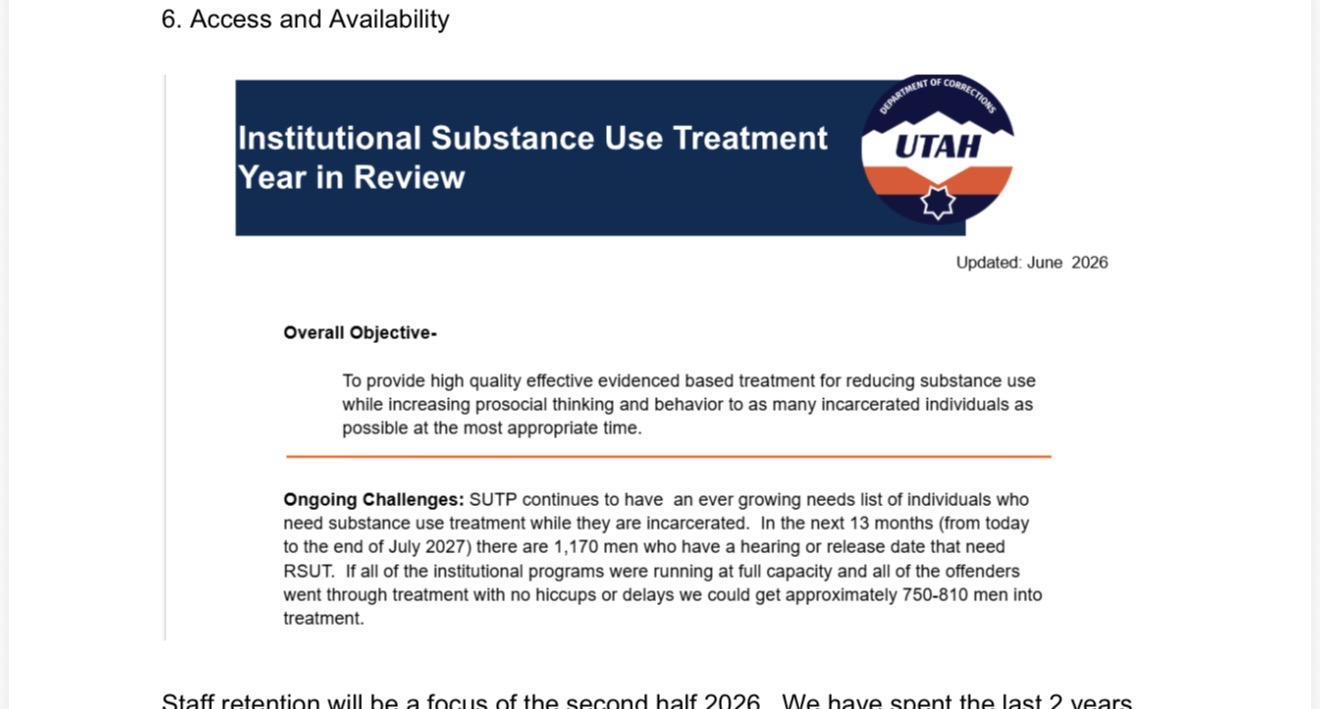
On page 4 of UDC's own GRAMA response, the Department included its *Institutional Substance Use Treatment Year in Review*. UDC reported that approximately 1,170 men with a hearing or release date during the following 13 months needed residential substance-use treatment.
UDC then estimated that even if all institutional programs were operating at full capacity and treatment proceeded without disruptions or delays, only approximately 750 to 810 men could enter treatment.
That leaves a potential difference of approximately 360 to 420 men between UDC's identified near-term need and its own projected ability to provide access under ideal conditions.
Those figures were not created by an advocate. They were not generated by artificial intelligence. They came directly from UDC's own report.
The records do not, by themselves, establish how many people will remain incarcerated longer because of that gap or the precise cost to taxpayers. They do establish a serious capacity question that UDC leadership should be able to answer clearly, with data.
Then Legislators Asked About It
During a legislative hearing, Representative Miller raised the GRAMA response and asked what lawmakers could do to help UDC get people into programming and reduce the lists.
Commissioner Garcia responded by telling lawmakers that the individual responsible for the request "floods" the agency with GRAMA requests. He referenced the use of artificial intelligence and said that much of the information was inaccurate.
The individual he was referring to was the founder of Utah Corrections Watch.
For context, during the preceding year, that individual submitted seven GRAMA requests to UDC. Four were partially denied, two were denied and one remained pending. Seven public-records requests over approximately twelve months were characterized before lawmakers as "flooding" the agency.
More importantly, Commissioner Garcia did not identify a single allegedly inaccurate figure, provide a corrected figure or explain how the figures from UDC's own report should be interpreted differently.
Deputy Commissioner Rebecca Brown explained that UDC distinguishes between a broad needs list and an active waitlist, and said some identified treatment needs extend as far into the future as 2065. That distinction is relevant. But it did not resolve the central question presented by page 4 of UDC's report.
The 1,170-person figure was already limited to men with a hearing or release date during the following 13 months. UDC's report then estimated that only approximately 750 to 810 could enter treatment under ideal conditions.
The substantive question was straightforward:
**If UDC identified approximately 1,170 men needing residential treatment within the following 13 months but estimated that only 750 to 810 could enter treatment under ideal conditions, what was the Department's plan for the remaining approximately 360 to 420?**
That question was not answered.
Instead, lawmakers heard about long-term needs lists, technology upgrades, artificial intelligence, the requester and improvements in what UDC calls "stuck status." Those subjects may be relevant to UDC's operations, but they did not reconcile the Department's own near-term treatment figures.
Why the Hearing Matters
This hearing was not merely an uncomfortable exchange between an agency leader and an advocate. Utah lawmakers make policy and funding decisions based on information provided by agency leadership.
When asked to explain a documented treatment-capacity problem, Commissioner Garcia did not identify the allegedly inaccurate information or reconcile UDC's own figures. Instead, he redirected part of the discussion toward the requester, the use of artificial intelligence and the number of GRAMA requests submitted.
If information derived from a GRAMA response is wrong, the proper response is straightforward:
1. Identify the incorrect figure or statement.
2. Provide the correct information.
3. Explain the methodology and relevant distinctions.
4. Correct the public record.
Public-records requests are not attacks on government. They are one of the lawful mechanisms Utah residents have to understand how their government operates and how public money is being used.
Criticizing a requester without specifically correcting the underlying evidence interferes with meaningful oversight and leaves lawmakers and taxpayers without a verifiable answer.
This does not establish Commissioner Garcia's intent. It does raise legitimate questions about his approach to transparency, accountability and legislative oversight.
The Broader Leadership Question
The treatment-capacity exchange is one documented example of a larger concern: Does UDC have the leadership systems necessary to identify problems, measure outcomes, allocate resources effectively and give decision-makers reliable answers?
Utah should be able to determine:
- Whether programming delays contribute to unnecessary additional incarceration and, if so, at what cost.
- Whether treatment capacity is sufficient for near-term Board of Pardons and Parole and release-related needs.
- Whether healthcare and behavioral-health systems provide timely, continuous and effective care.
- Whether staffing levels allow funded programs and essential operations to function as intended.
- Whether contractors and providers are evaluated using measurable outcomes.
- Whether grievances and recurring complaints are tracked in a way that reveals systemic patterns.
- Whether UDC accurately measures reentry, recidivism, treatment completion and other institutional outcomes.
- Whether lawmakers receive complete and materially responsive answers when exercising oversight.
- Whether outdated technology and fragmented data are impairing fiscal management and public accountability.
Without reliable measurement, neither UDC nor the Legislature can distinguish effective programs from ineffective ones, isolated problems from systemic failures, or necessary expenditures from avoidable costs.
Utah Needs Modern Corrections Leadership
Accountability and rehabilitation are not opposites. Nor are rehabilitation and public safety.
Public safety is strengthened when people leave prison treated for addiction and mental-health needs, medically stable, educated, employable, connected to their families and prepared to live lawfully.
Effective corrections leadership must protect staff, incarcerated people and the public while also producing measurable reductions in future harm.
That requires more than law-enforcement experience. It requires sophisticated executive management, fiscal discipline, healthcare and treatment oversight, workforce planning, contract accountability, credible data systems, legislative responsiveness and a demonstrated commitment to evidence-based rehabilitation and reentry.
Utah should independently evaluate whether its current commissioner and leadership structure meet those requirements.
What We Are Asking For
We are asking Governor Spencer Cox and the Utah Legislature to commission an independent leadership, management and organizational review of the Utah Department of Corrections.
That review should determine:
1. Whether Commissioner Jared Garcia possesses the executive-management competencies necessary to lead a modern statewide correctional system.
2. Whether UDC has adequate performance measures for treatment, healthcare, behavioral health, programming, staffing, grievances, contracts, reentry, recidivism and institutional outcomes.
3. Whether UDC provides legislators with complete, accurate and materially responsive information when legitimate oversight questions are raised.
4. Whether treatment capacity is sufficient to meet near-term Board of Pardons and Parole and release-related needs.
5. Whether programming delays contribute to unnecessary additional incarceration and avoidable taxpayer expense.
6. Whether healthcare, behavioral-health and medication-continuity systems are delivering timely, effective and fiscally responsible care.
7. Whether UDC adequately measures contractor and provider performance before additional public funds are committed.
8. Whether staffing shortages, turnover and training limitations prevent programs or essential services from delivering their funded capacity.
9. Whether UDC appropriately tracks grievances, systemic complaints and recurring patterns reported by incarcerated individuals, employees and families.
10. Whether UDC's data systems allow lawmakers and the public to evaluate spending, capacity, outcomes and agency performance.
11. Whether the Department's organizational culture sufficiently values transparency, lawful public oversight and accountability.
12. Whether Utah needs an independent correctional oversight body outside UDC.
13. Whether UDC's leadership structure appropriately supports security, treatment, healthcare, rehabilitation, reentry, logistics, technology and other complex civilian operations.
14. Whether the Department's leadership philosophy appropriately balances institutional security with rehabilitation, restorative practices, successful reentry and long-term public safety.
15. Ultimately, whether Jared Garcia is the right executive to continue leading the Utah Department of Corrections.
We are not asking Utahns to prejudge the outcome. We are asking for an independent evaluation based on records, performance data, professional standards and verifiable evidence.
If Commissioner Garcia's leadership withstands objective scrutiny, the public should see the evidence.
If it does not, Utah should appoint leadership with the executive-management experience, fiscal discipline and correctional philosophy necessary to move the system forward.
People incarcerated in Utah deserve competent government.
Families deserve transparency.
UDC employees deserve functional systems and effective leadership.
Crime victims deserve a correctional system designed to reduce future victimization.
Lawmakers deserve direct, accurate answers.
Taxpayers deserve measurable results.
And every Utah resident deserves a Department of Corrections whose leadership welcomes accountability rather than discrediting the people who ask legitimate questions.
**Please sign this petition if you believe the leadership and performance of the Utah Department of Corrections should be independently evaluated.**
---
Relevant Legislative Hearing Transcript
Lightly edited for punctuation and obvious transcription errors. Unclear wording has been identified rather than guessed.*
**Representative Miller:**
Thank you, Mr. Chair. A quick question. A lot of us got an email. Someone sent out a GRAMA request. I think you're familiar with it, about waitlists and the programs in the correctional setting.
My question is, what can we do as a legislative committee to help improve the integration of people on the waitlist into these programs? What can we do to help you guys get these waitlists down?
**Jared Garcia:**
Well, I would say, yes, we are absolutely familiar with that extensive GRAMA request that's then been placed in artificial intelligence. That specific individual does flood our agency with GRAMA requests, and a lot of the information is inaccurate.
I'll defer to Deputy Commissioner Brown. She'll tell you where we're at.
I would say, before she answers, though, as all of you know, there's probably not enough resources for people, not only those who are incarcerated, but those in our community that need help as well.
We are in the process of upgrading our O-Track system, which is essentially, we're operating corrections with an Atari, and we need to upgrade that. It has taken years to get all that information into the cloud. We're about there. I think it'll be done next month.
And then we'll start onboarding these microservices to help us get there. We will need ongoing funding, which I'm hoping will be in the governor's budget. We got one-time funding last year, and that's going to make a tremendous difference because we're going to be able to conduct assessments much quicker. We're going to be able to measure the efficacy of the providers that we're currently using and hold them accountable.
So we're very excited about that. We would just ask that you continue to support us with the technology upgrade, and if there are service providers that are willing to help us with our population, we want to know about them and partner with them. And again, we'll measure their efficacy as we move forward.
So, I'll turn some time over to Becky as well.
Rebecca Brown:
Um, I think, you know, there are many things that are [unclear] that have been taken from some of the narrative of those GRAMA requests.
I will say that, for that particular request, it’s well over 200 sub-requests that our agency has been asked to provide, and we just received another. So we are working through that.
But to just give one point of interest, a waitlist and a needs list in a Department of Corrections are two very different things. And what we’re interpreting is that waitlists and needs lists are the same.
So that data actually dates out to 2065.
We have committed to putting the right people in the right place at the right time and making sure that we are not rescinding dates, that we are providing access to resources before individuals are hitting their guidelines, and that we are taking into account mandatory and discretionary time cuts.
And we believe that, with our partnership with the Board of Pardons and Parole, we have been very successful in illustrating that and fixing problems that were inherent when we got here.
But those dates, like I mentioned, date out to 2065. So those are not actually waitlisted individuals. They’ve just been identified as having a need to access that treatment when their timeline is ready.
We are going to put some proactive effort into making sure that we provide information to all of you that helps you sit at ease with how we are managing our current populations and the distinct effort that we’re putting into quality of care and evidence-based practice and all of those pieces.
And again, we will miss it every once in a while.
We did receive a report from the Board of Pardons. You’ll remember that there was an issue with what they call “stuck status,” reported in the media several years ago.
We saw a trend from hundreds to 67 individuals, and last week we were given some information that the Board may mention that we had only one individual rescinded for being in stuck status last year, which is remarkable, and we’ll continue to keep that dedication.
So I hope that answers your question. Happy to answer more.
Representative Miller:
No, it certainly does. I appreciate the explanation. Thank you.
Here is the link. Question starts at 1:31 https://le.utah.gov/committee/committee.jsp?year=2026&com=APPCRI

740
The Issue
Is Jared Garcia the Right Person to Lead the Utah Department of Corrections?
Is Utah Receiving the Leadership, Accountability and Results Its Correctional System Requires?
Petition to Governor Spencer Cox and the Utah Legislature
We are asking Governor Spencer Cox and the Utah Legislature to commission an independent, transparent review of Commissioner Jared Garcia's fitness to continue leading the Utah Department of Corrections and of whether UDC's current leadership structure is delivering measurable public-safety results for Utah taxpayers.
This is not about one disagreement, one public-records request, one advocate or one legislative hearing.
It is about whether the person leading one of Utah's largest and most consequential state agencies has the executive-management experience, transparency, accountability, data discipline and rehabilitative vision necessary for the job.
Jared Garcia has extensive experience in law enforcement and public safety. That experience should be acknowledged. But operating a modern statewide correctional system requires a much broader executive skill set than custody and security alone.
UDC is simultaneously a public-safety organization, healthcare and behavioral-health system, substance-use-treatment provider, education and vocational system, housing and food-service operation, transportation network, employer, contract-management organization and reentry system.
Leading an organization of that complexity requires the ability to:
- Establish meaningful performance measures and report reliable outcomes.
- Plan treatment capacity and manage operational backlogs.
- Oversee healthcare and behavioral-health systems.
- Address staffing shortages and workforce instability.
- Measure the performance of contractors and service providers.
- Manage public funds responsibly.
- Reduce recidivism through evidence-based rehabilitation and reentry.
- Answer legislators and the public with complete, verifiable information.
- Welcome lawful oversight rather than redirect attention toward the people asking questions.
The overwhelming majority of incarcerated people will eventually return to Utah communities. A successful correctional system must therefore maintain security while also preparing people to return healthier, more stable, employable and less likely to commit another crime.
That is not being soft on crime. It is responsible government and long-term public safety.
Why This Matters to Every Utah Taxpayer
These concerns are not limited to incarcerated people or their families. They concern how effectively Utah manages public resources and whether residents are receiving measurable public-safety results from that investment.
When treatment needs are identified but capacity is insufficient, people may remain incarcerated longer without receiving programming necessary for release or successful reentry. That can increase incarceration costs without producing a corresponding public-safety benefit.
When healthcare, behavioral-health care or medication continuity is delayed or poorly coordinated, manageable conditions can become more serious, more dangerous and more expensive.
When programs are understaffed, Utah may be paying for positions, contracts or facilities that cannot deliver their intended capacity.
When referral times, treatment-list removals, completion rates, provider outcomes and other key measures are unknown or inconsistently tracked, legislators and taxpayers cannot determine whether public money is producing results.
When outdated technology and unreliable data prevent UDC from answering basic operational questions, lawmakers cannot make informed funding decisions or effectively hold programs and contractors accountable.
When rehabilitation and reentry systems fail, the consequences extend beyond prison walls. Utah residents bear the financial and human costs of repeated incarceration, avoidable instability and future victimization.
Taxpayer accountability is not simply about spending less. It is about knowing what Utah is paying for, whether it works and whether Department leadership can provide reliable evidence of the results.
This Concern Did Not Begin With One Hearing
Utah Corrections Watch maintains a documentation log that has grown to approximately 257 pages and continues to grow.
It includes public records, correspondence, GRAMA responses, legislative and stakeholder testimony, and reports received from incarcerated individuals, family members, employees and other sources. The documented concerns span treatment and programming, medical and behavioral-health access, staffing, medication continuity, property, grievances, disciplinary processes, accessibility, conditions of confinement, communication, contracts and providers, rehabilitation, reentry, data reliability, transparency and retaliation concerns.
Not every report received from inside a correctional system can automatically be treated as a proven fact. That is precisely why independent oversight, reliable data and transparent investigation matter.
When similar categories of concern repeatedly appear across different people, facilities and sources, leadership should be asking:
- What does the evidence show?
- Where are the systemic failures?
- What outcomes are being measured?
- What corrective action is being taken?
- How much are these failures costing Utah?
- Can legislators and the public independently verify the answers?
## UDC's Own Records Raise Serious Questions
A recent GRAMA request asked UDC for information regarding treatment-program capacity, needs lists, waitlists, admissions, staffing, completion rates and access to treatment.
UDC's response revealed significant gaps in what the Department tracks.
For several substance-use programs, average referral-to-admission wait times were listed as unknown. For some programs, the longest wait was not tracked. For several programs, UDC could not report how many people were removed from lists without ever being admitted.
UDC also acknowledged that none of its treatment programs were fully staffed and identified recruitment, turnover and training as continuing challenges.
Then came one of the most consequential findings.
On page 4 of UDC's own GRAMA response, the Department included its *Institutional Substance Use Treatment Year in Review*. UDC reported that approximately 1,170 men with a hearing or release date during the following 13 months needed residential substance-use treatment.
UDC then estimated that even if all institutional programs were operating at full capacity and treatment proceeded without disruptions or delays, only approximately 750 to 810 men could enter treatment.
That leaves a potential difference of approximately 360 to 420 men between UDC's identified near-term need and its own projected ability to provide access under ideal conditions.
Those figures were not created by an advocate. They were not generated by artificial intelligence. They came directly from UDC's own report.
The records do not, by themselves, establish how many people will remain incarcerated longer because of that gap or the precise cost to taxpayers. They do establish a serious capacity question that UDC leadership should be able to answer clearly, with data.
Then Legislators Asked About It
During a legislative hearing, Representative Miller raised the GRAMA response and asked what lawmakers could do to help UDC get people into programming and reduce the lists.
Commissioner Garcia responded by telling lawmakers that the individual responsible for the request "floods" the agency with GRAMA requests. He referenced the use of artificial intelligence and said that much of the information was inaccurate.
The individual he was referring to was the founder of Utah Corrections Watch.
For context, during the preceding year, that individual submitted seven GRAMA requests to UDC. Four were partially denied, two were denied and one remained pending. Seven public-records requests over approximately twelve months were characterized before lawmakers as "flooding" the agency.
More importantly, Commissioner Garcia did not identify a single allegedly inaccurate figure, provide a corrected figure or explain how the figures from UDC's own report should be interpreted differently.
Deputy Commissioner Rebecca Brown explained that UDC distinguishes between a broad needs list and an active waitlist, and said some identified treatment needs extend as far into the future as 2065. That distinction is relevant. But it did not resolve the central question presented by page 4 of UDC's report.
The 1,170-person figure was already limited to men with a hearing or release date during the following 13 months. UDC's report then estimated that only approximately 750 to 810 could enter treatment under ideal conditions.
The substantive question was straightforward:
**If UDC identified approximately 1,170 men needing residential treatment within the following 13 months but estimated that only 750 to 810 could enter treatment under ideal conditions, what was the Department's plan for the remaining approximately 360 to 420?**
That question was not answered.
Instead, lawmakers heard about long-term needs lists, technology upgrades, artificial intelligence, the requester and improvements in what UDC calls "stuck status." Those subjects may be relevant to UDC's operations, but they did not reconcile the Department's own near-term treatment figures.
Why the Hearing Matters
This hearing was not merely an uncomfortable exchange between an agency leader and an advocate. Utah lawmakers make policy and funding decisions based on information provided by agency leadership.
When asked to explain a documented treatment-capacity problem, Commissioner Garcia did not identify the allegedly inaccurate information or reconcile UDC's own figures. Instead, he redirected part of the discussion toward the requester, the use of artificial intelligence and the number of GRAMA requests submitted.
If information derived from a GRAMA response is wrong, the proper response is straightforward:
1. Identify the incorrect figure or statement.
2. Provide the correct information.
3. Explain the methodology and relevant distinctions.
4. Correct the public record.
Public-records requests are not attacks on government. They are one of the lawful mechanisms Utah residents have to understand how their government operates and how public money is being used.
Criticizing a requester without specifically correcting the underlying evidence interferes with meaningful oversight and leaves lawmakers and taxpayers without a verifiable answer.
This does not establish Commissioner Garcia's intent. It does raise legitimate questions about his approach to transparency, accountability and legislative oversight.
The Broader Leadership Question
The treatment-capacity exchange is one documented example of a larger concern: Does UDC have the leadership systems necessary to identify problems, measure outcomes, allocate resources effectively and give decision-makers reliable answers?
Utah should be able to determine:
- Whether programming delays contribute to unnecessary additional incarceration and, if so, at what cost.
- Whether treatment capacity is sufficient for near-term Board of Pardons and Parole and release-related needs.
- Whether healthcare and behavioral-health systems provide timely, continuous and effective care.
- Whether staffing levels allow funded programs and essential operations to function as intended.
- Whether contractors and providers are evaluated using measurable outcomes.
- Whether grievances and recurring complaints are tracked in a way that reveals systemic patterns.
- Whether UDC accurately measures reentry, recidivism, treatment completion and other institutional outcomes.
- Whether lawmakers receive complete and materially responsive answers when exercising oversight.
- Whether outdated technology and fragmented data are impairing fiscal management and public accountability.
Without reliable measurement, neither UDC nor the Legislature can distinguish effective programs from ineffective ones, isolated problems from systemic failures, or necessary expenditures from avoidable costs.
Utah Needs Modern Corrections Leadership
Accountability and rehabilitation are not opposites. Nor are rehabilitation and public safety.
Public safety is strengthened when people leave prison treated for addiction and mental-health needs, medically stable, educated, employable, connected to their families and prepared to live lawfully.
Effective corrections leadership must protect staff, incarcerated people and the public while also producing measurable reductions in future harm.
That requires more than law-enforcement experience. It requires sophisticated executive management, fiscal discipline, healthcare and treatment oversight, workforce planning, contract accountability, credible data systems, legislative responsiveness and a demonstrated commitment to evidence-based rehabilitation and reentry.
Utah should independently evaluate whether its current commissioner and leadership structure meet those requirements.
What We Are Asking For
We are asking Governor Spencer Cox and the Utah Legislature to commission an independent leadership, management and organizational review of the Utah Department of Corrections.
That review should determine:
1. Whether Commissioner Jared Garcia possesses the executive-management competencies necessary to lead a modern statewide correctional system.
2. Whether UDC has adequate performance measures for treatment, healthcare, behavioral health, programming, staffing, grievances, contracts, reentry, recidivism and institutional outcomes.
3. Whether UDC provides legislators with complete, accurate and materially responsive information when legitimate oversight questions are raised.
4. Whether treatment capacity is sufficient to meet near-term Board of Pardons and Parole and release-related needs.
5. Whether programming delays contribute to unnecessary additional incarceration and avoidable taxpayer expense.
6. Whether healthcare, behavioral-health and medication-continuity systems are delivering timely, effective and fiscally responsible care.
7. Whether UDC adequately measures contractor and provider performance before additional public funds are committed.
8. Whether staffing shortages, turnover and training limitations prevent programs or essential services from delivering their funded capacity.
9. Whether UDC appropriately tracks grievances, systemic complaints and recurring patterns reported by incarcerated individuals, employees and families.
10. Whether UDC's data systems allow lawmakers and the public to evaluate spending, capacity, outcomes and agency performance.
11. Whether the Department's organizational culture sufficiently values transparency, lawful public oversight and accountability.
12. Whether Utah needs an independent correctional oversight body outside UDC.
13. Whether UDC's leadership structure appropriately supports security, treatment, healthcare, rehabilitation, reentry, logistics, technology and other complex civilian operations.
14. Whether the Department's leadership philosophy appropriately balances institutional security with rehabilitation, restorative practices, successful reentry and long-term public safety.
15. Ultimately, whether Jared Garcia is the right executive to continue leading the Utah Department of Corrections.
We are not asking Utahns to prejudge the outcome. We are asking for an independent evaluation based on records, performance data, professional standards and verifiable evidence.
If Commissioner Garcia's leadership withstands objective scrutiny, the public should see the evidence.
If it does not, Utah should appoint leadership with the executive-management experience, fiscal discipline and correctional philosophy necessary to move the system forward.
People incarcerated in Utah deserve competent government.
Families deserve transparency.
UDC employees deserve functional systems and effective leadership.
Crime victims deserve a correctional system designed to reduce future victimization.
Lawmakers deserve direct, accurate answers.
Taxpayers deserve measurable results.
And every Utah resident deserves a Department of Corrections whose leadership welcomes accountability rather than discrediting the people who ask legitimate questions.
**Please sign this petition if you believe the leadership and performance of the Utah Department of Corrections should be independently evaluated.**
---
Relevant Legislative Hearing Transcript
Lightly edited for punctuation and obvious transcription errors. Unclear wording has been identified rather than guessed.*
**Representative Miller:**
Thank you, Mr. Chair. A quick question. A lot of us got an email. Someone sent out a GRAMA request. I think you're familiar with it, about waitlists and the programs in the correctional setting.
My question is, what can we do as a legislative committee to help improve the integration of people on the waitlist into these programs? What can we do to help you guys get these waitlists down?
**Jared Garcia:**
Well, I would say, yes, we are absolutely familiar with that extensive GRAMA request that's then been placed in artificial intelligence. That specific individual does flood our agency with GRAMA requests, and a lot of the information is inaccurate.
I'll defer to Deputy Commissioner Brown. She'll tell you where we're at.
I would say, before she answers, though, as all of you know, there's probably not enough resources for people, not only those who are incarcerated, but those in our community that need help as well.
We are in the process of upgrading our O-Track system, which is essentially, we're operating corrections with an Atari, and we need to upgrade that. It has taken years to get all that information into the cloud. We're about there. I think it'll be done next month.
And then we'll start onboarding these microservices to help us get there. We will need ongoing funding, which I'm hoping will be in the governor's budget. We got one-time funding last year, and that's going to make a tremendous difference because we're going to be able to conduct assessments much quicker. We're going to be able to measure the efficacy of the providers that we're currently using and hold them accountable.
So we're very excited about that. We would just ask that you continue to support us with the technology upgrade, and if there are service providers that are willing to help us with our population, we want to know about them and partner with them. And again, we'll measure their efficacy as we move forward.
So, I'll turn some time over to Becky as well.
Rebecca Brown:
Um, I think, you know, there are many things that are [unclear] that have been taken from some of the narrative of those GRAMA requests.
I will say that, for that particular request, it’s well over 200 sub-requests that our agency has been asked to provide, and we just received another. So we are working through that.
But to just give one point of interest, a waitlist and a needs list in a Department of Corrections are two very different things. And what we’re interpreting is that waitlists and needs lists are the same.
So that data actually dates out to 2065.
We have committed to putting the right people in the right place at the right time and making sure that we are not rescinding dates, that we are providing access to resources before individuals are hitting their guidelines, and that we are taking into account mandatory and discretionary time cuts.
And we believe that, with our partnership with the Board of Pardons and Parole, we have been very successful in illustrating that and fixing problems that were inherent when we got here.
But those dates, like I mentioned, date out to 2065. So those are not actually waitlisted individuals. They’ve just been identified as having a need to access that treatment when their timeline is ready.
We are going to put some proactive effort into making sure that we provide information to all of you that helps you sit at ease with how we are managing our current populations and the distinct effort that we’re putting into quality of care and evidence-based practice and all of those pieces.
And again, we will miss it every once in a while.
We did receive a report from the Board of Pardons. You’ll remember that there was an issue with what they call “stuck status,” reported in the media several years ago.
We saw a trend from hundreds to 67 individuals, and last week we were given some information that the Board may mention that we had only one individual rescinded for being in stuck status last year, which is remarkable, and we’ll continue to keep that dedication.
So I hope that answers your question. Happy to answer more.
Representative Miller:
No, it certainly does. I appreciate the explanation. Thank you.
Here is the link. Question starts at 1:31 https://le.utah.gov/committee/committee.jsp?year=2026&com=APPCRI
The Decision Makers


Supporter Voices
Petition Updates
Share this petition
Petition created on August 18, 2026