Pass the PROTECT Rare Act of 2025!
Pass the PROTECT Rare Act of 2025!
The Issue
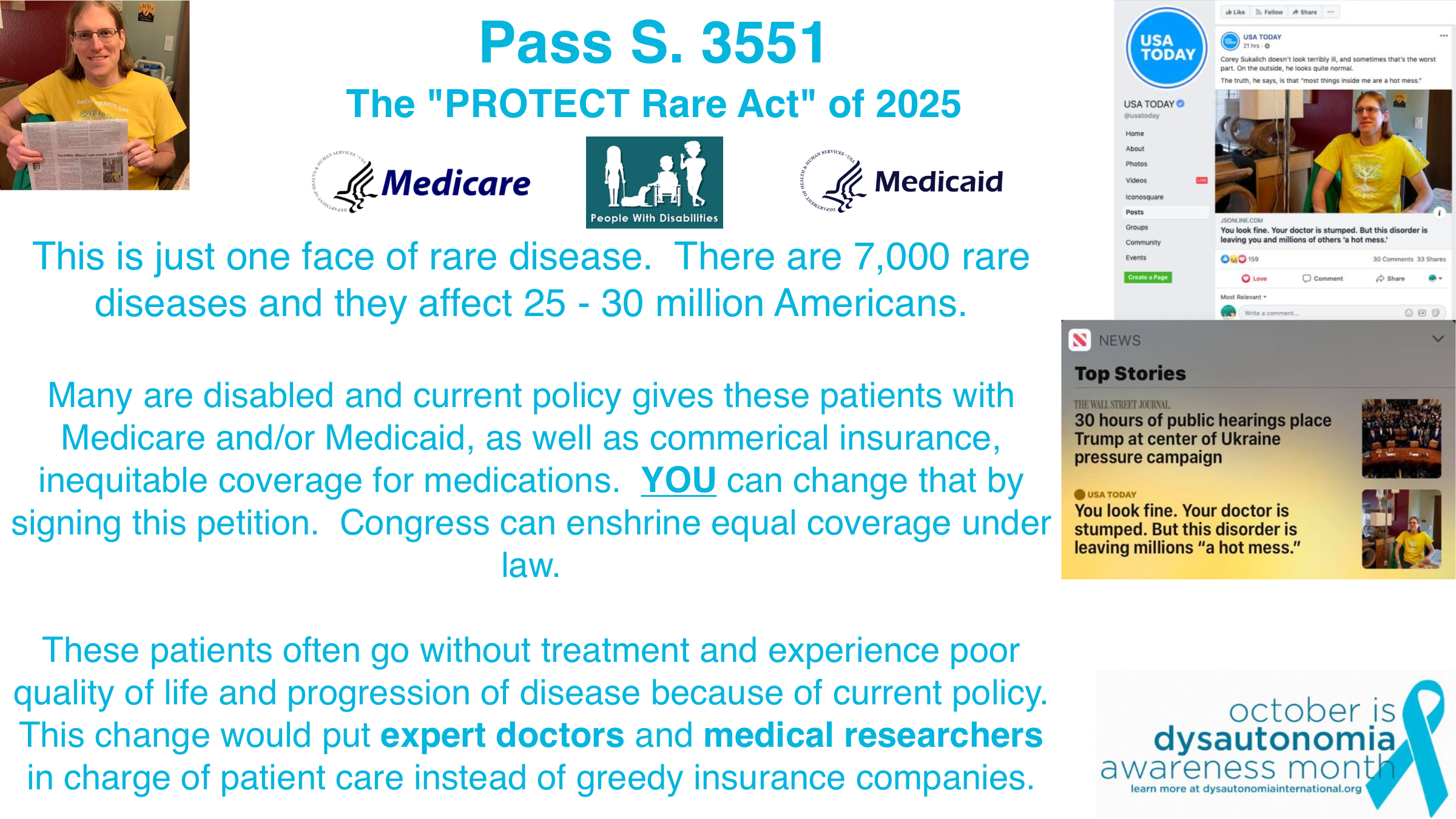
Americans with rare and poorly understood diseases face systemic discrimination in the medical system, often to the degree where they cannot get care and medications that are necessary to improve their health conditions. Drug companies can't or don't have the resource to test medications for every indication, which leaves these patients fighting for off-label coverage. Many of these diseases cause disabilities, which results in the patients ending up on Medicare and relying on Part D for drug coverage.
Part D requires coverage from dated, private compendia which often exclude these rare diseases from reviews of drug uses. The law prohibits plans from including any uses not mentioned in the compendia. There is no appeal or reconsideration mechanism that allows such patients to gain coverage. For some patients, this results in impartial care and for others, it causes them to receive no medications.
This presents significant challenges for a patient trying to make the most of their already reduced functional status and life at large.
Leaving this system in place will stifle innovation for rare disease patients, leading to a waste of medical resources because not treating these patients often results in them seeking more testing, medical encounters, and even emergency visits which present higher costs than many denied drugs. It also causes gross inequities for patients because a drug that treats multiple similar conditions is given based on a diagnosis code, and not on efficacy or necessity.
The time to act is now - Dysautonomia is one of the diseases that affects the writer of this petition and 3 million other Americans. In addition to this, 38 million Americans are now impacted by Long COVID and have forms of Dysautonomia. There are no on-label drugs for these conditions, yet a number of medications are effective based on anecdotal evidence AND medical journal studies of small patient groups.
None of these drugs are covered under Medicare Part D. To add insult to injury, many disabled Medicare patients have Medicaid. For the writer and others he knows, Medicaid coverage is inequitably lessened due to the presence of Medicare. Ensuring parity of coverage for all beneficiaries could be accomplished by changing the definition of "medically accepted use" for rare conditions to include the use of peer-reviewed medical literature and opinions of disease experts.
Congress previously passed a law that deemed certain uses of anti-cancer treatments as "medically accepted" if they were listed in the compendia OR if two or more peer-reviewed articles supported off-label use. The situation of those cancer patients is very similar to the patients who have thousands of rare conditions without on-label treatments and require off-label medication or face the reduction in quality of life from untreated disease.
The FDA's approval of medications is undermined when they determine medications to be safe and effective and patients do not get access to attempt to treat severe diseases that greatly impair quality of life, cause severe pain, and substantial disability.
The Access to Rare Indications Act of 2021 did not ultimately pass, however in 2023, a more expanded bill which would not only help Medicare and Medicaid patients, but also those with commercial insurance was introduced. The Providing Realistic Opportunity to Equal and Comparable Treatment for Rare (PROTECT Rare) Act of 2023 would have fixed inequities for ALL Americans with rare diseases. When that session of Congress ended, the bill had not advanced. In 2025, the bill was reintroduced as a BIPARTISAN bill again in the Senate as S.3551.

113
The Issue
Americans with rare and poorly understood diseases face systemic discrimination in the medical system, often to the degree where they cannot get care and medications that are necessary to improve their health conditions. Drug companies can't or don't have the resource to test medications for every indication, which leaves these patients fighting for off-label coverage. Many of these diseases cause disabilities, which results in the patients ending up on Medicare and relying on Part D for drug coverage.
Part D requires coverage from dated, private compendia which often exclude these rare diseases from reviews of drug uses. The law prohibits plans from including any uses not mentioned in the compendia. There is no appeal or reconsideration mechanism that allows such patients to gain coverage. For some patients, this results in impartial care and for others, it causes them to receive no medications.
This presents significant challenges for a patient trying to make the most of their already reduced functional status and life at large.
Leaving this system in place will stifle innovation for rare disease patients, leading to a waste of medical resources because not treating these patients often results in them seeking more testing, medical encounters, and even emergency visits which present higher costs than many denied drugs. It also causes gross inequities for patients because a drug that treats multiple similar conditions is given based on a diagnosis code, and not on efficacy or necessity.
The time to act is now - Dysautonomia is one of the diseases that affects the writer of this petition and 3 million other Americans. In addition to this, 38 million Americans are now impacted by Long COVID and have forms of Dysautonomia. There are no on-label drugs for these conditions, yet a number of medications are effective based on anecdotal evidence AND medical journal studies of small patient groups.
None of these drugs are covered under Medicare Part D. To add insult to injury, many disabled Medicare patients have Medicaid. For the writer and others he knows, Medicaid coverage is inequitably lessened due to the presence of Medicare. Ensuring parity of coverage for all beneficiaries could be accomplished by changing the definition of "medically accepted use" for rare conditions to include the use of peer-reviewed medical literature and opinions of disease experts.
Congress previously passed a law that deemed certain uses of anti-cancer treatments as "medically accepted" if they were listed in the compendia OR if two or more peer-reviewed articles supported off-label use. The situation of those cancer patients is very similar to the patients who have thousands of rare conditions without on-label treatments and require off-label medication or face the reduction in quality of life from untreated disease.
The FDA's approval of medications is undermined when they determine medications to be safe and effective and patients do not get access to attempt to treat severe diseases that greatly impair quality of life, cause severe pain, and substantial disability.
The Access to Rare Indications Act of 2021 did not ultimately pass, however in 2023, a more expanded bill which would not only help Medicare and Medicaid patients, but also those with commercial insurance was introduced. The Providing Realistic Opportunity to Equal and Comparable Treatment for Rare (PROTECT Rare) Act of 2023 would have fixed inequities for ALL Americans with rare diseases. When that session of Congress ended, the bill had not advanced. In 2025, the bill was reintroduced as a BIPARTISAN bill again in the Senate as S.3551.
The Decision Makers


Supporter Voices
Petition Updates
Share this petition
Petition created on October 5, 2023