
Juvenile Justice Reform: Expand Mental Health Access for Youth in the System
The Issue
“Youth who were formally processed [in juvenile court] were more likely to be rearrested, more likely to be incarcerated, engaged in more violence, reported a greater affiliation with delinquent peers, reported lower school enrollment, were less likely to graduate high school within 5 years, reported less ability to suppress aggression, and had lower perceptions of opportunities as compared to similarly situated youth who were diverted”.1 MA Juvenile Justice Policy and Data Board (2025)
The 2018 Criminal Justice Reform Act explicitly included reforms targeted to reduce the incarceration of youth in state custody and to address racial/ethnic disparities. Over the past six years, juvenile court caseload increases have been driven by low-level offenses that, due to the statute’s reliance adult system laws, are ineligible for judicial diversion: • 33% of juvenile court arraignments are for misdemeanors • 1 in 2 cases arraigned in juvenile court end in a dismissal, but result in a juvenile record • Racial/ethnic disparities persist throughout the court process, driven by higher referral rates of white youth than youth of color to diversion at the initial stages of the juvenile justice process. • More than half of youth committed to DYS are charged with low level offenses • Youth in DCF custody (care and protection and CRA) make up 0.6% of the Massachusetts child population but represent over 50% of youth detained by DYS and 40% of youth committed to DYS. Girls in DYS custody are twice as likely as boys to be DCF-involved.
Massachusetts’ has one of the worst rates of racial disparity in youth incarceration in the country despite more than two decades of reforms to reduce the pretrial detention of youth. While youth of color make up only 29% of the youth population in Massachusetts, they represent 60% of juvenile arraignments, 80% of all pretrial detentions and 84% of commitments to the Department of Youth Services (DYS) in FY2024.
Research has shown that these youths have unmet behavioral and mental health needs. With many youths' stability in school, home, and their communities impacted by this. Massachusetts has seen an increase in juvenile offenders which is tied to these unmet needs.
Post-pandemic, Massachusetts has been dealing with a pediatric behavioral health crisis. Three factors have been identified as contributors to this crisis. There has been an increased demand for mental health services, but the behavioral health field has been dealing with an insufficient workforce. In addition, limited impatient and home, community, base care capacity has compounded the issue.
Massachusetts has the highest rates of childhood depression and anxiety nationwide . Since the COVID 19 pandemic , children have reported trauma, social isolation, and other factors further impacting their mental health struggle. From 2016 to 2020, the rate of anxiety and depressions diagnosis for children in Massachusetts increased from 51%.
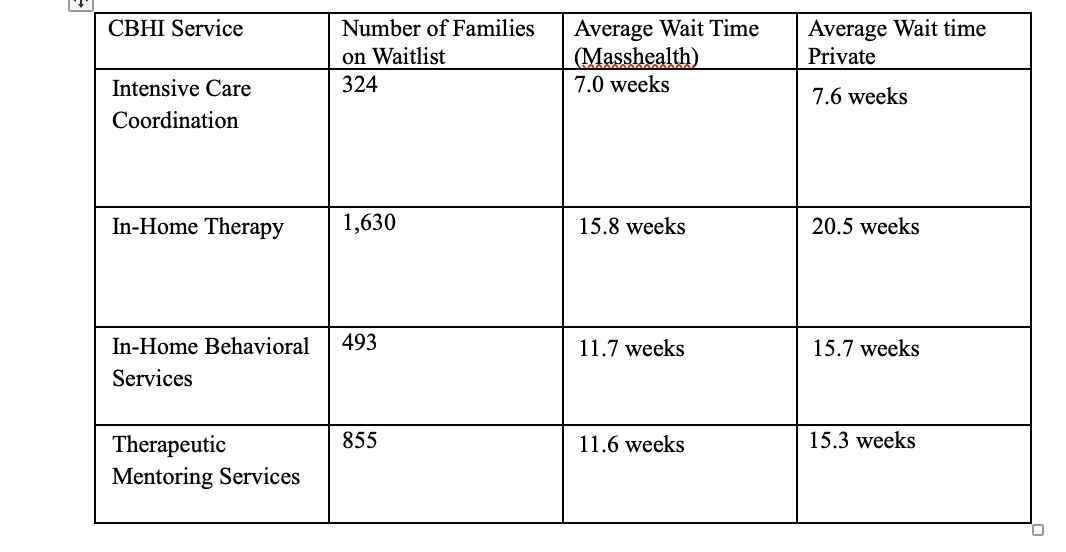
The Children’s Behavioral Health Initiative provides the following services for MassHealth members under the age of 21; intensive care coordination, family partner, in-home therapy, in home behavioral services, and therapeutic mentoring services. Families and children with either MassHealth or private insurance are facing significant barriers in accessing care due to this staffing and healthcare facility shortages.
The cause of this shortage has been attributed to low wages, burnout, and schedule flexibility.
There have been three notable workforce declines from 2019 to 2023.
Psychologists at -41.5%
• Counselors at -28.6%
• Community Health Workers at -25.6%
These are the current wait times to start services that families experience;
There are major policy actions that can be taken to address adequate access to mental health services and improve the workforce that serves the youth.
We must call on our elected officials to enact these proposed bills that will address adequate access to behavioral health services.
An Act Promoting Diversion of Juveniles to Community Supervision and Services (HD.3434/SD.246) is a legislative proposal in Massachusetts, sponsored by Senator Cindy Creem and Representative Brandy Fluker-Reid. The bill aims to reform the juvenile justice system by expanding the eligibility criteria for diversion programs, thereby allowing more youth to participate in community-based supervision and services as alternatives to formal judicial proceedings.
Key Provisions of the Bill:
1. Expanded Eligibility for Diversion:
a. The bill seeks to broaden the list of offenses eligible for diversion, enabling a greater number of juveniles to benefit from alternatives to court involvement. However, it maintains exclusions for offenses that would subject adults to mandatory incarceration of five or more years, ensuring that serious crimes remain within the traditional judicial process. Children's League of Massachusetts
2. Judicial Discretion:
a. By expanding judicial diversion, the legislation empowers judges to determine if a youth and public safety are better served through alternatives to the juvenile justice system. This approach allows for individualized assessments, considering the unique circumstances of each case. CfJJ
3. Focus on Rehabilitation:
a. The bill emphasizes rehabilitation over punitive measures by facilitating access to community-based programs that address underlying issues such as mental health challenges, substance use, and behavioral concerns. This approach aligns with evidence suggesting that community interventions can lead to better outcomes for youth and enhance public safety.
Legislative Context:
This bill builds upon previous legislative efforts, such as House Bill H.1495 from the 193rd General Court (2023-2024 session), which also aimed to promote juvenile diversion to community supervision and services. The reintroduction of this initiative in the current session underscores a continued commitment to juvenile justice reform in Massachusetts. Massachusetts General Court
Support and Advocacy:
The proposed legislation has garnered support from various advocacy groups dedicated to juvenile justice reform, including the Children's League of Massachusetts and Citizens for Juvenile Justice. These organizations emphasize the importance of providing judicial discretion to divert appropriate cases, thereby mitigating the harsh and long-term consequences that court processing can impose on young individuals.
By expanding access to diversion programs, An Act Promoting Diversion of Juveniles to Community Supervision and Services aims to reduce the long-term negative impacts associated with juvenile court involvement, such as incarceration and the creation of a criminal record. The bill reflects a growing recognition of the need for rehabilitative approaches within the juvenile justice system, focusing on addressing the root causes of delinquent behavior and promoting positive development among youth.
In response to the legislative requirements of Chapter 240 of the Acts of 2012 to support Children Requiring Assistance (CRA), Family Resource Centers were created. The FRCs also implement services and resources for families with children at risk of a CRA filing or with an existing filing with a juvenile court. FRCs work to strengthen relationships between children and their families so that both can thrive.
An Act Strengthening Mental Health Centers
MA S874 increases behavioral health reimbursement rates by 5% starting in 2027, sets clinic rates 20% higher than independent providers, and mandates biennial rate reviews.
Dr. Lorna Breen Health Care Provider Protection Reauthorization Act
The Dr. Lorna Breen Health Care Provider Protection Reauthorization Act aims to extend federal programs that address mental health concerns and burnout among health care workers, initially established by the 2022 Act. It provides funding for mental health education, training, and awareness programs to support health care professionals and reduce stigma around seeking help.

626
The Issue
“Youth who were formally processed [in juvenile court] were more likely to be rearrested, more likely to be incarcerated, engaged in more violence, reported a greater affiliation with delinquent peers, reported lower school enrollment, were less likely to graduate high school within 5 years, reported less ability to suppress aggression, and had lower perceptions of opportunities as compared to similarly situated youth who were diverted”.1 MA Juvenile Justice Policy and Data Board (2025)
The 2018 Criminal Justice Reform Act explicitly included reforms targeted to reduce the incarceration of youth in state custody and to address racial/ethnic disparities. Over the past six years, juvenile court caseload increases have been driven by low-level offenses that, due to the statute’s reliance adult system laws, are ineligible for judicial diversion: • 33% of juvenile court arraignments are for misdemeanors • 1 in 2 cases arraigned in juvenile court end in a dismissal, but result in a juvenile record • Racial/ethnic disparities persist throughout the court process, driven by higher referral rates of white youth than youth of color to diversion at the initial stages of the juvenile justice process. • More than half of youth committed to DYS are charged with low level offenses • Youth in DCF custody (care and protection and CRA) make up 0.6% of the Massachusetts child population but represent over 50% of youth detained by DYS and 40% of youth committed to DYS. Girls in DYS custody are twice as likely as boys to be DCF-involved.
Massachusetts’ has one of the worst rates of racial disparity in youth incarceration in the country despite more than two decades of reforms to reduce the pretrial detention of youth. While youth of color make up only 29% of the youth population in Massachusetts, they represent 60% of juvenile arraignments, 80% of all pretrial detentions and 84% of commitments to the Department of Youth Services (DYS) in FY2024.
Research has shown that these youths have unmet behavioral and mental health needs. With many youths' stability in school, home, and their communities impacted by this. Massachusetts has seen an increase in juvenile offenders which is tied to these unmet needs.
Post-pandemic, Massachusetts has been dealing with a pediatric behavioral health crisis. Three factors have been identified as contributors to this crisis. There has been an increased demand for mental health services, but the behavioral health field has been dealing with an insufficient workforce. In addition, limited impatient and home, community, base care capacity has compounded the issue.
Massachusetts has the highest rates of childhood depression and anxiety nationwide . Since the COVID 19 pandemic , children have reported trauma, social isolation, and other factors further impacting their mental health struggle. From 2016 to 2020, the rate of anxiety and depressions diagnosis for children in Massachusetts increased from 51%.
The Children’s Behavioral Health Initiative provides the following services for MassHealth members under the age of 21; intensive care coordination, family partner, in-home therapy, in home behavioral services, and therapeutic mentoring services. Families and children with either MassHealth or private insurance are facing significant barriers in accessing care due to this staffing and healthcare facility shortages.
The cause of this shortage has been attributed to low wages, burnout, and schedule flexibility.
There have been three notable workforce declines from 2019 to 2023.
Psychologists at -41.5%
• Counselors at -28.6%
• Community Health Workers at -25.6%
These are the current wait times to start services that families experience;
There are major policy actions that can be taken to address adequate access to mental health services and improve the workforce that serves the youth.
We must call on our elected officials to enact these proposed bills that will address adequate access to behavioral health services.
An Act Promoting Diversion of Juveniles to Community Supervision and Services (HD.3434/SD.246) is a legislative proposal in Massachusetts, sponsored by Senator Cindy Creem and Representative Brandy Fluker-Reid. The bill aims to reform the juvenile justice system by expanding the eligibility criteria for diversion programs, thereby allowing more youth to participate in community-based supervision and services as alternatives to formal judicial proceedings.
Key Provisions of the Bill:
1. Expanded Eligibility for Diversion:
a. The bill seeks to broaden the list of offenses eligible for diversion, enabling a greater number of juveniles to benefit from alternatives to court involvement. However, it maintains exclusions for offenses that would subject adults to mandatory incarceration of five or more years, ensuring that serious crimes remain within the traditional judicial process. Children's League of Massachusetts
2. Judicial Discretion:
a. By expanding judicial diversion, the legislation empowers judges to determine if a youth and public safety are better served through alternatives to the juvenile justice system. This approach allows for individualized assessments, considering the unique circumstances of each case. CfJJ
3. Focus on Rehabilitation:
a. The bill emphasizes rehabilitation over punitive measures by facilitating access to community-based programs that address underlying issues such as mental health challenges, substance use, and behavioral concerns. This approach aligns with evidence suggesting that community interventions can lead to better outcomes for youth and enhance public safety.
Legislative Context:
This bill builds upon previous legislative efforts, such as House Bill H.1495 from the 193rd General Court (2023-2024 session), which also aimed to promote juvenile diversion to community supervision and services. The reintroduction of this initiative in the current session underscores a continued commitment to juvenile justice reform in Massachusetts. Massachusetts General Court
Support and Advocacy:
The proposed legislation has garnered support from various advocacy groups dedicated to juvenile justice reform, including the Children's League of Massachusetts and Citizens for Juvenile Justice. These organizations emphasize the importance of providing judicial discretion to divert appropriate cases, thereby mitigating the harsh and long-term consequences that court processing can impose on young individuals.
By expanding access to diversion programs, An Act Promoting Diversion of Juveniles to Community Supervision and Services aims to reduce the long-term negative impacts associated with juvenile court involvement, such as incarceration and the creation of a criminal record. The bill reflects a growing recognition of the need for rehabilitative approaches within the juvenile justice system, focusing on addressing the root causes of delinquent behavior and promoting positive development among youth.
In response to the legislative requirements of Chapter 240 of the Acts of 2012 to support Children Requiring Assistance (CRA), Family Resource Centers were created. The FRCs also implement services and resources for families with children at risk of a CRA filing or with an existing filing with a juvenile court. FRCs work to strengthen relationships between children and their families so that both can thrive.
An Act Strengthening Mental Health Centers
MA S874 increases behavioral health reimbursement rates by 5% starting in 2027, sets clinic rates 20% higher than independent providers, and mandates biennial rate reviews.
Dr. Lorna Breen Health Care Provider Protection Reauthorization Act
The Dr. Lorna Breen Health Care Provider Protection Reauthorization Act aims to extend federal programs that address mental health concerns and burnout among health care workers, initially established by the 2022 Act. It provides funding for mental health education, training, and awareness programs to support health care professionals and reduce stigma around seeking help.
The Decision Makers




Petition Updates
Share this petition
Petition created on April 1, 2025