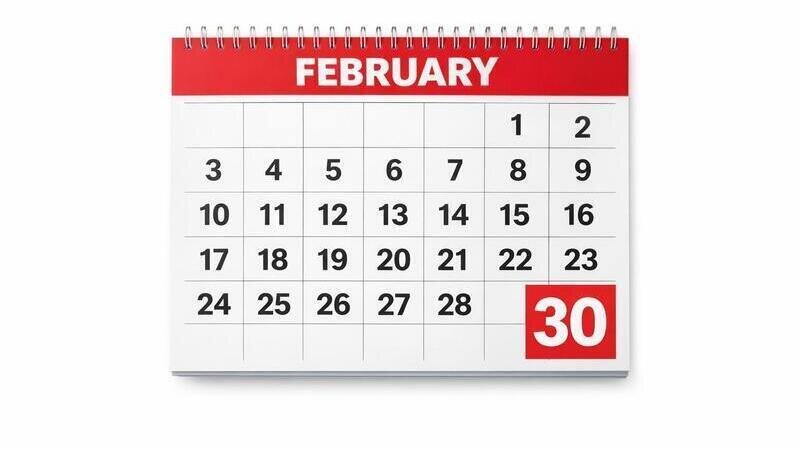
Introduce February 30th in the calendar
The Issue
The modern Gregorian calendar has remained largely unchanged for centuries, despite the massive transformation of our technological, economic, and computational world.
This proposal explores the idea of introducing “February 30” as part of a more balanced and efficient calendar structure.
While the idea may initially sound unusual, the current calendar system contains several inconsistencies:
• Uneven month lengths
• Irregular leap-year adjustments
• Inconsistent weekday alignment across years
• Increased complexity in scheduling, analytics, and digital systems
February, in particular, remains an irregular outlier with only 28 days, forcing repeated adjustments that affect planning models, financial reporting, computational systems, and long-term organization.
A more uniform calendar structure could:
• Improve predictability in scheduling
• Simplify computational and database systems
• Create more consistent time divisions
• Reduce irregular calendar exceptions
This petition is not merely about adding an extra date. It is about encouraging discussion on whether our modern world still operates on an optimally designed calendar system.
Time is one of humanity’s most important structures. It should evolve with civilization itself.
Support the conversation for a more balanced future of timekeeping.
A proposal to introduce February 30th offers a solution that streamlines our calendar and balances the year more effectively. This change would result in every month having roughly the same number of days, making year-long planning and financial forecasting significantly easier for businesses, educational institutions, and governments. Such predictability could lead to increased productivity and efficiency.
I wanted to respectfully share the proposal for consideration and discussion.
[ https://www.linkedin.com/posts/raghav-daharwal-311087356_activity-7464565550036303872-pdV0?utm_source=share&utm_medium=member_desktop&rcm=ACoAAFik2P0BxGZ5rraZCYvQVUzxHUiaGEKE7xs ]

Victory
The Issue
The modern Gregorian calendar has remained largely unchanged for centuries, despite the massive transformation of our technological, economic, and computational world.
This proposal explores the idea of introducing “February 30” as part of a more balanced and efficient calendar structure.
While the idea may initially sound unusual, the current calendar system contains several inconsistencies:
• Uneven month lengths
• Irregular leap-year adjustments
• Inconsistent weekday alignment across years
• Increased complexity in scheduling, analytics, and digital systems
February, in particular, remains an irregular outlier with only 28 days, forcing repeated adjustments that affect planning models, financial reporting, computational systems, and long-term organization.
A more uniform calendar structure could:
• Improve predictability in scheduling
• Simplify computational and database systems
• Create more consistent time divisions
• Reduce irregular calendar exceptions
This petition is not merely about adding an extra date. It is about encouraging discussion on whether our modern world still operates on an optimally designed calendar system.
Time is one of humanity’s most important structures. It should evolve with civilization itself.
Support the conversation for a more balanced future of timekeeping.
A proposal to introduce February 30th offers a solution that streamlines our calendar and balances the year more effectively. This change would result in every month having roughly the same number of days, making year-long planning and financial forecasting significantly easier for businesses, educational institutions, and governments. Such predictability could lead to increased productivity and efficiency.
I wanted to respectfully share the proposal for consideration and discussion.
[ https://www.linkedin.com/posts/raghav-daharwal-311087356_activity-7464565550036303872-pdV0?utm_source=share&utm_medium=member_desktop&rcm=ACoAAFik2P0BxGZ5rraZCYvQVUzxHUiaGEKE7xs ]


Petition Updates
Share this petition
Petition created on 25 May 2026