

IMPACT OF THE ONE SEATTLE PLAN IN MADISON PARK
The Issue
MADISON PARK'S CONCERNS WITH THE IMPACT OF THE ONE SEATTLE PLAN
Friends of Madison Park (FoMP) recognizes that Seattle is facing significant growth, along with major challenges in home affordability, making it increasingly difficult for many to live and thrive in our city. We are committed to supporting a sustainable and comprehensive future for our neighborhood and the broader community.
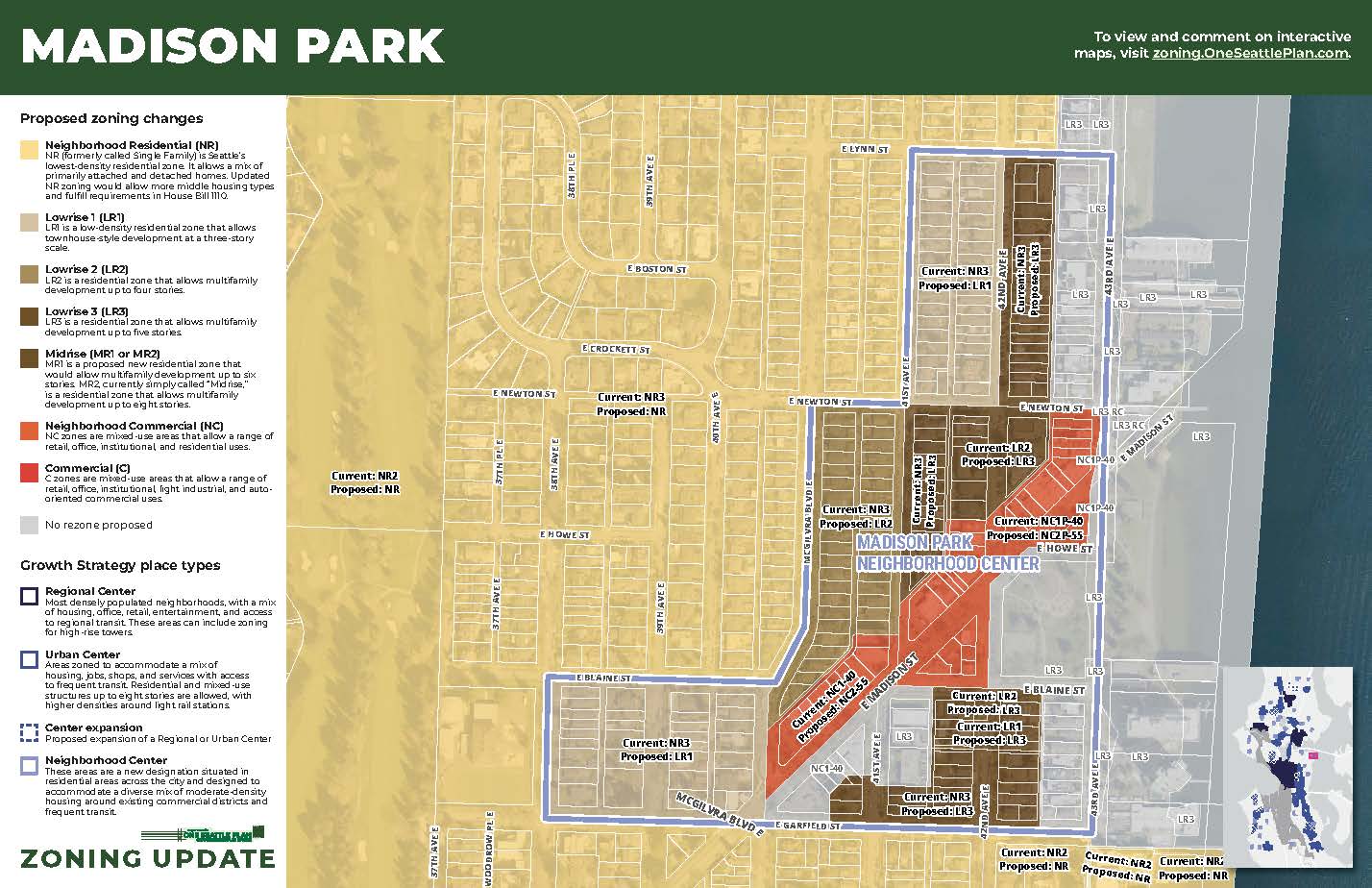
The present proposed designation of Madison Park as a Neighborhood Center fails to factor in the environmental impact on our location, our existing multi-family residential community and community's active partnership with the city in fostering equity and growth to our neighborhood.
FOUR GOALS OF THE ONE SEATTLE PLAN:
The One Seattle Plan has been proposed with following purposes-
1. Increase Housing Opportunities and Affordability
2. Focus on Investment for Complete, Walkable Communities
3. Promote an Equitable City
4. Create Environmental and Climate Strategies for a Resilient Future
As a Neighborhood Association representing our community the following are our concerns and responses to these stated goals.
GOAL 1: Housing Opportunities and Affordability
The Plan states that “the city envisions an ample supply of housing for a diverse range of incomes and cultures”.
1. Madison Park already has 1,377 multi-family units, compared to 675 single family residences.
In other words, 67% of our neighborhood housing is already multi-family and 33% is single family homes.
Many of these are rental units- at “affordable” rates by Seattle standards. With two-thirds of the 2052 residences being multi-family, these percentages are the opposite of most Seattle communities.
2. The mapped boundaries designating Madison Park as a “Neighborhood Center” do not include significant multi-family residential areas right on the edge of this NC/LR designation and within a block or two from the business center.
For example, 43rd Ave E is not included; E McGilvra with the Edgewater Apartments, Canterbury Shore Condos and other small complexes are not factored into the Plan.
4. We propose the One Seattle Plan expand its boundaries to include 43rd Ave E. and E. McGilvra, 41st Ave E and 42nd Ave E bordering E Madison in considering the need for Madison Park’s inclusion in the increased density of the One Seattle Plan..
5. We would further propose designating Madison Park as an NC1-40 Zone in the E. Madison corridor and retain the NR3 and LR1, LR2 designations already in place.
GOAL 2: Focus on Complete, Walkable Neighborhoods
Madison Park is already a “Complete, Walkable Neighborhood”.
1. The businesses, as well as community and recreational areas, are accessible within walking distance for the neighbors- ½ mile from one end of Madison Park to the other.
2. The businesses provide all the amenities of a Neighborhood Center- grocery store, pharmacy, post office, banks, shops, restaurants, housing- ALL within walking distance of multiunit and single family residences. Community events are abundant- children’s events, neighborhood meetings,book club, art walks and holiday events, crafts markets and social gatherings.
3. Friends of Madison Park is currently partnered with the City Parks and Recreation and the Seattle Parks Foundation- planning major improvements to the Madison Park Bathhouse as a gathering place for all, including the continued home of a community preschool.
Restoration of the Beach, replacement of the dock, enhancements to the park and playground are all in the planning stages with the goal for completion in five years. FoMP has joined the Friends of the Park city program for maintenance and improvements to our public spaces.
GOAL 3: Promotion of an Equitable City
1. The heart of Madison Park is adjacent to many blocks of historically beautiful homes- none of those touched by the proposed One Seattle Plan. But the flats of Madison Park combine diverse bungalows and ramblers, apartment buildings and condos that have been home to generations of Seattle residents.
2. The focus of the plan targets the core of our neighborhood that already provides amenities and housing accessibility to all and will erase the historic character and charm of our business area that goes back over a century.
3. Madison Park beach and its parks are already a city-wide destination year-round and plans with the City are already underway to enhance these public spaces and their availability to Seattle at large.
4. In the past, Seattle has implemented onerous regulations for landlords and is now faced with older apartment buildings being replaced with significantly more expensive high-rise housing- again pushing out people from city neighborhoods.
We would propose working with the property owners in Madison Park and throughout city neighborhoods to allow for affordable upgrades to existing condo and apartment buildings rather than tearing down blocks of single-family homes and businesses to be replaced with 4, 5 and 6 story multi-family- units crammed on small lots and still unaffordable.
GOAL 4: Implement Environmental and Climate Strategies for a Resilient Future
1. The proposed high-density growth in Madison Park ignores the fact that much of the area targeted as a Neighborhood Center is built on lake bottom clay of Lake Washington (after the lake was dropped 9 feet with the ship canal construction). Madison Park is effectively a peninsula, bounded by water on two sides and with Washington Park/Broadmoor acting as a third barrier.
2. Madison Park lacks sufficient drainage already- with sanitary sewers, but not storm sewers, resulting in overflow in the streets and washing into the lake, and ultimately into Puget Sound. The contamination of the water at the swimming beaches endangers public health (the beach was closed for several weeks this summer 2024 due to bacterial contamination from sewage overflows into the lake), and ultimately the salmon population.
3. The scale of increased density construction will result in more impervious surfaces, more runoff, removal of essential tree canopy and contra to Seattle’s Urban Forest Management Plan of 2020.
See Seattle Times editorial regarding the destructive effects of reduced open space integral to this high density model. https://www.seattletimes.com/opinion/more-concrete-less-green-a-cautionary-tale-about-upzoning-from-south-park/
4. With only one primary roadway in and out— already strained by choke points at Lake Washington Blvd and Madison Valley, increased density would overburden this single corridor.
Madison Park’s main bus route, the #11, is not a Bus Rapid Transit (BRT) line in Madison Park. Without genuine high- capacity transit at our doorstep, there is no compelling state mandate to push density beyond what our local infrastructure can bear. This lack of BRT or rail service justifies a more measured approach, not a full-scale upzoning to LR3.
5. Madison Park’s unique constraints, potential environmentally critical area (ECA)-like conditions, the requirements of the Growth Management Act (GMA), existing infrastructure limitations, mandates a thorough environmental review to ensure compliance with state requirements for protecting critical areas and preventing further environmental harm.
We, the undersigned, would propose that Seattle City Council pursue a scaled-back growth model.
* One that accounts for the environmental concerns of being on the shores of Lake Washington and being a destination neighborhood with no rapid transit, no infrastructure system that is feasible without exorbitant costs,
* One that recognizes the reality of Madison Park already being a community of financial diversity and walkability with a strong neighborhood center already in place and the vision underway for future improvements.
____________________________________
Signed

510
The Issue
MADISON PARK'S CONCERNS WITH THE IMPACT OF THE ONE SEATTLE PLAN
Friends of Madison Park (FoMP) recognizes that Seattle is facing significant growth, along with major challenges in home affordability, making it increasingly difficult for many to live and thrive in our city. We are committed to supporting a sustainable and comprehensive future for our neighborhood and the broader community.
The present proposed designation of Madison Park as a Neighborhood Center fails to factor in the environmental impact on our location, our existing multi-family residential community and community's active partnership with the city in fostering equity and growth to our neighborhood.
FOUR GOALS OF THE ONE SEATTLE PLAN:
The One Seattle Plan has been proposed with following purposes-
1. Increase Housing Opportunities and Affordability
2. Focus on Investment for Complete, Walkable Communities
3. Promote an Equitable City
4. Create Environmental and Climate Strategies for a Resilient Future
As a Neighborhood Association representing our community the following are our concerns and responses to these stated goals.
GOAL 1: Housing Opportunities and Affordability
The Plan states that “the city envisions an ample supply of housing for a diverse range of incomes and cultures”.
1. Madison Park already has 1,377 multi-family units, compared to 675 single family residences.
In other words, 67% of our neighborhood housing is already multi-family and 33% is single family homes.
Many of these are rental units- at “affordable” rates by Seattle standards. With two-thirds of the 2052 residences being multi-family, these percentages are the opposite of most Seattle communities.
2. The mapped boundaries designating Madison Park as a “Neighborhood Center” do not include significant multi-family residential areas right on the edge of this NC/LR designation and within a block or two from the business center.
For example, 43rd Ave E is not included; E McGilvra with the Edgewater Apartments, Canterbury Shore Condos and other small complexes are not factored into the Plan.
4. We propose the One Seattle Plan expand its boundaries to include 43rd Ave E. and E. McGilvra, 41st Ave E and 42nd Ave E bordering E Madison in considering the need for Madison Park’s inclusion in the increased density of the One Seattle Plan..
5. We would further propose designating Madison Park as an NC1-40 Zone in the E. Madison corridor and retain the NR3 and LR1, LR2 designations already in place.
GOAL 2: Focus on Complete, Walkable Neighborhoods
Madison Park is already a “Complete, Walkable Neighborhood”.
1. The businesses, as well as community and recreational areas, are accessible within walking distance for the neighbors- ½ mile from one end of Madison Park to the other.
2. The businesses provide all the amenities of a Neighborhood Center- grocery store, pharmacy, post office, banks, shops, restaurants, housing- ALL within walking distance of multiunit and single family residences. Community events are abundant- children’s events, neighborhood meetings,book club, art walks and holiday events, crafts markets and social gatherings.
3. Friends of Madison Park is currently partnered with the City Parks and Recreation and the Seattle Parks Foundation- planning major improvements to the Madison Park Bathhouse as a gathering place for all, including the continued home of a community preschool.
Restoration of the Beach, replacement of the dock, enhancements to the park and playground are all in the planning stages with the goal for completion in five years. FoMP has joined the Friends of the Park city program for maintenance and improvements to our public spaces.
GOAL 3: Promotion of an Equitable City
1. The heart of Madison Park is adjacent to many blocks of historically beautiful homes- none of those touched by the proposed One Seattle Plan. But the flats of Madison Park combine diverse bungalows and ramblers, apartment buildings and condos that have been home to generations of Seattle residents.
2. The focus of the plan targets the core of our neighborhood that already provides amenities and housing accessibility to all and will erase the historic character and charm of our business area that goes back over a century.
3. Madison Park beach and its parks are already a city-wide destination year-round and plans with the City are already underway to enhance these public spaces and their availability to Seattle at large.
4. In the past, Seattle has implemented onerous regulations for landlords and is now faced with older apartment buildings being replaced with significantly more expensive high-rise housing- again pushing out people from city neighborhoods.
We would propose working with the property owners in Madison Park and throughout city neighborhoods to allow for affordable upgrades to existing condo and apartment buildings rather than tearing down blocks of single-family homes and businesses to be replaced with 4, 5 and 6 story multi-family- units crammed on small lots and still unaffordable.
GOAL 4: Implement Environmental and Climate Strategies for a Resilient Future
1. The proposed high-density growth in Madison Park ignores the fact that much of the area targeted as a Neighborhood Center is built on lake bottom clay of Lake Washington (after the lake was dropped 9 feet with the ship canal construction). Madison Park is effectively a peninsula, bounded by water on two sides and with Washington Park/Broadmoor acting as a third barrier.
2. Madison Park lacks sufficient drainage already- with sanitary sewers, but not storm sewers, resulting in overflow in the streets and washing into the lake, and ultimately into Puget Sound. The contamination of the water at the swimming beaches endangers public health (the beach was closed for several weeks this summer 2024 due to bacterial contamination from sewage overflows into the lake), and ultimately the salmon population.
3. The scale of increased density construction will result in more impervious surfaces, more runoff, removal of essential tree canopy and contra to Seattle’s Urban Forest Management Plan of 2020.
See Seattle Times editorial regarding the destructive effects of reduced open space integral to this high density model. https://www.seattletimes.com/opinion/more-concrete-less-green-a-cautionary-tale-about-upzoning-from-south-park/
4. With only one primary roadway in and out— already strained by choke points at Lake Washington Blvd and Madison Valley, increased density would overburden this single corridor.
Madison Park’s main bus route, the #11, is not a Bus Rapid Transit (BRT) line in Madison Park. Without genuine high- capacity transit at our doorstep, there is no compelling state mandate to push density beyond what our local infrastructure can bear. This lack of BRT or rail service justifies a more measured approach, not a full-scale upzoning to LR3.
5. Madison Park’s unique constraints, potential environmentally critical area (ECA)-like conditions, the requirements of the Growth Management Act (GMA), existing infrastructure limitations, mandates a thorough environmental review to ensure compliance with state requirements for protecting critical areas and preventing further environmental harm.
We, the undersigned, would propose that Seattle City Council pursue a scaled-back growth model.
* One that accounts for the environmental concerns of being on the shores of Lake Washington and being a destination neighborhood with no rapid transit, no infrastructure system that is feasible without exorbitant costs,
* One that recognizes the reality of Madison Park already being a community of financial diversity and walkability with a strong neighborhood center already in place and the vision underway for future improvements.
____________________________________
Signed
The Decision Makers


Supporter Voices
Petition Updates
Share this petition
Petition created on January 29, 2025