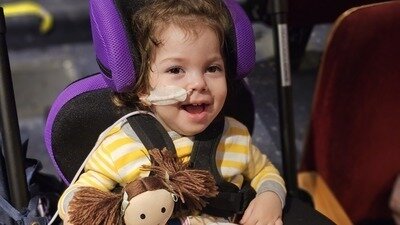

How Disabled Does a Child Need to Be? Approve Abby’s Companion Card
The issue
Every day, my daughter Abby wakes up completely dependent on the people around her. She cannot sit up by herself, stand, walk or reposition her body when she becomes uncomfortable or begins to collapse to one side. She cannot independently reach for what she needs, clearly tell us what is wrong, feed herself safely or move towards the people and things she loves.
Abby relies on us for almost every part of her day. We lift her out of bed, support and position her body, carry her or place her into specialised seating and mobility equipment. We prepare her food to a safe texture, carefully feed her and watch for signs that she is struggling to swallow. Because of her feeding difficulties and aspiration risk, Abby also requires nasogastric tube feeds. Each feed involves checking the placement of the tube, preparing and slowly administering the feed, flushing the tube and monitoring her throughout.
We give her anti-seizure and antiviral medication twice every day. We take her to medical appointments and therapies, manage her equipment, advocate for funding and services, complete reports and applications, communicate with her extensive care team and constantly plan around her physical and medical needs.
We also sing to her, cuddle her, help her play, interpret her smiles and cries, and work hard to make sure she is included in the world around her. We do all of this because Abby is our beautiful little girl and we love her beyond words. But none of this is ordinary supervision for a child her age.
Abby developed HSV-1 encephalitis as a newborn. The infection caused significant and permanent injury to her brain. She now lives with quadriplegic cerebral palsy, global developmental delay, severe physical impairment, feeding and swallowing difficulties, complex communication needs and a history of seizures.
She works incredibly hard for every achievement. Abby has a beautiful smile and loves songs, bubbles, cuddles and being spoken to directly. She wants to be involved in everything happening around her. But wanting to participate and being physically able to participate are two very different things.
When Abby attends a community venue, activity or family outing, the adult accompanying her is not simply watching over a young child. That person must lift and transfer her, safely position her body, manage her wheelchair and equipment, support her posture, assist with feeding, monitor her swallowing and medical safety, interpret her communication, provide personal care and physically enable her to participate.
Without that support, Abby cannot safely access or participate in the community.
Abby’s Companion Card has been denied twice
A Companion Card recognises that a person with significant and permanent disability cannot access the community without another person providing essential attendant care. Despite Abby’s profound and permanent disabilities, her application has now been denied twice.
After the first denial, I gathered extensive additional evidence from the professionals who know Abby and care for her. Her second application included supporting letters from her GP, paediatrician, neurologist, physiotherapist, occupational therapist, speech pathologist, dietitian, feeding specialists and music therapist. I also submitted a detailed parent statement explaining Abby’s daily life and her complete dependence on an adult and a supporting letter from her paediatrician that clearly states her condition is a permanent disability.
Despite all of this evidence, her application was denied again. The refusal email did not even explain why.
When I eventually spoke with the Companion Card team, I was told that it was still difficult to prove that Abby’s need for attendant care would be lifelong. I was also told that, because of her age, she already requires adult supervision.
That explanation has left our family shocked and deeply angry.
Of course young children need supervision. But most young children do not need to be lifted and transferred throughout the day. They do not require specialised wheelchairs and supportive seating. They do not depend on another person to hold their body safely upright. They do not require tube feeding, aspiration monitoring, seizure medication and disability-specific support to participate in a simple family outing.
They do not need another person to physically enable every part of their participation.
To describe Abby’s care as ordinary age-related supervision is to ignore the reality of her disability.
How is a young child supposed to prove a lifetime?
Abby has permanent brain injury and quadriplegic cerebral palsy. Her age does not make those diagnoses temporary.
Therapy may help her build skills and reach her potential. We will always encourage her and never place limits on what she may achieve. But therapy cannot undo her brain injury, remove her cerebral palsy or turn her disability-specific care needs into ordinary parenting.
Abby appears to be trapped by an impossible standard. She is considered too young for her extensive care needs to be distinguished from ordinary parental supervision, yet she is also considered too young to prove that those needs will continue throughout her life.
How can any profoundly disabled child meet that test?
How disabled does a child need to be before their need for essential attendant care is recognised?
This decision affects our whole family
Every family outing already requires careful planning. We need to consider wheelchair access, feeding times, medications, safe positioning, fatigue, transfers, personal care and whether Abby’s needs can be managed at the venue. We cannot simply arrive somewhere and participate like another family.
When we do attend a zoo, museum, show, attraction or community event, the adult supporting Abby is not an optional extra guest. They are there because Abby cannot attend without them.
Without a Companion Card, our family is expected to pay an additional admission fee for the person providing Abby’s essential disability care. We are being financially penalised simply because our daughter is disabled.
This creates another barrier between Abby and the ordinary childhood experiences she deserves to share with her brother and family.
What we are asking for
We are calling on the NSW Government and the NSW Companion Card program to urgently review and approve Abby’s application. We are asking them to recognise the difference between ordinary parental supervision and disability-specific attendant care, properly consider the extensive evidence already provided by Abby’s medical and therapy team, provide transparent written reasons for the previous refusals, and ensure that young children with profound and permanent disabilities are not disadvantaged because of their age.
Please sign and share this petition.
Help us tell the NSW Government that permanent disability does not become less real because the person living with it is a child.
Abby deserves access, inclusion and the opportunity to participate in family and community life without her disability becoming an additional admission charge.
Most of all, she deserves to have her very real and lifelong needs recognised.

Victory
The issue
Every day, my daughter Abby wakes up completely dependent on the people around her. She cannot sit up by herself, stand, walk or reposition her body when she becomes uncomfortable or begins to collapse to one side. She cannot independently reach for what she needs, clearly tell us what is wrong, feed herself safely or move towards the people and things she loves.
Abby relies on us for almost every part of her day. We lift her out of bed, support and position her body, carry her or place her into specialised seating and mobility equipment. We prepare her food to a safe texture, carefully feed her and watch for signs that she is struggling to swallow. Because of her feeding difficulties and aspiration risk, Abby also requires nasogastric tube feeds. Each feed involves checking the placement of the tube, preparing and slowly administering the feed, flushing the tube and monitoring her throughout.
We give her anti-seizure and antiviral medication twice every day. We take her to medical appointments and therapies, manage her equipment, advocate for funding and services, complete reports and applications, communicate with her extensive care team and constantly plan around her physical and medical needs.
We also sing to her, cuddle her, help her play, interpret her smiles and cries, and work hard to make sure she is included in the world around her. We do all of this because Abby is our beautiful little girl and we love her beyond words. But none of this is ordinary supervision for a child her age.
Abby developed HSV-1 encephalitis as a newborn. The infection caused significant and permanent injury to her brain. She now lives with quadriplegic cerebral palsy, global developmental delay, severe physical impairment, feeding and swallowing difficulties, complex communication needs and a history of seizures.
She works incredibly hard for every achievement. Abby has a beautiful smile and loves songs, bubbles, cuddles and being spoken to directly. She wants to be involved in everything happening around her. But wanting to participate and being physically able to participate are two very different things.
When Abby attends a community venue, activity or family outing, the adult accompanying her is not simply watching over a young child. That person must lift and transfer her, safely position her body, manage her wheelchair and equipment, support her posture, assist with feeding, monitor her swallowing and medical safety, interpret her communication, provide personal care and physically enable her to participate.
Without that support, Abby cannot safely access or participate in the community.
Abby’s Companion Card has been denied twice
A Companion Card recognises that a person with significant and permanent disability cannot access the community without another person providing essential attendant care. Despite Abby’s profound and permanent disabilities, her application has now been denied twice.
After the first denial, I gathered extensive additional evidence from the professionals who know Abby and care for her. Her second application included supporting letters from her GP, paediatrician, neurologist, physiotherapist, occupational therapist, speech pathologist, dietitian, feeding specialists and music therapist. I also submitted a detailed parent statement explaining Abby’s daily life and her complete dependence on an adult and a supporting letter from her paediatrician that clearly states her condition is a permanent disability.
Despite all of this evidence, her application was denied again. The refusal email did not even explain why.
When I eventually spoke with the Companion Card team, I was told that it was still difficult to prove that Abby’s need for attendant care would be lifelong. I was also told that, because of her age, she already requires adult supervision.
That explanation has left our family shocked and deeply angry.
Of course young children need supervision. But most young children do not need to be lifted and transferred throughout the day. They do not require specialised wheelchairs and supportive seating. They do not depend on another person to hold their body safely upright. They do not require tube feeding, aspiration monitoring, seizure medication and disability-specific support to participate in a simple family outing.
They do not need another person to physically enable every part of their participation.
To describe Abby’s care as ordinary age-related supervision is to ignore the reality of her disability.
How is a young child supposed to prove a lifetime?
Abby has permanent brain injury and quadriplegic cerebral palsy. Her age does not make those diagnoses temporary.
Therapy may help her build skills and reach her potential. We will always encourage her and never place limits on what she may achieve. But therapy cannot undo her brain injury, remove her cerebral palsy or turn her disability-specific care needs into ordinary parenting.
Abby appears to be trapped by an impossible standard. She is considered too young for her extensive care needs to be distinguished from ordinary parental supervision, yet she is also considered too young to prove that those needs will continue throughout her life.
How can any profoundly disabled child meet that test?
How disabled does a child need to be before their need for essential attendant care is recognised?
This decision affects our whole family
Every family outing already requires careful planning. We need to consider wheelchair access, feeding times, medications, safe positioning, fatigue, transfers, personal care and whether Abby’s needs can be managed at the venue. We cannot simply arrive somewhere and participate like another family.
When we do attend a zoo, museum, show, attraction or community event, the adult supporting Abby is not an optional extra guest. They are there because Abby cannot attend without them.
Without a Companion Card, our family is expected to pay an additional admission fee for the person providing Abby’s essential disability care. We are being financially penalised simply because our daughter is disabled.
This creates another barrier between Abby and the ordinary childhood experiences she deserves to share with her brother and family.
What we are asking for
We are calling on the NSW Government and the NSW Companion Card program to urgently review and approve Abby’s application. We are asking them to recognise the difference between ordinary parental supervision and disability-specific attendant care, properly consider the extensive evidence already provided by Abby’s medical and therapy team, provide transparent written reasons for the previous refusals, and ensure that young children with profound and permanent disabilities are not disadvantaged because of their age.
Please sign and share this petition.
Help us tell the NSW Government that permanent disability does not become less real because the person living with it is a child.
Abby deserves access, inclusion and the opportunity to participate in family and community life without her disability becoming an additional admission charge.
Most of all, she deserves to have her very real and lifelong needs recognised.
The Decision Makers

Supporter voices
Petition Updates
Share this petition
Petition created on 19 July 2026