

Health Stars on Ultra-Processed Foods? Say NO to Mandating a Broken Labelling System!
The issue
The Australian Government is about to lock in a food rating system that risks misleading families, undermines public health, and shields processed food giants from accountability at the expense of Australians’ wellbeing.
The Australian Government is preparing to mandate the Health Star Rating system, meaning all packaged foods will be required to display it on their labels.
Parents across Australia are already standing with us. Every signature strengthens our voice and makes it harder for the government to ignore. When thousands speak as one, we change the conversation and the system.
Ultra-processed foods (UPFs) now make up more than 50% of the average Australian diet. Research, including large-scale international studies, has linked UPF consumption to:
- ADHD like symptoms – ↑ risk up to 25%
- Cancer – ↑ risk up to 32%
- Heart disease – ↑ risk up to 50%
- Depression – ↑ risk up to 22%
- Type 2 diabetes – ↑ risk up to 12%
- Early death – ↑ risk up to 21%
MANDATING IT NOW POSES SIGNIFICANT RISKS
Food manufacturers can easily manipulate the system and reward their products with high, inflated ratings. If we do nothing now, this flawed system will continue to confuse shoppers, penalise clean-label brands, and lock in a broken algorithm that benefits Big Food over Australian families. Once this system becomes mandatory, it will influence every trolley, every home, and every child’s lunchbox.
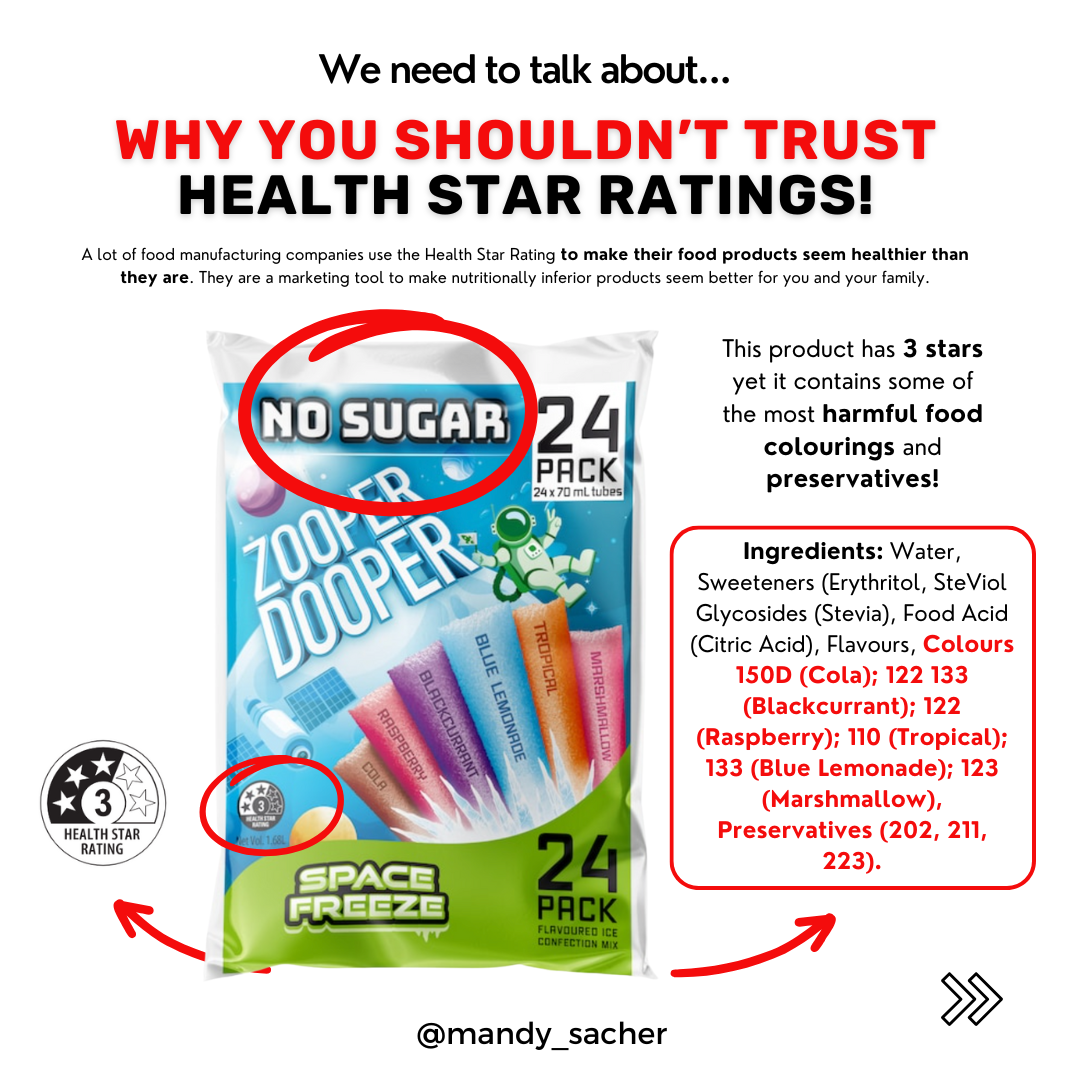
WHAT'S WRONG WITH THE HEALTH STAR RATING SYSTEM?
- Ignores ultra-processing and additives despite strong evidence linking both to chronic disease
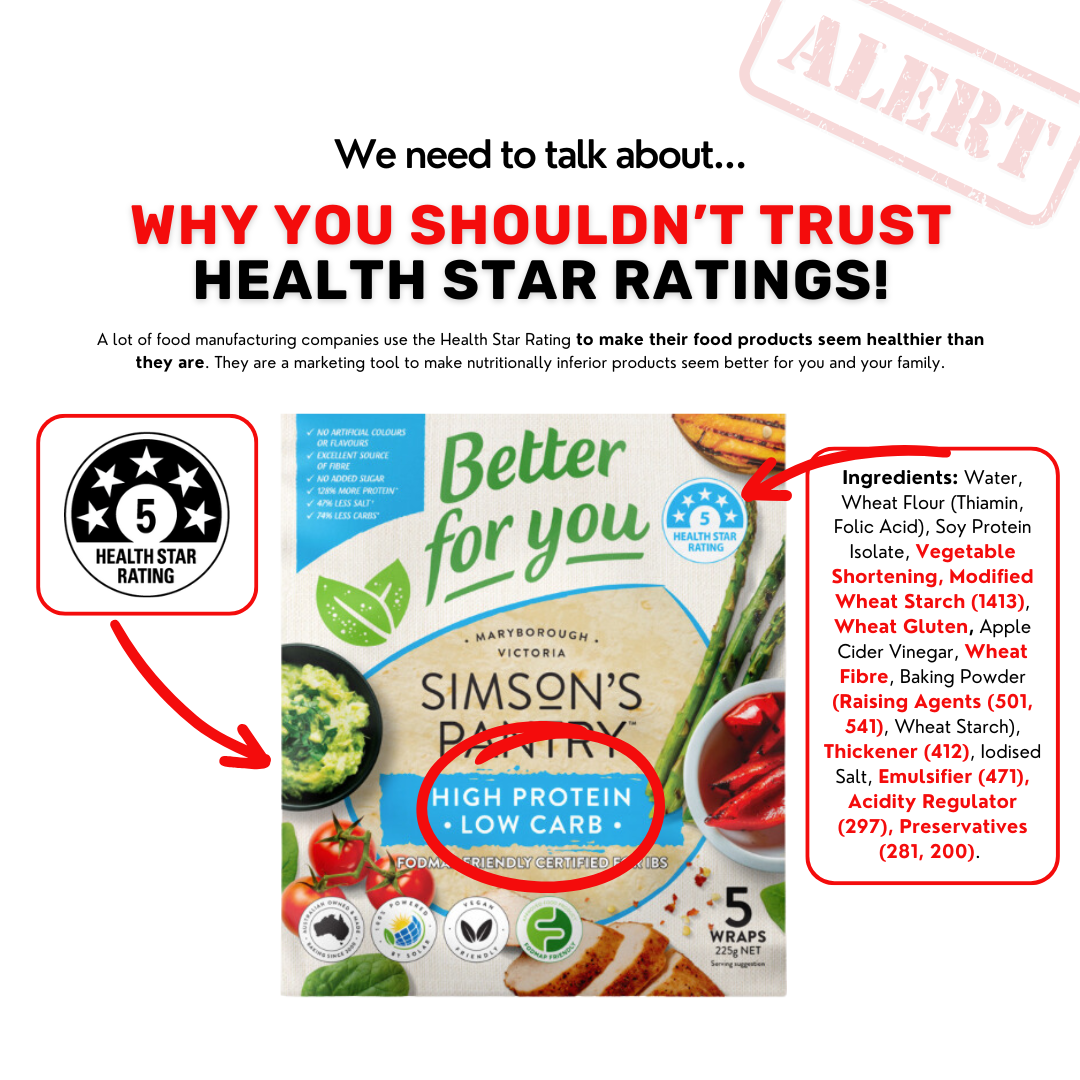
- Rewards ultra-processed food, penalises real food with UPFs routinely outscoring nutrient-dense wholefoods like nuts, butter, seeds, and plain yoghurt.
- Lacks independent oversight as brands can “game” the system with no watchdog to keep them accountable.
- Influenced by food industry stakeholders, who helped to develop the algorithm and calculator.
- Built on outdated nutrition science as still tied to the 2013 Australian Dietary Guidelines.
- Category comparisons hide the truth allowing confectionery and junk foods to achieve high ratings that mislead consumers about absolute healthiness.
- Inflates scores with synthetic fibres and isolated proteins that boost star ratings without improving real nutritional quality.
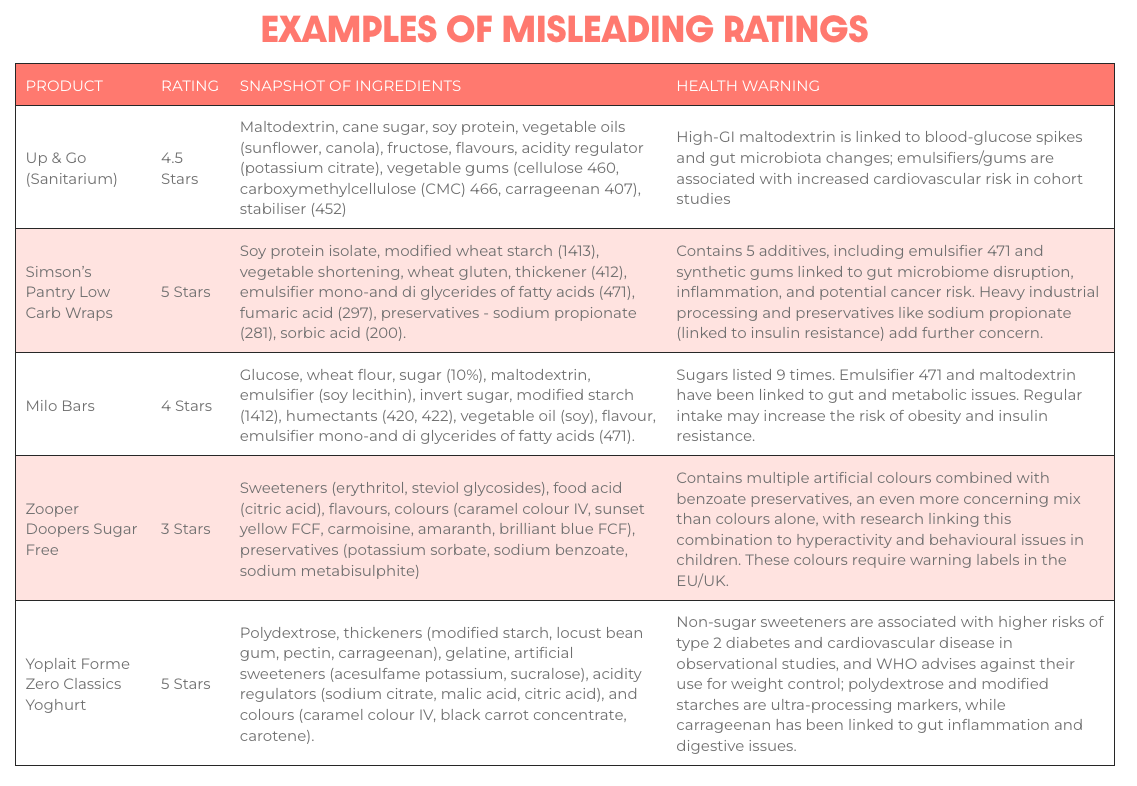
The result? Ultra-processed snacks loaded with sugar, emulsifiers and fake fibre score higher than nuts, seeds, dried fruit, wholegrain bread or yoghurt.
WHAT WE'RE DEMANDING
We are calling on all Australian State and Territory Health Ministers, and the Australian Department of Health and Aged Care.
- Pause the mandate until a full, independent review of the Health Star Rating algorithm – including how stars are calculated and the criteria they’re based on – is conducted free from industry influence and grounded in the latest science.
- Factor in processing level and additive burden in the algorithm, including the number and type of additives, the presence of ultra-processed ingredients, and the degree of industrial processing (as defined by the NOVA classification).
- Ban Health Star Ratings above 3 for products containing:
- Artificial colours (linked to hyperactivity in children and carrying EU behavioural warnings, e.g. 102 Tartrazine, 104 Quinoline Yellow, 110 Sunset Yellow FCF, 122 Carmoisine, 123 Amaranth, 124 Ponceau 4R, 129 Allura Red AC)
- Emulsifiers (e.g. 471 Mono- & diglycerides, 407 Carrageenan, 432–436 Polysorbates)
- Artificial sweeteners (e.g. 951 Aspartame, 955 Sucralose, 954 Saccharin, 952 Cyclamates)
- Preservatives (e.g. 211 Sodium Benzoate, 320 BHA, 321 BHT)
- Flavour enhancers (e.g. 621 MSG, 627 Disodium guanylate, 631 Disodium inosinate)
- Synthetic fibres (e.g. 466 Carboxymethylcellulose (CMC), 1200 Polydextrose)
- Update the Australian Dietary Guidelines every five years. Australia’s Dietary Guidelines have not been updated since 2013, yet they continue to shape the Health Star Rating algorithm, school canteen menus, and childcare centre food policies. Outdated science is guiding what’s fed to our children at a national level.
- Appoint independent public health experts with no ties to the food industry to govern the system, ensure transparency, and safeguard public trust.
- Reward additive-free, wholefood formulations with higher star ratings and provide incentives for manufacturers to use real, nutrient-dense ingredients.
We’re not anti-labelling. We’re pro-science, pro-parent, and pro-transparency.
We're not asking to scrap the system. Front of packaging labels are a helpful tool when they are independent and transparent. We're asking to fix it before it's made mandatory because, as it stands, it's more of a marketing tool than a practical nutrition guide for consumers.
When you add your name, you’re joining a movement of parents, educators, health professionals, and everyday Australians who believe our kids deserve better. This is more than a petition. It’s a stand for transparency, for science, and for the future of real food in Australia.
That’s why I founded the Real Food Rating — to expose what’s really in our food and show how a science-based system should work.
While countries like Brazil advise avoiding UPFs altogether and the EU warns consumers about risky additives, Australia is about to give ultra-processed products a government-endorsed “health” tick.
Even worse, clean-label brands may be forced to add gut-disrupting synthetic fibres and protein isolates just to keep their stars high, punishing wholefoods and rewarding industrial processing.
THIS IS ABOUT PROTECTING FAMILIES
We are shaping children’s taste preferences from the very first bite. When parents are steered toward ultra-processed snacks disguised as healthy, we’re setting them up for a lifetime of poor eating habits.
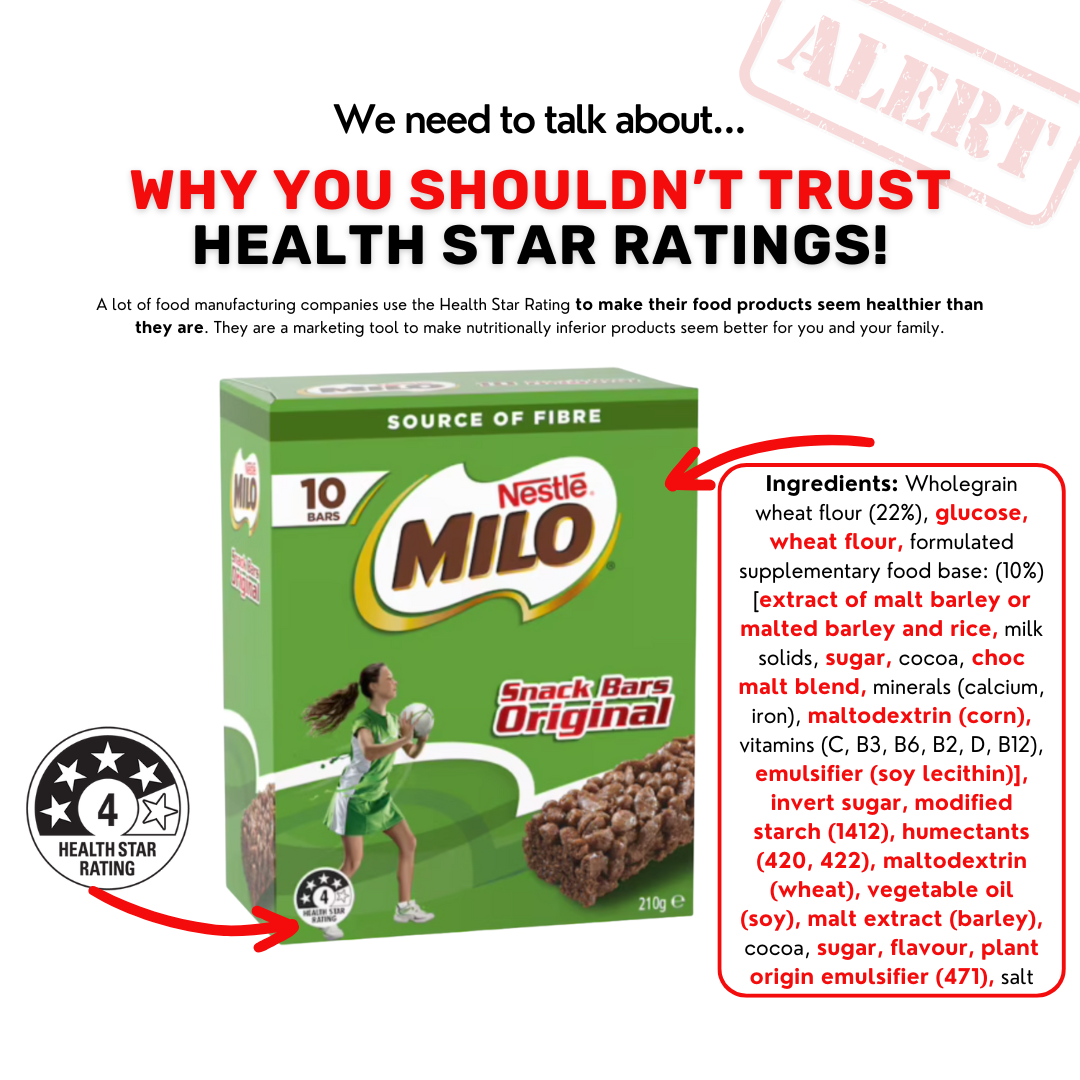
These products are engineered to override hunger cues and hijack developing brains, making real food less appealing over time. Once those patterns take hold, they are hard to break.
Don’t let health ratings serve as marketing tools for the processed food industry. We need truth in labelling built on independent science, not a system created by the very companies it is meant to regulate.
SIGN THE PETITION
We have a small window to act before this becomes policy. The sooner we build momentum, the stronger our case will be when we demand change. Every day we delay is another day this system gains ground.
- Let’s fix this system before it’s locked in.
- Let’s demand a food labelling standard that reflects real science, not industry spin.
- Let’s protect children, families, and the future of our food system.
Sign the petition now on Change.org — it takes just 20 seconds. Our ultimate goal is 5,000 signatures to show the government that families want change. Help us hit our first milestone of 500 today!
Then head to the Real Food Rating petition page where you can access detailed information on the science and research that this petition is based on.
Join our Real Food Rating newsletter. You’ll get campaign updates, breaking news on food labelling, real food recipes, early access to the Real Food Rating app, and access to detailed information on the science and research that the Real Food Rating is built on.
You can also explore the products we’ve already rated to see exactly how different foods stack up on ingredients, additives, and processing.
Signing shows your support. Joining our newsletter gives you the tools, knowledge, and resources to keep making change long after this petition closes.

15,701
The issue
The Australian Government is about to lock in a food rating system that risks misleading families, undermines public health, and shields processed food giants from accountability at the expense of Australians’ wellbeing.
The Australian Government is preparing to mandate the Health Star Rating system, meaning all packaged foods will be required to display it on their labels.
Parents across Australia are already standing with us. Every signature strengthens our voice and makes it harder for the government to ignore. When thousands speak as one, we change the conversation and the system.
Ultra-processed foods (UPFs) now make up more than 50% of the average Australian diet. Research, including large-scale international studies, has linked UPF consumption to:
- ADHD like symptoms – ↑ risk up to 25%
- Cancer – ↑ risk up to 32%
- Heart disease – ↑ risk up to 50%
- Depression – ↑ risk up to 22%
- Type 2 diabetes – ↑ risk up to 12%
- Early death – ↑ risk up to 21%
MANDATING IT NOW POSES SIGNIFICANT RISKS
Food manufacturers can easily manipulate the system and reward their products with high, inflated ratings. If we do nothing now, this flawed system will continue to confuse shoppers, penalise clean-label brands, and lock in a broken algorithm that benefits Big Food over Australian families. Once this system becomes mandatory, it will influence every trolley, every home, and every child’s lunchbox.
WHAT'S WRONG WITH THE HEALTH STAR RATING SYSTEM?
- Ignores ultra-processing and additives despite strong evidence linking both to chronic disease
- Rewards ultra-processed food, penalises real food with UPFs routinely outscoring nutrient-dense wholefoods like nuts, butter, seeds, and plain yoghurt.
- Lacks independent oversight as brands can “game” the system with no watchdog to keep them accountable.
- Influenced by food industry stakeholders, who helped to develop the algorithm and calculator.
- Built on outdated nutrition science as still tied to the 2013 Australian Dietary Guidelines.
- Category comparisons hide the truth allowing confectionery and junk foods to achieve high ratings that mislead consumers about absolute healthiness.
- Inflates scores with synthetic fibres and isolated proteins that boost star ratings without improving real nutritional quality.
The result? Ultra-processed snacks loaded with sugar, emulsifiers and fake fibre score higher than nuts, seeds, dried fruit, wholegrain bread or yoghurt.
WHAT WE'RE DEMANDING
We are calling on all Australian State and Territory Health Ministers, and the Australian Department of Health and Aged Care.
- Pause the mandate until a full, independent review of the Health Star Rating algorithm – including how stars are calculated and the criteria they’re based on – is conducted free from industry influence and grounded in the latest science.
- Factor in processing level and additive burden in the algorithm, including the number and type of additives, the presence of ultra-processed ingredients, and the degree of industrial processing (as defined by the NOVA classification).
- Ban Health Star Ratings above 3 for products containing:
- Artificial colours (linked to hyperactivity in children and carrying EU behavioural warnings, e.g. 102 Tartrazine, 104 Quinoline Yellow, 110 Sunset Yellow FCF, 122 Carmoisine, 123 Amaranth, 124 Ponceau 4R, 129 Allura Red AC)
- Emulsifiers (e.g. 471 Mono- & diglycerides, 407 Carrageenan, 432–436 Polysorbates)
- Artificial sweeteners (e.g. 951 Aspartame, 955 Sucralose, 954 Saccharin, 952 Cyclamates)
- Preservatives (e.g. 211 Sodium Benzoate, 320 BHA, 321 BHT)
- Flavour enhancers (e.g. 621 MSG, 627 Disodium guanylate, 631 Disodium inosinate)
- Synthetic fibres (e.g. 466 Carboxymethylcellulose (CMC), 1200 Polydextrose)
- Update the Australian Dietary Guidelines every five years. Australia’s Dietary Guidelines have not been updated since 2013, yet they continue to shape the Health Star Rating algorithm, school canteen menus, and childcare centre food policies. Outdated science is guiding what’s fed to our children at a national level.
- Appoint independent public health experts with no ties to the food industry to govern the system, ensure transparency, and safeguard public trust.
- Reward additive-free, wholefood formulations with higher star ratings and provide incentives for manufacturers to use real, nutrient-dense ingredients.
We’re not anti-labelling. We’re pro-science, pro-parent, and pro-transparency.
We're not asking to scrap the system. Front of packaging labels are a helpful tool when they are independent and transparent. We're asking to fix it before it's made mandatory because, as it stands, it's more of a marketing tool than a practical nutrition guide for consumers.
When you add your name, you’re joining a movement of parents, educators, health professionals, and everyday Australians who believe our kids deserve better. This is more than a petition. It’s a stand for transparency, for science, and for the future of real food in Australia.
That’s why I founded the Real Food Rating — to expose what’s really in our food and show how a science-based system should work.
While countries like Brazil advise avoiding UPFs altogether and the EU warns consumers about risky additives, Australia is about to give ultra-processed products a government-endorsed “health” tick.
Even worse, clean-label brands may be forced to add gut-disrupting synthetic fibres and protein isolates just to keep their stars high, punishing wholefoods and rewarding industrial processing.
THIS IS ABOUT PROTECTING FAMILIES
We are shaping children’s taste preferences from the very first bite. When parents are steered toward ultra-processed snacks disguised as healthy, we’re setting them up for a lifetime of poor eating habits.
These products are engineered to override hunger cues and hijack developing brains, making real food less appealing over time. Once those patterns take hold, they are hard to break.
Don’t let health ratings serve as marketing tools for the processed food industry. We need truth in labelling built on independent science, not a system created by the very companies it is meant to regulate.
SIGN THE PETITION
We have a small window to act before this becomes policy. The sooner we build momentum, the stronger our case will be when we demand change. Every day we delay is another day this system gains ground.
- Let’s fix this system before it’s locked in.
- Let’s demand a food labelling standard that reflects real science, not industry spin.
- Let’s protect children, families, and the future of our food system.
Sign the petition now on Change.org — it takes just 20 seconds. Our ultimate goal is 5,000 signatures to show the government that families want change. Help us hit our first milestone of 500 today!
Then head to the Real Food Rating petition page where you can access detailed information on the science and research that this petition is based on.
Join our Real Food Rating newsletter. You’ll get campaign updates, breaking news on food labelling, real food recipes, early access to the Real Food Rating app, and access to detailed information on the science and research that the Real Food Rating is built on.
You can also explore the products we’ve already rated to see exactly how different foods stack up on ingredients, additives, and processing.
Signing shows your support. Joining our newsletter gives you the tools, knowledge, and resources to keep making change long after this petition closes.
Supporter voices
Petition Updates
Share this petition
Petition created on 9 August 2025