

Exonerate Ron Makin for baseless arson charges!
The Issue
Short version in these bullet items:
- With ZERO evidence of Ron Makin's guilt, investigators and prosecutors falsely accused Ron of starting a small, minimally dangerous fire along the full length of a public hallway and adjacent stairwell in the west building of the Meadows Apartments. The fire caused almost no damage.
- Investigators allege that gasoline was used in the fire, without any evidence that it was a gasoline fire or that anyone brought gasoline inside the building! The residents along that hallway didn't report smelling any gasoline inside the building, which would be impossible in these buildings if gasoline had been used.
- A man in a red T-shirt — NOT Ron — actually confessed to being in the fire area when the fire started, and seemed to say it was an accident and acted like he thought he was at fault!
- All of the evidence strongly indicates that this "man in red" accidentally spilled alcohol from a leaking garbage bag on the way to the outside dumpster. This man in red said, in the officer's bodycam video, that he was around the flames while smoke and flames were starting; but the surveillance footage of the man in red being in this area has been withheld! The man in red was also the only person medically treated for fire-related injuries (smoke inhalation), yet he is only shown in the fire area (in the provided footage) after the fire was extinguished and after he (the man in red) had REENTERED the building to look at the post-fire damage after his initial evacuation. The man in red was obviously panicking, AFTER he saw that the fire was out!
- The man in red didn't live in the fire-affected area of the building, but after he returned from the hospital, he inexplicably moved out of the building that very night!
- Investigators never provided any evidence that Ron was on (or near) the Meadows property around the time the fire ignited. Investigators didn't provide any outdoor surveillance footage, even though there were two outdoor cameras watching the Meadows property. The outdoor footage would have exonerated Ron by showing him leaving the Meadows property ~15 minutes before the fire ignited and later returning to the property ~15 minutes after ignition. The indoor surveillance footage corroborates Ron's assertion that he wasn't near the Meadows property by showing him leaving and reentering his apartment building at those respective times.
- Further, at the same time that the Meadows fire started, Ron witnessed a documented traffic stop during his late-night walk a half-mile away from the Meadows, and he described this traffic stop event multiple times in an officer's bodycam footage and the jail interview video, an event which investigators ignored. Ron could not have known about this traffic stop if he had not physically been there.
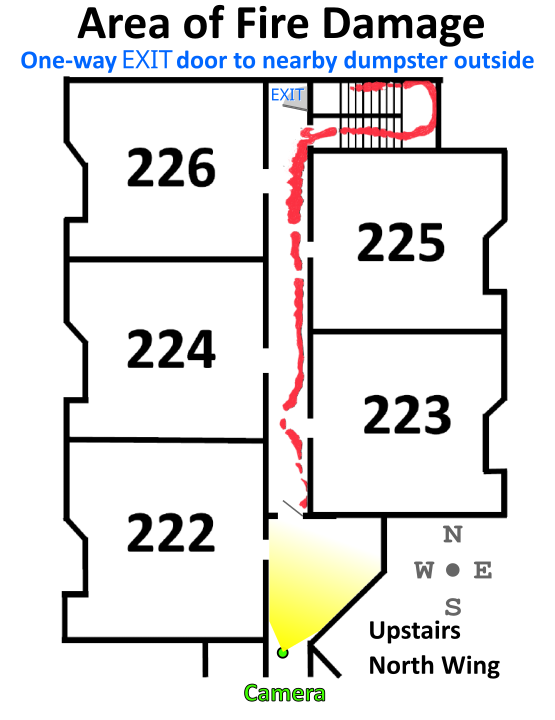
The right-handed red path, which was drawn by the Prosecution, indicates the exact areas of fire damage. This negligible damage amount cannot be the result of a gasoline fire!
Also see MeadowsFire.com (Flames Of Injustice) -- On Oct 12, 2022, Ronald Wayne Makin, who has obvious communicative and neurological disabilities from a childhood traumatic brain injury (TBI), as well as several serious physical health issues, was sentenced harshly for starting an indoor, alleged "gasoline" fire (in which no one smelled gasoline!) when he was 1/2 mile away from the fire and had nothing to do with starting, after his own attorney coerced him into pleading "no contest," which was not what he or his friends wanted. There is tons of evidence to prove that Ron is fully innocent, but...
- Ron's last two (of three) lawyers never tried to defend Ron in court nor even suggest that he was or could be innocent. They did not seem to care what the hard facts were and only relied upon the counterfactual statements, materials, hearsay and the opinions of NON-material and NON-expert witness statements of residents and police officers, provided by the Prosecution.
- Ron's last two (of three) lawyers only ever urged Ron to plead "no contest." "Not guilty" was never considered by them. Ron had previously pleaded "not guilty," and he had been adamant that he would never plead "no contest," but Ron was eventually "persuaded" by his latest lawyer to believe that pleading "no contest" was the best option.
- The Prosecution only made outrageous, counterfactual claims against Ron and never substantiated their claims with evidence.
- Ron's last two (of three) lawyers never objected to any of the Prosecution's claims.
- At Ron's sentencing, the Prosecution, who strongly implied that Ron is a consummate liar, claimed that Ron "always" had some kind of story, machination or excuse for everything the investigators questioned him about. (That's another way of saying that Ron had nothing to do with starting the fire and that he was telling the truth!)
- The Prosecution never presented any direct evidence or physical attributes to show that it was emphatically a gasoline fire.
- The only evidence that was presented was created in pathetic hearsay and concoction.
- Ron was convicted and sentenced by the judge based on only the vicious, unsubstantiated lies from the Prosecution, without any favorable evidence ever having been presented to the judge!
- The judge sentenced Ron without ever hearing any evidence that gives the slightest indication that Ron could have or would have done it. (We mean that there was absolutely NO substantive evidence that Ron did it.)
- No just trial was ever held. No form of trial was ever held, not even a semblance of a trial!
The judge said that he would treat Ron's "no contest" plea as severely as a "guilty" plea! Ron's sentence is a horrendous slew of punishments:
- The judge sentenced Ron to 1-15 years prison but is suspending that requirement.
- Ron must serve a total of 90 days in jail (starting on Oct 14, 2022),
- 105 days on an ankle monitor,
- 36 months probation,
- over $30,000 in damages restitution (to be determined at Nov 23 hearing),
- additional, frequently-assigned requirements,
- a Felony 1 charge will be on his record—with the shame and heartbreak and consequent encumbrances—for the rest of his life, for something he DID NOT DO!
The investigators relied upon the uneducated opinions of the residents to "determine" that it was arson, without having inspected the area or considered the fact that there is a dumpster near the fire area and that some form of alcohol very likely leaked from a trash bag on the way to the dumpster, which easily explains why there was apparently no motive or target for the fire. The officer with the bodycam briefly looked at the contents of the dumpster and failed to acknowledge the empty Budweiser box (which indicated that alcoholic beverages had been at least present in the building)—this officer, along with the others, was now only looking for suspicious containers (presumably, of gasoline) and was blind to the possibilities of it being an accident. The dumpster was right there, near the fire area, with alcoholic beverage containers (and possibly other forms of household alcohol), and yet they totally missed the dumpster as the most obvious final depository of flammable liquid containers!
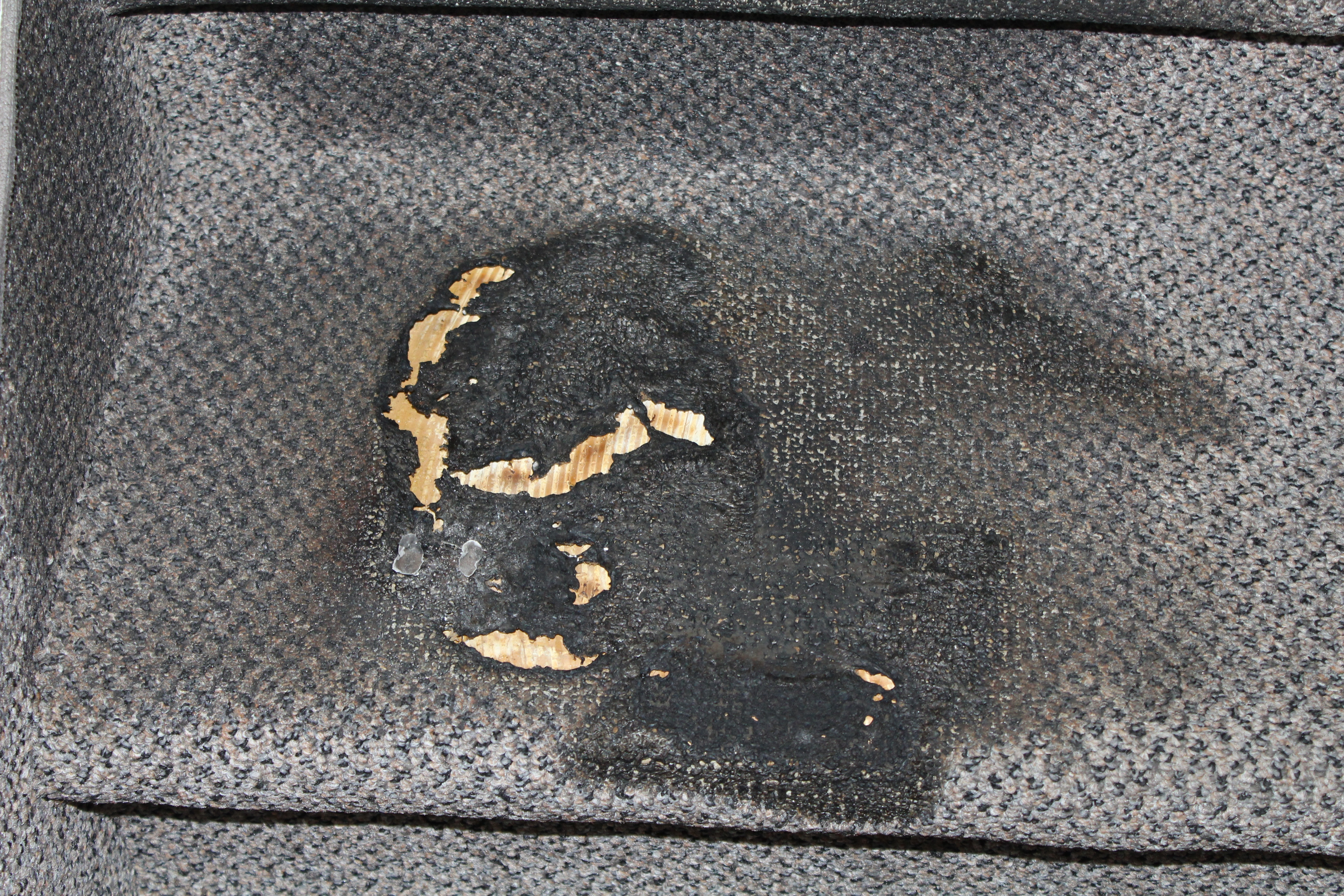
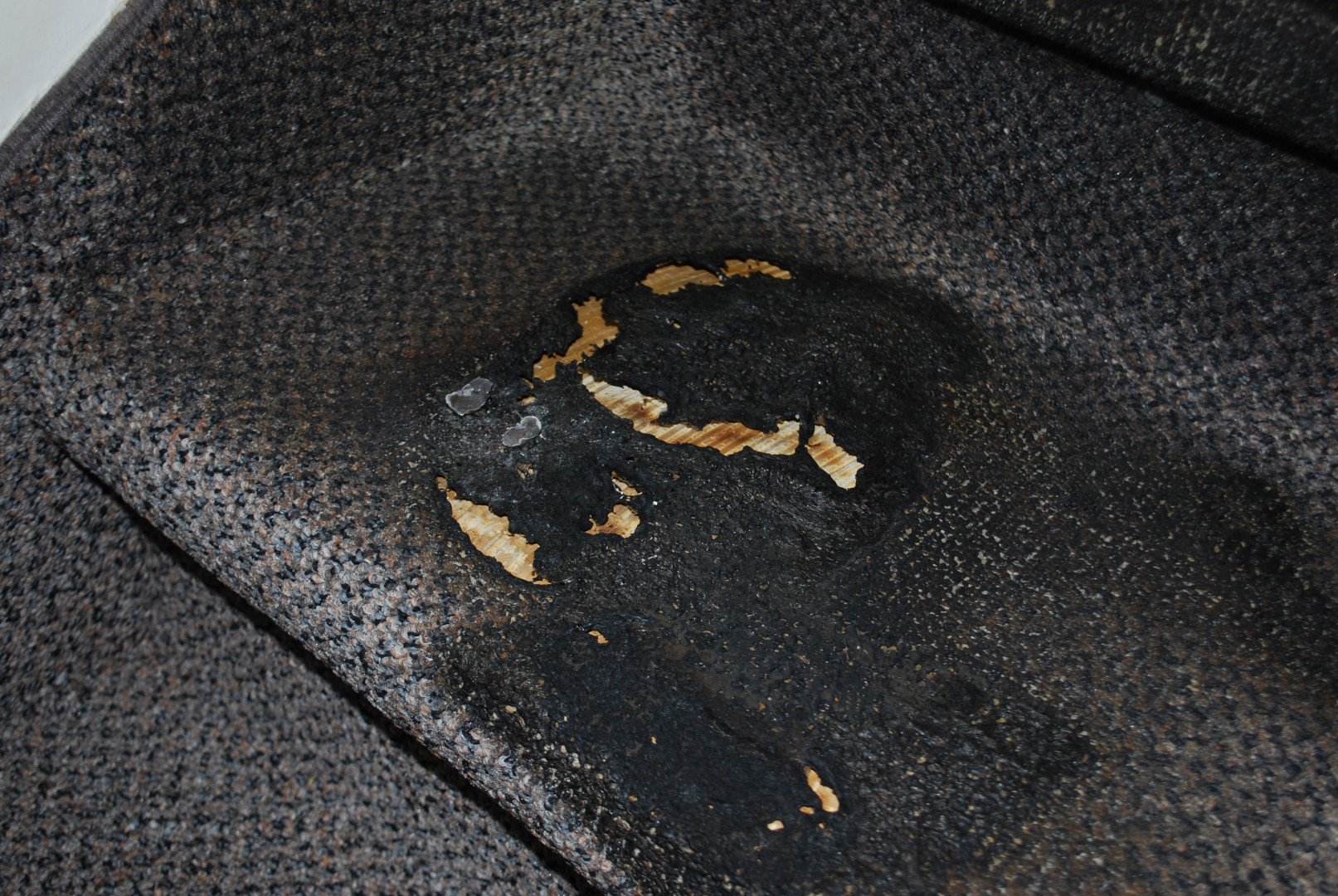
The spill/fire trail ends on the third step from the bottom. There is obviously a circular and a square pattern, indicating that objects were placed here while a flammable liquid was leaking onto the step. The objects were likely a leaking grocery bag and another object with a square base. Accidental ignition took place shortly after the objects had been removed from the step; otherwise, these shapes would not have been preserved.
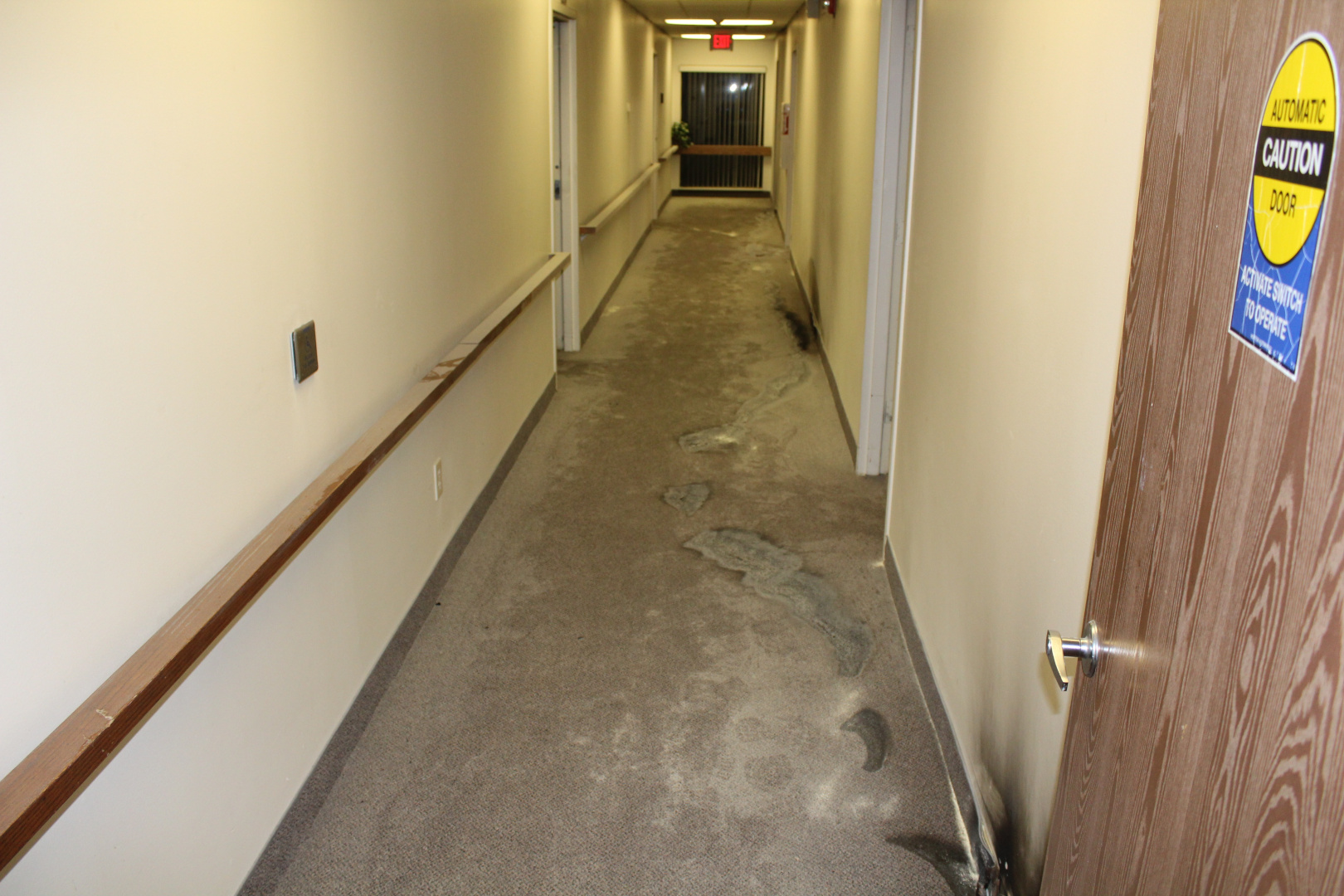
Low-height drizzle of a flammable liquid on the path toward an outdoor dumpster indicates that it was an accidental leak of a low-height garbage bag, NOT arson and NOT gasoline! Notice the "right-handedness" of this supposed "arsonist." (Camera facing north.)
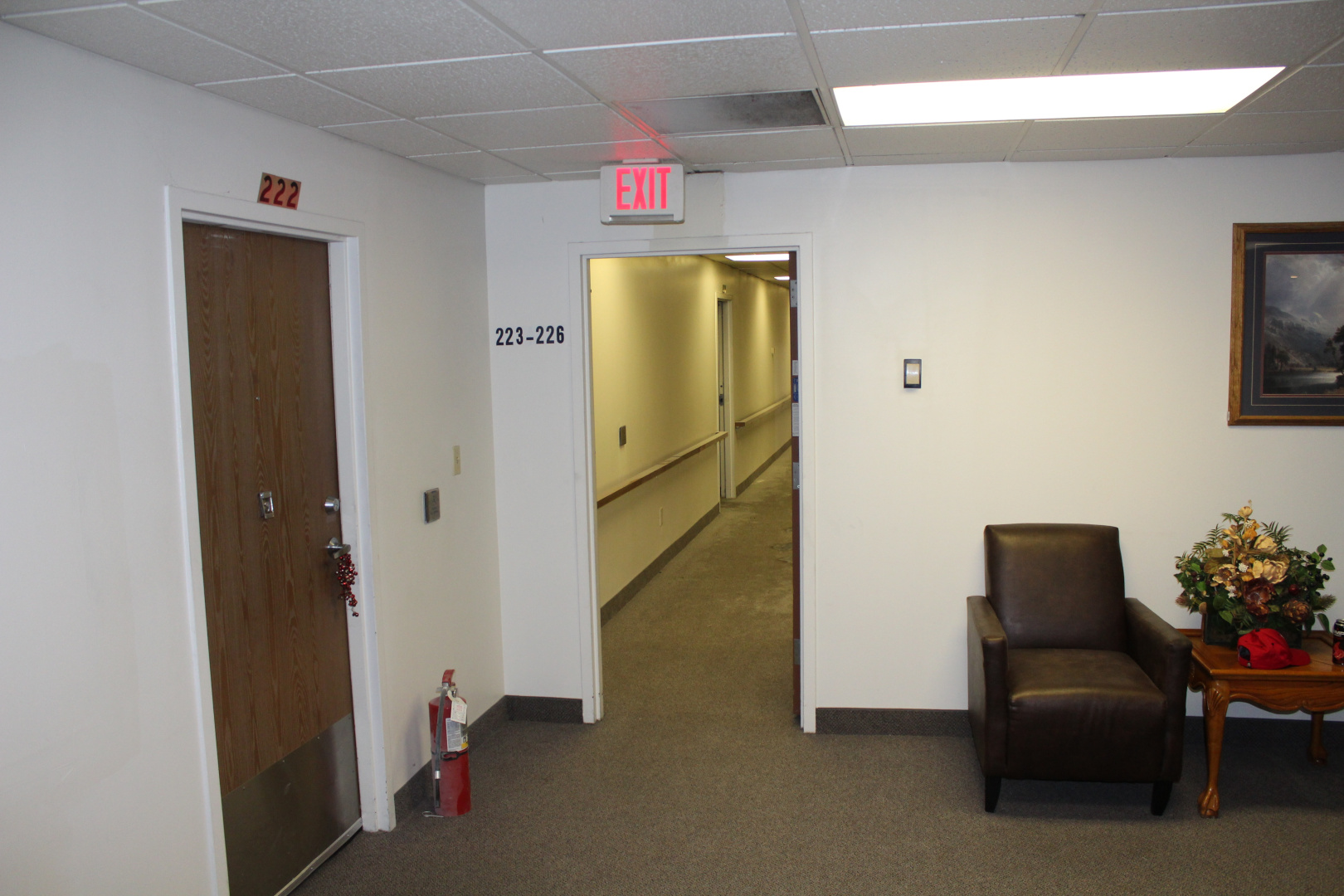
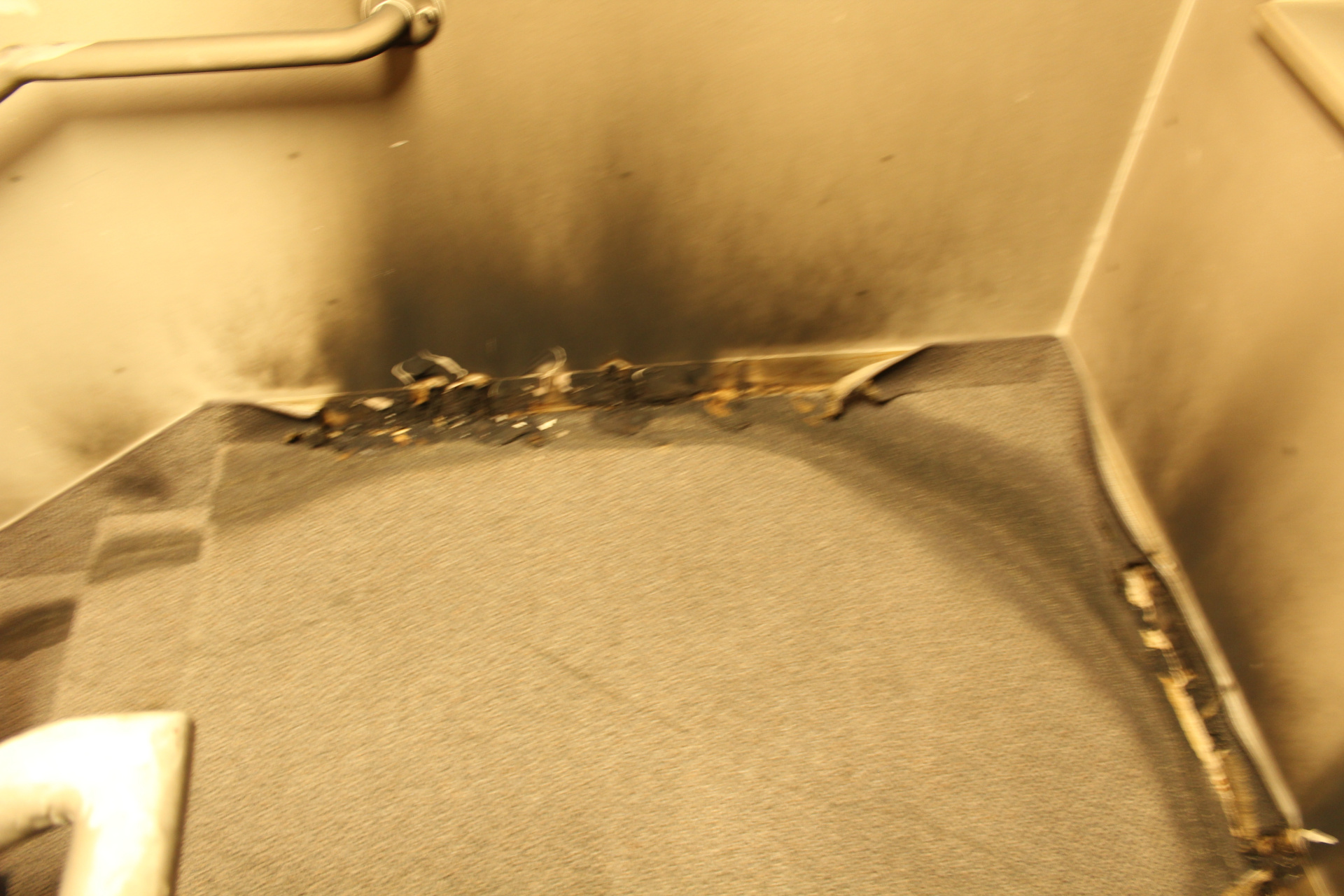
The front (start) of the liquid spill was behind the hallway's automatic door (opened here). This pathway leads only to the stairwell's one-way exit door to outside, whose exit door cannot be opened from outside.
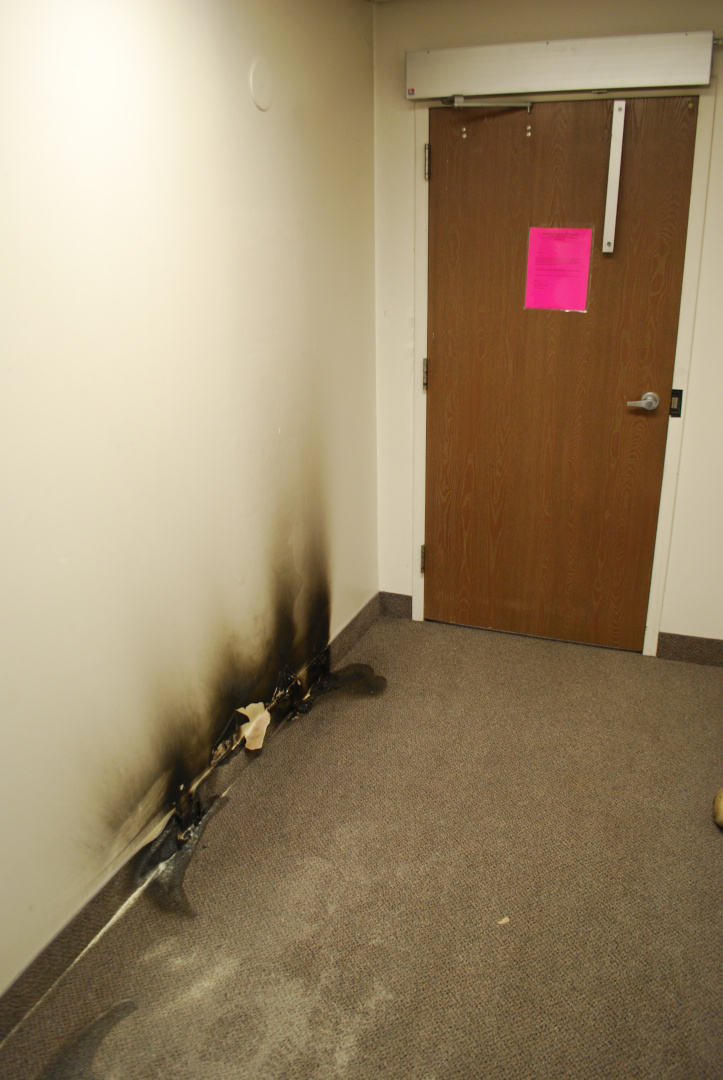
Unusual place to start a spill/leak of flammable liquid: behind the hallway's automatic door. It sure didn't burn like gasoline! White extinguisher powder covers the hallway's carpet in these photos.
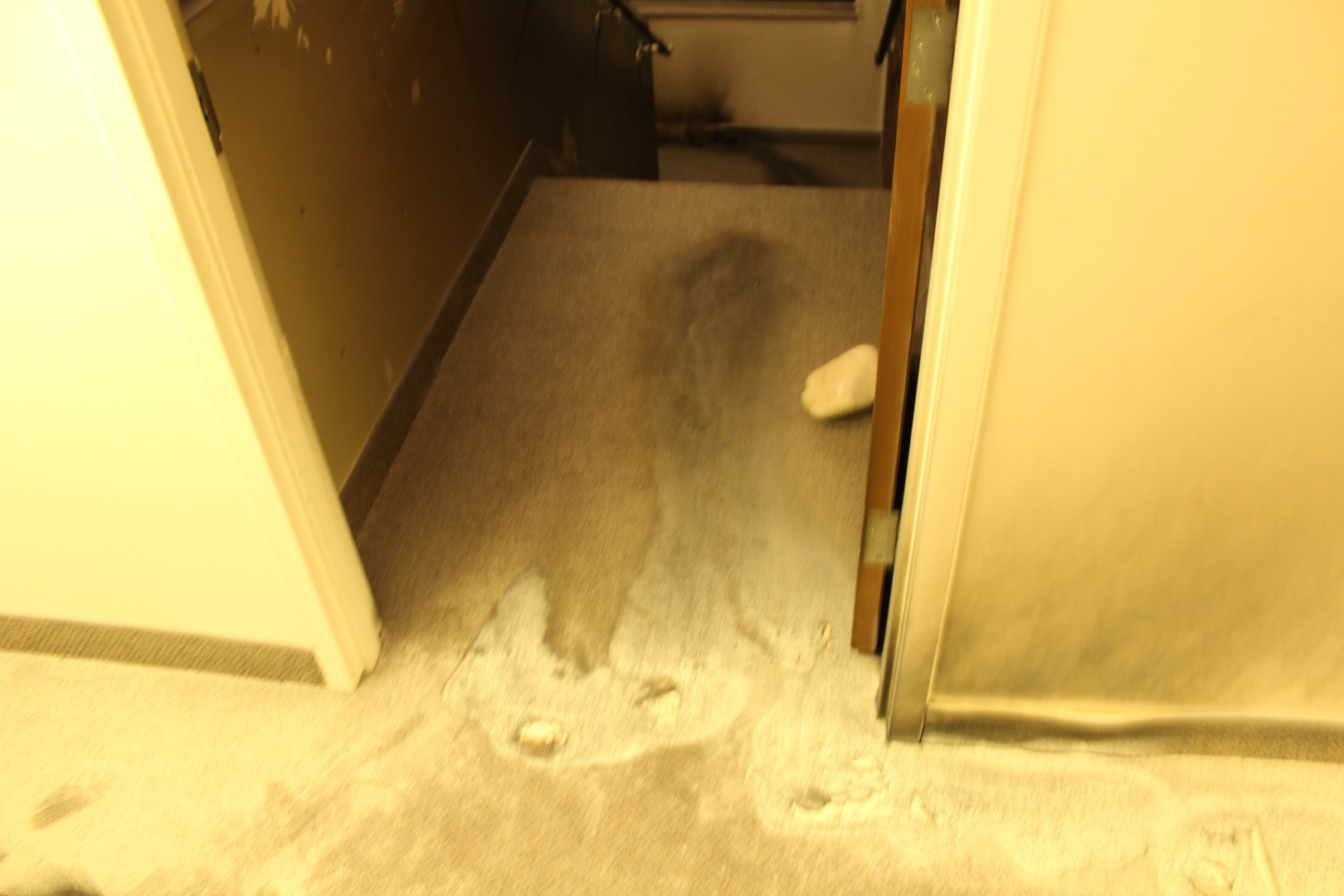
The entrance of the stairwell near the north end of the hallway. Notice the spill's "hook," which indicates that the person's right hand, which held a leaking trash bag, likely turned the door's handle to open the door before resuming his right-handed spill path down the stairs. It indicates that it was more convenient for the man in the red shirt to use his right hand than his left hand, who is reliant on two forearm crutches for mobility. This corroborates the other overwhelming evidence—including his own video testimony that he was there during the fire's ignition, and his extensive smoke inhalation symptoms—that the man in red was there, and that he was likely responsible for the accidental spill. (Camera facing east.)
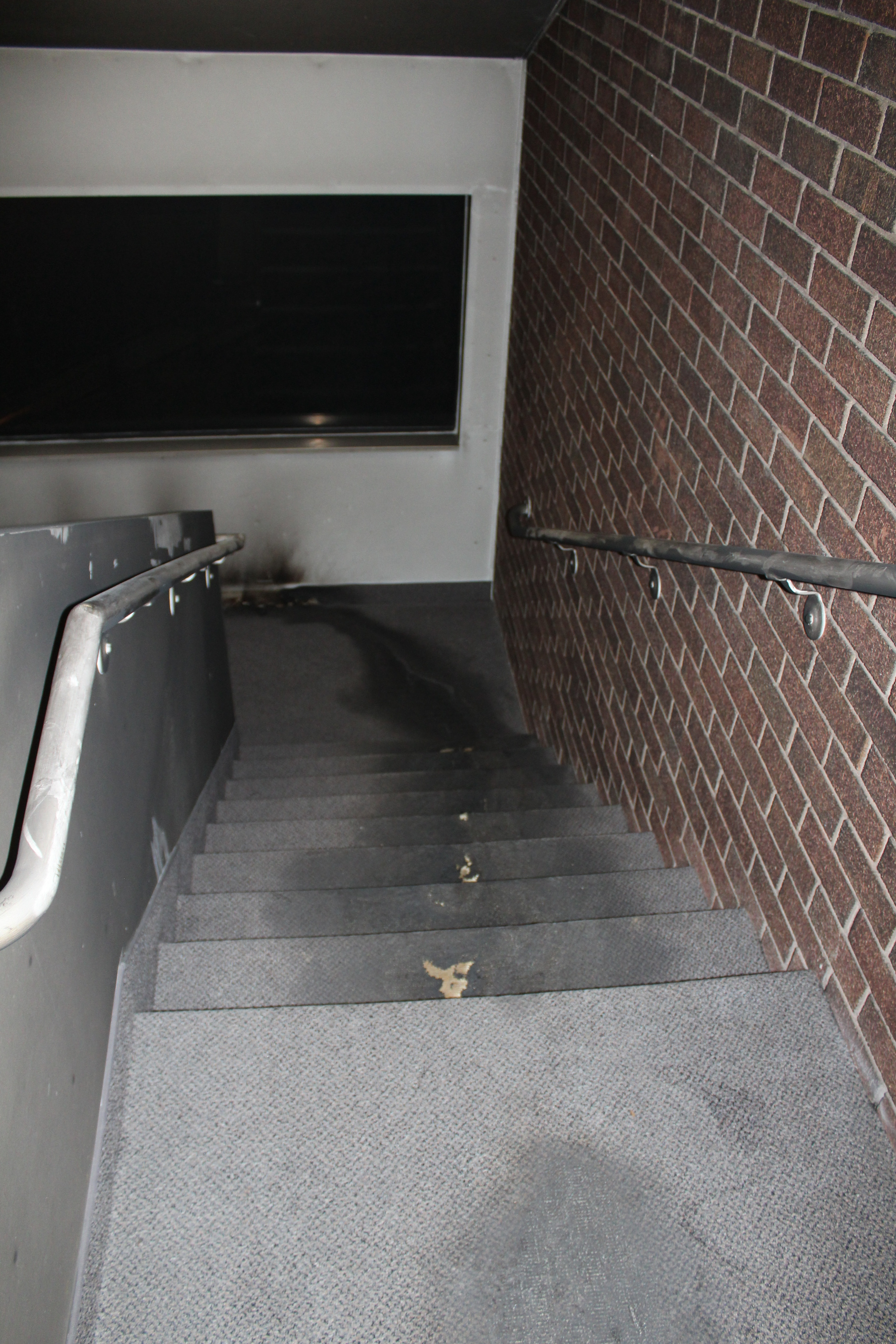
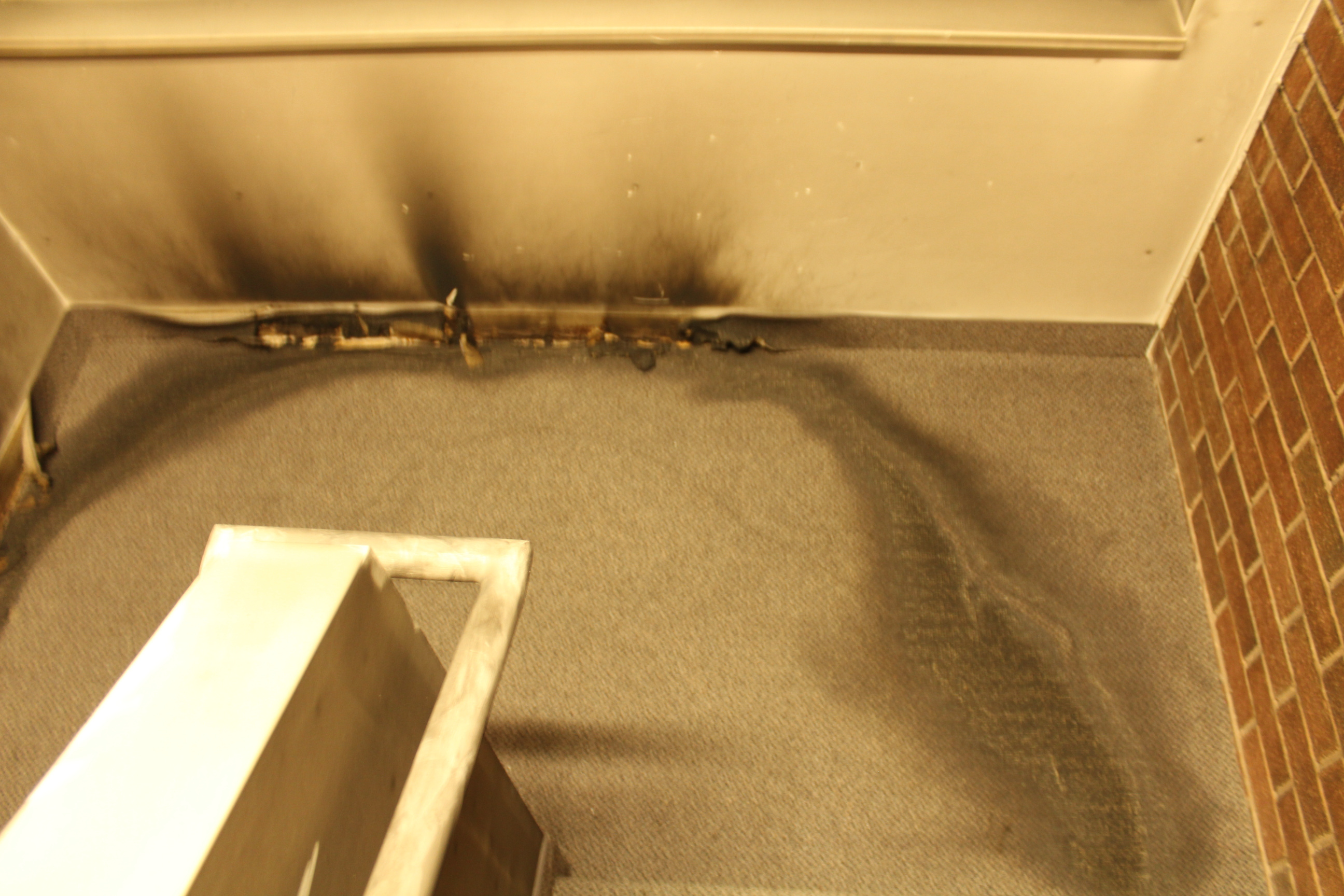
"Right-handed arsonist's" right-hand swinging of his leaking trash bag on the way down the stairs to the dumpster.
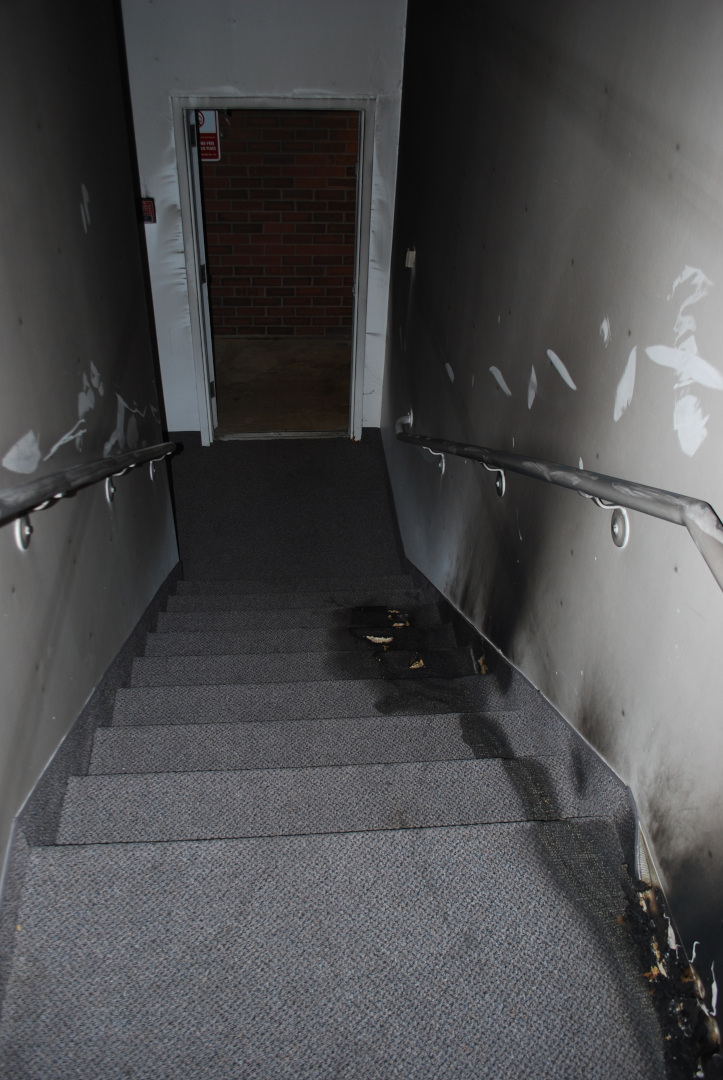
The spill/burn area stopped at the third step from the bottom, where the person who uses crutches (yes, he can navigate stairs) would have momentarily placed a leaky garbage bag while he propped open the one-way exit door to allow reentry after throwing the trash bag into the dumpster. An alcove is to the left of the door frame. (Camera facing west.)
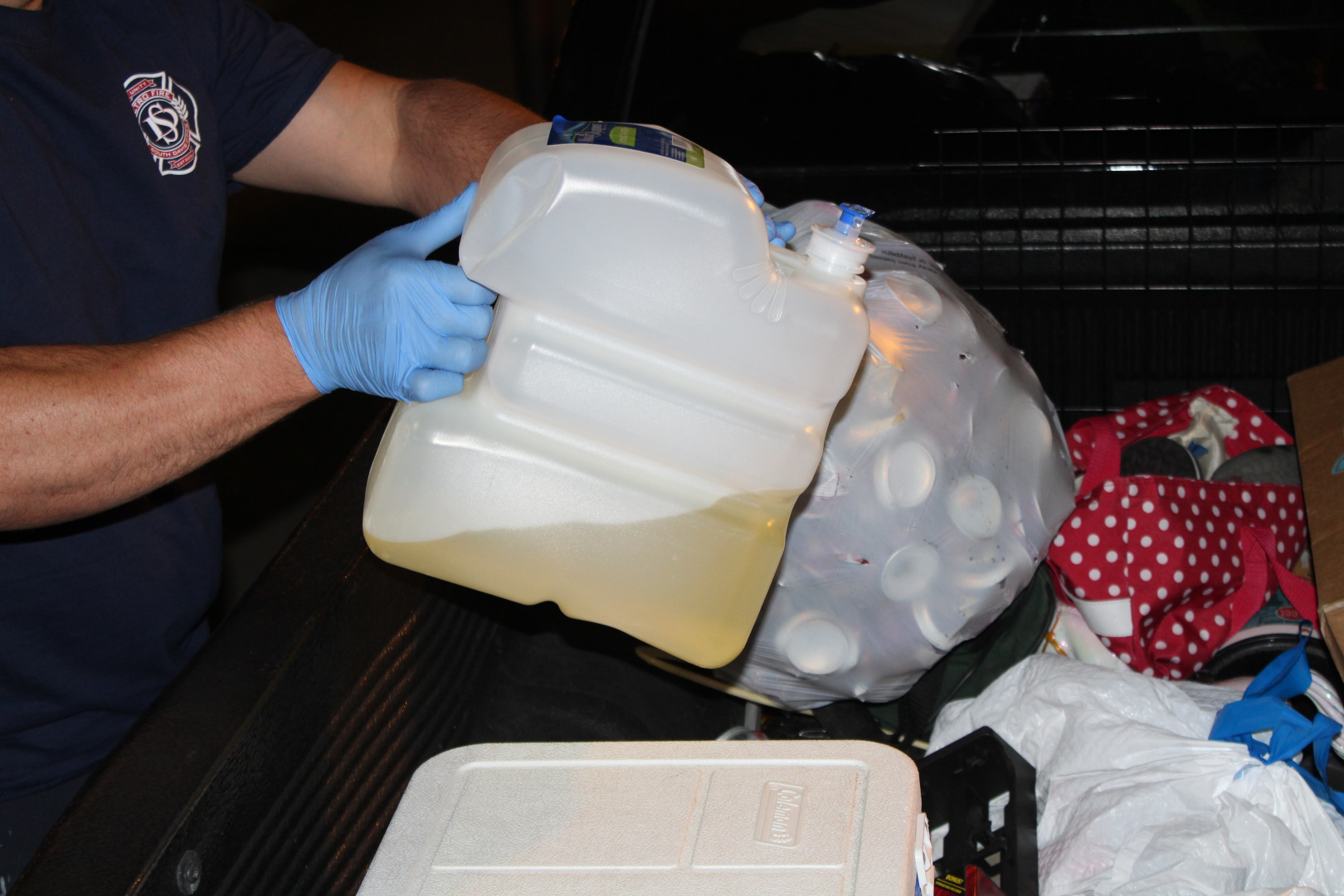
Naturally, this absurd photo was taken by investigators after the fire, while the jug still contained gasoline! The fire didn't burn at all like gasoline, i.e. there was no explosion or ferocious fire, the building was still in one piece, and only a little bit of carpet was burned. If this gasoline was used in the fire, why was this much gasoline found in the jug in the back of Ron's pickup truck in full view, and why didn't he dispose of or hide the jug? Most arsonists use all of their fuel (unless they're frugal)! If you've seen a gasoline fire and an alcohol fire, you can easily tell which kind of fire the Meadows fire was (even if you did not graduate from kindergarten). ACTUAL gasoline fires!
See Utah's ABC 4 News story about the Meadows fire, by Marcos Ortiz., from 2019, one year after the fire.
Please share this petition with ALL of your friends, especially with this new info! Thank you for your efforts to save a disabled and fully innocent man's life from a corrupt legal system!
ORIGINAL PETITION:
Ronald Wayne Makin, who is mentally and physically disabled, was falsely accused of starting a ‘small’ fire (as multiple witnesses called it) on the carpet along a community hallway and adjacent stairwell inside his government housing apartment building, called The Meadows, located at 285 E. 1450 N. in Bountiful, UT. The Meadows apartments houses low-income disabled and elderly residents. On the night of the fire, which ignited at about 11:35 pm on May 19, 2018, Ron was baselessly charged with Aggravated Arson, a first degree felony, which could mean life imprisonment if convicted.
Investigators and Prosecution claim that this carpet fire was arson, that it was a gasoline fire, and that Ron Makin started the fire. But they have not provided any evidence that any of those claims are true—none, even after four years since the fire! No witnesses, no indicative forensic evidence, and no indicative surveillance footage, even though there were 15 indoor and 2 outdoor surveillance cameras! Only footage of 4 cameras was provided (provided to the Defense after many months after the fire), which has crucial gaps of footage which would prove Ron's innocence if provided. The Defense has been waiting for that missing surveillance footage and other discovery that has been withheld.
PLEASE SIGN AND SHARE! WE NEED YOUR PUBLICITY SUPPORT to spread the news of this injustice around the world, telling everyone you know, to save Ron’s life and freedom and protect him and his loved ones from being victimized and harassed. We believe there have been multiple, regular attempts to entrap Ron to prevent a successful trial for him in the arson case, in the form of being repeatedly tailed, harassed, tempted and provoked. WE NEED CITIZENS AND MEDIA to inform and put pressure on leaders of the nation, states, local governments and other leaders so that Ron Makin can receive justice and so that baseless charges like this can never happen again to anyone, no matter who they are!
Investigators claim Ron started the fire in person, but they haven’t placed Ron at or near the scene within an incredible 1hr 40m before the automatic fire alarm sounded at 11:47 pm (not when the fire ignited, which was at ~11:30-11:35 pm). Investigators have not suggested how (or when) Ron managed to avoid being caught by surveillance cameras when he supposedly approached or exited the area and poured a flammable liquid and ignited it. See ALL of the provided surveillance footage.
Officer’s bodycam recorded another individual, wearing a red T-shirt, clearly claiming to have been in the fire area during its ignition(!!!), and this is confirmed by this person's respiratory distress from smoke inhalation, receiving high-flow oxygen, being treated in the ambulance and taken to the hospital. This individual was the initial suspect and was the only person who needed fire-related medical attention. However, the Prosecution has not provided any building surveillance footage of this person being around the fire area around the time of ignition. The provided surveillance footage doesn't show this person receiving any appreciable amount of smoke inhalation.
Investigators claim, without any evidence, that Ron took gasoline from a container in the bed of his truck and poured gasoline down the community hallway and adjacent stairwell and then ignited it. The fire burned mildly, not ferociously or explosively as would be expected if it had been gasoline. The fire caused NO damage to the building but only to small portions of the carpet. We estimate that about one quart of a flammable liquid was spilled inside the Meadows, but it couldn't have been gasoline. For comparison, gasoline’s energy outputs are
- 1 gallon gasoline = 20 sticks of dynamite,
- 1 quart gasoline = 5 sticks of dynamite.
Ron’s Disabilities
Ron has multiple neurological and physiological health problems, involving heart and faulty pacemaker (manufacturer’s recall—finally!—in 2021), liver, lungs, gastrointestinal, and traumatic brain injury from falling out of a truck as a toddler. He went to special education and was always being teased, harassed, bullied and taken advantage of. Ron has borderline autism, marked writing, reading, communicative and processing disabilities, with great difficulty in accessing the desired memory without combining it with an unrelated memory. He also has great difficulty in accessing memories of an event in the correct sequence, or describing roughly when a recent personal event occurred, even if it was only an hour earlier. He also sometimes vocalizes his thoughts (e.g., imagining hypothetical situations) without considering the consequences while being questioned by authorities.
Because of Ron’s neurological, cognitive and communicative disabilities, he was also baselessly charged with Obstructing Justice, a second degree felony, because the investigators said Ron’s account of the events, circumstances and his actions in relation to the fire “[was] inconsistent, and didn’t make sense.” Other reasons he was charged with Obstructing Justice are because he couldn’t explain the fire or flammable liquid in the fire area (because he wasn’t involved in either one) and because he couldn’t provide the address of a person whom he hadn’t had any contact with for several years until the week of the fire. That’s right: Ron was actually charged a serious “second degree felony” because of his disabilities, and because he wasn’t involved in starting the fire and therefore didn’t know about the fire’s origin, and because he didn’t know the address of someone he had only just seen for the first time in several years. Ron’s obstruction charge was added one year after the fire, soon after he had found out the address of that person and relayed the address to police!
Because of investigators’ baseless accusation that Ron started the fire, and the attempts to entrap him in other situations, Ron’s life has been destroyed. After the fire, he and his wife were immediately evicted because he was falsely accused. For the “arson” fire he was immediately jailed, where he spent 13 days without being allowed to talk to his family or friends or to an attorney of his choice. His disabled wife filed for divorce at the request of her parents. Ron lost his prized possessions and heirlooms. He lost valuable papers and records. And he lost his dignity as a free man, being unjustly painted as a criminal but who is actually a loving person who cares deeply for people who have disabilities similar to his own.
After the fire, Ron was homeless and was reliant on the great generosity of friends and strangers to allow him to live in their homes for many months, each. To help exonerate Ron from this atrocity against him, he has been reliant on the tens of thousands of hours’ work and great kindness of friends and strangers.
When investigators talked with Ron on the night of the fire, they made it clear that they knew the Meadows housed many disabled residents, some of whom had mental or psychiatric disabilities. Also during that night, the officers and investigators collectively spent many hours talking to and detaining Ron, so they must have easily recognized that Ron has neurological, cognitive and communicative disabilities.
Ron is respectful and friendly with officers and public servants, having served as a first responder himself and trained to save lives. Because Ron basically trusted the investigators’ claims (given his nature and his cognitive disabilities) and wanted to help investigators as much as possible, and because he believed in the justice system, he wasn’t very concerned about being accused for the fire, knowing that the Meadows has a building surveillance system that would prove his innocence and would have captured in video whoever started the fire (though that exonerating footage has not been provided by the Prosecution). Ron is agreeable with those in authority, but he doesn’t necessarily understand what he’s being agreeable to; e.g., after being read his Miranda rights in jail, Ron was okay with not getting an attorney because the interrogator acted like it was okay to not get an attorney, and Ron didn’t understand the risks. Ron tends to just go along with what an authority figure wants. But given Ron’s neurological, cognitive and communicative disabilities, he should have never been allowed to be questioned without counsel! Ron’s ADA rights (American’s with Disabilities Act) were ignored, as well as his constitutional rights.
This arson case is unusual in that it should be based entirely on hard, physical evidence and valid facts. Currently, this case is based entirely upon conjecture, speculation, opinions, faulty reasoning, and non-material witness statements, without using the scientific method or following the rules of fire investigation, NFPA 921. Investigators did not analyze the fire itself or contrast it with actual gasoline fires. They did not compare the negligible damage at the Meadows building to the catastrophic damage that gasoline fires usually cause to buildings. Investigators did not seek to validate or invalidate Ron’s account of events related to his activities or to the fire. It seems they only sought for a confession instead of investigative work and seeking the truth.
The laws of chemistry dictate that if a fire doesn’t burn like a gasoline fire, it isn’t a gasoline fire! The Meadows surveillance footage of the fire’s characteristics reveals the truth.
- Witnesses called it a ‘small’ fire, and the surveillance footage concurs and shows the fire quietly but quickly dying out.
- This was an indoor fire that caused almost no damage, and was even fully extinguished, with almost no assistance, within a few minutes of the alarm and before nearby firemen even arrived. This is unheard of in gasoline fires! The fire burned only the carpet, within a few inches of the drizzle path of flammable liquid. The drizzle path can most easily be explained by a leaking garbage bag being carried to the nearby dumpster outside, which the evidence supports as the most likely cause.
- No one, including those living along that hallway of the fire, claimed to have smelled gasoline inside the building at any time. If there had been gasoline in the building, they would have noticed the odor and wouldn’t have forgotten to report it.
- The residents living along the hallway of the fire that night did not even know there was a fire until the automatic fire alarm sounded (roughly 10‑15 minutes after the fire’s ignition, as estimated from the slow flames shown in footage), despite being so close to the fire. Those residents were in their apartments and did not hear nor witness anything from the fire area.
- If it took a whole 10-15 minutes for the Meadows’ small fire to trigger the alarm or took that long for anyone to notice there was a fire right next to their apartment in that hallway, it wasn’t a gasoline fire!
The evidence indicates that someone besides Ron accidentally spilled an alcohol-like liquid down the fire area on the way to an outside dumpster and that the spilled liquid somehow ignited accidentally. All indications are that the spill and its ignition were completely accidental. The ignition could have easily been caused by friction, static discharge, someone lighting up their cigarette, or a nearby 7.2‑kV power transformer.
We know that there must have been someone who poured or spilled a flammable liquid in that area, despite there being no footage of it provided to the Defense, because a liquid doesn’t pour itself along a thin path down the full length of a hallway and stairwell!
Investigators have not identified a motive for Ron to commit arson. At the time of the fire, Ron was on good, friendly terms with the residents in that area of the building, which was at another end of the building from where his apartment was located. Ron would never bring gasoline into a building or try to commit arson; he had no reason to commit arson and risk losing his home, being dependent on government housing because of his numerous disabilities.
They say Ron intentionally ignited the fire in person, but no one claimed to have witnessed Ron on or near the Meadows property around the time when he supposedly started the fire. Investigators have ignored the fact that when the fire started at about 11:35 pm, Ron was taking a long walk around the block and was half a mile away from the property, witnessing a documented traffic stop that he could not have known about if he wasn’t present to witness the pullover. Ron was shown in surveillance leaving the Meadows at 11:15 pm to go on this long walk.
A mile away from the Meadows, and two hours prior to the fire, Ron accidentally spilled gasoline on himself while lifting a jug of gasoline from his truck’s open bed. This 2.5‑gal jug was actually a repurposed water jug. The water jug’s spout was designed to prevent resealing and tampering, and Ron was unaware that it would leak on his clothing when he moved and lifted it. When Ron exerted himself to lift the jug, his defective pacemaker also delivered a painful shock and spasm. The previous Wednesday, this water jug had been used at a gas station by Ron’s estranged family associate to fill multiple lawn-care machines on an equipment trailer but who didn’t want to be caught with a partially filled container unapproved for gasoline. This person saw Ron while at the gas station, thought of Ron as a “patsy,” and asked if he could place the jug in the back of Ron’s truck to, allegedly, be retrieved later but which never happened. Ron never handled the jug until two hours before the fire.
Investigators claim that since Ron had spilled gasoline on himself (two hours before the fire) and that his truck’s open bed held the just-mentioned leaky, 2.5‑gal repurposed water jug unlawfully containing gasoline—and which still contained about 2 quarts of gasoline after(!!!) the fire when investigators found it—they claim that these indicated that the fire inside the building was therefore a gasoline fire and that Ron started it. After the fire, this water jug, still containing gasoline, was actually photographed and taken as evidence for a “gasoline fire.”
The initial suspect—the “guy in a red shirt”
On the night of the fire, as emergency units arrived at the Meadows property, an officer’s bodycam recorded statements of himself and a fellow officer outside of the building, referring to a man being seen just inside on the upper floor near the hallway of the fire: “There’s a guy running around in a red shirt upstairs up and down the hallway” and “He’s trying to hide.” The video shows this panicking “guy in a red shirt,” who requires forearm crutches for walking.
This “guy in a red shirt” had earlier already evacuated the building with most of the other residents, but he soon inexplicably reentered the building, went up the main stairwell, and dashed toward the then post-fire hallway area where no more smoke was being produced. He spent only a total of about ten (only 10!) seconds either at the hallway threshold or just inside it, not even near much smoke. He then left the hallway and saw firefighters approaching him, and then he fainted, and he was carried out of the building.
The Prosecution has not provided any pre-alarm surveillance footage of this “guy in a red shirt,” but the provided bodycam footage of him and the negligible amount of smoke inhalation captured in provided surveillance footage, cannot account for his degree of respiratory distress. The limited surveillance footage also cannot account for his unexplained reentry into the building to see if someone was still in the (post-)fire area and what he told the officer and medics in the bodycam video:
- Officer: Hey, are you able to talk to me for a second, man? Is there anyone else in there [in the fire area]?
Suspect (Man in Red): There was a gal in the hallway.
Officer: There’s another person down the hallway?
Suspect: Yeah.
Officer: OK. How did this start, do you know?
Suspect: Uh, I guess somebody had some oil that leaked into the, uh, carpet, and it [developed the smoke?] everywhere. There was a fire into that room, I guess that’s it.
Officer: Do you know what room number?
Suspect: It’s just the one right here… [pointing] #136.
Officer: 136? [Note that #136 does not exist.]
Suspect: Yeah.
… - Medic: Hey, what’s the other person in the room with you [i.e. in the fire area]? What’s her name?
Suspect: [Panicking] I don’t know their [unintelligible]. I mean, I was just, I drop, I dropped one of my crutches and I went back up to grab it and I couldn’t find it and then that’s when I started passing out….
Medic: Okay, but, you said there’s somebody else in the room, that didn’t get out?
Suspect: There was someone in the hallway, I thought.
Medic: Okay. So, you don’t know if they got out?
Suspect: I don’t know if they got out [of there?] or not.
… - Medic: Were you around the fire at all, or just the smoke?
Suspect: I was just around, like, a small flame [cough] over into the hallway.
Medic: You were around the small flames in the hallway?
Suspect: Yeah, it was next to the door there were small flames.
Medic: And, how come you were right there? What happened?
Suspect: Uh, I had dropped my crutch, and I, I can’t really walk with one crutch, and so I was trying to feel [unintelligible]…. I started feeling nauseous and I started [having the?] smoke into my lungs.
Medic: Okay. Do you want to go to the hospital with us today?
Suspect: Not really, but I don’t feel good.
This man in the red shirt, for no logical reason (if he wanted to avoid incriminating himself), clearly stated that he WAS in the hallway during the fire. We believe that he carried a leaking garbage bag that contained an alcohol-like liquid dripping down the pathway, and that the trail of liquid accidentally ignited from a static discharge, friction, someone lighting up their cigarette, or a nearby 7.2‑kV power transformer. It was common for people to smoke just outside of the stairwell. (See photos of outside of the stairwell and nearby cigarette butts.) Ron stated that he saw a smoker there that night.
This man in the red shirt stated that his reason for reentering the building and going to see the fire, was that he thought someone was still in the fire area. But this doesn’t explain why he didn’t go there before/during his earlier evacuation, or why he didn’t attempt to enter far into the hallway, or why he reentered with the hope to save the person which he knew he was incapable of because of his physical disability.
The man in the red shirt did not really know what happened, but he clearly states he was in the fire area during the fire, and he likely thought he himself might have had something to do with the spill of the flammable liquid and/or the fire’s ignition but knew that it was all an accident! Notice that he doesn’t think it was an intentional fire, unlike some other residents; he states that he thinks somebody (possibly himself) spilled some oil and that there was probably a fire in one of the apartments whose flames passed underneath the door through the gap at its bottom and continued into the hallway and down the stairway, though the fire was actually limited to the hallway and stairway.
The man in the red shirt is obviously innocent of deliberately setting the conditions and igniting the fire, but he knew it erupted during his transit and activities. Investigators failed to consider this man’s statements and behavior that implicated himself in the fire event, as soon as they discovered that Ron smelled like gasoline (which was because he had accidentally spilled gasoline on himself at his truck, two hours prior to the fire, from the above-mentioned leaky water jug which contained gasoline). Vindictive tenants were quickly accusing Ron of the crime who did not like him.
Conclusion
Despite Ron’s many disabilities and health issues, he is skilled at protecting others, having been a first responder and serving in search and rescue, taking action in emergency situations, and saving lives. He has a knack for showing up where his emergency training skills are immediately needed. This fire was one of those times. He was the Good Samaritan in this fire, but his life has been ruined because of a baseless charge of arson where there was no evidence connecting him to starting the fire. There would have been hard evidence—especially surveillance footage(!)—of Ron's guilt if he had been guilty.
More details about the "arson" case are at our website, meadowsfire.com. See more photos, documents, footage, etc.
PLEASE SHARE: We NEED public awareness of Ron Makin's case, to get justice and protect and save Ron and his loved ones. So we ask you to share this petition with everyone you know. But we would also deeply appreciate financial help to cover costs to save Ron's life and freedom! We are financially depleted from 5+ years of legal and discovery costs for Ron. Information about how you can make financial donations in Ron's defense can be found on the Contact page of our site, at www.meadowsfire.com/contact/. Thank you!
Search terms: flamesOfInjustice.com flamesOfInjustice meadowsFire carpetFire meadowsCarpetFire ronmakin arsonThatNeverWas arsonOrAccident
Petition Closed
The Issue
Short version in these bullet items:
- With ZERO evidence of Ron Makin's guilt, investigators and prosecutors falsely accused Ron of starting a small, minimally dangerous fire along the full length of a public hallway and adjacent stairwell in the west building of the Meadows Apartments. The fire caused almost no damage.
- Investigators allege that gasoline was used in the fire, without any evidence that it was a gasoline fire or that anyone brought gasoline inside the building! The residents along that hallway didn't report smelling any gasoline inside the building, which would be impossible in these buildings if gasoline had been used.
- A man in a red T-shirt — NOT Ron — actually confessed to being in the fire area when the fire started, and seemed to say it was an accident and acted like he thought he was at fault!
- All of the evidence strongly indicates that this "man in red" accidentally spilled alcohol from a leaking garbage bag on the way to the outside dumpster. This man in red said, in the officer's bodycam video, that he was around the flames while smoke and flames were starting; but the surveillance footage of the man in red being in this area has been withheld! The man in red was also the only person medically treated for fire-related injuries (smoke inhalation), yet he is only shown in the fire area (in the provided footage) after the fire was extinguished and after he (the man in red) had REENTERED the building to look at the post-fire damage after his initial evacuation. The man in red was obviously panicking, AFTER he saw that the fire was out!
- The man in red didn't live in the fire-affected area of the building, but after he returned from the hospital, he inexplicably moved out of the building that very night!
- Investigators never provided any evidence that Ron was on (or near) the Meadows property around the time the fire ignited. Investigators didn't provide any outdoor surveillance footage, even though there were two outdoor cameras watching the Meadows property. The outdoor footage would have exonerated Ron by showing him leaving the Meadows property ~15 minutes before the fire ignited and later returning to the property ~15 minutes after ignition. The indoor surveillance footage corroborates Ron's assertion that he wasn't near the Meadows property by showing him leaving and reentering his apartment building at those respective times.
- Further, at the same time that the Meadows fire started, Ron witnessed a documented traffic stop during his late-night walk a half-mile away from the Meadows, and he described this traffic stop event multiple times in an officer's bodycam footage and the jail interview video, an event which investigators ignored. Ron could not have known about this traffic stop if he had not physically been there.
The right-handed red path, which was drawn by the Prosecution, indicates the exact areas of fire damage. This negligible damage amount cannot be the result of a gasoline fire!
Also see MeadowsFire.com (Flames Of Injustice) -- On Oct 12, 2022, Ronald Wayne Makin, who has obvious communicative and neurological disabilities from a childhood traumatic brain injury (TBI), as well as several serious physical health issues, was sentenced harshly for starting an indoor, alleged "gasoline" fire (in which no one smelled gasoline!) when he was 1/2 mile away from the fire and had nothing to do with starting, after his own attorney coerced him into pleading "no contest," which was not what he or his friends wanted. There is tons of evidence to prove that Ron is fully innocent, but...
- Ron's last two (of three) lawyers never tried to defend Ron in court nor even suggest that he was or could be innocent. They did not seem to care what the hard facts were and only relied upon the counterfactual statements, materials, hearsay and the opinions of NON-material and NON-expert witness statements of residents and police officers, provided by the Prosecution.
- Ron's last two (of three) lawyers only ever urged Ron to plead "no contest." "Not guilty" was never considered by them. Ron had previously pleaded "not guilty," and he had been adamant that he would never plead "no contest," but Ron was eventually "persuaded" by his latest lawyer to believe that pleading "no contest" was the best option.
- The Prosecution only made outrageous, counterfactual claims against Ron and never substantiated their claims with evidence.
- Ron's last two (of three) lawyers never objected to any of the Prosecution's claims.
- At Ron's sentencing, the Prosecution, who strongly implied that Ron is a consummate liar, claimed that Ron "always" had some kind of story, machination or excuse for everything the investigators questioned him about. (That's another way of saying that Ron had nothing to do with starting the fire and that he was telling the truth!)
- The Prosecution never presented any direct evidence or physical attributes to show that it was emphatically a gasoline fire.
- The only evidence that was presented was created in pathetic hearsay and concoction.
- Ron was convicted and sentenced by the judge based on only the vicious, unsubstantiated lies from the Prosecution, without any favorable evidence ever having been presented to the judge!
- The judge sentenced Ron without ever hearing any evidence that gives the slightest indication that Ron could have or would have done it. (We mean that there was absolutely NO substantive evidence that Ron did it.)
- No just trial was ever held. No form of trial was ever held, not even a semblance of a trial!
The judge said that he would treat Ron's "no contest" plea as severely as a "guilty" plea! Ron's sentence is a horrendous slew of punishments:
- The judge sentenced Ron to 1-15 years prison but is suspending that requirement.
- Ron must serve a total of 90 days in jail (starting on Oct 14, 2022),
- 105 days on an ankle monitor,
- 36 months probation,
- over $30,000 in damages restitution (to be determined at Nov 23 hearing),
- additional, frequently-assigned requirements,
- a Felony 1 charge will be on his record—with the shame and heartbreak and consequent encumbrances—for the rest of his life, for something he DID NOT DO!
The investigators relied upon the uneducated opinions of the residents to "determine" that it was arson, without having inspected the area or considered the fact that there is a dumpster near the fire area and that some form of alcohol very likely leaked from a trash bag on the way to the dumpster, which easily explains why there was apparently no motive or target for the fire. The officer with the bodycam briefly looked at the contents of the dumpster and failed to acknowledge the empty Budweiser box (which indicated that alcoholic beverages had been at least present in the building)—this officer, along with the others, was now only looking for suspicious containers (presumably, of gasoline) and was blind to the possibilities of it being an accident. The dumpster was right there, near the fire area, with alcoholic beverage containers (and possibly other forms of household alcohol), and yet they totally missed the dumpster as the most obvious final depository of flammable liquid containers!
The spill/fire trail ends on the third step from the bottom. There is obviously a circular and a square pattern, indicating that objects were placed here while a flammable liquid was leaking onto the step. The objects were likely a leaking grocery bag and another object with a square base. Accidental ignition took place shortly after the objects had been removed from the step; otherwise, these shapes would not have been preserved.
Low-height drizzle of a flammable liquid on the path toward an outdoor dumpster indicates that it was an accidental leak of a low-height garbage bag, NOT arson and NOT gasoline! Notice the "right-handedness" of this supposed "arsonist." (Camera facing north.)
The front (start) of the liquid spill was behind the hallway's automatic door (opened here). This pathway leads only to the stairwell's one-way exit door to outside, whose exit door cannot be opened from outside.
Unusual place to start a spill/leak of flammable liquid: behind the hallway's automatic door. It sure didn't burn like gasoline! White extinguisher powder covers the hallway's carpet in these photos.
The entrance of the stairwell near the north end of the hallway. Notice the spill's "hook," which indicates that the person's right hand, which held a leaking trash bag, likely turned the door's handle to open the door before resuming his right-handed spill path down the stairs. It indicates that it was more convenient for the man in the red shirt to use his right hand than his left hand, who is reliant on two forearm crutches for mobility. This corroborates the other overwhelming evidence—including his own video testimony that he was there during the fire's ignition, and his extensive smoke inhalation symptoms—that the man in red was there, and that he was likely responsible for the accidental spill. (Camera facing east.)
"Right-handed arsonist's" right-hand swinging of his leaking trash bag on the way down the stairs to the dumpster.
The spill/burn area stopped at the third step from the bottom, where the person who uses crutches (yes, he can navigate stairs) would have momentarily placed a leaky garbage bag while he propped open the one-way exit door to allow reentry after throwing the trash bag into the dumpster. An alcove is to the left of the door frame. (Camera facing west.)
Naturally, this absurd photo was taken by investigators after the fire, while the jug still contained gasoline! The fire didn't burn at all like gasoline, i.e. there was no explosion or ferocious fire, the building was still in one piece, and only a little bit of carpet was burned. If this gasoline was used in the fire, why was this much gasoline found in the jug in the back of Ron's pickup truck in full view, and why didn't he dispose of or hide the jug? Most arsonists use all of their fuel (unless they're frugal)! If you've seen a gasoline fire and an alcohol fire, you can easily tell which kind of fire the Meadows fire was (even if you did not graduate from kindergarten). ACTUAL gasoline fires!
See Utah's ABC 4 News story about the Meadows fire, by Marcos Ortiz., from 2019, one year after the fire.
Please share this petition with ALL of your friends, especially with this new info! Thank you for your efforts to save a disabled and fully innocent man's life from a corrupt legal system!
ORIGINAL PETITION:
Ronald Wayne Makin, who is mentally and physically disabled, was falsely accused of starting a ‘small’ fire (as multiple witnesses called it) on the carpet along a community hallway and adjacent stairwell inside his government housing apartment building, called The Meadows, located at 285 E. 1450 N. in Bountiful, UT. The Meadows apartments houses low-income disabled and elderly residents. On the night of the fire, which ignited at about 11:35 pm on May 19, 2018, Ron was baselessly charged with Aggravated Arson, a first degree felony, which could mean life imprisonment if convicted.
Investigators and Prosecution claim that this carpet fire was arson, that it was a gasoline fire, and that Ron Makin started the fire. But they have not provided any evidence that any of those claims are true—none, even after four years since the fire! No witnesses, no indicative forensic evidence, and no indicative surveillance footage, even though there were 15 indoor and 2 outdoor surveillance cameras! Only footage of 4 cameras was provided (provided to the Defense after many months after the fire), which has crucial gaps of footage which would prove Ron's innocence if provided. The Defense has been waiting for that missing surveillance footage and other discovery that has been withheld.
PLEASE SIGN AND SHARE! WE NEED YOUR PUBLICITY SUPPORT to spread the news of this injustice around the world, telling everyone you know, to save Ron’s life and freedom and protect him and his loved ones from being victimized and harassed. We believe there have been multiple, regular attempts to entrap Ron to prevent a successful trial for him in the arson case, in the form of being repeatedly tailed, harassed, tempted and provoked. WE NEED CITIZENS AND MEDIA to inform and put pressure on leaders of the nation, states, local governments and other leaders so that Ron Makin can receive justice and so that baseless charges like this can never happen again to anyone, no matter who they are!
Investigators claim Ron started the fire in person, but they haven’t placed Ron at or near the scene within an incredible 1hr 40m before the automatic fire alarm sounded at 11:47 pm (not when the fire ignited, which was at ~11:30-11:35 pm). Investigators have not suggested how (or when) Ron managed to avoid being caught by surveillance cameras when he supposedly approached or exited the area and poured a flammable liquid and ignited it. See ALL of the provided surveillance footage.
Officer’s bodycam recorded another individual, wearing a red T-shirt, clearly claiming to have been in the fire area during its ignition(!!!), and this is confirmed by this person's respiratory distress from smoke inhalation, receiving high-flow oxygen, being treated in the ambulance and taken to the hospital. This individual was the initial suspect and was the only person who needed fire-related medical attention. However, the Prosecution has not provided any building surveillance footage of this person being around the fire area around the time of ignition. The provided surveillance footage doesn't show this person receiving any appreciable amount of smoke inhalation.
Investigators claim, without any evidence, that Ron took gasoline from a container in the bed of his truck and poured gasoline down the community hallway and adjacent stairwell and then ignited it. The fire burned mildly, not ferociously or explosively as would be expected if it had been gasoline. The fire caused NO damage to the building but only to small portions of the carpet. We estimate that about one quart of a flammable liquid was spilled inside the Meadows, but it couldn't have been gasoline. For comparison, gasoline’s energy outputs are
- 1 gallon gasoline = 20 sticks of dynamite,
- 1 quart gasoline = 5 sticks of dynamite.
Ron’s Disabilities
Ron has multiple neurological and physiological health problems, involving heart and faulty pacemaker (manufacturer’s recall—finally!—in 2021), liver, lungs, gastrointestinal, and traumatic brain injury from falling out of a truck as a toddler. He went to special education and was always being teased, harassed, bullied and taken advantage of. Ron has borderline autism, marked writing, reading, communicative and processing disabilities, with great difficulty in accessing the desired memory without combining it with an unrelated memory. He also has great difficulty in accessing memories of an event in the correct sequence, or describing roughly when a recent personal event occurred, even if it was only an hour earlier. He also sometimes vocalizes his thoughts (e.g., imagining hypothetical situations) without considering the consequences while being questioned by authorities.
Because of Ron’s neurological, cognitive and communicative disabilities, he was also baselessly charged with Obstructing Justice, a second degree felony, because the investigators said Ron’s account of the events, circumstances and his actions in relation to the fire “[was] inconsistent, and didn’t make sense.” Other reasons he was charged with Obstructing Justice are because he couldn’t explain the fire or flammable liquid in the fire area (because he wasn’t involved in either one) and because he couldn’t provide the address of a person whom he hadn’t had any contact with for several years until the week of the fire. That’s right: Ron was actually charged a serious “second degree felony” because of his disabilities, and because he wasn’t involved in starting the fire and therefore didn’t know about the fire’s origin, and because he didn’t know the address of someone he had only just seen for the first time in several years. Ron’s obstruction charge was added one year after the fire, soon after he had found out the address of that person and relayed the address to police!
Because of investigators’ baseless accusation that Ron started the fire, and the attempts to entrap him in other situations, Ron’s life has been destroyed. After the fire, he and his wife were immediately evicted because he was falsely accused. For the “arson” fire he was immediately jailed, where he spent 13 days without being allowed to talk to his family or friends or to an attorney of his choice. His disabled wife filed for divorce at the request of her parents. Ron lost his prized possessions and heirlooms. He lost valuable papers and records. And he lost his dignity as a free man, being unjustly painted as a criminal but who is actually a loving person who cares deeply for people who have disabilities similar to his own.
After the fire, Ron was homeless and was reliant on the great generosity of friends and strangers to allow him to live in their homes for many months, each. To help exonerate Ron from this atrocity against him, he has been reliant on the tens of thousands of hours’ work and great kindness of friends and strangers.
When investigators talked with Ron on the night of the fire, they made it clear that they knew the Meadows housed many disabled residents, some of whom had mental or psychiatric disabilities. Also during that night, the officers and investigators collectively spent many hours talking to and detaining Ron, so they must have easily recognized that Ron has neurological, cognitive and communicative disabilities.
Ron is respectful and friendly with officers and public servants, having served as a first responder himself and trained to save lives. Because Ron basically trusted the investigators’ claims (given his nature and his cognitive disabilities) and wanted to help investigators as much as possible, and because he believed in the justice system, he wasn’t very concerned about being accused for the fire, knowing that the Meadows has a building surveillance system that would prove his innocence and would have captured in video whoever started the fire (though that exonerating footage has not been provided by the Prosecution). Ron is agreeable with those in authority, but he doesn’t necessarily understand what he’s being agreeable to; e.g., after being read his Miranda rights in jail, Ron was okay with not getting an attorney because the interrogator acted like it was okay to not get an attorney, and Ron didn’t understand the risks. Ron tends to just go along with what an authority figure wants. But given Ron’s neurological, cognitive and communicative disabilities, he should have never been allowed to be questioned without counsel! Ron’s ADA rights (American’s with Disabilities Act) were ignored, as well as his constitutional rights.
This arson case is unusual in that it should be based entirely on hard, physical evidence and valid facts. Currently, this case is based entirely upon conjecture, speculation, opinions, faulty reasoning, and non-material witness statements, without using the scientific method or following the rules of fire investigation, NFPA 921. Investigators did not analyze the fire itself or contrast it with actual gasoline fires. They did not compare the negligible damage at the Meadows building to the catastrophic damage that gasoline fires usually cause to buildings. Investigators did not seek to validate or invalidate Ron’s account of events related to his activities or to the fire. It seems they only sought for a confession instead of investigative work and seeking the truth.
The laws of chemistry dictate that if a fire doesn’t burn like a gasoline fire, it isn’t a gasoline fire! The Meadows surveillance footage of the fire’s characteristics reveals the truth.
- Witnesses called it a ‘small’ fire, and the surveillance footage concurs and shows the fire quietly but quickly dying out.
- This was an indoor fire that caused almost no damage, and was even fully extinguished, with almost no assistance, within a few minutes of the alarm and before nearby firemen even arrived. This is unheard of in gasoline fires! The fire burned only the carpet, within a few inches of the drizzle path of flammable liquid. The drizzle path can most easily be explained by a leaking garbage bag being carried to the nearby dumpster outside, which the evidence supports as the most likely cause.
- No one, including those living along that hallway of the fire, claimed to have smelled gasoline inside the building at any time. If there had been gasoline in the building, they would have noticed the odor and wouldn’t have forgotten to report it.
- The residents living along the hallway of the fire that night did not even know there was a fire until the automatic fire alarm sounded (roughly 10‑15 minutes after the fire’s ignition, as estimated from the slow flames shown in footage), despite being so close to the fire. Those residents were in their apartments and did not hear nor witness anything from the fire area.
- If it took a whole 10-15 minutes for the Meadows’ small fire to trigger the alarm or took that long for anyone to notice there was a fire right next to their apartment in that hallway, it wasn’t a gasoline fire!
The evidence indicates that someone besides Ron accidentally spilled an alcohol-like liquid down the fire area on the way to an outside dumpster and that the spilled liquid somehow ignited accidentally. All indications are that the spill and its ignition were completely accidental. The ignition could have easily been caused by friction, static discharge, someone lighting up their cigarette, or a nearby 7.2‑kV power transformer.
We know that there must have been someone who poured or spilled a flammable liquid in that area, despite there being no footage of it provided to the Defense, because a liquid doesn’t pour itself along a thin path down the full length of a hallway and stairwell!
Investigators have not identified a motive for Ron to commit arson. At the time of the fire, Ron was on good, friendly terms with the residents in that area of the building, which was at another end of the building from where his apartment was located. Ron would never bring gasoline into a building or try to commit arson; he had no reason to commit arson and risk losing his home, being dependent on government housing because of his numerous disabilities.
They say Ron intentionally ignited the fire in person, but no one claimed to have witnessed Ron on or near the Meadows property around the time when he supposedly started the fire. Investigators have ignored the fact that when the fire started at about 11:35 pm, Ron was taking a long walk around the block and was half a mile away from the property, witnessing a documented traffic stop that he could not have known about if he wasn’t present to witness the pullover. Ron was shown in surveillance leaving the Meadows at 11:15 pm to go on this long walk.
A mile away from the Meadows, and two hours prior to the fire, Ron accidentally spilled gasoline on himself while lifting a jug of gasoline from his truck’s open bed. This 2.5‑gal jug was actually a repurposed water jug. The water jug’s spout was designed to prevent resealing and tampering, and Ron was unaware that it would leak on his clothing when he moved and lifted it. When Ron exerted himself to lift the jug, his defective pacemaker also delivered a painful shock and spasm. The previous Wednesday, this water jug had been used at a gas station by Ron’s estranged family associate to fill multiple lawn-care machines on an equipment trailer but who didn’t want to be caught with a partially filled container unapproved for gasoline. This person saw Ron while at the gas station, thought of Ron as a “patsy,” and asked if he could place the jug in the back of Ron’s truck to, allegedly, be retrieved later but which never happened. Ron never handled the jug until two hours before the fire.
Investigators claim that since Ron had spilled gasoline on himself (two hours before the fire) and that his truck’s open bed held the just-mentioned leaky, 2.5‑gal repurposed water jug unlawfully containing gasoline—and which still contained about 2 quarts of gasoline after(!!!) the fire when investigators found it—they claim that these indicated that the fire inside the building was therefore a gasoline fire and that Ron started it. After the fire, this water jug, still containing gasoline, was actually photographed and taken as evidence for a “gasoline fire.”
The initial suspect—the “guy in a red shirt”
On the night of the fire, as emergency units arrived at the Meadows property, an officer’s bodycam recorded statements of himself and a fellow officer outside of the building, referring to a man being seen just inside on the upper floor near the hallway of the fire: “There’s a guy running around in a red shirt upstairs up and down the hallway” and “He’s trying to hide.” The video shows this panicking “guy in a red shirt,” who requires forearm crutches for walking.
This “guy in a red shirt” had earlier already evacuated the building with most of the other residents, but he soon inexplicably reentered the building, went up the main stairwell, and dashed toward the then post-fire hallway area where no more smoke was being produced. He spent only a total of about ten (only 10!) seconds either at the hallway threshold or just inside it, not even near much smoke. He then left the hallway and saw firefighters approaching him, and then he fainted, and he was carried out of the building.
The Prosecution has not provided any pre-alarm surveillance footage of this “guy in a red shirt,” but the provided bodycam footage of him and the negligible amount of smoke inhalation captured in provided surveillance footage, cannot account for his degree of respiratory distress. The limited surveillance footage also cannot account for his unexplained reentry into the building to see if someone was still in the (post-)fire area and what he told the officer and medics in the bodycam video:
- Officer: Hey, are you able to talk to me for a second, man? Is there anyone else in there [in the fire area]?
Suspect (Man in Red): There was a gal in the hallway.
Officer: There’s another person down the hallway?
Suspect: Yeah.
Officer: OK. How did this start, do you know?
Suspect: Uh, I guess somebody had some oil that leaked into the, uh, carpet, and it [developed the smoke?] everywhere. There was a fire into that room, I guess that’s it.
Officer: Do you know what room number?
Suspect: It’s just the one right here… [pointing] #136.
Officer: 136? [Note that #136 does not exist.]
Suspect: Yeah.
… - Medic: Hey, what’s the other person in the room with you [i.e. in the fire area]? What’s her name?
Suspect: [Panicking] I don’t know their [unintelligible]. I mean, I was just, I drop, I dropped one of my crutches and I went back up to grab it and I couldn’t find it and then that’s when I started passing out….
Medic: Okay, but, you said there’s somebody else in the room, that didn’t get out?
Suspect: There was someone in the hallway, I thought.
Medic: Okay. So, you don’t know if they got out?
Suspect: I don’t know if they got out [of there?] or not.
… - Medic: Were you around the fire at all, or just the smoke?
Suspect: I was just around, like, a small flame [cough] over into the hallway.
Medic: You were around the small flames in the hallway?
Suspect: Yeah, it was next to the door there were small flames.
Medic: And, how come you were right there? What happened?
Suspect: Uh, I had dropped my crutch, and I, I can’t really walk with one crutch, and so I was trying to feel [unintelligible]…. I started feeling nauseous and I started [having the?] smoke into my lungs.
Medic: Okay. Do you want to go to the hospital with us today?
Suspect: Not really, but I don’t feel good.
This man in the red shirt, for no logical reason (if he wanted to avoid incriminating himself), clearly stated that he WAS in the hallway during the fire. We believe that he carried a leaking garbage bag that contained an alcohol-like liquid dripping down the pathway, and that the trail of liquid accidentally ignited from a static discharge, friction, someone lighting up their cigarette, or a nearby 7.2‑kV power transformer. It was common for people to smoke just outside of the stairwell. (See photos of outside of the stairwell and nearby cigarette butts.) Ron stated that he saw a smoker there that night.
This man in the red shirt stated that his reason for reentering the building and going to see the fire, was that he thought someone was still in the fire area. But this doesn’t explain why he didn’t go there before/during his earlier evacuation, or why he didn’t attempt to enter far into the hallway, or why he reentered with the hope to save the person which he knew he was incapable of because of his physical disability.
The man in the red shirt did not really know what happened, but he clearly states he was in the fire area during the fire, and he likely thought he himself might have had something to do with the spill of the flammable liquid and/or the fire’s ignition but knew that it was all an accident! Notice that he doesn’t think it was an intentional fire, unlike some other residents; he states that he thinks somebody (possibly himself) spilled some oil and that there was probably a fire in one of the apartments whose flames passed underneath the door through the gap at its bottom and continued into the hallway and down the stairway, though the fire was actually limited to the hallway and stairway.
The man in the red shirt is obviously innocent of deliberately setting the conditions and igniting the fire, but he knew it erupted during his transit and activities. Investigators failed to consider this man’s statements and behavior that implicated himself in the fire event, as soon as they discovered that Ron smelled like gasoline (which was because he had accidentally spilled gasoline on himself at his truck, two hours prior to the fire, from the above-mentioned leaky water jug which contained gasoline). Vindictive tenants were quickly accusing Ron of the crime who did not like him.
Conclusion
Despite Ron’s many disabilities and health issues, he is skilled at protecting others, having been a first responder and serving in search and rescue, taking action in emergency situations, and saving lives. He has a knack for showing up where his emergency training skills are immediately needed. This fire was one of those times. He was the Good Samaritan in this fire, but his life has been ruined because of a baseless charge of arson where there was no evidence connecting him to starting the fire. There would have been hard evidence—especially surveillance footage(!)—of Ron's guilt if he had been guilty.
More details about the "arson" case are at our website, meadowsfire.com. See more photos, documents, footage, etc.
PLEASE SHARE: We NEED public awareness of Ron Makin's case, to get justice and protect and save Ron and his loved ones. So we ask you to share this petition with everyone you know. But we would also deeply appreciate financial help to cover costs to save Ron's life and freedom! We are financially depleted from 5+ years of legal and discovery costs for Ron. Information about how you can make financial donations in Ron's defense can be found on the Contact page of our site, at www.meadowsfire.com/contact/. Thank you!
Search terms: flamesOfInjustice.com flamesOfInjustice meadowsFire carpetFire meadowsCarpetFire ronmakin arsonThatNeverWas arsonOrAccident
Petition Updates
Share this petition
Petition created on August 22, 2022