

Erasing a Word Erases a People: Reinstate Palestine in the British Museum
The Issue
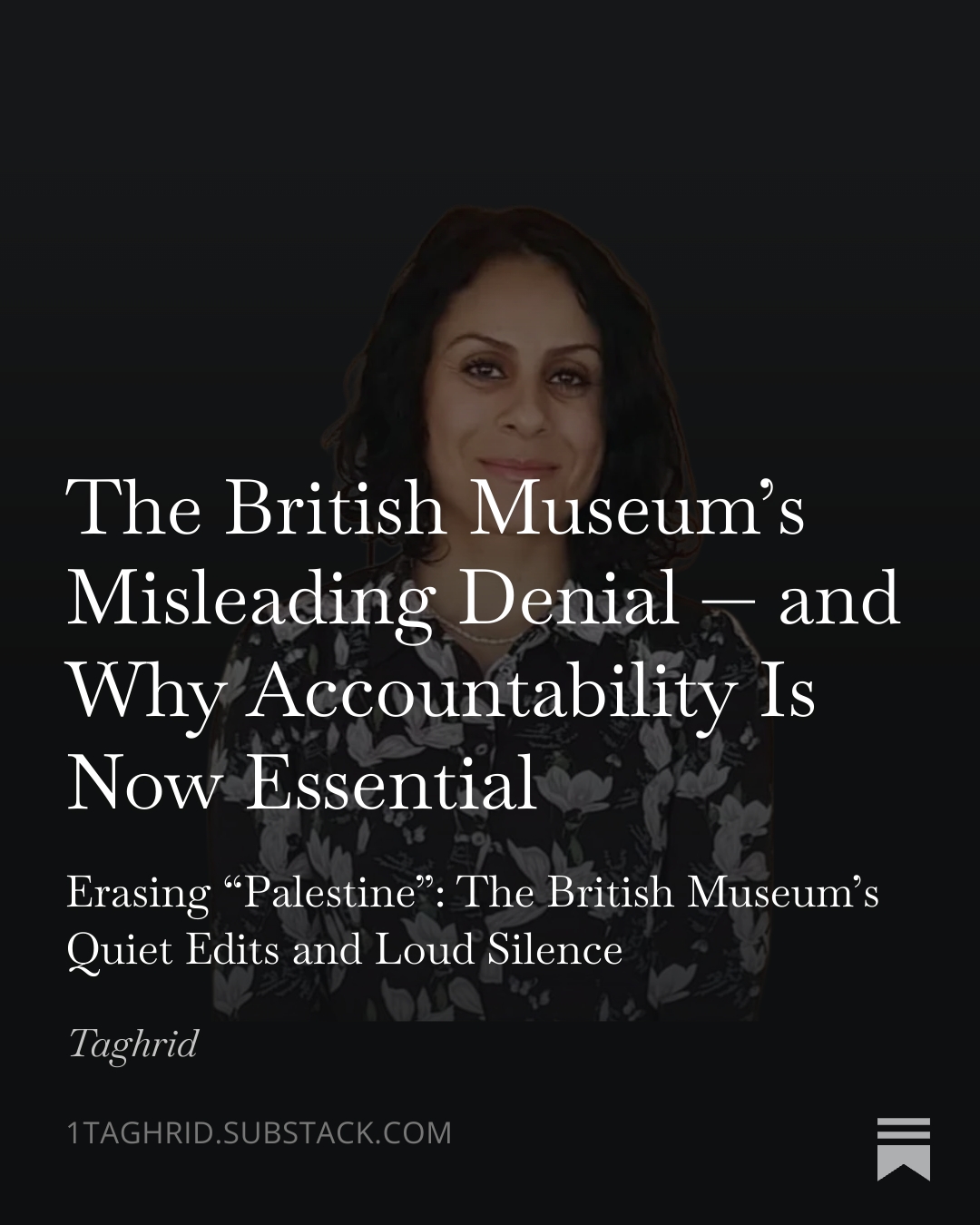
The British Museum has recently removed the word “Palestine” from several displays in its Ancient Middle East galleries, claiming the term is “anachronistic.” This decision is not supported by historical evidence and contributes to a wider pattern of erasing Palestinian presence from public memory.
The term Palestine has been used for over two millennia. It appears in:
Herodotus (5th century BCE) as Palaistinê
Roman administrative records as Syria Palaestina (135 CE)
Byzantine, early Islamic, Crusader, and Ottoman sources
European maps from the medieval period through the 19th century
Shakespeare’s Othello — a cornerstone of British cultural heritage
If the term is acceptable in Shakespeare, it should not be erased from a national museum.
If the British Museum is genuinely concerned about modern etymology, then consistency would require similar scrutiny of terms such as “Britain”, which is itself a relatively modern political construct. Yet “Britain” remains unchallenged in the museum’s own galleries.
This selective removal suggests inconsistency in curatorial standards and raises concerns about political pressure influencing historical presentation.
We call on the British Museum to:
1) Restore the term “Palestine” to all relevant displays.
2) Provide transparency regarding the decision-making process.
3) Ensure that curatorial choices reflect historical accuracy, not political pressure.
4) Uphold its responsibility as a publicly funded institution to present history with integrity.
Erasing a word erases a people. History includes Palestine — and the British Museum must reflect that truth.

28,613
The Issue
The British Museum has recently removed the word “Palestine” from several displays in its Ancient Middle East galleries, claiming the term is “anachronistic.” This decision is not supported by historical evidence and contributes to a wider pattern of erasing Palestinian presence from public memory.
The term Palestine has been used for over two millennia. It appears in:
Herodotus (5th century BCE) as Palaistinê
Roman administrative records as Syria Palaestina (135 CE)
Byzantine, early Islamic, Crusader, and Ottoman sources
European maps from the medieval period through the 19th century
Shakespeare’s Othello — a cornerstone of British cultural heritage
If the term is acceptable in Shakespeare, it should not be erased from a national museum.
If the British Museum is genuinely concerned about modern etymology, then consistency would require similar scrutiny of terms such as “Britain”, which is itself a relatively modern political construct. Yet “Britain” remains unchallenged in the museum’s own galleries.
This selective removal suggests inconsistency in curatorial standards and raises concerns about political pressure influencing historical presentation.
We call on the British Museum to:
1) Restore the term “Palestine” to all relevant displays.
2) Provide transparency regarding the decision-making process.
3) Ensure that curatorial choices reflect historical accuracy, not political pressure.
4) Uphold its responsibility as a publicly funded institution to present history with integrity.
Erasing a word erases a people. History includes Palestine — and the British Museum must reflect that truth.
The Decision Makers

Supporter Voices
Petition Updates
Share this petition
Petition created on 15 February 2026