

Demand Due Process in DURHAM NC: Apply the Statutory Elements in Brenay's Cyberstalking
The Issue
This petition calls on the Durham County District Court to demand due process, statutory consistency, and constitutional rigor in the cyberstalking prosecution of Brenay Kennard. In a highly publicized matter arising from widely reported civil litigation and a divorce already in the public domain, the public has a right to assurance that criminal charges are supported by specific facts meeting every element of North Carolina’s cyberstalking statute, not conclusory allegations or subjective emotional distress. This petition respectfully requests that sworn statements, law-enforcement narratives, and the scope of any restraining order be measured directly against the North Carolina General Statutes, with careful attention to First Amendment protections and equal application of the law.
Whether the prosecution of Brenay Kennard for cyberstalking satisfies the requirements of N.C. Gen. Stat. § 14-196.3, where the publicly filed materials rely primarily on conclusory assertions and alleged emotional distress, and where sworn statements and law-enforcement narratives do not clearly articulate facts corresponding to each statutory element.
This matter arises out of a widely reported, high-profile civil dispute involving Brenay Kennard and Timothy Montague. The underlying divorce and related civil litigation have been extensively discussed in the media and across public platforms. These proceedings are matters of public record and have generated significant public attention well before the initiation of the present criminal charge.
Public discussion of a divorce or civil litigation—particularly one that has been openly litigated and widely reported—does not, standing alone, constitute criminal conduct. Where expressive activity concerns matters already in the public domain, heightened statutory and constitutional scrutiny is required before criminal liability may attach.
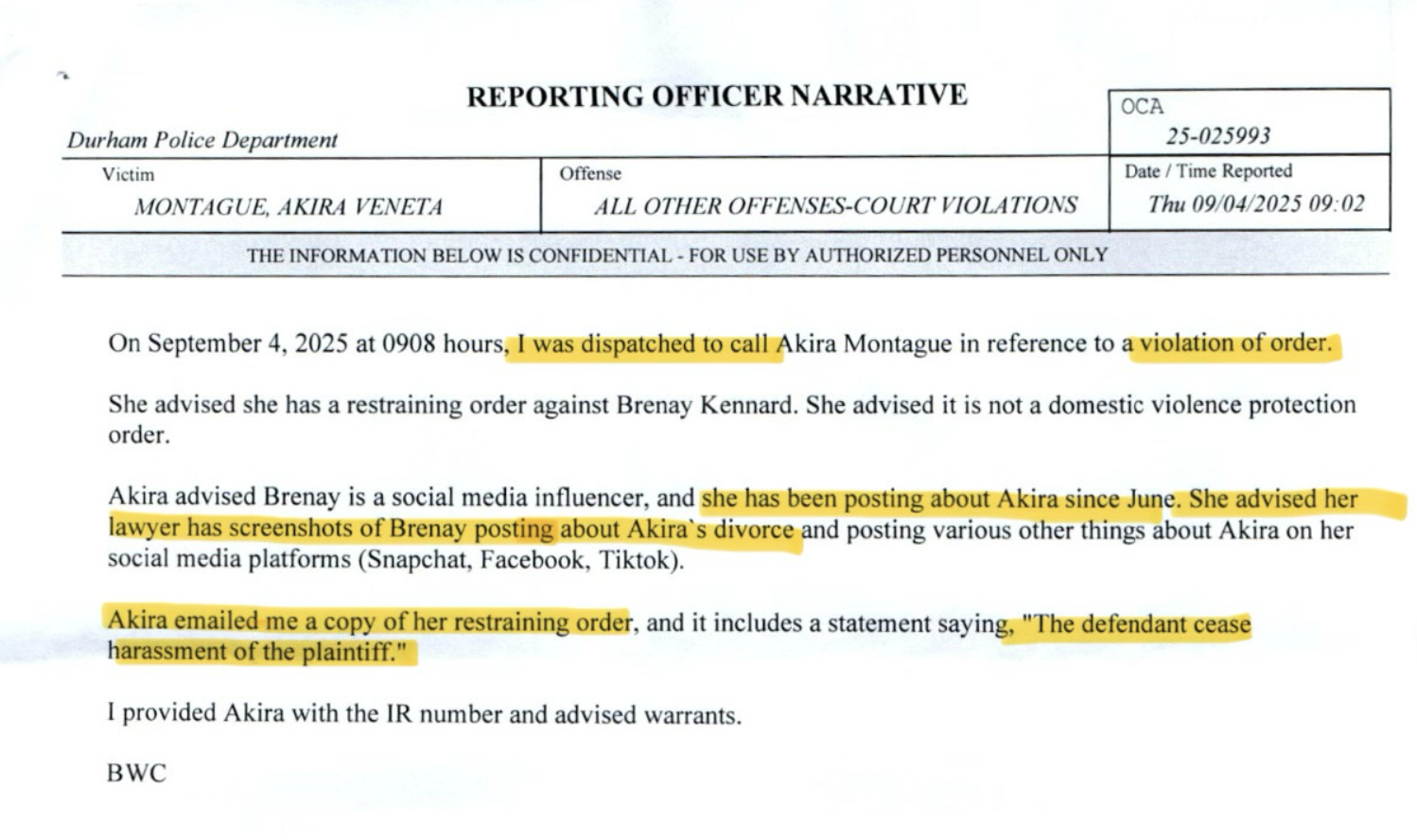
The restraining order referenced in the reporting officer’s narrative was received by the defendant. However, nothing in the publicly described language of that order prohibits posting about the civil litigation, or related public matters online aside from the children of the couple. The narrative reflects only a generalized directive to “cease harassment,” without defining prohibited conduct, without referencing social media outside of referencing the children, and without articulating any no-posting or no-mention provisions that Akira alleges.
Criminal enforcement of a restraining order requires clear, specific, and narrowly defined prohibitions, particularly where speech is implicated. Vague directives cannot constitutionally serve as the basis for criminal liability.
The reporting officer’s narrative characterizes the alleged conduct as public social-media posting “about” the alleged victim, not direct communication, contact, or messaging to that individual. The narrative does not quote any posts, does not identify dates or frequency, does not allege threats or intimidation, and relies on references to screenshots that are not included in the record.
These deficiencies raise serious due-process concerns where criminal charges require proof of repeated conduct, specific intent, and conduct directed at a particular person, as required under the statute.
Cyberstalking under N.C. Gen. Stat. § 14-196.3 requires proof beyond a reasonable doubt that a defendant:
Used electronic communication;
Directed the conduct at a specific person;
Engaged in repeated or continuing conduct;
Acted with the specific intent to harass, intimidate, or cause substantial emotional distress; and
Acted without any legitimate purpose.
Assertions of emotional impact, public notoriety, or generalized allegations are not substitutes for element-by-element statutory proof.
For more than five years, documented matters—including State of North Carolina v. Marie Shaw Green (21CR055131-310), criminal matters involving the North Carolina Industrial Commission Fraud Investigation Section and the wife of Durham County Mayor Leonardo Williams wife in (25CR012434-310), and the highly publicized case of State of North Carolina v. Clayton Jones Jr. (25CR481553-310) the current Chief Judge of the Superior Court of Durham—have resulted in acquittals, dismissals, or failures to prosecute despite the presence of evidence.
Against this backdrop, the advancement of criminal charges in the present matter, absent clear factual alignment with statutory elements, raises legitimate public concern regarding consistency, evidentiary thresholds, and equal application of the law.
This petition respectfully requests assurance that the Court:
Applies all elements of the cyberstalking statute independently and rigorously;
Distinguishes protected public speech from criminal conduct;
Enforces restraining orders only within their clearly defined terms;
Requires specific, fact-based allegations of intent and conduct before sustaining criminal charges;
Upholds due process consistently, particularly in high-profile matters.
This is a public plea in support of Brenay Kennard, not for preferential treatment, but for the same statutory discipline and constitutional safeguards applied in other Durham County cases.
Justice is strengthened when facts, statutes, and process align. Public confidence depends on visible, consistent adherence to the law as written—no more and no less.

Victory
The Issue
This petition calls on the Durham County District Court to demand due process, statutory consistency, and constitutional rigor in the cyberstalking prosecution of Brenay Kennard. In a highly publicized matter arising from widely reported civil litigation and a divorce already in the public domain, the public has a right to assurance that criminal charges are supported by specific facts meeting every element of North Carolina’s cyberstalking statute, not conclusory allegations or subjective emotional distress. This petition respectfully requests that sworn statements, law-enforcement narratives, and the scope of any restraining order be measured directly against the North Carolina General Statutes, with careful attention to First Amendment protections and equal application of the law.
Whether the prosecution of Brenay Kennard for cyberstalking satisfies the requirements of N.C. Gen. Stat. § 14-196.3, where the publicly filed materials rely primarily on conclusory assertions and alleged emotional distress, and where sworn statements and law-enforcement narratives do not clearly articulate facts corresponding to each statutory element.
This matter arises out of a widely reported, high-profile civil dispute involving Brenay Kennard and Timothy Montague. The underlying divorce and related civil litigation have been extensively discussed in the media and across public platforms. These proceedings are matters of public record and have generated significant public attention well before the initiation of the present criminal charge.
Public discussion of a divorce or civil litigation—particularly one that has been openly litigated and widely reported—does not, standing alone, constitute criminal conduct. Where expressive activity concerns matters already in the public domain, heightened statutory and constitutional scrutiny is required before criminal liability may attach.
The restraining order referenced in the reporting officer’s narrative was received by the defendant. However, nothing in the publicly described language of that order prohibits posting about the civil litigation, or related public matters online aside from the children of the couple. The narrative reflects only a generalized directive to “cease harassment,” without defining prohibited conduct, without referencing social media outside of referencing the children, and without articulating any no-posting or no-mention provisions that Akira alleges.
Criminal enforcement of a restraining order requires clear, specific, and narrowly defined prohibitions, particularly where speech is implicated. Vague directives cannot constitutionally serve as the basis for criminal liability.
The reporting officer’s narrative characterizes the alleged conduct as public social-media posting “about” the alleged victim, not direct communication, contact, or messaging to that individual. The narrative does not quote any posts, does not identify dates or frequency, does not allege threats or intimidation, and relies on references to screenshots that are not included in the record.
These deficiencies raise serious due-process concerns where criminal charges require proof of repeated conduct, specific intent, and conduct directed at a particular person, as required under the statute.
Cyberstalking under N.C. Gen. Stat. § 14-196.3 requires proof beyond a reasonable doubt that a defendant:
Used electronic communication;
Directed the conduct at a specific person;
Engaged in repeated or continuing conduct;
Acted with the specific intent to harass, intimidate, or cause substantial emotional distress; and
Acted without any legitimate purpose.
Assertions of emotional impact, public notoriety, or generalized allegations are not substitutes for element-by-element statutory proof.
For more than five years, documented matters—including State of North Carolina v. Marie Shaw Green (21CR055131-310), criminal matters involving the North Carolina Industrial Commission Fraud Investigation Section and the wife of Durham County Mayor Leonardo Williams wife in (25CR012434-310), and the highly publicized case of State of North Carolina v. Clayton Jones Jr. (25CR481553-310) the current Chief Judge of the Superior Court of Durham—have resulted in acquittals, dismissals, or failures to prosecute despite the presence of evidence.
Against this backdrop, the advancement of criminal charges in the present matter, absent clear factual alignment with statutory elements, raises legitimate public concern regarding consistency, evidentiary thresholds, and equal application of the law.
This petition respectfully requests assurance that the Court:
Applies all elements of the cyberstalking statute independently and rigorously;
Distinguishes protected public speech from criminal conduct;
Enforces restraining orders only within their clearly defined terms;
Requires specific, fact-based allegations of intent and conduct before sustaining criminal charges;
Upholds due process consistently, particularly in high-profile matters.
This is a public plea in support of Brenay Kennard, not for preferential treatment, but for the same statutory discipline and constitutional safeguards applied in other Durham County cases.
Justice is strengthened when facts, statutes, and process align. Public confidence depends on visible, consistent adherence to the law as written—no more and no less.
The Decision Makers

Supporter Voices
Petition Updates
Share this petition
Petition created on January 24, 2026