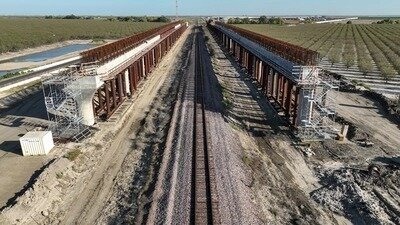
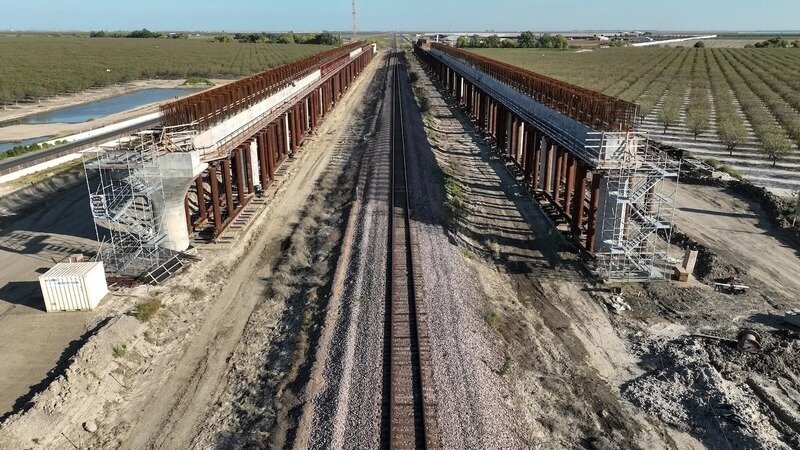
Billions spent. No trains. No passengers. We must rethink California's high-speed rail.
The Issue
Eighteen years after California voters approved Proposition 1A, and 6 years after the full Phase I system from San Francisco to Anaheim via Los Angeles was mandated to be finished, the barely built California High-Speed Rail project is clearly in trouble. As a state we are now facing the prospect of a portion of the intended system possibly operating from Bakersfield to Merced by the mid-2030s. That is far from what was originally promised and funding to move beyond that is yet to be identified. California High Speed Rail needs to be placed on a firm financial and legal footing to succeed. The time has come to go back to the voters.
When Californians passed Proposition 1A in 2008, they approved specific terms. The law requires that trains complete the San Francisco to Los Angeles trip in no more than two hours and forty minutes. It also requires that passenger service not receive an operating subsidy; it must either break even or make a profit.
The Authority has now acknowledged that it cannot meet either requirement. Its CEO's preferred current plan would route trains onto existing Caltrain track north of Gilroy, where safety regulations cap speeds far below what high-speed rail requires, pushing travel times above the legal limit. And the Authority's own ridership projections show that the Merced to Bakersfield segment could lose $100 million per year in operations, a direct violation of the no-subsidy provision. Meanwhile, Cap-and-Invest revenue is not flowing in fast enough to complete even that segment by 2033, the deadline the Authority covenanted with the federal government.
The project is currently caught between what the law requires, what the legislature has been willing to fund, and time. That gap is not one that the legislature seems willing to close on its own. It requires a decision by the people, who authorized the high-speed rail project in the first place.
We are asking the California legislature and Governor to place a new measure before voters that resolves this honestly. A new measure should provide sufficient bonding authority to fund a realistic phased plan, starting with San Francisco to Bakersfield. Financing for Bakersfield to Anaheim, extensions to Sacramento and San Diego could continue later if the public proved satisfied by the San Francisco to Bakersfield portion. The new measure should also remove the provisions that have made the current plan legally untenable, including the rigid travel time mandates and the prohibition on operating support.
A reauthorized plan should not rely only on new bonds, federal grants, and Cap-and-Invest revenue. It should also create a framework for successful early segments to help generate less taxpayer-dependent funding for later extensions. A new measure should therefore encourage Corridor Investment Zones: voluntary, locally partnered value-capture frameworks that coordinate California’s existing infrastructure-financing tools across major transportation corridors, not just individual stations or isolated local districts. Where a public or private transportation project increases land values or economic activity along a defined route, participating local governments, communities, public agencies, and project sponsors — including private operators where appropriate — should be able to share in that upside and reinvest a portion of the added value into station access, local infrastructure, public-realm improvements, and future corridor extensions.
While a new ballot measure should give the High-Speed Rail Authority more flexibility, it should also include safeguards to prevent tens of billions of dollars of new bond money from being wasted. For example. the measure might require the Authority to fully design a segment before hiring contractors and placing limits on change orders that have drained billions from the project’s budget.
If Californians want to continue building high-speed rail, they deserve the chance to approve a plan that can actually be built. If they decide the project is not worth continuing on new terms, they deserve the chance to say that too. Either way, the current situation is a multi-billion-dollar program operating outside its legal mandate, and it serves no passengers.

1,084
The Issue
Eighteen years after California voters approved Proposition 1A, and 6 years after the full Phase I system from San Francisco to Anaheim via Los Angeles was mandated to be finished, the barely built California High-Speed Rail project is clearly in trouble. As a state we are now facing the prospect of a portion of the intended system possibly operating from Bakersfield to Merced by the mid-2030s. That is far from what was originally promised and funding to move beyond that is yet to be identified. California High Speed Rail needs to be placed on a firm financial and legal footing to succeed. The time has come to go back to the voters.
When Californians passed Proposition 1A in 2008, they approved specific terms. The law requires that trains complete the San Francisco to Los Angeles trip in no more than two hours and forty minutes. It also requires that passenger service not receive an operating subsidy; it must either break even or make a profit.
The Authority has now acknowledged that it cannot meet either requirement. Its CEO's preferred current plan would route trains onto existing Caltrain track north of Gilroy, where safety regulations cap speeds far below what high-speed rail requires, pushing travel times above the legal limit. And the Authority's own ridership projections show that the Merced to Bakersfield segment could lose $100 million per year in operations, a direct violation of the no-subsidy provision. Meanwhile, Cap-and-Invest revenue is not flowing in fast enough to complete even that segment by 2033, the deadline the Authority covenanted with the federal government.
The project is currently caught between what the law requires, what the legislature has been willing to fund, and time. That gap is not one that the legislature seems willing to close on its own. It requires a decision by the people, who authorized the high-speed rail project in the first place.
We are asking the California legislature and Governor to place a new measure before voters that resolves this honestly. A new measure should provide sufficient bonding authority to fund a realistic phased plan, starting with San Francisco to Bakersfield. Financing for Bakersfield to Anaheim, extensions to Sacramento and San Diego could continue later if the public proved satisfied by the San Francisco to Bakersfield portion. The new measure should also remove the provisions that have made the current plan legally untenable, including the rigid travel time mandates and the prohibition on operating support.
A reauthorized plan should not rely only on new bonds, federal grants, and Cap-and-Invest revenue. It should also create a framework for successful early segments to help generate less taxpayer-dependent funding for later extensions. A new measure should therefore encourage Corridor Investment Zones: voluntary, locally partnered value-capture frameworks that coordinate California’s existing infrastructure-financing tools across major transportation corridors, not just individual stations or isolated local districts. Where a public or private transportation project increases land values or economic activity along a defined route, participating local governments, communities, public agencies, and project sponsors — including private operators where appropriate — should be able to share in that upside and reinvest a portion of the added value into station access, local infrastructure, public-realm improvements, and future corridor extensions.
While a new ballot measure should give the High-Speed Rail Authority more flexibility, it should also include safeguards to prevent tens of billions of dollars of new bond money from being wasted. For example. the measure might require the Authority to fully design a segment before hiring contractors and placing limits on change orders that have drained billions from the project’s budget.
If Californians want to continue building high-speed rail, they deserve the chance to approve a plan that can actually be built. If they decide the project is not worth continuing on new terms, they deserve the chance to say that too. Either way, the current situation is a multi-billion-dollar program operating outside its legal mandate, and it serves no passengers.
The Decision Makers


Supporter Voices
Petition Updates
Share this petition
Petition created on June 8, 2026