

Keep Astoria Park Public: Protect Our Free Tennis Courts and Green Space
The Issue
Public land is for public use - not for whoever wins a bidding war. Once 20 years of parkland is signed away, it doesn't come back.
WE'VE BEEN HERE BEFORE | NYC Parks proposed this same bubble in 2005 and in 1992. Both times, the community POPPED THE BUBBLE
UPDATE - August 2026: Here's where we are, and what's next...
Astoria Park's tennis courts are 14 free, public courts. NYC Parks wants to hand at least 8 of them to a private, for-profit company for the next 20 years. And "at least" is the key word: officials told the community the bubble would be capped at 8. The RFP sets no cap at all, just a minimum.
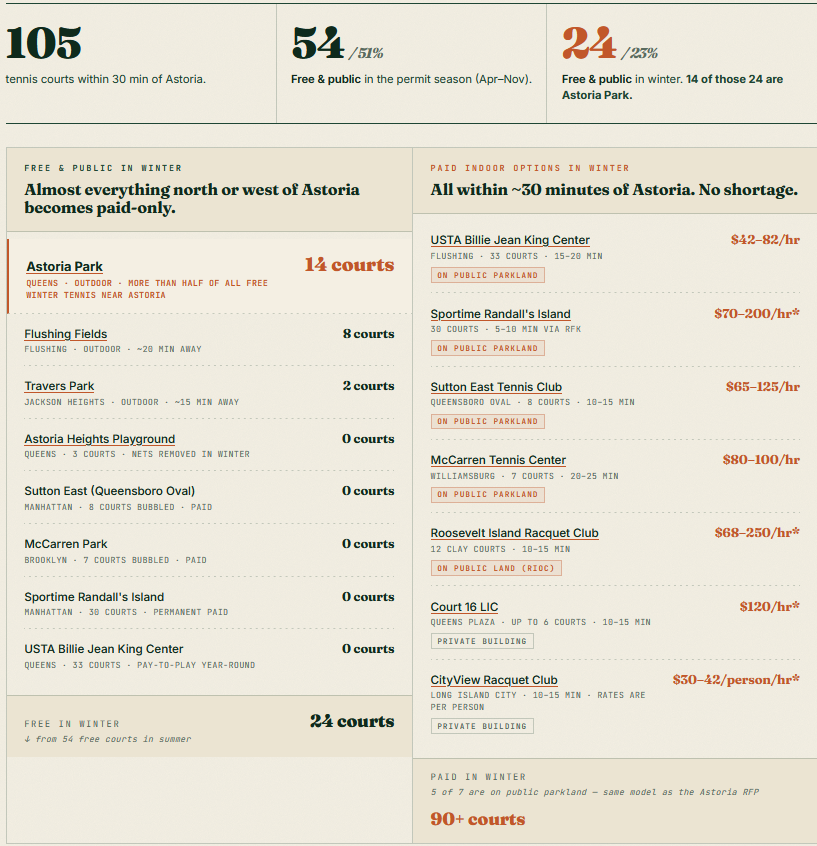
The public loses something irreplaceable. Within 30 minutes of Astoria there are already 90+ paid indoor courts in winter — USTA Billie Jean King (33 courts), Sportime Randall's Island (30), Sutton East, McCarren, Roosevelt Island, and more. Five of those seven facilities sit on public parkland under this same concession model. What's scarce isn't paid indoor tennis. It's free tennis. Only 24 free courts remain in winter within 30 minutes — and 14 of them are Astoria Park.
It’s not just winter. The bubble is up, and public access is restricted, for 7 months a year. Much of that time, the average highs are over 50°F.
Here's what changes:
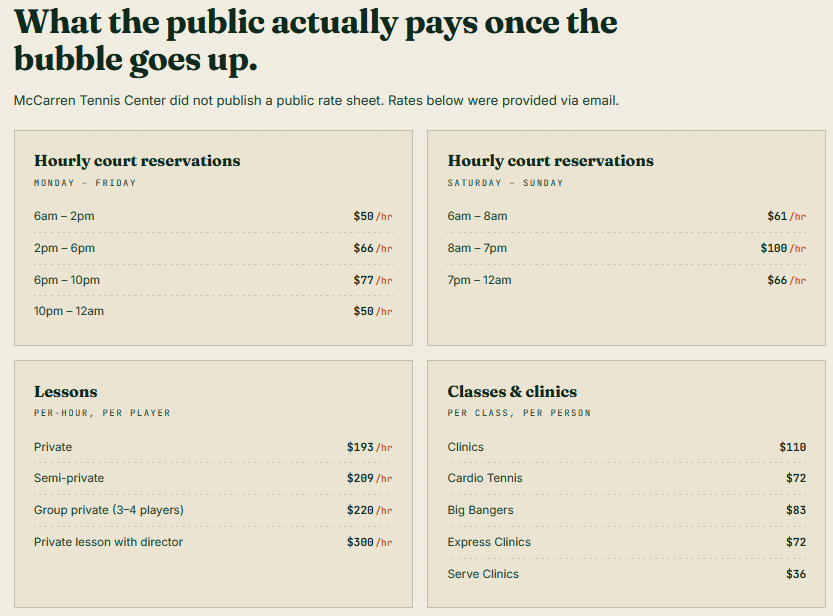
Today, summer play costs $100 maximum for the whole season, and winter access is free, no permit needed. Under this deal, that free winter access disappears, replaced by court sessions running upwards of $100/ hour, based on rates at the closest comparable bubble. That prices out families, casual players, and anyone who isn't treating tennis as a luxury expense. And even if you can pay, you may not get a court, the incentive runs toward expensive group clinics over public bookings, so prime-time slots vanish fast.
It doesn't stop at winter. Even during the outdoor season, when the courts are supposed to stay free and public, the operator gets at least 2 courts of their own for private lessons, up from the one teaching court Astoria has today. And just like the winter minimum, that number has no cap. Parks can hand over more courts "at its sole discretion," anytime, with no public vote required.
The trees and hawks are in the path. Bubbles need anchoring and clearance beyond the courts - no bubble anywhere encloses tall, mature trees. Based on the required footprint, that clearance comes from the tree line beside courts 4, 7, 8, and 11 and the shade row between courts 1-7. The red-tailed hawks nesting above court 8 would face 24/7 blowers, night lighting, and a dome in their flight path.
And what the City gets back doesn't match what it's giving away. The RFP's own comparable concession paid Parks just $210K–$287K a year. Within 30 minutes of Astoria there are already 90+ paid indoor courts — and only 24 free ones left. 14 of those are right here, in Astoria Park.
McCarren Park in Brooklyn has run under this exact model since 2017.
The community was told lighting would be installed within a year. Lights eventually went in — years late, and only on 3 of the 7 courts, the ones the operator actually uses. Parks never required lighting the rest of the lot. The community is now raising the money to light the remaining courts themselves. On top of that, the bubble is supposed to come down each season — but in 2020, it stayed up all summer instead. Rates, meanwhile, only moved one direction: $45–55/hour in 2019, up to $100/hour today. No fines. No terminated contract. No enforcement from NYC Parks. Just broken promises from the concessionaire that has contractual obligation to meet, but failed.
Given that record, what makes anyone think this time is different?
A better path exists
Fort Greene just resurfaced all 6 of its courts ($348K) through community fundraising and USTA public-court grants — the same program that resurfaced McCarren in 2010. Renovation doesn't require privatization.
Here's the timeline so far:
- Nov 2025: Earliest public discussion of a bubble at Astoria Park.
- March 2026: NYC Parks presents the plan to Community Board 1.
- May 2026: CB1 signals conditional support only, with a list of required protections. No RFP yet.
- June 9, 2026: Opposition petition passes 2,500 signatures.
- June 12, 2026: RFP formally issued (Solicitation #Q4-IT-2026).
- July 2026: Proposals submitted (deadline extended from July 17 to end of July).
- August 2026: WE ARE HERE! Parks is reviewing proposals. No award has been made. No public hearing date has been set. Over 3,300 signatures and counting. We are working behind the scenes to help spread awareness and trying to get our local reps on board. Please join us!
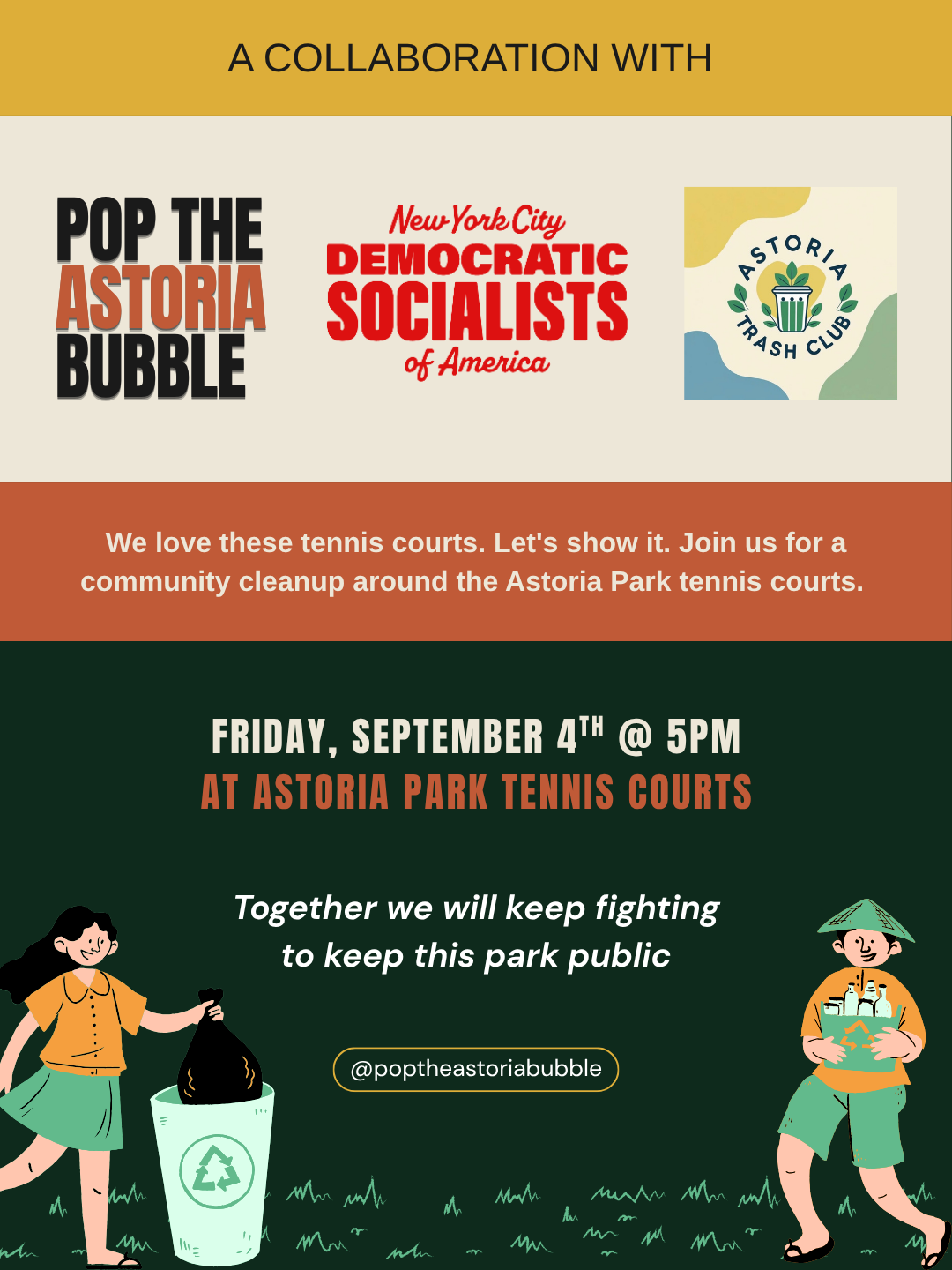
- Sept 4, 2026: 5PM - Community Clean-up Event @ Astoria Park Tennis Courts. Come meet your neighbors!
- Sept 22, 2026: 6PM Next Community Board 1 meeting at Astoria Manor / The Marquee , come and tell your story why our tennis court shouldn't be privatized!
- October 5: CB1 Parks Committee Meeting - no time and location listed
------------------------------------------------------
NEXT STEPS
------------------------------------------------------
1 - Email & Call Your Reps:
- Council Member Tiffany Cabán — District22@council.nyc.gov | 718-274-4500
- Assemblymember Diana Moreno — morenod@nyassembly.gov | 718-545-3889
- State Senator Kristen Gonzalez — gonzalez@nysenate.gov | 718-765-6674
- Richard Khuzami, Community Board 1 - qn01@cb.nyc.gov | 718-626-1021
- Mayor Zohran Mamdani — Contact-The-Mayor Form
2 - Write to the FCRC: A few sentences in your own words go furthest. Short on time? Our template is ready, just add your name. astoriatennis.com/letter
3 - Speak up and tell your story @ Community Board Meeting on September 22nd at 6pm | Astoria Manor / The Marquee in Astoria
4 - Share & Sign the Petition 🙏 We got over 3300 signatures. Let's get more!
5 - Come to our community event!
- Friday, Sept 4th @ 5PM Clean Up the Tennis Court Event.
- Collaboration with Astoria Trash Club x NYC Democratic Socialist of Queens
- You can also sign-up to meet your neighbors! Sign-Up Link
6 - Follow us on Instagram: @poptheastoriabubble
- Our message to Mayor Mamdani: Video
7 - Testimony: If you would like to tell us your story and would like us to post it so, please DM us on Instagram or email us! Pop The Astoria Bubble Email
IF YOU WANT TO LEARN MORE, HERE IS OUR Full research and sources LINK.

3,729
The Issue
Public land is for public use - not for whoever wins a bidding war. Once 20 years of parkland is signed away, it doesn't come back.
WE'VE BEEN HERE BEFORE | NYC Parks proposed this same bubble in 2005 and in 1992. Both times, the community POPPED THE BUBBLE
UPDATE - August 2026: Here's where we are, and what's next...
Astoria Park's tennis courts are 14 free, public courts. NYC Parks wants to hand at least 8 of them to a private, for-profit company for the next 20 years. And "at least" is the key word: officials told the community the bubble would be capped at 8. The RFP sets no cap at all, just a minimum.
The public loses something irreplaceable. Within 30 minutes of Astoria there are already 90+ paid indoor courts in winter — USTA Billie Jean King (33 courts), Sportime Randall's Island (30), Sutton East, McCarren, Roosevelt Island, and more. Five of those seven facilities sit on public parkland under this same concession model. What's scarce isn't paid indoor tennis. It's free tennis. Only 24 free courts remain in winter within 30 minutes — and 14 of them are Astoria Park.
It’s not just winter. The bubble is up, and public access is restricted, for 7 months a year. Much of that time, the average highs are over 50°F.
Here's what changes:
Today, summer play costs $100 maximum for the whole season, and winter access is free, no permit needed. Under this deal, that free winter access disappears, replaced by court sessions running upwards of $100/ hour, based on rates at the closest comparable bubble. That prices out families, casual players, and anyone who isn't treating tennis as a luxury expense. And even if you can pay, you may not get a court, the incentive runs toward expensive group clinics over public bookings, so prime-time slots vanish fast.
It doesn't stop at winter. Even during the outdoor season, when the courts are supposed to stay free and public, the operator gets at least 2 courts of their own for private lessons, up from the one teaching court Astoria has today. And just like the winter minimum, that number has no cap. Parks can hand over more courts "at its sole discretion," anytime, with no public vote required.
The trees and hawks are in the path. Bubbles need anchoring and clearance beyond the courts - no bubble anywhere encloses tall, mature trees. Based on the required footprint, that clearance comes from the tree line beside courts 4, 7, 8, and 11 and the shade row between courts 1-7. The red-tailed hawks nesting above court 8 would face 24/7 blowers, night lighting, and a dome in their flight path.
And what the City gets back doesn't match what it's giving away. The RFP's own comparable concession paid Parks just $210K–$287K a year. Within 30 minutes of Astoria there are already 90+ paid indoor courts — and only 24 free ones left. 14 of those are right here, in Astoria Park.
McCarren Park in Brooklyn has run under this exact model since 2017.
The community was told lighting would be installed within a year. Lights eventually went in — years late, and only on 3 of the 7 courts, the ones the operator actually uses. Parks never required lighting the rest of the lot. The community is now raising the money to light the remaining courts themselves. On top of that, the bubble is supposed to come down each season — but in 2020, it stayed up all summer instead. Rates, meanwhile, only moved one direction: $45–55/hour in 2019, up to $100/hour today. No fines. No terminated contract. No enforcement from NYC Parks. Just broken promises from the concessionaire that has contractual obligation to meet, but failed.
Given that record, what makes anyone think this time is different?
A better path exists
Fort Greene just resurfaced all 6 of its courts ($348K) through community fundraising and USTA public-court grants — the same program that resurfaced McCarren in 2010. Renovation doesn't require privatization.
Here's the timeline so far:
- Nov 2025: Earliest public discussion of a bubble at Astoria Park.
- March 2026: NYC Parks presents the plan to Community Board 1.
- May 2026: CB1 signals conditional support only, with a list of required protections. No RFP yet.
- June 9, 2026: Opposition petition passes 2,500 signatures.
- June 12, 2026: RFP formally issued (Solicitation #Q4-IT-2026).
- July 2026: Proposals submitted (deadline extended from July 17 to end of July).
- August 2026: WE ARE HERE! Parks is reviewing proposals. No award has been made. No public hearing date has been set. Over 3,300 signatures and counting. We are working behind the scenes to help spread awareness and trying to get our local reps on board. Please join us!
- Sept 4, 2026: 5PM - Community Clean-up Event @ Astoria Park Tennis Courts. Come meet your neighbors!
- Sept 22, 2026: 6PM Next Community Board 1 meeting at Astoria Manor / The Marquee , come and tell your story why our tennis court shouldn't be privatized!
- October 5: CB1 Parks Committee Meeting - no time and location listed
------------------------------------------------------
NEXT STEPS
------------------------------------------------------
1 - Email & Call Your Reps:
- Council Member Tiffany Cabán — District22@council.nyc.gov | 718-274-4500
- Assemblymember Diana Moreno — morenod@nyassembly.gov | 718-545-3889
- State Senator Kristen Gonzalez — gonzalez@nysenate.gov | 718-765-6674
- Richard Khuzami, Community Board 1 - qn01@cb.nyc.gov | 718-626-1021
- Mayor Zohran Mamdani — Contact-The-Mayor Form
2 - Write to the FCRC: A few sentences in your own words go furthest. Short on time? Our template is ready, just add your name. astoriatennis.com/letter
3 - Speak up and tell your story @ Community Board Meeting on September 22nd at 6pm | Astoria Manor / The Marquee in Astoria
4 - Share & Sign the Petition 🙏 We got over 3300 signatures. Let's get more!
5 - Come to our community event!
- Friday, Sept 4th @ 5PM Clean Up the Tennis Court Event.
- Collaboration with Astoria Trash Club x NYC Democratic Socialist of Queens
- You can also sign-up to meet your neighbors! Sign-Up Link
6 - Follow us on Instagram: @poptheastoriabubble
- Our message to Mayor Mamdani: Video
7 - Testimony: If you would like to tell us your story and would like us to post it so, please DM us on Instagram or email us! Pop The Astoria Bubble Email
IF YOU WANT TO LEARN MORE, HERE IS OUR Full research and sources LINK.
The Decision Makers


Supporter Voices
Petition Updates
Share this petition
Petition created on May 7, 2026