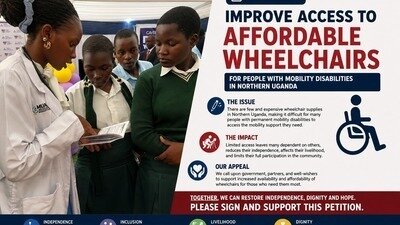

Wheelchair accessibility
The Issue
In northern Uganda, affordable and readily available wheelchairs remain scarce, making it difficult for many people living with permanent mobility disabilities to access the assistive devices they need. The high cost and limited supply of wheelchairs leave countless individuals confined to their homes or dependent on family members and caregivers for even the simplest daily activities.
This lack of mobility not only reduces their independence but also limits their access to education, employment, healthcare, and social participation. As a result, many individuals experience reduced quality of life, financial hardship, and social exclusion, while their families bear an increased caregiving burden.
Increasing the availability of affordable, durable, and locally accessible wheelchairs would empower people with permanent mobility disabilities to move independently, perform daily tasks with dignity, participate actively in their communities, and pursue education and income-generating opportunities. Investing in accessible wheelchair provision is not merely a health intervention;it is a commitment to inclusion, equal opportunity, and the fundamental rights of persons with disabilities.
In northern Uganda, affordable and readily available wheelchairs remain scarce, making it difficult for many people living with permanent mobility disabilities to access the assistive devices they need. The high cost and limited supply of wheelchairs leave countless individuals confined to their homes or dependent on family members and caregivers for even the simplest daily activities.
The need for action is urgent. Recent data indicate that about one in five Ugandans (approximately 7.5 million people) require rehabilitation services, while around 26% of the population needs at least one assistive product, including wheelchairs, walking aids, and prosthetic devices. Yet only about 5% have access to the assistive products they need, leaving millions without the mobility support required to live independently.
Affordability is one of the greatest barriers. In Uganda, 87% of people who need assistive technology report that cost prevents them from obtaining it, and many rely on charities, family members, or self-made devices because public provision is limited.
The challenge is even more pronounced in northern Uganda, where disability rates are among the highest in the country. For example, the Lango sub-region recorded a disability prevalence of 17.4%, with walking disabilities accounting for a large proportion of cases.
Providing affordable, durable, and locally accessible wheelchairs would restore independence, improve access to education, employment, healthcare, and community participation, and reduce the burden on families and caregivers. Every person deserves the opportunity to live a productive and dignified life.
We therefore call upon the Government of Uganda, development partners, non-governmental organizations, manufacturers, and other stakeholders to increase the supply, affordability, and equitable distribution of quality wheelchairs across northern Uganda. Investing in wheelchair access is an investment in dignity, inclusion, and equal opportunity for all.
Every person deserves the opportunity to live an independent, productive, and dignified life.
This change begins with you, a signature a time can evoke change

61
The Issue
In northern Uganda, affordable and readily available wheelchairs remain scarce, making it difficult for many people living with permanent mobility disabilities to access the assistive devices they need. The high cost and limited supply of wheelchairs leave countless individuals confined to their homes or dependent on family members and caregivers for even the simplest daily activities.
This lack of mobility not only reduces their independence but also limits their access to education, employment, healthcare, and social participation. As a result, many individuals experience reduced quality of life, financial hardship, and social exclusion, while their families bear an increased caregiving burden.
Increasing the availability of affordable, durable, and locally accessible wheelchairs would empower people with permanent mobility disabilities to move independently, perform daily tasks with dignity, participate actively in their communities, and pursue education and income-generating opportunities. Investing in accessible wheelchair provision is not merely a health intervention;it is a commitment to inclusion, equal opportunity, and the fundamental rights of persons with disabilities.
In northern Uganda, affordable and readily available wheelchairs remain scarce, making it difficult for many people living with permanent mobility disabilities to access the assistive devices they need. The high cost and limited supply of wheelchairs leave countless individuals confined to their homes or dependent on family members and caregivers for even the simplest daily activities.
The need for action is urgent. Recent data indicate that about one in five Ugandans (approximately 7.5 million people) require rehabilitation services, while around 26% of the population needs at least one assistive product, including wheelchairs, walking aids, and prosthetic devices. Yet only about 5% have access to the assistive products they need, leaving millions without the mobility support required to live independently.
Affordability is one of the greatest barriers. In Uganda, 87% of people who need assistive technology report that cost prevents them from obtaining it, and many rely on charities, family members, or self-made devices because public provision is limited.
The challenge is even more pronounced in northern Uganda, where disability rates are among the highest in the country. For example, the Lango sub-region recorded a disability prevalence of 17.4%, with walking disabilities accounting for a large proportion of cases.
Providing affordable, durable, and locally accessible wheelchairs would restore independence, improve access to education, employment, healthcare, and community participation, and reduce the burden on families and caregivers. Every person deserves the opportunity to live a productive and dignified life.
We therefore call upon the Government of Uganda, development partners, non-governmental organizations, manufacturers, and other stakeholders to increase the supply, affordability, and equitable distribution of quality wheelchairs across northern Uganda. Investing in wheelchair access is an investment in dignity, inclusion, and equal opportunity for all.
Every person deserves the opportunity to live an independent, productive, and dignified life.
This change begins with you, a signature a time can evoke change
The Decision Makers

Petition Updates
Share this petition
Petition created on 9 July 2026