

Whatcom Creek Protection & Sanctioned Outdoor Sites
The Issue
The Petition Ask:
We, residents of Bellingham, demand that Mayor Lund and the Bellingham City Council immediately halt the upcoming King Mountain encampment sweep until the city establishes a managed, low-barrier, sanctioned outdoor shelter space.
Sweeping hundreds of people without providing a serviced alternative will inevitably disperse individuals directly into remaining natural areas and back down into the Whatcom Creek riparian corridor. The city must provide a managed location with basic waste and hygiene infrastructure to intercept trash at the source, ensure public safety, and fulfill its legal obligations under the Bellingham Critical Areas Ordinance (BMC 16.55).
Why This Matters:
As the coordinator of Trash Club, I've spent the last five years working alongside dedicated volunteers to remove over 80 tons of waste from Whatcom Creek in the downtown corridor, including biohazards, weapons, needles, and industrial chemicals. Through our on-the-ground efforts, one observation is clear: the vast majority of this trash is the direct output of unsanctioned camping. At any given time, dozens of small encampments are active in the Whatcom Creek corridor, resulting in continual gross degradation of the local ecology and our community park spaces. Without sanctioned, serviced outdoor spaces to meet the needs of individuals who are structurally locked out of traditional indoor services, the ongoing contamination and degradation of the creek corridor is an inevitable certainty. The environmental destruction we are witnessing is not a failure of individual campers but the direct result of a lack of structural alternatives provided by the city.
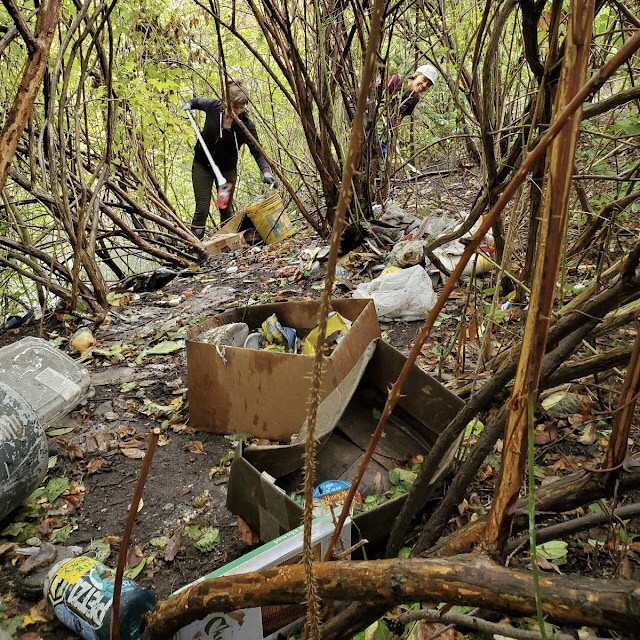
(Photo: Trash Club volunteers cleaning up litter in the bushes along the creek.)
In an effort to mitigate the impacts of this crisis, Trash Club began partnering with the Parks Department in January to install six 55-gallon public trash cans along a four-block stretch of the downtown corridor where waste regularly accumulates and city services are absent. These cans are currently filling completely every two to three days. This single, localized micro-intervention is currently processing an additional 1.5 tons of trash each month. This is trash that would have ended up on the ground or in the creek, and this work is done entirely by hand by dedicated volunteers.
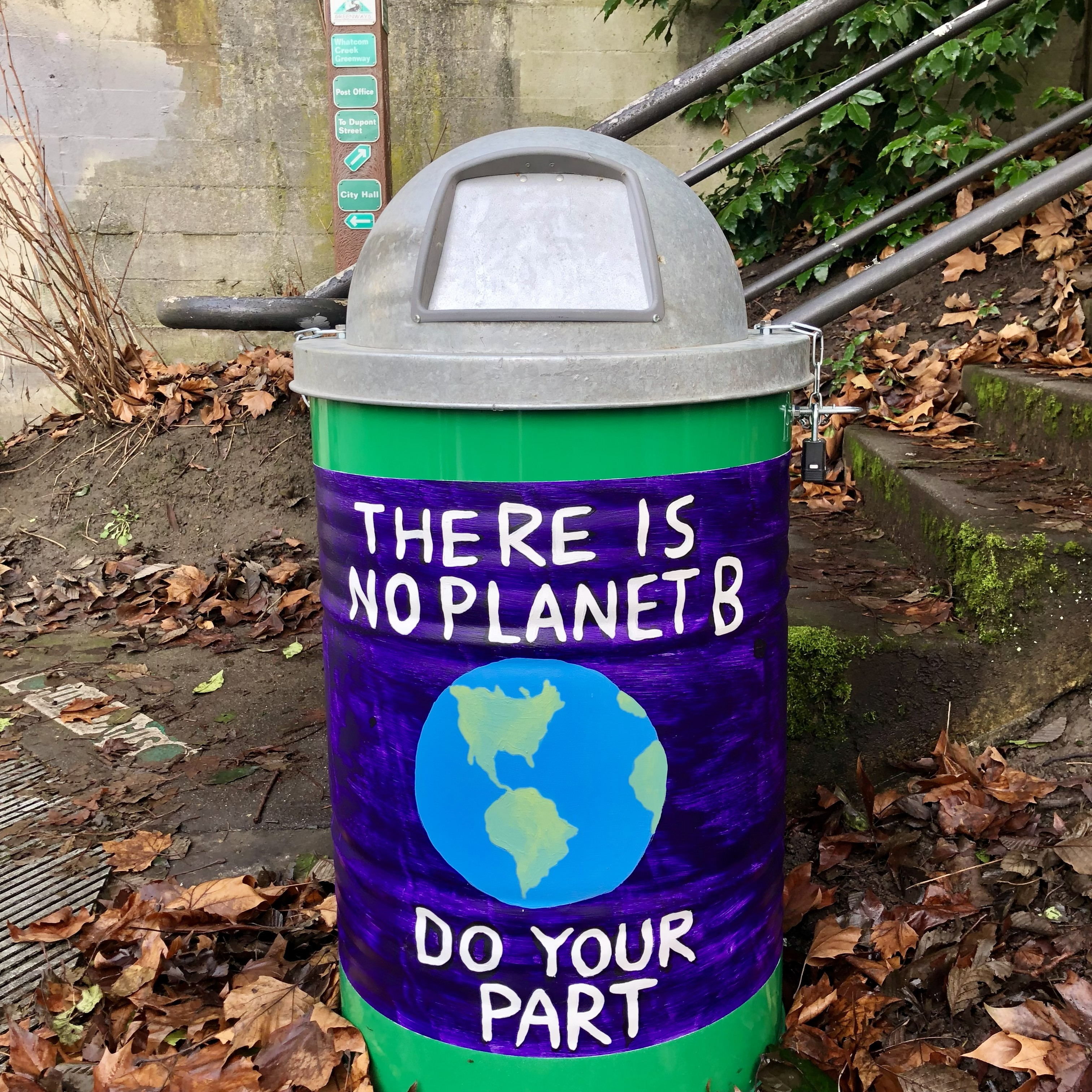
(Photo: Trash Club garbage can at Maritime Heritage Park.)
While we appreciate the cooperation of the Parks Department, this massive maintenance effort is overwhelming our volunteer crew. The volume of trash has continually worsened since we started our work in 2021. The work of Trash Club has now become the de facto management of a municipal problem, with the unfinished work of the city being completed by volunteers who refuse to see our local ecology further degraded and the needs of vulnerable community members overlooked.
The underlying cause remains completely unaddressed: our city offers zero sanctioned, low-barrier outdoor spaces. According to the Whatcom County Snapshot on Homelessness, our unsheltered (outdoor) population was 337 individuals in 2025, with 68% in Bellingham. This suggests that on any given night, we have more than 200 individuals within city limits who cannot access indoor services and lack any form of supported shelter for sleeping. For those unaware, a short walk along the downtown Whatcom Creek Trail from the Food Bank to the Senior Center will quickly reveal the extent of this crisis and its impacts on the surrounding environment.
Unfortunately, this crisis was recently worsened by the closure of downtown alleyways (which displaced individuals from downtown to the banks of the creek) and is about to hit a breaking point. As reported by the Bellingham Herald, the city is moving forward with an enforcement and abatement plan to sweep the King Mountain encampment in the near future. While the conditions there are a recognized safety concern, on-the-ground estimates suggest there are currently several hundred people living in that camp. Without a sanctioned, managed outdoor location for these individuals to relocate, this action will inevitably disperse these people into other nearby natural areas. Historically, these encampment sweeps conducted (at great cost) by the city have triggered immediate, multi-month spikes in camping along the downtown creek corridor.
Critics often point to the operational costs and logistical challenges of running sanctioned, managed outdoor sites, but we must recognize that our current strategy of endless sweeps is already carrying a massive, invisible cost. We are paying public works crews to shuffle trash, police to enforce temporary bans, and emergency services to respond to crises, all while our critical environmental habitats pay the hidden cost. When the city’s primary mechanism for addressing these camps is a policy of displacement, it does nothing to stop the generation and mismanagement of waste. Continual sweeps without relocation alternatives simply spread out, disguise, and shuffle a heavy ecological footprint up and down the creek, leaving a continual trail of solid and human waste (feces) behind, which poses an extensive bacterial threat to the riparian ecosystem.
Under Washington's Growth Management Act (RCW 36.70A) and the Bellingham Critical Areas Ordinance (BMC 16.55), the city has a binding statutory obligation to protect fish and wildlife habitat conservation areas and restrict degradation within stream corridors. Protection of the creek corridor cannot wait for a multi-year affordable housing construction pipeline, nor can it be buffered from the environmental fallout of the King Mountain displacement without an immediate mitigation plan.
Intercepting waste at a managed source is the only way to fulfill the city's legal obligation to the watershed while providing a stable, humane baseline for our unsheltered neighbors. Please sign this petition to urge Mayor Lund and the Bellingham City Council to establish a managed, low-barrier, sanctioned outdoor site before the King Mountain enforcement action takes place.
Note: The establishment of a managed, low-barrier outdoor site must not divert resources from permanent affordable housing initiatives or long-term supportive housing pipelines. A sanctioned interim site is not a substitute for permanent housing; it is emergency public health and environmental harm-reduction infrastructure. Just as funding emergency services does not diminish a municipality's commitment to building long-term infrastructure, funding a temporary site serves as an immediate mechanism to stabilize individuals and protect public land while permanent units are secured.
Relevant resources:

427
The Issue
The Petition Ask:
We, residents of Bellingham, demand that Mayor Lund and the Bellingham City Council immediately halt the upcoming King Mountain encampment sweep until the city establishes a managed, low-barrier, sanctioned outdoor shelter space.
Sweeping hundreds of people without providing a serviced alternative will inevitably disperse individuals directly into remaining natural areas and back down into the Whatcom Creek riparian corridor. The city must provide a managed location with basic waste and hygiene infrastructure to intercept trash at the source, ensure public safety, and fulfill its legal obligations under the Bellingham Critical Areas Ordinance (BMC 16.55).
Why This Matters:
As the coordinator of Trash Club, I've spent the last five years working alongside dedicated volunteers to remove over 80 tons of waste from Whatcom Creek in the downtown corridor, including biohazards, weapons, needles, and industrial chemicals. Through our on-the-ground efforts, one observation is clear: the vast majority of this trash is the direct output of unsanctioned camping. At any given time, dozens of small encampments are active in the Whatcom Creek corridor, resulting in continual gross degradation of the local ecology and our community park spaces. Without sanctioned, serviced outdoor spaces to meet the needs of individuals who are structurally locked out of traditional indoor services, the ongoing contamination and degradation of the creek corridor is an inevitable certainty. The environmental destruction we are witnessing is not a failure of individual campers but the direct result of a lack of structural alternatives provided by the city.
(Photo: Trash Club volunteers cleaning up litter in the bushes along the creek.)
In an effort to mitigate the impacts of this crisis, Trash Club began partnering with the Parks Department in January to install six 55-gallon public trash cans along a four-block stretch of the downtown corridor where waste regularly accumulates and city services are absent. These cans are currently filling completely every two to three days. This single, localized micro-intervention is currently processing an additional 1.5 tons of trash each month. This is trash that would have ended up on the ground or in the creek, and this work is done entirely by hand by dedicated volunteers.
(Photo: Trash Club garbage can at Maritime Heritage Park.)
While we appreciate the cooperation of the Parks Department, this massive maintenance effort is overwhelming our volunteer crew. The volume of trash has continually worsened since we started our work in 2021. The work of Trash Club has now become the de facto management of a municipal problem, with the unfinished work of the city being completed by volunteers who refuse to see our local ecology further degraded and the needs of vulnerable community members overlooked.
The underlying cause remains completely unaddressed: our city offers zero sanctioned, low-barrier outdoor spaces. According to the Whatcom County Snapshot on Homelessness, our unsheltered (outdoor) population was 337 individuals in 2025, with 68% in Bellingham. This suggests that on any given night, we have more than 200 individuals within city limits who cannot access indoor services and lack any form of supported shelter for sleeping. For those unaware, a short walk along the downtown Whatcom Creek Trail from the Food Bank to the Senior Center will quickly reveal the extent of this crisis and its impacts on the surrounding environment.
Unfortunately, this crisis was recently worsened by the closure of downtown alleyways (which displaced individuals from downtown to the banks of the creek) and is about to hit a breaking point. As reported by the Bellingham Herald, the city is moving forward with an enforcement and abatement plan to sweep the King Mountain encampment in the near future. While the conditions there are a recognized safety concern, on-the-ground estimates suggest there are currently several hundred people living in that camp. Without a sanctioned, managed outdoor location for these individuals to relocate, this action will inevitably disperse these people into other nearby natural areas. Historically, these encampment sweeps conducted (at great cost) by the city have triggered immediate, multi-month spikes in camping along the downtown creek corridor.
Critics often point to the operational costs and logistical challenges of running sanctioned, managed outdoor sites, but we must recognize that our current strategy of endless sweeps is already carrying a massive, invisible cost. We are paying public works crews to shuffle trash, police to enforce temporary bans, and emergency services to respond to crises, all while our critical environmental habitats pay the hidden cost. When the city’s primary mechanism for addressing these camps is a policy of displacement, it does nothing to stop the generation and mismanagement of waste. Continual sweeps without relocation alternatives simply spread out, disguise, and shuffle a heavy ecological footprint up and down the creek, leaving a continual trail of solid and human waste (feces) behind, which poses an extensive bacterial threat to the riparian ecosystem.
Under Washington's Growth Management Act (RCW 36.70A) and the Bellingham Critical Areas Ordinance (BMC 16.55), the city has a binding statutory obligation to protect fish and wildlife habitat conservation areas and restrict degradation within stream corridors. Protection of the creek corridor cannot wait for a multi-year affordable housing construction pipeline, nor can it be buffered from the environmental fallout of the King Mountain displacement without an immediate mitigation plan.
Intercepting waste at a managed source is the only way to fulfill the city's legal obligation to the watershed while providing a stable, humane baseline for our unsheltered neighbors. Please sign this petition to urge Mayor Lund and the Bellingham City Council to establish a managed, low-barrier, sanctioned outdoor site before the King Mountain enforcement action takes place.
Note: The establishment of a managed, low-barrier outdoor site must not divert resources from permanent affordable housing initiatives or long-term supportive housing pipelines. A sanctioned interim site is not a substitute for permanent housing; it is emergency public health and environmental harm-reduction infrastructure. Just as funding emergency services does not diminish a municipality's commitment to building long-term infrastructure, funding a temporary site serves as an immediate mechanism to stabilize individuals and protect public land while permanent units are secured.
Relevant resources:
The Decision Makers


Supporter Voices
Petition Updates
Share this petition
Petition created on June 23, 2026