WHADJUK MEMBERS' PETITION

WHADJUK MEMBERS' PETITION
The issue
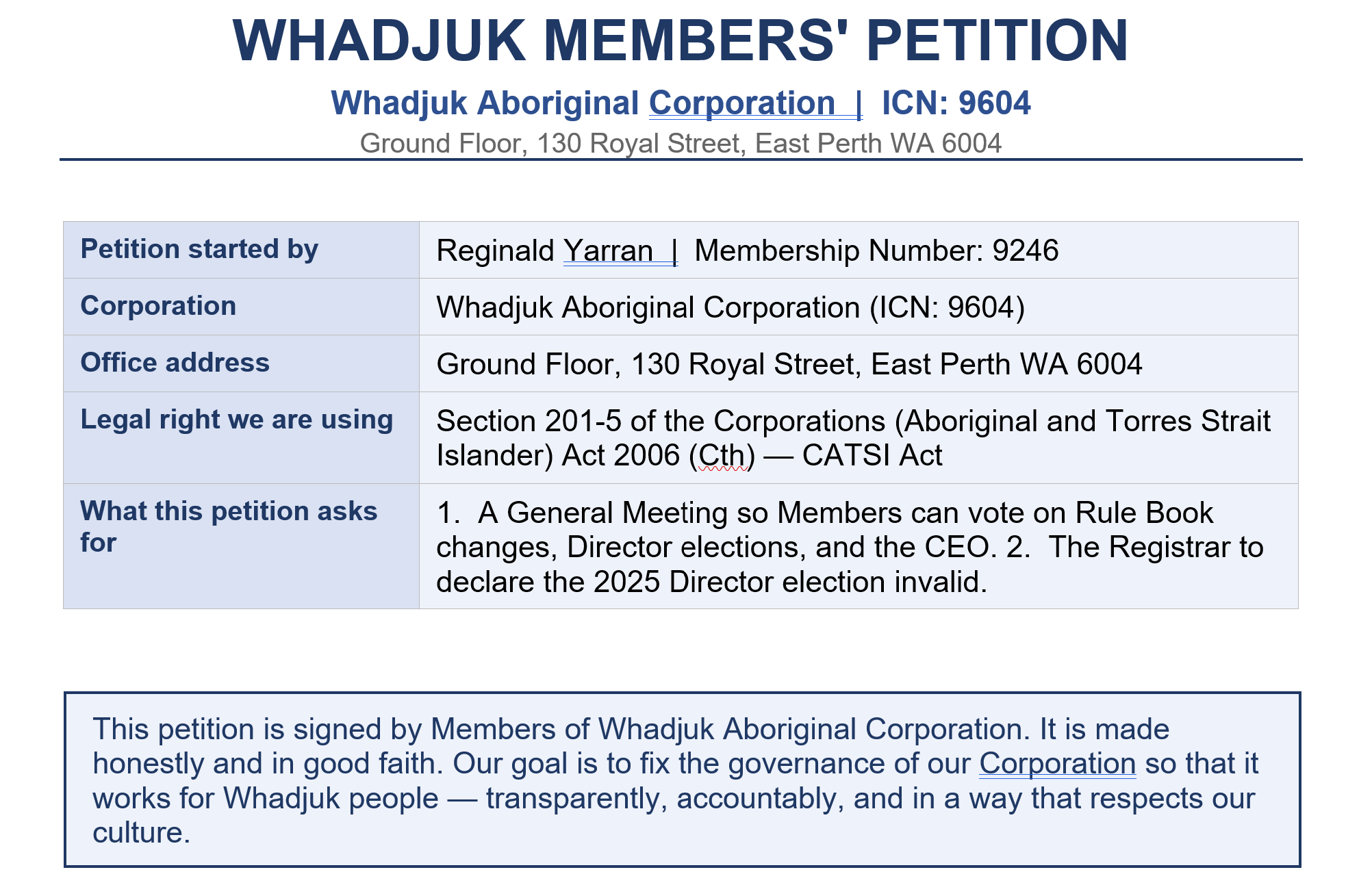
This petition is signed by Members of Whadjuk Aboriginal Corporation. It is made honestly and in good faith. Our goal is to fix the governance of our Corporation so that it works for Whadjuk people — transparently, accountably, and in a way that respects our culture.
SECTION 1 — WHY WE ARE SIGNING THIS PETITION
Whadjuk Aboriginal Corporation (WAC) is our corporation. It was set up to look after Whadjuk people — our culture, our Country, and our rights under the South West Native Title Settlement.
Right now, WAC is not working the way it should. We believe:
• The way the Corporation is being run needs to be fixed.
• The 2025 Director election was not done properly and should be cancelled.
• The Rule Book needs to be updated so that Whadjuk Members — not outside committees — decide who leads our Corporation.
• The current Board needs to answer for the decisions it has made and the problems it has caused.
• The Corporation needs new leadership at the top that serves Whadjuk people and our cultural obligations.
• The only way to fix these things properly is for all Members to meet and vote together at a General Meeting.
Under the CATSI Act (section 201-5), we have the legal right to ask the Directors to hold a General Meeting. We are using that right now.
This petition does two things:
• It asks the Directors to hold a General Meeting so Members can vote on Rule Book changes, who leads the Corporation, and what happens with the CEO.
• It asks the Registrar of Indigenous Corporations (ORIC) to rule that the 2025 Director election was invalid and to appoint an independent administrator to help fix the Corporation.
SECTION 2 — OUR CONCERNS ABOUT DIRECTOR CHARNE HAYDEN
Members have serious concerns about whether Charne Hayden should be a Director of WAC. These concerns are about how she behaved at the 2025 AGM and about her history as a director at other Aboriginal corporations.
Her behaviour at the 2025 AGM
At the 2025 Annual General Meeting, Members say Charne Hayden:
• Disrupted the meeting, pushed a member who was invited to speak from the floor and tried to prevent the same member from questioning Charne Hayden about the non-repayment of substantial amount of money incorrectly paid to her by Wungening Aboriginal Corporation. The WAC Rule Book (rule 7.14) says that anyone who does this can be asked to leave, and could have their membership cancelled.
• Did not behave in a way that respected the dignity of the Corporation or the right of Members to participate in the Annual General Meeting.
• Acted to push her own interests rather than to serve WAC and its Members.
• Did not meet her legal duties as a Director. Under sections 265-5 and 265-10 of the CATSI Act, Directors must act carefully, in good faith, and in the best interests of the Corporation. Her behaviour at the AGM fell short of these duties.
The WAC Rule Book says a Director who disrupts a meeting can be directed to leave and may have their membership cancelled. We ask the Corporation and the Registrar to formally consider Charne Hayden's conduct at the 2025 AGM under rule 7.14.
Her record at other Aboriginal corporations
We are also concerned about Charne Hayden's history as a director at other Aboriginal and Torres Strait Islander corporations. In each of the corporations listed below, serious problems with governance or the management of funding occurred while she was in a leadership role.
1. Wungening Aboriginal Corporation
Wungening provides alcohol and other drug services to Aboriginal people. Members have concerns about how Charne Hayden has continually refused to repay substantial funds deposited incorrectly into her bank account whilst Charne was a director back to Wungening Aboriginal Corporation. This debt owed by Charne Hayden to Wungening, continues to be ignored by her.
2. Seabrook Aboriginal Corporation
Seabrook suffered significant financial losses in 2020-21. Members are concerned about the role of directors — including Charne Hayden — in allowing this to happen, and whether proper oversight and care were exercised.
3. Noongar Language and Culture Centre
Charne Hayden held a leadership role at the Noongar Language and Culture Centre. Members have concerns about how cultural funding, excessive travel expenditure to the United States and Canada and governance responsibilities were handled during her time there.
4. Derbal Yerrigan Health Service Aboriginal Corporation
Derbal Yerrigan provides health services to Aboriginal people in Perth. Members have concerns about governance, administration of financial matters, excessive drawing of sitting fees and accountability during Charne Hayden's time in a leadership role at this organisation.
5. Medina Aboriginal Centre
Members have concerns about how Charne Hayden fulfilled her governance duties and managed funding obligations while she was a director of Medina Aboriginal Centre.
6. Mandjah Boodjah Aboriginal Corporation
Members have concerns about current governance, lack of ORIC compliance reporting and financial management at Mandjah Boodjah Aboriginal Corporation during Charne Hayden's current stewardship as Chairperson of this Corporation.
Why this matters: The CATSI Act (section 246-1) requires Directors to act carefully and responsibly. Someone with a history of being involved in multiple corporations that experienced governance and funding failures does not meet the standard that WAC Members deserve. The Nominations Committee should have looked into this background before endorsing Charne Hayden as a candidate for the 2025 election. The fact that it did not is another reason why that the Whadjuk Aboriginal Corporation election was not done properly.
SECTION 3 — THE RULE BOOK CHANGES WE ARE ASKING FOR
Members have prepared a new draft Rule Book written in plain English. It is designed to give every Whadjuk Member real power over how WAC is run. Here is a plain English summary of the main changes:
1. No more Nominations Committee
Right now, every person who wants to be a Director has to be approved by the Nominations Committee of the Noongar Boodja Trust before they can stand. We believe this is wrong. It puts an outside body — which has its own financial interests in WAC — in charge of who gets to lead our Corporation.
Under the new Rule Book, any eligible Whadjuk Member can nominate to be a Director directly. An independent Returning Officer will check that the person meets the eligibility criteria. No outside committee can block them or limit them to appeal solely on Administrative grounds.
2. A Members' Charter of Rights
A new Charter will be added to the Rule Book that gives every Member the following guaranteed rights. The Charter has the same legal force as any other rule, and it overrides other rules if there is a conflict.
• Transparency — every month, WAC must publish on its website how much each Director is being paid, who is doing heritage surveys and for how much, all land decisions, every contract over $5,000, and all travel expenses.
• Democratic participation — any eligible Whadjuk Member can stand for election without a Nominations Committee, and Members can call a General Meeting if 10% of Members sign a request.
• Cultural integrity — the Cultural Advice Committee of Elders must be consulted on all land and cultural decisions. Members can overturn any Board decision that ignores this advice.
• Accountability — any Director who hides a conflict of interest is automatically removed. Directors can only serve two terms in a row. Members can request independent audits. Whistleblowers are protected.
3. Automatic removal for hidden conflicts of interest
Under the new Rule Book, if a Director has a conflict of interest and does not declare it and leave the room, they are automatically removed as a Director. There are no exceptions and no second chances. This applies the moment the conflict is discovered.
4. Protecting Whadjuk-owned businesses
WAC and its subsidiaries must not use WAC's position as the native title body to direct all heritage and cultural work to WAC's own companies while pushing out independent Whadjuk businesses. Before WAC sets up any new commercial subsidiary, it must first check whether Whadjuk people are already running businesses that provide those services. If they are, WAC should support them rather than compete against them.
5. Independent boards for commercial subsidiaries
If WAC sets up a company to run a commercial activity — for example a heritage consulting business — that company must have its own independent board of directors. No more than one WAC Director can sit on any subsidiary board. No WAC Director can be the chairperson of a subsidiary. The subsidiary's finances must be audited separately and reported to Members every year. Members must approve any new subsidiary at a General Meeting.
6. Quarterly money reports
WAC must publish a financial report on its website every three months within 30 days of each quarter ending. The report must show how much each Director was paid, how much was spent on consultants, heritage surveys, and travel, and how the Corporation is tracking against its plans. Members should not have to wait a year to find out what is happening to their Corporation's money.
7. Term limits for Directors
No Director can serve more than two terms in a row (about four years). After that, they must sit out for at least one full term before they can stand again. This stops anyone from staying in charge for too long.
8. Members must approve travel
Before anyone travels intrastate, interstate or overseas at WAC's expense, Members must approve it at a General Meeting. The approval must say who is going, where, why, and how much it will cost. If there is an emergency, the Board can approve travel, but must report the full details to Members within 14 days.
9. Whistleblower protection
Any Member, employee, contractor, or volunteer who reports wrongdoing is protected. They cannot be punished or treated badly for speaking up. Anonymous reports are allowed. WAC must keep a confidential complaints register and respond to every complaint within 30 days.
SECTION 4 — WHAT WE ARE FORMALLY ASKING THE DIRECTORS TO DO
Ask 1 — Hold a General Meeting
We formally ask the Directors to hold a General Meeting of all Members within the timeframe required by the CATSI Act and the WAC Rule Book. At that meeting, Members will vote on:
1. The new Rule Book;
2. Who the Directors should be going forward;
3. Governance and compliance matters; and
4. The appointment or removal of the CEO.
Ask 2 — Send out proper meeting notices
The Board must send every Member a meeting notice that includes:
(a) the date, time, place, and how to join online;
(b) a plain English explanation of what the meeting is for;
(c) the full text of the proposed Rule Book changes;
(d) how Director elections will work;
(e) the name of the independent Returning Officer who will run the election; and
(f) everything Members need to make up their own minds.
No Nominations Committee. Any eligible Whadjuk Member must be free to nominate for Director without anyone's approval. The use of a Nominations Committee is not consistent with how Noongar people make decisions.
Ask 3 — Vote on the new Rule Book
At the General Meeting, Members will vote on the new Rule Book. The changes must:
(g) restore proper Whadjuk governance, including giving the Cultural Advice Committee of Elders real authority over land and cultural decisions;
(h) remove the Nominations Committee so Members can nominate freely;
(i) strengthen Directors' legal duties, financial reporting, and conflict of interest rules;
(j) make sure WAC complies with the South West Settlement and the Noongar Boodja Trust; and
(k) add the Members' Charter of Rights.
To change the Rule Book, 75% of voting Members must agree. This is called a Special Resolution.
Ask 4 — Deal with the Board
At the General Meeting, Members will also vote on whether to:
(l) remove Director Charne Hayden because of her conduct at the 2025 AGM and her record at other Aboriginal corporations;
(m) set up a fair election process for new Directors — with no Nominations Committee;
(n) make sure the new Board represents families from across the Whadjuk region, with the Cultural Advice Committee open only to Members aged 50 or over; and
(o) put in place temporary arrangements to keep WAC running smoothly while new Directors are elected.
Ask 5 — Fix governance and leadership
At the General Meeting, Members will also consider:
(p) making sure all Directors know and follow their legal duties under the CATSI Act;
(q) improving how WAC manages its money and reports on what it does;
(r) bringing in an independent person to review how WAC has been run; and
(s) removing the current CEO and replacing them with someone who is Noongar or Aboriginal, chosen through an open and publicly advertised process.
Ask 6 — The Board must organise the meeting properly
The Directors must:
(t) send the meeting notice to all Members;
(u) organise a venue that is accessible, with catering and technology so Members can join online if needed;
(v) appoint an independent Returning Officer who has no ties to WAC, its Directors, or the Noongar Boodja Trust;
(w) make sure all Members get the proposed Rule Book changes and other relevant documents at least 21 days before the meeting; and
(x) follow all the legal requirements in the CATSI Act and the WAC Rule Book.
(y) organise a vote of the membership seeking the removal of the CEO Leon Ruri and the following members Charne Hayden, Geraldine Hayden and Bettina Hayden from the membership of Whadjuk Aboriginal Corporation.
Ask 7 — Follow the law
Everything done to organise and run the General Meeting — and every decision made at the meeting — must follow:
• the CATSI Act;
• the WAC Rule Book;
• ORIC's requirements; and
• the obligations under the South West Settlement, the Whadjuk ILUA, and the Noongar Boodja Trust Deed.
The Board must tell ORIC about the General Meeting and about any changes Members decide to make.
What happens if the Board does not act? If the Directors do not call the General Meeting within 21 days of receiving this petition, or if the meeting is not held within 2 months, we as Members have the legal right to organise the meeting ourselves under section 201-15 of the CATSI Act. WAC must pay our reasonable costs for doing so. We can also make a formal complaint to ORIC.
SECTION 5 — WHY THE 2025 DIRECTOR ELECTION WAS NOT VALID
Our petition to the Registrar of Indigenous Corporations (ORIC)
We are also asking the Registrar of Indigenous Corporations (ORIC) to cancel the 2025 Director election and to step in to help fix the Corporation's governance. Here is a plain English explanation of why we believe the election was not valid.
Reason 1 — More than 200 people were left off the voters' list
When the voting roll was finalised for the 2025 election, there were more than 200 membership applications that the Board had never dealt with. These applications had been piling up since at least 2024. The Board simply did not process them.
This meant that a large number of Whadjuk people who had applied to be Members — and who had every right to vote — were left off the voters' list and could not take part in the election.
• The WAC Rule Book says only people whose names are on the membership register when the voting roll closes can vote. By refusing to process applications, the Board effectively locked hundreds of people out of the election.
• ORIC confirmed this by sending WAC a formal legal notice on 22 September 2025 asking for information about the unprocessed applications.
• There were enough excluded people to have changed who won the election.
Reason 2 — The Board running the election did not have enough directors
For the period from January 2025 until 29 May 2025 they were organising the election, the WAC Board only had three directors — Reginald Yarran, Geraldine Hayden, and Kerry-Ann Winmar. The WAC Rule Book requires at least four directors. A board without enough directors cannot lawfully make decisions during this time.
This means that when the Board decided before the 29 May 2025, to hold the election, set the timetable, appointed the Returning Officer, and provided the voters' list — all of those decisions were potentially invalid because they were made without a proper quorum.
Reason 3 — The election used a Rule Book Members never agreed to
The election was run under a new version of the Rule Book that the Registrar registered on 29 May 2025. Members were never given the chance to vote on or agree to those changes.
Not only that — at the time of the election, Members had already made a formal legal challenge to those Rule Book changes (under section 620-5 of the CATSI Act). Running an election under rules that were being legally challenged was wrong and unfair.
• One of those new rules gave the Board the power to appoint new directors without holding an election — an emergency power the Board then used to stay in control.
• That emergency power was added to the Rule Book at the request of the very same Board that did not have a proper quorum and therefore had no legal authority to make such a request.
Reason 4 — The Nominations Committee was used against the wishes of Members
The election used the Nominations Committee of the Noongar Boodja Trust to decide who was allowed to stand as a candidate. Members had already formally signed a petition and passed a resolution saying they did not want a Nominations Committee used, because it is not consistent with how Noongar people make decisions.
The Noongar Boodja Trust also has a direct financial relationship with WAC and an interest in who sits on the WAC Board. Using the Trust's committee to decide who can stand for election to the WAC Board is a conflict of interest. Ignoring Member opposition and going ahead with the Nominations Committee was oppressive conduct under section 69-50 of the CATSI Act.
Reason 5 — The Nominations Committee did not properly check the candidates
The Nominations Committee approved candidates without properly checking their backgrounds, governance skills, or cultural connection to Whadjuk country. As explained in Section 2, Charne Hayden and her sisters have a history of being involved in Aboriginal corporations where serious governance and money management problems occurred. The Nominations Committee should have found this and taken it into account. It did not.
The CATSI Act requires Directors to act with care and skill (section 246-1). A Nominations Committee that approves candidates without basic background checks is not doing its job properly.
Reason 6 — The Corporation was in crisis when the election was held
The election took place in the middle of a serious governance crisis at WAC. At the same time as the election was being run:
• WAC had no staff — almost all employees were terminated on 26 March 2025, leaving the Corporation unable to manage elections, process membership applications, or meet its legal obligations;
• WAC's heritage and cultural work had been handed over to a private company (SWALS) connected to members of the Cultural Advice Committee — without Board approval and in breach of conflict of interest rules;
• The Cultural Advice Committee had been effectively shut down;
• The Board had ignored multiple formal requests from Members for a General Meeting; and
• ORIC had already found serious compliance failures at WAC, including problems with how the membership register was managed and how memberships were cancelled.
It was not possible to hold a fair and lawful election in these conditions.
SECTION 6 — WHAT WE ARE ASKING ORIC TO DO
We respectfully ask the Registrar of Indigenous Corporations to:
1. Cancel the 2025 Director election and set aside its results, for the reasons set out in Section 5.
2. Require a fresh election to be held — but only after all the outstanding membership applications have been processed so that every eligible Member can vote.
3. Make sure that any outstanding membership applications are properly dealt with before any new election is held.
4. Appoint an independent Special Administrator under Part 11-2 of the CATSI Act to: take over the running of WAC while things are fixed; deal with all the membership applications; review the Rule Book changes that were registered on 29 May 2025 without Member consent; organise and supervise a fair new Director election; and report back to ORIC on progress.
5. Investigate (under Part 11-1 of the CATSI Act): why the Board failed to process membership applications; the governance failures described in this petition; why all WAC staff were terminated; the conflict of interest issues with SWALS; and Charne Hayden's governance record at the corporations listed in Section 2.
6. Make sure any new election is: run without a Nominations Committee; overseen by an independent Returning Officer; held only after all membership applications are resolved; and run in a way that is consistent with Noongar decision-making processes.
7. Make any other orders needed to restore proper governance to WAC and protect its Members, assets, and community programs.
The laws we are relying on
This petition relies on the following parts of the Corporations (Aboriginal and Torres Strait Islander) Act 2006:
• Section 201-5 — our right to ask the Directors to hold a General Meeting;
• Sections 144-5 and 144-10 — the obligation to process membership applications;
• Section 69-50 — the rule against oppressive or unfair treatment of Members;
• Section 246-1 — Directors' duty of care and skill;
• Sections 265-1 to 265-20 — Directors' duties generally;
• Section 620-5 — our right to ask for a review of a Registrar decision;
• Part 11-1 — the Registrar's power to investigate;
• Part 11-2 (Division 487) — the Registrar's power to appoint a Special Administrator; and
• Section 69-35(1) — the Registrar's power to change a Rule Book, and the limits on that power when Member rights are affected.
SIGNATURES
We, the undersigned Members of Whadjuk Aboriginal Corporation (ICN: 9604), sign this petition to:
• ask the Directors to hold a General Meeting as set out in Section 4;
• support all the resolutions described in this petition;
• ask the Registrar to take the action described in Sections 5 and 6; and
• push for the governance reforms described in Section 3.
Petition started by
Reginald Yarran | Membership Number: 9246 |
Signature: ___________________________
NAME MEMBERSHIP NO. SIGNATURE

443
The issue
This petition is signed by Members of Whadjuk Aboriginal Corporation. It is made honestly and in good faith. Our goal is to fix the governance of our Corporation so that it works for Whadjuk people — transparently, accountably, and in a way that respects our culture.
SECTION 1 — WHY WE ARE SIGNING THIS PETITION
Whadjuk Aboriginal Corporation (WAC) is our corporation. It was set up to look after Whadjuk people — our culture, our Country, and our rights under the South West Native Title Settlement.
Right now, WAC is not working the way it should. We believe:
• The way the Corporation is being run needs to be fixed.
• The 2025 Director election was not done properly and should be cancelled.
• The Rule Book needs to be updated so that Whadjuk Members — not outside committees — decide who leads our Corporation.
• The current Board needs to answer for the decisions it has made and the problems it has caused.
• The Corporation needs new leadership at the top that serves Whadjuk people and our cultural obligations.
• The only way to fix these things properly is for all Members to meet and vote together at a General Meeting.
Under the CATSI Act (section 201-5), we have the legal right to ask the Directors to hold a General Meeting. We are using that right now.
This petition does two things:
• It asks the Directors to hold a General Meeting so Members can vote on Rule Book changes, who leads the Corporation, and what happens with the CEO.
• It asks the Registrar of Indigenous Corporations (ORIC) to rule that the 2025 Director election was invalid and to appoint an independent administrator to help fix the Corporation.
SECTION 2 — OUR CONCERNS ABOUT DIRECTOR CHARNE HAYDEN
Members have serious concerns about whether Charne Hayden should be a Director of WAC. These concerns are about how she behaved at the 2025 AGM and about her history as a director at other Aboriginal corporations.
Her behaviour at the 2025 AGM
At the 2025 Annual General Meeting, Members say Charne Hayden:
• Disrupted the meeting, pushed a member who was invited to speak from the floor and tried to prevent the same member from questioning Charne Hayden about the non-repayment of substantial amount of money incorrectly paid to her by Wungening Aboriginal Corporation. The WAC Rule Book (rule 7.14) says that anyone who does this can be asked to leave, and could have their membership cancelled.
• Did not behave in a way that respected the dignity of the Corporation or the right of Members to participate in the Annual General Meeting.
• Acted to push her own interests rather than to serve WAC and its Members.
• Did not meet her legal duties as a Director. Under sections 265-5 and 265-10 of the CATSI Act, Directors must act carefully, in good faith, and in the best interests of the Corporation. Her behaviour at the AGM fell short of these duties.
The WAC Rule Book says a Director who disrupts a meeting can be directed to leave and may have their membership cancelled. We ask the Corporation and the Registrar to formally consider Charne Hayden's conduct at the 2025 AGM under rule 7.14.
Her record at other Aboriginal corporations
We are also concerned about Charne Hayden's history as a director at other Aboriginal and Torres Strait Islander corporations. In each of the corporations listed below, serious problems with governance or the management of funding occurred while she was in a leadership role.
1. Wungening Aboriginal Corporation
Wungening provides alcohol and other drug services to Aboriginal people. Members have concerns about how Charne Hayden has continually refused to repay substantial funds deposited incorrectly into her bank account whilst Charne was a director back to Wungening Aboriginal Corporation. This debt owed by Charne Hayden to Wungening, continues to be ignored by her.
2. Seabrook Aboriginal Corporation
Seabrook suffered significant financial losses in 2020-21. Members are concerned about the role of directors — including Charne Hayden — in allowing this to happen, and whether proper oversight and care were exercised.
3. Noongar Language and Culture Centre
Charne Hayden held a leadership role at the Noongar Language and Culture Centre. Members have concerns about how cultural funding, excessive travel expenditure to the United States and Canada and governance responsibilities were handled during her time there.
4. Derbal Yerrigan Health Service Aboriginal Corporation
Derbal Yerrigan provides health services to Aboriginal people in Perth. Members have concerns about governance, administration of financial matters, excessive drawing of sitting fees and accountability during Charne Hayden's time in a leadership role at this organisation.
5. Medina Aboriginal Centre
Members have concerns about how Charne Hayden fulfilled her governance duties and managed funding obligations while she was a director of Medina Aboriginal Centre.
6. Mandjah Boodjah Aboriginal Corporation
Members have concerns about current governance, lack of ORIC compliance reporting and financial management at Mandjah Boodjah Aboriginal Corporation during Charne Hayden's current stewardship as Chairperson of this Corporation.
Why this matters: The CATSI Act (section 246-1) requires Directors to act carefully and responsibly. Someone with a history of being involved in multiple corporations that experienced governance and funding failures does not meet the standard that WAC Members deserve. The Nominations Committee should have looked into this background before endorsing Charne Hayden as a candidate for the 2025 election. The fact that it did not is another reason why that the Whadjuk Aboriginal Corporation election was not done properly.
SECTION 3 — THE RULE BOOK CHANGES WE ARE ASKING FOR
Members have prepared a new draft Rule Book written in plain English. It is designed to give every Whadjuk Member real power over how WAC is run. Here is a plain English summary of the main changes:
1. No more Nominations Committee
Right now, every person who wants to be a Director has to be approved by the Nominations Committee of the Noongar Boodja Trust before they can stand. We believe this is wrong. It puts an outside body — which has its own financial interests in WAC — in charge of who gets to lead our Corporation.
Under the new Rule Book, any eligible Whadjuk Member can nominate to be a Director directly. An independent Returning Officer will check that the person meets the eligibility criteria. No outside committee can block them or limit them to appeal solely on Administrative grounds.
2. A Members' Charter of Rights
A new Charter will be added to the Rule Book that gives every Member the following guaranteed rights. The Charter has the same legal force as any other rule, and it overrides other rules if there is a conflict.
• Transparency — every month, WAC must publish on its website how much each Director is being paid, who is doing heritage surveys and for how much, all land decisions, every contract over $5,000, and all travel expenses.
• Democratic participation — any eligible Whadjuk Member can stand for election without a Nominations Committee, and Members can call a General Meeting if 10% of Members sign a request.
• Cultural integrity — the Cultural Advice Committee of Elders must be consulted on all land and cultural decisions. Members can overturn any Board decision that ignores this advice.
• Accountability — any Director who hides a conflict of interest is automatically removed. Directors can only serve two terms in a row. Members can request independent audits. Whistleblowers are protected.
3. Automatic removal for hidden conflicts of interest
Under the new Rule Book, if a Director has a conflict of interest and does not declare it and leave the room, they are automatically removed as a Director. There are no exceptions and no second chances. This applies the moment the conflict is discovered.
4. Protecting Whadjuk-owned businesses
WAC and its subsidiaries must not use WAC's position as the native title body to direct all heritage and cultural work to WAC's own companies while pushing out independent Whadjuk businesses. Before WAC sets up any new commercial subsidiary, it must first check whether Whadjuk people are already running businesses that provide those services. If they are, WAC should support them rather than compete against them.
5. Independent boards for commercial subsidiaries
If WAC sets up a company to run a commercial activity — for example a heritage consulting business — that company must have its own independent board of directors. No more than one WAC Director can sit on any subsidiary board. No WAC Director can be the chairperson of a subsidiary. The subsidiary's finances must be audited separately and reported to Members every year. Members must approve any new subsidiary at a General Meeting.
6. Quarterly money reports
WAC must publish a financial report on its website every three months within 30 days of each quarter ending. The report must show how much each Director was paid, how much was spent on consultants, heritage surveys, and travel, and how the Corporation is tracking against its plans. Members should not have to wait a year to find out what is happening to their Corporation's money.
7. Term limits for Directors
No Director can serve more than two terms in a row (about four years). After that, they must sit out for at least one full term before they can stand again. This stops anyone from staying in charge for too long.
8. Members must approve travel
Before anyone travels intrastate, interstate or overseas at WAC's expense, Members must approve it at a General Meeting. The approval must say who is going, where, why, and how much it will cost. If there is an emergency, the Board can approve travel, but must report the full details to Members within 14 days.
9. Whistleblower protection
Any Member, employee, contractor, or volunteer who reports wrongdoing is protected. They cannot be punished or treated badly for speaking up. Anonymous reports are allowed. WAC must keep a confidential complaints register and respond to every complaint within 30 days.
SECTION 4 — WHAT WE ARE FORMALLY ASKING THE DIRECTORS TO DO
Ask 1 — Hold a General Meeting
We formally ask the Directors to hold a General Meeting of all Members within the timeframe required by the CATSI Act and the WAC Rule Book. At that meeting, Members will vote on:
1. The new Rule Book;
2. Who the Directors should be going forward;
3. Governance and compliance matters; and
4. The appointment or removal of the CEO.
Ask 2 — Send out proper meeting notices
The Board must send every Member a meeting notice that includes:
(a) the date, time, place, and how to join online;
(b) a plain English explanation of what the meeting is for;
(c) the full text of the proposed Rule Book changes;
(d) how Director elections will work;
(e) the name of the independent Returning Officer who will run the election; and
(f) everything Members need to make up their own minds.
No Nominations Committee. Any eligible Whadjuk Member must be free to nominate for Director without anyone's approval. The use of a Nominations Committee is not consistent with how Noongar people make decisions.
Ask 3 — Vote on the new Rule Book
At the General Meeting, Members will vote on the new Rule Book. The changes must:
(g) restore proper Whadjuk governance, including giving the Cultural Advice Committee of Elders real authority over land and cultural decisions;
(h) remove the Nominations Committee so Members can nominate freely;
(i) strengthen Directors' legal duties, financial reporting, and conflict of interest rules;
(j) make sure WAC complies with the South West Settlement and the Noongar Boodja Trust; and
(k) add the Members' Charter of Rights.
To change the Rule Book, 75% of voting Members must agree. This is called a Special Resolution.
Ask 4 — Deal with the Board
At the General Meeting, Members will also vote on whether to:
(l) remove Director Charne Hayden because of her conduct at the 2025 AGM and her record at other Aboriginal corporations;
(m) set up a fair election process for new Directors — with no Nominations Committee;
(n) make sure the new Board represents families from across the Whadjuk region, with the Cultural Advice Committee open only to Members aged 50 or over; and
(o) put in place temporary arrangements to keep WAC running smoothly while new Directors are elected.
Ask 5 — Fix governance and leadership
At the General Meeting, Members will also consider:
(p) making sure all Directors know and follow their legal duties under the CATSI Act;
(q) improving how WAC manages its money and reports on what it does;
(r) bringing in an independent person to review how WAC has been run; and
(s) removing the current CEO and replacing them with someone who is Noongar or Aboriginal, chosen through an open and publicly advertised process.
Ask 6 — The Board must organise the meeting properly
The Directors must:
(t) send the meeting notice to all Members;
(u) organise a venue that is accessible, with catering and technology so Members can join online if needed;
(v) appoint an independent Returning Officer who has no ties to WAC, its Directors, or the Noongar Boodja Trust;
(w) make sure all Members get the proposed Rule Book changes and other relevant documents at least 21 days before the meeting; and
(x) follow all the legal requirements in the CATSI Act and the WAC Rule Book.
(y) organise a vote of the membership seeking the removal of the CEO Leon Ruri and the following members Charne Hayden, Geraldine Hayden and Bettina Hayden from the membership of Whadjuk Aboriginal Corporation.
Ask 7 — Follow the law
Everything done to organise and run the General Meeting — and every decision made at the meeting — must follow:
• the CATSI Act;
• the WAC Rule Book;
• ORIC's requirements; and
• the obligations under the South West Settlement, the Whadjuk ILUA, and the Noongar Boodja Trust Deed.
The Board must tell ORIC about the General Meeting and about any changes Members decide to make.
What happens if the Board does not act? If the Directors do not call the General Meeting within 21 days of receiving this petition, or if the meeting is not held within 2 months, we as Members have the legal right to organise the meeting ourselves under section 201-15 of the CATSI Act. WAC must pay our reasonable costs for doing so. We can also make a formal complaint to ORIC.
SECTION 5 — WHY THE 2025 DIRECTOR ELECTION WAS NOT VALID
Our petition to the Registrar of Indigenous Corporations (ORIC)
We are also asking the Registrar of Indigenous Corporations (ORIC) to cancel the 2025 Director election and to step in to help fix the Corporation's governance. Here is a plain English explanation of why we believe the election was not valid.
Reason 1 — More than 200 people were left off the voters' list
When the voting roll was finalised for the 2025 election, there were more than 200 membership applications that the Board had never dealt with. These applications had been piling up since at least 2024. The Board simply did not process them.
This meant that a large number of Whadjuk people who had applied to be Members — and who had every right to vote — were left off the voters' list and could not take part in the election.
• The WAC Rule Book says only people whose names are on the membership register when the voting roll closes can vote. By refusing to process applications, the Board effectively locked hundreds of people out of the election.
• ORIC confirmed this by sending WAC a formal legal notice on 22 September 2025 asking for information about the unprocessed applications.
• There were enough excluded people to have changed who won the election.
Reason 2 — The Board running the election did not have enough directors
For the period from January 2025 until 29 May 2025 they were organising the election, the WAC Board only had three directors — Reginald Yarran, Geraldine Hayden, and Kerry-Ann Winmar. The WAC Rule Book requires at least four directors. A board without enough directors cannot lawfully make decisions during this time.
This means that when the Board decided before the 29 May 2025, to hold the election, set the timetable, appointed the Returning Officer, and provided the voters' list — all of those decisions were potentially invalid because they were made without a proper quorum.
Reason 3 — The election used a Rule Book Members never agreed to
The election was run under a new version of the Rule Book that the Registrar registered on 29 May 2025. Members were never given the chance to vote on or agree to those changes.
Not only that — at the time of the election, Members had already made a formal legal challenge to those Rule Book changes (under section 620-5 of the CATSI Act). Running an election under rules that were being legally challenged was wrong and unfair.
• One of those new rules gave the Board the power to appoint new directors without holding an election — an emergency power the Board then used to stay in control.
• That emergency power was added to the Rule Book at the request of the very same Board that did not have a proper quorum and therefore had no legal authority to make such a request.
Reason 4 — The Nominations Committee was used against the wishes of Members
The election used the Nominations Committee of the Noongar Boodja Trust to decide who was allowed to stand as a candidate. Members had already formally signed a petition and passed a resolution saying they did not want a Nominations Committee used, because it is not consistent with how Noongar people make decisions.
The Noongar Boodja Trust also has a direct financial relationship with WAC and an interest in who sits on the WAC Board. Using the Trust's committee to decide who can stand for election to the WAC Board is a conflict of interest. Ignoring Member opposition and going ahead with the Nominations Committee was oppressive conduct under section 69-50 of the CATSI Act.
Reason 5 — The Nominations Committee did not properly check the candidates
The Nominations Committee approved candidates without properly checking their backgrounds, governance skills, or cultural connection to Whadjuk country. As explained in Section 2, Charne Hayden and her sisters have a history of being involved in Aboriginal corporations where serious governance and money management problems occurred. The Nominations Committee should have found this and taken it into account. It did not.
The CATSI Act requires Directors to act with care and skill (section 246-1). A Nominations Committee that approves candidates without basic background checks is not doing its job properly.
Reason 6 — The Corporation was in crisis when the election was held
The election took place in the middle of a serious governance crisis at WAC. At the same time as the election was being run:
• WAC had no staff — almost all employees were terminated on 26 March 2025, leaving the Corporation unable to manage elections, process membership applications, or meet its legal obligations;
• WAC's heritage and cultural work had been handed over to a private company (SWALS) connected to members of the Cultural Advice Committee — without Board approval and in breach of conflict of interest rules;
• The Cultural Advice Committee had been effectively shut down;
• The Board had ignored multiple formal requests from Members for a General Meeting; and
• ORIC had already found serious compliance failures at WAC, including problems with how the membership register was managed and how memberships were cancelled.
It was not possible to hold a fair and lawful election in these conditions.
SECTION 6 — WHAT WE ARE ASKING ORIC TO DO
We respectfully ask the Registrar of Indigenous Corporations to:
1. Cancel the 2025 Director election and set aside its results, for the reasons set out in Section 5.
2. Require a fresh election to be held — but only after all the outstanding membership applications have been processed so that every eligible Member can vote.
3. Make sure that any outstanding membership applications are properly dealt with before any new election is held.
4. Appoint an independent Special Administrator under Part 11-2 of the CATSI Act to: take over the running of WAC while things are fixed; deal with all the membership applications; review the Rule Book changes that were registered on 29 May 2025 without Member consent; organise and supervise a fair new Director election; and report back to ORIC on progress.
5. Investigate (under Part 11-1 of the CATSI Act): why the Board failed to process membership applications; the governance failures described in this petition; why all WAC staff were terminated; the conflict of interest issues with SWALS; and Charne Hayden's governance record at the corporations listed in Section 2.
6. Make sure any new election is: run without a Nominations Committee; overseen by an independent Returning Officer; held only after all membership applications are resolved; and run in a way that is consistent with Noongar decision-making processes.
7. Make any other orders needed to restore proper governance to WAC and protect its Members, assets, and community programs.
The laws we are relying on
This petition relies on the following parts of the Corporations (Aboriginal and Torres Strait Islander) Act 2006:
• Section 201-5 — our right to ask the Directors to hold a General Meeting;
• Sections 144-5 and 144-10 — the obligation to process membership applications;
• Section 69-50 — the rule against oppressive or unfair treatment of Members;
• Section 246-1 — Directors' duty of care and skill;
• Sections 265-1 to 265-20 — Directors' duties generally;
• Section 620-5 — our right to ask for a review of a Registrar decision;
• Part 11-1 — the Registrar's power to investigate;
• Part 11-2 (Division 487) — the Registrar's power to appoint a Special Administrator; and
• Section 69-35(1) — the Registrar's power to change a Rule Book, and the limits on that power when Member rights are affected.
SIGNATURES
We, the undersigned Members of Whadjuk Aboriginal Corporation (ICN: 9604), sign this petition to:
• ask the Directors to hold a General Meeting as set out in Section 4;
• support all the resolutions described in this petition;
• ask the Registrar to take the action described in Sections 5 and 6; and
• push for the governance reforms described in Section 3.
Petition started by
Reginald Yarran | Membership Number: 9246 |
Signature: ___________________________
NAME MEMBERSHIP NO. SIGNATURE
443
The Decision Makers

Supporter voices
Petition Updates
Share this petition
Petition created on 9 March 2026