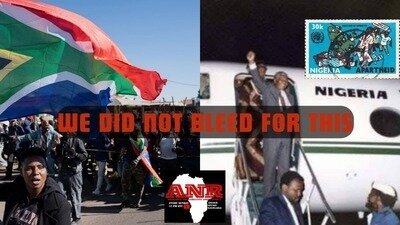

WE DID NOT BLEED FOR THIS
WE DID NOT BLEED FOR THIS
The Issue
Nigeria Must Hold South Africa Accountable for Systematic Afrophobic Violence Against Fellow Africans
We, the undersigned citizens of Nigeria, the African continent, and the global African diaspora, hereby call upon the Government of the Federal Republic of Nigeria to take decisive, unapologetic, and sustained action against the South African government's failure to protect fellow Africans within its borders from recurring waves of xenophobic violence, economic persecution, and systematic dehumanisation.
This is not merely a humanitarian appeal. This is a demand rooted in history, blood, solidarity, and Pan-African dignity. Nigeria did not contribute immeasurably to the dismantling of apartheid — sending funds, diplomats, soldiers, and moral authority across decades — only to watch South African citizens burn the shops, homes, and bodies of the very people who helped set them free.
We demand that Nigeria act. Now. With force. With strategy. And without apology.
NIGERIA'S SACRIFICE FOR SOUTH AFRICAN FREEDOM
To understand the magnitude of this betrayal, one must first understand the magnitude of Nigeria's sacrifice.
NIGERIA AS THE FINANCIAL BACKBONE OF THE ANTI-APARTHEID STRUGGLE
From the 1960s through to 1994, Nigeria was the single largest African contributor to the liberation of South Africa. Under General Yakubu Gowon, Nigeria donated £5 million to the African National Congress (ANC) at a time when the organisation was outlawed and fighting for survival. Under General Murtala Muhammed, Nigeria nationalised British Petroleum assets in direct retaliation for British companies' collusion with the apartheid regime — a radical, costly act of Pan-African defiance.
EXPELLING APARTHEID'S ALLIES
In 1977, Nigeria expelled British companies — Barclays Bank and British Petroleum — from its economy as punishment for Britain's continued economic engagement with Pretoria. Nigeria sacrificed billions in trade relationships to stand on the right side of history. No other African nation made such a dramatic economic sacrifice in solidarity with the South African people.
THE LAGOS DECLARATION AND CONTINENTAL LEADERSHIP
It was on Nigerian soil — at the 1977 Lagos Commonwealth Heads of Government Meeting — that Nigeria's pressure directly resulted in the exclusion of apartheid South Africa from Commonwealth affairs. Nigeria essentially shamed the global community into isolating Pretoria. The Commonwealth Heads were warned plainly: if South Africa remained, Nigeria would leave. South Africa was excluded.
SHELTERING FREEDOM FIGHTERS
Nigeria provided safe harbour to ANC leaders, fighters, and families who fled the murderous apartheid state. Nigerian universities trained South African exiles. Nigerian government funds paid for ANC political offices across the continent and internationally. Oliver Tambo, then ANC President-in-exile, described Nigeria as 'our second home.'
THE FINAL PUSH: NELSON MANDELA'S FREEDOM
When Nelson Mandela was released in 1990, and South Africa moved toward democratic transition, it was Nigeria — along with other frontline states — that had sustained international pressure on Western governments to impose sanctions. It was Nigerian leadership at the OAU (now African Union) that held the line when Western powers wavered. Nigeria's first State visit from a newly free South Africa was treated as the most symbolically significant moment in Pan-African history.
And yet — barely thirty years later — Nigerian traders, Zimbabwean nurses, Mozambican workers, Malawian labourers, and Ethiopian entrepreneurs are being dragged from their shops, beaten in the streets, and killed in the townships of the very nation Nigeria helped deliver from oppression.
THE CRISIS — A PATTERN OF LAWLESSNESS, NOT ISOLATED INCIDENTS
The South African government and its defenders would have the world believe that xenophobic violence is the work of a few criminal elements, unrepresentative of the broader population. History and evidence emphatically reject this fiction.
DOCUMENTED WAVES OF ATROCITY
2008: More than 60 people — predominantly Zimbabweans, Mozambicans, and Nigerians — were killed in nationwide xenophobic pogroms. Entire communities were burned out. The South African Police Service stood aside.
2015: A fresh wave of attacks swept KwaZulu-Natal and Johannesburg. Thousands of African migrants were displaced. The then-Zulu King Goodwill Zwelithini made public statements widely interpreted as incitement, calling for foreigners to 'pack their bags.'
2019: Nigeria was forced to airlift over 600 of its citizens from South Africa after Nigerians were specifically targeted, their shops looted and destroyed in Johannesburg, Pretoria, and other urban centres. Nigeria recalled its High Commissioner. MTN, a South African company, was boycotted across Nigeria.
2021–2024: Attacks continued with renewed ferocity. Spaza shops owned by Africans — particularly Somalis, Nigerians, and Ethiopians — were systematically torched. Criminal networks, with apparent police complicity, ran extortion rackets against migrant business owners.
2023–2025: Operation Dudula, a vigilante movement targeting African migrants, marched through townships with impunity, shutting down businesses, threatening residents, and in several documented cases, physically assaulting Africans while police watched.
SOUTH AFRICAN GOVERNMENT COMPLICITY BY INACTION
The South African government's consistent failure to prosecute perpetrators, discipline delinquent police officers, or disband violent vigilante groups constitutes complicity. When a government knows attacks will occur, watches them unfold repeatedly, and consistently fails to punish those responsible, it is not a bystander. It is an accessory.
The African Union itself has noted South Africa's failure to implement adequate protections for migrants within its borders. Multiple UN Special Rapporteurs have raised concerns. And yet the violence continues, the prosecutions remain scarce, and the South African political class continues to use African migrants as electoral scapegoats.
WHAT WE DEMAND — A COMPREHENSIVE AGENDA FOR NIGERIAN ACTION
We demand that the Nigerian Government move beyond diplomatic pleasantries and implement a structured, multi-tiered response across political, economic, and cultural fronts. Below is a clear, actionable framework.
POLITICAL & DIPLOMATIC ACTIONS
IMMEDIATE DIPLOMATIC DEMARCHE: Nigeria's Ministry of Foreign Affairs must formally summon the South African High Commissioner in Abuja to deliver an official note of protest — not a press release, not a tweet, but a written, logged diplomatic demarche demanding a formal response from Pretoria within 30 days outlining concrete protective measures for African nationals.
RECALL THE NIGERIAN HIGH COMMISSIONER: As was done briefly in 2019, Nigeria must recall its High Commissioner from Pretoria until South Africa presents verifiable evidence of systemic reform — including prosecution records, police retraining protocols, and legislative steps to dismantle Operation Dudula-type groups under existing anti-hate laws.
TABLE A RESOLUTION AT THE AFRICAN UNION: Nigeria must use its considerable influence within the African Union to table a formal resolution condemning the South African government's failure to protect African nationals, calling for a continent-wide review of South Africa's obligations under the 1969 OAU Convention Governing Specific Aspects of Refugee Problems in Africa.
LEAD A SADC ACCOUNTABILITY MECHANISM: Nigeria should pressure the Southern African Development Community (SADC) to establish a formal accountability mechanism — with Nigeria providing the political weight — compelling South Africa to report quarterly on anti-xenophobia enforcement to a continental oversight body.
BLACKLIST SOUTH AFRICAN OFFICIALS COMPLICIT IN INACTION: Nigeria should compile and publish a list of South African police commanders, prosecutors, and politicians who demonstrably failed in their duties to protect African nationals, and advocate for travel bans and asset freezes on these individuals within AU and ECOWAS frameworks.
ECONOMIC & TRADE ACTIONS
REVIEW ALL BILATERAL TRADE AGREEMENTS: The Nigerian government must commission an immediate audit of all bilateral trade agreements with South Africa — including in the oil, gas, banking, and telecommunications sectors — with a view to suspending preferential terms until South Africa demonstrates measurable progress on African migrant protection.
TARGETED ECONOMIC SANCTIONS ON SOUTH AFRICAN BRANDS: Nigeria must give South African-owned multinational companies — MTN, Shoprite, Standard Bank (Stanbic IBTC), and others — a formal notice that continued operations in Nigeria require South Africa to meet specific, time-bound accountability benchmarks. This leverage is enormous and has precedent: MTN was nearly forced out of Nigeria in 2019.
NATIONAL BOYCOTT FRAMEWORK: The Federal Government should establish a formal framework through which civil society and consumer groups can activate structured, government-supported boycotts of South African goods when bilateral diplomatic processes stall — modelled on Nigeria's 1970s expulsion of British companies during apartheid-era solidarity campaigns.
DIASPORA RESTITUTION FUND: Nigeria must establish a dedicated restitution fund — seeded by federal appropriations and voluntary contributions — to compensate Nigerian citizens who have lost property, businesses, or livelihoods in xenophobic attacks in South Africa, and to cover legal costs for those pursuing civil redress in South African courts.
AFCFTA LEVERAGE: Under the Africa Continental Free Trade Area agreement, Nigeria must advocate for provisions that explicitly tie full trade access to verifiable protections for African migrants and nationals — making the free movement of people and economic security two sides of the same coin.
CULTURAL & SOFT POWER ACTIONS
NATIONAL REMEMBRANCE & SOLIDARITY DAY: The Nigerian government should declare an annual Pan-African Solidarity and Anti-Xenophobia Day — held on the anniversary of the 2008 South African pogroms — to educate Nigerian youth about the continent's collective liberation struggles and the duty of solidarity.
CURRICULUM REFORM — TEACH AFRICAN SOLIDARITY: The Federal Ministry of Education must update the national secondary school curriculum to include comprehensive African history modules covering Nigeria's role in defeating apartheid — so that future generations understand what was sacrificed, and why betrayal of that legacy is intolerable.
NOLLYWOOD & MEDIA MOBILISATION: The Nigerian government should work with the Nigerian Film Corporation and major streaming platforms to commission and amplify documentaries, films, and series that accurately document: (a) Nigeria's sacrifice during the anti-apartheid struggle, and (b) the ongoing suffering of African migrants in South Africa. Cultural power is strategic power.
WITHDRAW CULTURAL EXCHANGE AGREEMENTS: Nigeria should suspend all cultural exchange programs, joint arts initiatives, and government-to-government cultural delegations with South Africa — restoring them only when concrete legal protections for African nationals are enacted and enforced.
PAN-AFRICAN MEDIA TASK FORCE: Nigeria should convene a Pan-African Media Task Force — including diaspora journalists, African media houses, and human rights organisations — to ensure that xenophobic attacks in South Africa receive consistent, sustained global attention, countering South Africa's ability to manage its international image while allowing violence to continue domestically.
THE MORAL IMPERATIVE — PAN-AFRICANISM IS NOT OPTIONAL
Pan-Africanism is not a slogan for speeches. It is a covenant written in the blood of those who resisted colonialism, slavery, and apartheid across centuries. When Oliver Tambo came to Lagos, he did not come as a beggar. He came as a brother, and Nigeria received him as such. The resources Nigeria poured into the ANC were not charity. They were investments in the shared dream of a free, dignified, and self-determining African continent.
That dream is being desecrated on the streets of Johannesburg, in the townships of KwaZulu-Natal, in the burning spaza shops of Pretoria, every time a Zimbabwean mother is chased from her home, every time a Nigerian trader is beaten and his goods stolen, every time an Ethiopian entrepreneur watches his years of work turned to ash while police do nothing.
South Africa does not exist in isolation from the rest of Africa. Its freedom was purchased with continental blood and treasure. And with freedom comes responsibility. The South African government has a duty — moral, legal, and historical — to protect every African life within its borders. It has failed. Repeatedly. Catastrophically.
Nigeria, as the continent's most populous nation, its largest economy, and one of the most consequential voices in African politics, has both the power and the obligation to lead this reckoning.
We will not be silenced by diplomatic niceties. We will not be pacified by press conferences. We will not accept hollow condemnations from Pretoria that are followed by zero prosecutions, zero police reforms, and zero accountability.
We did not bleed for apartheid's end, only to bleed again in its aftermath.
SIGN THIS PETITION — DEMAND ACCOUNTABILITY, DEMAND DIGNITY
Every signature on this petition is a declaration that Africa's liberation was not a transaction — it was a promise. A promise that we would rise together, protect each other, and never allow the logic of oppression to be wielded by those who were themselves once oppressed.
Sign. Share. Demand Action.
32
The Issue
Nigeria Must Hold South Africa Accountable for Systematic Afrophobic Violence Against Fellow Africans
We, the undersigned citizens of Nigeria, the African continent, and the global African diaspora, hereby call upon the Government of the Federal Republic of Nigeria to take decisive, unapologetic, and sustained action against the South African government's failure to protect fellow Africans within its borders from recurring waves of xenophobic violence, economic persecution, and systematic dehumanisation.
This is not merely a humanitarian appeal. This is a demand rooted in history, blood, solidarity, and Pan-African dignity. Nigeria did not contribute immeasurably to the dismantling of apartheid — sending funds, diplomats, soldiers, and moral authority across decades — only to watch South African citizens burn the shops, homes, and bodies of the very people who helped set them free.
We demand that Nigeria act. Now. With force. With strategy. And without apology.
NIGERIA'S SACRIFICE FOR SOUTH AFRICAN FREEDOM
To understand the magnitude of this betrayal, one must first understand the magnitude of Nigeria's sacrifice.
NIGERIA AS THE FINANCIAL BACKBONE OF THE ANTI-APARTHEID STRUGGLE
From the 1960s through to 1994, Nigeria was the single largest African contributor to the liberation of South Africa. Under General Yakubu Gowon, Nigeria donated £5 million to the African National Congress (ANC) at a time when the organisation was outlawed and fighting for survival. Under General Murtala Muhammed, Nigeria nationalised British Petroleum assets in direct retaliation for British companies' collusion with the apartheid regime — a radical, costly act of Pan-African defiance.
EXPELLING APARTHEID'S ALLIES
In 1977, Nigeria expelled British companies — Barclays Bank and British Petroleum — from its economy as punishment for Britain's continued economic engagement with Pretoria. Nigeria sacrificed billions in trade relationships to stand on the right side of history. No other African nation made such a dramatic economic sacrifice in solidarity with the South African people.
THE LAGOS DECLARATION AND CONTINENTAL LEADERSHIP
It was on Nigerian soil — at the 1977 Lagos Commonwealth Heads of Government Meeting — that Nigeria's pressure directly resulted in the exclusion of apartheid South Africa from Commonwealth affairs. Nigeria essentially shamed the global community into isolating Pretoria. The Commonwealth Heads were warned plainly: if South Africa remained, Nigeria would leave. South Africa was excluded.
SHELTERING FREEDOM FIGHTERS
Nigeria provided safe harbour to ANC leaders, fighters, and families who fled the murderous apartheid state. Nigerian universities trained South African exiles. Nigerian government funds paid for ANC political offices across the continent and internationally. Oliver Tambo, then ANC President-in-exile, described Nigeria as 'our second home.'
THE FINAL PUSH: NELSON MANDELA'S FREEDOM
When Nelson Mandela was released in 1990, and South Africa moved toward democratic transition, it was Nigeria — along with other frontline states — that had sustained international pressure on Western governments to impose sanctions. It was Nigerian leadership at the OAU (now African Union) that held the line when Western powers wavered. Nigeria's first State visit from a newly free South Africa was treated as the most symbolically significant moment in Pan-African history.
And yet — barely thirty years later — Nigerian traders, Zimbabwean nurses, Mozambican workers, Malawian labourers, and Ethiopian entrepreneurs are being dragged from their shops, beaten in the streets, and killed in the townships of the very nation Nigeria helped deliver from oppression.
THE CRISIS — A PATTERN OF LAWLESSNESS, NOT ISOLATED INCIDENTS
The South African government and its defenders would have the world believe that xenophobic violence is the work of a few criminal elements, unrepresentative of the broader population. History and evidence emphatically reject this fiction.
DOCUMENTED WAVES OF ATROCITY
2008: More than 60 people — predominantly Zimbabweans, Mozambicans, and Nigerians — were killed in nationwide xenophobic pogroms. Entire communities were burned out. The South African Police Service stood aside.
2015: A fresh wave of attacks swept KwaZulu-Natal and Johannesburg. Thousands of African migrants were displaced. The then-Zulu King Goodwill Zwelithini made public statements widely interpreted as incitement, calling for foreigners to 'pack their bags.'
2019: Nigeria was forced to airlift over 600 of its citizens from South Africa after Nigerians were specifically targeted, their shops looted and destroyed in Johannesburg, Pretoria, and other urban centres. Nigeria recalled its High Commissioner. MTN, a South African company, was boycotted across Nigeria.
2021–2024: Attacks continued with renewed ferocity. Spaza shops owned by Africans — particularly Somalis, Nigerians, and Ethiopians — were systematically torched. Criminal networks, with apparent police complicity, ran extortion rackets against migrant business owners.
2023–2025: Operation Dudula, a vigilante movement targeting African migrants, marched through townships with impunity, shutting down businesses, threatening residents, and in several documented cases, physically assaulting Africans while police watched.
SOUTH AFRICAN GOVERNMENT COMPLICITY BY INACTION
The South African government's consistent failure to prosecute perpetrators, discipline delinquent police officers, or disband violent vigilante groups constitutes complicity. When a government knows attacks will occur, watches them unfold repeatedly, and consistently fails to punish those responsible, it is not a bystander. It is an accessory.
The African Union itself has noted South Africa's failure to implement adequate protections for migrants within its borders. Multiple UN Special Rapporteurs have raised concerns. And yet the violence continues, the prosecutions remain scarce, and the South African political class continues to use African migrants as electoral scapegoats.
WHAT WE DEMAND — A COMPREHENSIVE AGENDA FOR NIGERIAN ACTION
We demand that the Nigerian Government move beyond diplomatic pleasantries and implement a structured, multi-tiered response across political, economic, and cultural fronts. Below is a clear, actionable framework.
POLITICAL & DIPLOMATIC ACTIONS
IMMEDIATE DIPLOMATIC DEMARCHE: Nigeria's Ministry of Foreign Affairs must formally summon the South African High Commissioner in Abuja to deliver an official note of protest — not a press release, not a tweet, but a written, logged diplomatic demarche demanding a formal response from Pretoria within 30 days outlining concrete protective measures for African nationals.
RECALL THE NIGERIAN HIGH COMMISSIONER: As was done briefly in 2019, Nigeria must recall its High Commissioner from Pretoria until South Africa presents verifiable evidence of systemic reform — including prosecution records, police retraining protocols, and legislative steps to dismantle Operation Dudula-type groups under existing anti-hate laws.
TABLE A RESOLUTION AT THE AFRICAN UNION: Nigeria must use its considerable influence within the African Union to table a formal resolution condemning the South African government's failure to protect African nationals, calling for a continent-wide review of South Africa's obligations under the 1969 OAU Convention Governing Specific Aspects of Refugee Problems in Africa.
LEAD A SADC ACCOUNTABILITY MECHANISM: Nigeria should pressure the Southern African Development Community (SADC) to establish a formal accountability mechanism — with Nigeria providing the political weight — compelling South Africa to report quarterly on anti-xenophobia enforcement to a continental oversight body.
BLACKLIST SOUTH AFRICAN OFFICIALS COMPLICIT IN INACTION: Nigeria should compile and publish a list of South African police commanders, prosecutors, and politicians who demonstrably failed in their duties to protect African nationals, and advocate for travel bans and asset freezes on these individuals within AU and ECOWAS frameworks.
ECONOMIC & TRADE ACTIONS
REVIEW ALL BILATERAL TRADE AGREEMENTS: The Nigerian government must commission an immediate audit of all bilateral trade agreements with South Africa — including in the oil, gas, banking, and telecommunications sectors — with a view to suspending preferential terms until South Africa demonstrates measurable progress on African migrant protection.
TARGETED ECONOMIC SANCTIONS ON SOUTH AFRICAN BRANDS: Nigeria must give South African-owned multinational companies — MTN, Shoprite, Standard Bank (Stanbic IBTC), and others — a formal notice that continued operations in Nigeria require South Africa to meet specific, time-bound accountability benchmarks. This leverage is enormous and has precedent: MTN was nearly forced out of Nigeria in 2019.
NATIONAL BOYCOTT FRAMEWORK: The Federal Government should establish a formal framework through which civil society and consumer groups can activate structured, government-supported boycotts of South African goods when bilateral diplomatic processes stall — modelled on Nigeria's 1970s expulsion of British companies during apartheid-era solidarity campaigns.
DIASPORA RESTITUTION FUND: Nigeria must establish a dedicated restitution fund — seeded by federal appropriations and voluntary contributions — to compensate Nigerian citizens who have lost property, businesses, or livelihoods in xenophobic attacks in South Africa, and to cover legal costs for those pursuing civil redress in South African courts.
AFCFTA LEVERAGE: Under the Africa Continental Free Trade Area agreement, Nigeria must advocate for provisions that explicitly tie full trade access to verifiable protections for African migrants and nationals — making the free movement of people and economic security two sides of the same coin.
CULTURAL & SOFT POWER ACTIONS
NATIONAL REMEMBRANCE & SOLIDARITY DAY: The Nigerian government should declare an annual Pan-African Solidarity and Anti-Xenophobia Day — held on the anniversary of the 2008 South African pogroms — to educate Nigerian youth about the continent's collective liberation struggles and the duty of solidarity.
CURRICULUM REFORM — TEACH AFRICAN SOLIDARITY: The Federal Ministry of Education must update the national secondary school curriculum to include comprehensive African history modules covering Nigeria's role in defeating apartheid — so that future generations understand what was sacrificed, and why betrayal of that legacy is intolerable.
NOLLYWOOD & MEDIA MOBILISATION: The Nigerian government should work with the Nigerian Film Corporation and major streaming platforms to commission and amplify documentaries, films, and series that accurately document: (a) Nigeria's sacrifice during the anti-apartheid struggle, and (b) the ongoing suffering of African migrants in South Africa. Cultural power is strategic power.
WITHDRAW CULTURAL EXCHANGE AGREEMENTS: Nigeria should suspend all cultural exchange programs, joint arts initiatives, and government-to-government cultural delegations with South Africa — restoring them only when concrete legal protections for African nationals are enacted and enforced.
PAN-AFRICAN MEDIA TASK FORCE: Nigeria should convene a Pan-African Media Task Force — including diaspora journalists, African media houses, and human rights organisations — to ensure that xenophobic attacks in South Africa receive consistent, sustained global attention, countering South Africa's ability to manage its international image while allowing violence to continue domestically.
THE MORAL IMPERATIVE — PAN-AFRICANISM IS NOT OPTIONAL
Pan-Africanism is not a slogan for speeches. It is a covenant written in the blood of those who resisted colonialism, slavery, and apartheid across centuries. When Oliver Tambo came to Lagos, he did not come as a beggar. He came as a brother, and Nigeria received him as such. The resources Nigeria poured into the ANC were not charity. They were investments in the shared dream of a free, dignified, and self-determining African continent.
That dream is being desecrated on the streets of Johannesburg, in the townships of KwaZulu-Natal, in the burning spaza shops of Pretoria, every time a Zimbabwean mother is chased from her home, every time a Nigerian trader is beaten and his goods stolen, every time an Ethiopian entrepreneur watches his years of work turned to ash while police do nothing.
South Africa does not exist in isolation from the rest of Africa. Its freedom was purchased with continental blood and treasure. And with freedom comes responsibility. The South African government has a duty — moral, legal, and historical — to protect every African life within its borders. It has failed. Repeatedly. Catastrophically.
Nigeria, as the continent's most populous nation, its largest economy, and one of the most consequential voices in African politics, has both the power and the obligation to lead this reckoning.
We will not be silenced by diplomatic niceties. We will not be pacified by press conferences. We will not accept hollow condemnations from Pretoria that are followed by zero prosecutions, zero police reforms, and zero accountability.
We did not bleed for apartheid's end, only to bleed again in its aftermath.
SIGN THIS PETITION — DEMAND ACCOUNTABILITY, DEMAND DIGNITY
Every signature on this petition is a declaration that Africa's liberation was not a transaction — it was a promise. A promise that we would rise together, protect each other, and never allow the logic of oppression to be wielded by those who were themselves once oppressed.
Sign. Share. Demand Action.
32

Petition Updates
Share this petition
Petition created on 13 June 2026