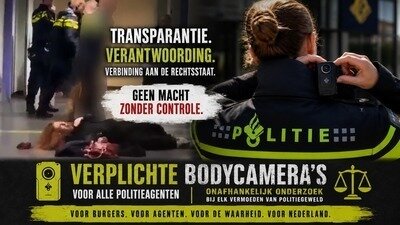

Verplichte Bodycamera's voor Politie en Onafhankelijk Onderzoek
Verplichte Bodycamera's voor Politie en Onafhankelijk Onderzoek
The Issue
ENGLISH BELOW
Naar aanleiding van het incident in Zeist en de groeiende maatschappelijke zorgen over politiegeweld, bewijsveiligheid en publieke verantwoording
Aan de Tweede Kamer der Staten-Generaal, de Minister van Justitie en Veiligheid, de Nationale Politie, de Nationale Ombudsman, het College voor de Rechten van de Mens en alle bevoegde toezichthoudende instanties
Wij, ondergetekenden, richten ons tot u vanuit een fundamentele overtuiging die de kern vormt van iedere democratische rechtsstaat:
Niemand staat boven de wet.
Niet de burger.
Niet de overheid.
Niet de politie.
Juist daarom moet iedere vorm van overheidsmacht controleerbaar, toetsbaar en transparant zijn.
De politie vervult een essentiële en vaak gevaarlijke taak. Dagelijks zetten duizenden agenten zich in om onze samenleving veilig te houden. Zij verdienen respect, bescherming en het vertrouwen van de samenleving.
Maar vertrouwen kan nooit uitsluitend worden gevraagd.
Vertrouwen moet worden verdiend.
En vertrouwen kan alleen bestaan wanneer er volledige transparantie bestaat over het gebruik van staatsmacht.
Het incident in Zeist
De recente beelden uit Zeist, waarop een zichtbaar zwangere vrouw tijdens een politieoptreden tegen de grond wordt gebracht, hebben diepe maatschappelijke verontwaardiging veroorzaakt.
Voor velen was dit niet slechts een schokkend incident.
Het werd een symbool van een bredere vraag:
Wie controleert de controleurs?
Wanneer een burger geweld ervaart door toedoen van de overheid, wie onderzoekt dat dan?
Wanneer verklaringen van burgers en politie uiteenlopen, waar ligt dan de objectieve waarheid?
Wanneer cruciaal bewijs ontbreekt of niet onmiddellijk beschikbaar is, hoe kan het publiek vertrouwen houden in de uitkomst van een onderzoek?
Deze vragen raken niet alleen het incident in Zeist.
Zij raken het fundament van de rechtsstaat.
Een terugkerend maatschappelijk probleem
Door de jaren heen hebben verschillende incidenten geleid tot maatschappelijke discussie over politieoptreden, demonstratiehandhaving, gebruik van geweld, etnisch profileren, arrestaties van kwetsbare personen en de behandeling van burgers tijdens confrontaties met de politie.
In veel van deze zaken ontstond discussie over:
- ontbrekend beeldmateriaal;
- beperkte toegang tot opnamen;
- technische storingen;
- tegenstrijdige lezingen van gebeurtenissen;
- langdurige onderzoeken;
- gebrek aan onafhankelijk toezicht.
Zelfs wanneer onderzoeken uiteindelijk concluderen dat geen sprake was van onrechtmatig handelen, blijft bij een aanzienlijk deel van het publiek het gevoel bestaan dat de waarheid moeilijk controleerbaar is.
Een rechtsstaat kan niet functioneren op basis van vertrouwen alleen.
Een rechtsstaat vereist controleerbaar bewijs.
Waarom deze petitie noodzakelijk is
In de eenentwintigste eeuw beschikken wij over technologie die gebeurtenissen vrijwel volledig objectief kan vastleggen.
Wanneer politieagenten gebruikmaken van geweld, dwangmiddelen of vrijheidsbeperkende bevoegdheden, zou de samenleving niet afhankelijk moeten zijn van tegenstrijdige verklaringen.
De waarheid behoort vastgelegd te worden.
Niet om agenten te wantrouwen.
Maar juist om zowel burgers als agenten te beschermen.
Bodycamera's beschermen burgers tegen misbruik.
Bodycamera's beschermen agenten tegen valse beschuldigingen.
Bodycamera's beschermen de integriteit van onderzoeken.
Bodycamera's beschermen de waarheid.
Onze juridische uitgangspunten
Deze petitie vindt haar grondslag in:
- Artikel 1 van de Grondwet (gelijkheidsbeginsel);
- Artikel 11 van de Grondwet (onaantastbaarheid van het lichaam);
- Artikel 2 EVRM (recht op leven);
- Artikel 3 EVRM (verbod op onmenselijke of vernederende behandeling);
- Artikel 6 EVRM (recht op een eerlijk proces);
- Artikel 8 EVRM (recht op privéleven);
- Artikel 13 EVRM (recht op een effectief rechtsmiddel);
- Het EU-Handvest van de Grondrechten;
- De VN-Basisbeginselen inzake het gebruik van geweld en vuurwapens door wetshandhavers;
- De fundamentele beginselen van proportionaliteit, subsidiariteit, noodzakelijkheid en verantwoording.
Deze normen verplichten de Nederlandse overheid niet alleen om burgers te beschermen tegen onrechtmatig geweld, maar ook om effectieve en onafhankelijke controlemechanismen te waarborgen.
Daarom eisen wij
1. Verplichte bodycamera's voor alle operationele politieagenten
Iedere agent die betrokken kan raken bij handhaving, aanhoudingen, demonstraties, vreemdelingentoezicht, openbare-ordehandhaving of gebruik van geweld dient verplicht een goed functionerende bodycamera te dragen.
2. Verplichte activatie
Bodycamera's dienen automatisch of verplicht te worden geactiveerd bij:
- aanhoudingen;
- geweldsgebruik;
- demonstraties;
- identiteitscontroles die escaleren;
- fouilleringen;
- huiszoekingen;
- situaties met verhoogd risico.
3. Onafhankelijke opslag van bewijsmateriaal
Beelden mogen niet afhankelijk zijn van individuele beslissingen binnen de operationele keten.
Alle opnamen dienen automatisch te worden opgeslagen in een onafhankelijk, beveiligd en controleerbaar systeem.
4. Volledige audittrail
Iedere handeling met betrekking tot beeldmateriaal dient digitaal te worden geregistreerd zodat verwijdering, wijziging of ongeautoriseerde toegang volledig traceerbaar is.
5. Verplichte bewaring
Wanneer sprake is van geweld, letsel, overlijden, een klacht of maatschappelijke controverse dienen alle relevante opnamen automatisch te worden veiliggesteld.
6. Werkelijk onafhankelijk onderzoek
Onderzoeken naar ernstig politiegeweld mogen niet uitsluitend plaatsvinden binnen structuren die organisatorisch onderdeel uitmaken van de politie.
Onafhankelijkheid moet niet alleen bestaan, maar ook zichtbaar zijn.
7. Jaarlijkse publieke verantwoording
Openbare rapportages dienen inzicht te geven in:
- geweldsincidenten;
- klachten;
- gegronde klachten;
- disciplinaire maatregelen;
- bodycamstoringen;
- ontbrekende beelden;
- onderzoeksuitkomsten.
8. Extra bescherming van kwetsbare personen
Bij contact met zwangere vrouwen, minderjarigen, ouderen, personen met een beperking, personen in psychische crisis, vluchtelingen en asielzoekers dienen aanvullende beschermingsmaatregelen verplicht te zijn.
Onze oproep
Deze petitie is geen aanval op de politie.
Deze petitie is een oproep tot versterking van de rechtsstaat.
Want een sterke politie heeft niets te vrezen van transparantie.
Een professionele politie heeft niets te vrezen van onafhankelijk toezicht.
Een democratische overheid heeft niets te vrezen van verantwoording.
Wanneer de overheid geweld mag gebruiken, moet de burger kunnen vertrouwen op volledige openheid over dat geweld.
Dat is geen gunst.
Dat is een democratische verplichting.
Daarom roepen wij de Tweede Kamer, de regering en de Nationale Politie op om deze hervormingen onverwijld door te voeren.
Voor de bescherming van burgers.
Voor de bescherming van politieagenten.
Voor het herstel van vertrouwen.
Voor de waarheid.
Voor de rechtsstaat.
-----------------------------------------------------------------------------------------------------------------
Mandatory Body Cameras for Police and Independent Investigations
In response to the Zeist incident and growing public concerns regarding police use of force, evidence preservation, and democratic accountability
Addressed to the Dutch House of Representatives, the Minister of Justice and Security, the National Police of the Netherlands, the National Ombudsman, the Netherlands Institute for Human Rights, and all relevant oversight authorities
We, the undersigned citizens, residents, legal professionals, academics, journalists, human rights advocates, and members of the public, submit this petition based on a principle that lies at the very heart of every democratic society governed by the rule of law:
No one is above the law.
Not the citizen.
Not the government.
Not the police.
The authority entrusted to law enforcement is among the most powerful authorities that a democratic state can exercise. Police officers have the legal power to stop individuals, restrict freedom of movement, conduct searches, make arrests, and, when necessary, use force.
Because these powers are extraordinary, they must be accompanied by extraordinary accountability.
The stronger the power granted by the state, the stronger the safeguards that must exist to oversee its use.
This principle is not anti-police.
It is pro-democracy.
It is pro-accountability.
It is pro-rule of law.
Why This Petition Matters
The recent incident in Zeist, in which a visibly pregnant woman was forcefully taken to the ground during a police intervention, has generated widespread concern both within the Netherlands and internationally.
The images shocked many members of the public and raised serious questions regarding proportionality, transparency, and the treatment of vulnerable individuals during police operations.
Regardless of the outcome of any ongoing investigation, the incident has highlighted a broader issue that extends far beyond a single event.
It has reignited a question increasingly asked throughout democratic societies around the world:
Who watches the watchdogs?
When allegations of excessive force arise, who conducts the investigation?
When citizens and police officers provide conflicting accounts, where can objective truth be found?
When critical evidence is unavailable, disputed, delayed, or inaccessible to the public, how can confidence in the outcome of an investigation be maintained?
These questions are not about assigning guilt before the facts are established.
They are about ensuring that the facts can be established at all.
Public Trust Requires More Than Assurances
Public trust is essential to effective policing.
However, trust cannot rely solely on assurances.
Trust must be supported by transparency.
Trust must be supported by accountability.
Trust must be supported by evidence.
In recent years, public debate in the Netherlands has repeatedly focused on controversial police interventions, demonstrations, allegations of excessive force, concerns regarding racial profiling, and interactions involving vulnerable individuals.
In many of these cases, public controversy was intensified because of disputes concerning evidence, video footage, witness testimony, or the transparency of investigative processes.
Even when investigations ultimately conclude that officers acted lawfully, a lack of independently verifiable evidence can leave lasting public doubts.
A modern democratic state should not depend solely upon conflicting testimonies when objective technological tools are available to establish what occurred.
The Importance of Body Cameras
Body cameras are not a threat to professional policing.
They are one of its strongest protections.
Body cameras protect citizens from potential abuse.
Body cameras protect police officers from false accusations.
Body cameras protect investigators from uncertainty.
Body cameras protect courts from incomplete evidence.
Most importantly, body cameras protect the truth.
In an age where technology can provide objective documentation of critical encounters between citizens and state authorities, transparency should be the rule, not the exception.
Legal and Human Rights Foundations
This petition is grounded in fundamental constitutional, European, and international legal principles, including:
- The Constitution of the Kingdom of the Netherlands;
- Article 2 of the European Convention on Human Rights (Right to Life);
- Article 3 of the European Convention on Human Rights (Prohibition of Inhuman or Degrading Treatment);
- Article 6 of the European Convention on Human Rights (Right to a Fair Trial);
- Article 8 of the European Convention on Human Rights (Right to Respect for Private Life);
- Article 13 of the European Convention on Human Rights (Right to an Effective Remedy);
- The Charter of Fundamental Rights of the European Union;
- The United Nations Basic Principles on the Use of Force and Firearms by Law Enforcement Officials;
- The principles of proportionality, necessity, subsidiarity, legality, and accountability that govern democratic policing.
- These legal standards require not only lawful conduct by public authorities but also effective mechanisms capable of independently investigating alleged misconduct.
Therefore, We Demand
1. Mandatory Body Cameras for All Operational Police Officers
Every police officer engaged in patrol duties, arrests, crowd control, immigration enforcement, public-order operations, demonstrations, or any situation involving potential use of force should be required to wear a fully functioning body camera.
2. Mandatory Activation
Body cameras must be activated during:
- arrests;
- searches;
- use-of-force incidents;
- demonstrations;
- public-order operations;
- escalating encounters;
- any interaction where coercive powers are exercised.
3. Independent and Secure Evidence Storage
Body-camera footage should be automatically uploaded to secure systems that prevent unauthorized deletion, modification, or manipulation.
4. Complete Audit Trails
Every access, transfer, review, or modification attempt relating to footage must be permanently recorded and independently auditable.
5. Automatic Preservation of Evidence
Whenever force is used, injuries occur, complaints are filed, deaths occur, or incidents generate significant public concern, all relevant recordings must be immediately preserved.
6. Truly Independent Investigations
Investigations into serious allegations of police misconduct or excessive force should not be conducted exclusively within structures that are organizationally part of the police service.
Independent oversight must be genuinely independent and visibly independent.
Justice must not only be done.
It must be seen to be done.
7. Annual Public Accountability Reports
Authorities should publish annual reports detailing:
- use-of-force incidents;
- complaints against officers;
- substantiated complaints;
- disciplinary measures;
- body-camera failures;
- incidents involving unavailable footage;
- outcomes of misconduct investigations.
8. Enhanced Protection for Vulnerable Individuals
Special safeguards should apply during police interactions involving:
- pregnant women;
- children;
- elderly individuals;
- persons with disabilities;
- asylum seekers and refugees;
- individuals experiencing mental health crises.
9. Parliamentary Review and Independent Evaluation
An independent commission should regularly evaluate the effectiveness of body-camera policies, complaint procedures, oversight mechanisms, and public accountability systems.
Our Message
This petition is not an attack on the police.
It is a call to strengthen the legitimacy of policing.
Professional police officers have nothing to fear from transparency.
Honest institutions have nothing to fear from accountability.
Democratic governments have nothing to fear from independent oversight.
When the state is empowered to use force, citizens must be able to trust that such power is subject to meaningful scrutiny.
Transparency is not a privilege.
Transparency is a democratic obligation.
Accountability is not hostility.
Accountability is the foundation of public trust.
A strong democracy requires a strong police service.
A strong police service requires public confidence.
Public confidence requires transparency.
And transparency begins with independent oversight, secure evidence preservation, and reliable body-camera documentation.
For the protection of citizens.
For the protection of police officers.
For the protection of truth.
For the protection of the rule of law.
Sign this petition and support transparency, accountability, and public trust in policing.

13
The Issue
ENGLISH BELOW
Naar aanleiding van het incident in Zeist en de groeiende maatschappelijke zorgen over politiegeweld, bewijsveiligheid en publieke verantwoording
Aan de Tweede Kamer der Staten-Generaal, de Minister van Justitie en Veiligheid, de Nationale Politie, de Nationale Ombudsman, het College voor de Rechten van de Mens en alle bevoegde toezichthoudende instanties
Wij, ondergetekenden, richten ons tot u vanuit een fundamentele overtuiging die de kern vormt van iedere democratische rechtsstaat:
Niemand staat boven de wet.
Niet de burger.
Niet de overheid.
Niet de politie.
Juist daarom moet iedere vorm van overheidsmacht controleerbaar, toetsbaar en transparant zijn.
De politie vervult een essentiële en vaak gevaarlijke taak. Dagelijks zetten duizenden agenten zich in om onze samenleving veilig te houden. Zij verdienen respect, bescherming en het vertrouwen van de samenleving.
Maar vertrouwen kan nooit uitsluitend worden gevraagd.
Vertrouwen moet worden verdiend.
En vertrouwen kan alleen bestaan wanneer er volledige transparantie bestaat over het gebruik van staatsmacht.
Het incident in Zeist
De recente beelden uit Zeist, waarop een zichtbaar zwangere vrouw tijdens een politieoptreden tegen de grond wordt gebracht, hebben diepe maatschappelijke verontwaardiging veroorzaakt.
Voor velen was dit niet slechts een schokkend incident.
Het werd een symbool van een bredere vraag:
Wie controleert de controleurs?
Wanneer een burger geweld ervaart door toedoen van de overheid, wie onderzoekt dat dan?
Wanneer verklaringen van burgers en politie uiteenlopen, waar ligt dan de objectieve waarheid?
Wanneer cruciaal bewijs ontbreekt of niet onmiddellijk beschikbaar is, hoe kan het publiek vertrouwen houden in de uitkomst van een onderzoek?
Deze vragen raken niet alleen het incident in Zeist.
Zij raken het fundament van de rechtsstaat.
Een terugkerend maatschappelijk probleem
Door de jaren heen hebben verschillende incidenten geleid tot maatschappelijke discussie over politieoptreden, demonstratiehandhaving, gebruik van geweld, etnisch profileren, arrestaties van kwetsbare personen en de behandeling van burgers tijdens confrontaties met de politie.
In veel van deze zaken ontstond discussie over:
- ontbrekend beeldmateriaal;
- beperkte toegang tot opnamen;
- technische storingen;
- tegenstrijdige lezingen van gebeurtenissen;
- langdurige onderzoeken;
- gebrek aan onafhankelijk toezicht.
Zelfs wanneer onderzoeken uiteindelijk concluderen dat geen sprake was van onrechtmatig handelen, blijft bij een aanzienlijk deel van het publiek het gevoel bestaan dat de waarheid moeilijk controleerbaar is.
Een rechtsstaat kan niet functioneren op basis van vertrouwen alleen.
Een rechtsstaat vereist controleerbaar bewijs.
Waarom deze petitie noodzakelijk is
In de eenentwintigste eeuw beschikken wij over technologie die gebeurtenissen vrijwel volledig objectief kan vastleggen.
Wanneer politieagenten gebruikmaken van geweld, dwangmiddelen of vrijheidsbeperkende bevoegdheden, zou de samenleving niet afhankelijk moeten zijn van tegenstrijdige verklaringen.
De waarheid behoort vastgelegd te worden.
Niet om agenten te wantrouwen.
Maar juist om zowel burgers als agenten te beschermen.
Bodycamera's beschermen burgers tegen misbruik.
Bodycamera's beschermen agenten tegen valse beschuldigingen.
Bodycamera's beschermen de integriteit van onderzoeken.
Bodycamera's beschermen de waarheid.
Onze juridische uitgangspunten
Deze petitie vindt haar grondslag in:
- Artikel 1 van de Grondwet (gelijkheidsbeginsel);
- Artikel 11 van de Grondwet (onaantastbaarheid van het lichaam);
- Artikel 2 EVRM (recht op leven);
- Artikel 3 EVRM (verbod op onmenselijke of vernederende behandeling);
- Artikel 6 EVRM (recht op een eerlijk proces);
- Artikel 8 EVRM (recht op privéleven);
- Artikel 13 EVRM (recht op een effectief rechtsmiddel);
- Het EU-Handvest van de Grondrechten;
- De VN-Basisbeginselen inzake het gebruik van geweld en vuurwapens door wetshandhavers;
- De fundamentele beginselen van proportionaliteit, subsidiariteit, noodzakelijkheid en verantwoording.
Deze normen verplichten de Nederlandse overheid niet alleen om burgers te beschermen tegen onrechtmatig geweld, maar ook om effectieve en onafhankelijke controlemechanismen te waarborgen.
Daarom eisen wij
1. Verplichte bodycamera's voor alle operationele politieagenten
Iedere agent die betrokken kan raken bij handhaving, aanhoudingen, demonstraties, vreemdelingentoezicht, openbare-ordehandhaving of gebruik van geweld dient verplicht een goed functionerende bodycamera te dragen.
2. Verplichte activatie
Bodycamera's dienen automatisch of verplicht te worden geactiveerd bij:
- aanhoudingen;
- geweldsgebruik;
- demonstraties;
- identiteitscontroles die escaleren;
- fouilleringen;
- huiszoekingen;
- situaties met verhoogd risico.
3. Onafhankelijke opslag van bewijsmateriaal
Beelden mogen niet afhankelijk zijn van individuele beslissingen binnen de operationele keten.
Alle opnamen dienen automatisch te worden opgeslagen in een onafhankelijk, beveiligd en controleerbaar systeem.
4. Volledige audittrail
Iedere handeling met betrekking tot beeldmateriaal dient digitaal te worden geregistreerd zodat verwijdering, wijziging of ongeautoriseerde toegang volledig traceerbaar is.
5. Verplichte bewaring
Wanneer sprake is van geweld, letsel, overlijden, een klacht of maatschappelijke controverse dienen alle relevante opnamen automatisch te worden veiliggesteld.
6. Werkelijk onafhankelijk onderzoek
Onderzoeken naar ernstig politiegeweld mogen niet uitsluitend plaatsvinden binnen structuren die organisatorisch onderdeel uitmaken van de politie.
Onafhankelijkheid moet niet alleen bestaan, maar ook zichtbaar zijn.
7. Jaarlijkse publieke verantwoording
Openbare rapportages dienen inzicht te geven in:
- geweldsincidenten;
- klachten;
- gegronde klachten;
- disciplinaire maatregelen;
- bodycamstoringen;
- ontbrekende beelden;
- onderzoeksuitkomsten.
8. Extra bescherming van kwetsbare personen
Bij contact met zwangere vrouwen, minderjarigen, ouderen, personen met een beperking, personen in psychische crisis, vluchtelingen en asielzoekers dienen aanvullende beschermingsmaatregelen verplicht te zijn.
Onze oproep
Deze petitie is geen aanval op de politie.
Deze petitie is een oproep tot versterking van de rechtsstaat.
Want een sterke politie heeft niets te vrezen van transparantie.
Een professionele politie heeft niets te vrezen van onafhankelijk toezicht.
Een democratische overheid heeft niets te vrezen van verantwoording.
Wanneer de overheid geweld mag gebruiken, moet de burger kunnen vertrouwen op volledige openheid over dat geweld.
Dat is geen gunst.
Dat is een democratische verplichting.
Daarom roepen wij de Tweede Kamer, de regering en de Nationale Politie op om deze hervormingen onverwijld door te voeren.
Voor de bescherming van burgers.
Voor de bescherming van politieagenten.
Voor het herstel van vertrouwen.
Voor de waarheid.
Voor de rechtsstaat.
-----------------------------------------------------------------------------------------------------------------
Mandatory Body Cameras for Police and Independent Investigations
In response to the Zeist incident and growing public concerns regarding police use of force, evidence preservation, and democratic accountability
Addressed to the Dutch House of Representatives, the Minister of Justice and Security, the National Police of the Netherlands, the National Ombudsman, the Netherlands Institute for Human Rights, and all relevant oversight authorities
We, the undersigned citizens, residents, legal professionals, academics, journalists, human rights advocates, and members of the public, submit this petition based on a principle that lies at the very heart of every democratic society governed by the rule of law:
No one is above the law.
Not the citizen.
Not the government.
Not the police.
The authority entrusted to law enforcement is among the most powerful authorities that a democratic state can exercise. Police officers have the legal power to stop individuals, restrict freedom of movement, conduct searches, make arrests, and, when necessary, use force.
Because these powers are extraordinary, they must be accompanied by extraordinary accountability.
The stronger the power granted by the state, the stronger the safeguards that must exist to oversee its use.
This principle is not anti-police.
It is pro-democracy.
It is pro-accountability.
It is pro-rule of law.
Why This Petition Matters
The recent incident in Zeist, in which a visibly pregnant woman was forcefully taken to the ground during a police intervention, has generated widespread concern both within the Netherlands and internationally.
The images shocked many members of the public and raised serious questions regarding proportionality, transparency, and the treatment of vulnerable individuals during police operations.
Regardless of the outcome of any ongoing investigation, the incident has highlighted a broader issue that extends far beyond a single event.
It has reignited a question increasingly asked throughout democratic societies around the world:
Who watches the watchdogs?
When allegations of excessive force arise, who conducts the investigation?
When citizens and police officers provide conflicting accounts, where can objective truth be found?
When critical evidence is unavailable, disputed, delayed, or inaccessible to the public, how can confidence in the outcome of an investigation be maintained?
These questions are not about assigning guilt before the facts are established.
They are about ensuring that the facts can be established at all.
Public Trust Requires More Than Assurances
Public trust is essential to effective policing.
However, trust cannot rely solely on assurances.
Trust must be supported by transparency.
Trust must be supported by accountability.
Trust must be supported by evidence.
In recent years, public debate in the Netherlands has repeatedly focused on controversial police interventions, demonstrations, allegations of excessive force, concerns regarding racial profiling, and interactions involving vulnerable individuals.
In many of these cases, public controversy was intensified because of disputes concerning evidence, video footage, witness testimony, or the transparency of investigative processes.
Even when investigations ultimately conclude that officers acted lawfully, a lack of independently verifiable evidence can leave lasting public doubts.
A modern democratic state should not depend solely upon conflicting testimonies when objective technological tools are available to establish what occurred.
The Importance of Body Cameras
Body cameras are not a threat to professional policing.
They are one of its strongest protections.
Body cameras protect citizens from potential abuse.
Body cameras protect police officers from false accusations.
Body cameras protect investigators from uncertainty.
Body cameras protect courts from incomplete evidence.
Most importantly, body cameras protect the truth.
In an age where technology can provide objective documentation of critical encounters between citizens and state authorities, transparency should be the rule, not the exception.
Legal and Human Rights Foundations
This petition is grounded in fundamental constitutional, European, and international legal principles, including:
- The Constitution of the Kingdom of the Netherlands;
- Article 2 of the European Convention on Human Rights (Right to Life);
- Article 3 of the European Convention on Human Rights (Prohibition of Inhuman or Degrading Treatment);
- Article 6 of the European Convention on Human Rights (Right to a Fair Trial);
- Article 8 of the European Convention on Human Rights (Right to Respect for Private Life);
- Article 13 of the European Convention on Human Rights (Right to an Effective Remedy);
- The Charter of Fundamental Rights of the European Union;
- The United Nations Basic Principles on the Use of Force and Firearms by Law Enforcement Officials;
- The principles of proportionality, necessity, subsidiarity, legality, and accountability that govern democratic policing.
- These legal standards require not only lawful conduct by public authorities but also effective mechanisms capable of independently investigating alleged misconduct.
Therefore, We Demand
1. Mandatory Body Cameras for All Operational Police Officers
Every police officer engaged in patrol duties, arrests, crowd control, immigration enforcement, public-order operations, demonstrations, or any situation involving potential use of force should be required to wear a fully functioning body camera.
2. Mandatory Activation
Body cameras must be activated during:
- arrests;
- searches;
- use-of-force incidents;
- demonstrations;
- public-order operations;
- escalating encounters;
- any interaction where coercive powers are exercised.
3. Independent and Secure Evidence Storage
Body-camera footage should be automatically uploaded to secure systems that prevent unauthorized deletion, modification, or manipulation.
4. Complete Audit Trails
Every access, transfer, review, or modification attempt relating to footage must be permanently recorded and independently auditable.
5. Automatic Preservation of Evidence
Whenever force is used, injuries occur, complaints are filed, deaths occur, or incidents generate significant public concern, all relevant recordings must be immediately preserved.
6. Truly Independent Investigations
Investigations into serious allegations of police misconduct or excessive force should not be conducted exclusively within structures that are organizationally part of the police service.
Independent oversight must be genuinely independent and visibly independent.
Justice must not only be done.
It must be seen to be done.
7. Annual Public Accountability Reports
Authorities should publish annual reports detailing:
- use-of-force incidents;
- complaints against officers;
- substantiated complaints;
- disciplinary measures;
- body-camera failures;
- incidents involving unavailable footage;
- outcomes of misconduct investigations.
8. Enhanced Protection for Vulnerable Individuals
Special safeguards should apply during police interactions involving:
- pregnant women;
- children;
- elderly individuals;
- persons with disabilities;
- asylum seekers and refugees;
- individuals experiencing mental health crises.
9. Parliamentary Review and Independent Evaluation
An independent commission should regularly evaluate the effectiveness of body-camera policies, complaint procedures, oversight mechanisms, and public accountability systems.
Our Message
This petition is not an attack on the police.
It is a call to strengthen the legitimacy of policing.
Professional police officers have nothing to fear from transparency.
Honest institutions have nothing to fear from accountability.
Democratic governments have nothing to fear from independent oversight.
When the state is empowered to use force, citizens must be able to trust that such power is subject to meaningful scrutiny.
Transparency is not a privilege.
Transparency is a democratic obligation.
Accountability is not hostility.
Accountability is the foundation of public trust.
A strong democracy requires a strong police service.
A strong police service requires public confidence.
Public confidence requires transparency.
And transparency begins with independent oversight, secure evidence preservation, and reliable body-camera documentation.
For the protection of citizens.
For the protection of police officers.
For the protection of truth.
For the protection of the rule of law.
Sign this petition and support transparency, accountability, and public trust in policing.
13
The Decision Makers

Petition Updates
Share this petition
Petition created on June 1, 2026