Open Letter to Vanderbilt Administration
The Issue
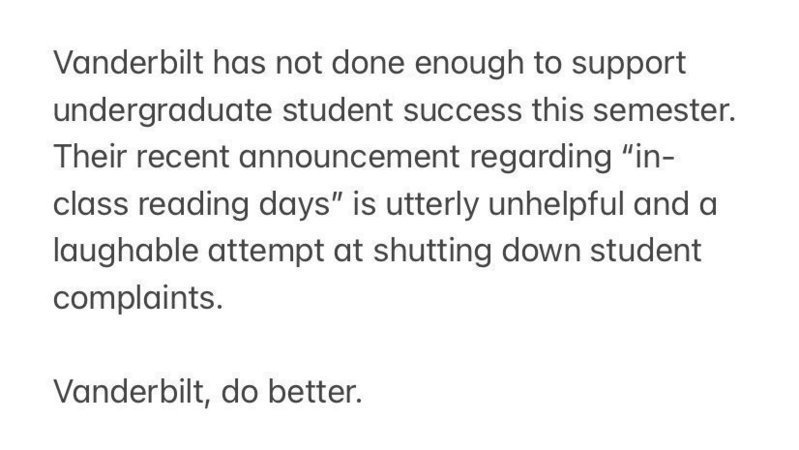
In the midst of this pandemic, all of us are working hard to perform our best under the current circumstances. This semester has proven to be a challenge for students, as well as faculty and staff. Despite efforts by the university, student well-being has taken quite the stumble this semester, the consequences of which are devastating. In short, the student body believes that lack of support provided by the administration has made it impossible to stay afloat mentally, physically, and academically.
Though many support resources for students remain available, they are inadequately equipped to keep up with the volume and severity of student needs, which encourages students to leave campus to fulfill these needs. Appointments with the UCC have become scarce and competitive, and are less personal due to the nature of video meetings. Students, then, are understandably seeking support from outside counseling offices. General school stress is amplified, as all students are doing their best to adjust to new courses, professors, and class formats. Schedules are hectic, with the combination of online, in person, and hybrid classes. It seems common for online deadlines to be easily missed, and in-person assignments to slip through the cracks. Catching up in class requires more effort, since many professors have taken advantage of the online format by assigning additional work. Others have forgone lecturing entirely, requiring students to teach themselves a $75,000 education from a $150 textbook. Undergraduates, especially first years, have a chance to relax and unwind during a typical school year with the inclusion of fall break. The omission of this short recess has compounded the stress on students, providing no relief during an already hectic semester. Lack of a break in classes deters but does not prevent students from travelling. Many are becoming burnt out academically. Due to the restrictions on visiting with other students, forming and maintaining close connections with others proves difficult and at times feels impossible. To be able to interact with friends in a closer setting, students prefer to hang out in Nashville at restaurants, or apartments of their off-campus colleagues.
In terms of physical health, the student body is lacking ample resources to keep them engaged and in shape. With the recreation center closed, students have to develop new ways to get active. Many groups on campus are unable to meet due to size limitations on student events. This motivates students to engage in activities off campus, which increases the risk of bringing the virus back into residence halls. Students are in dire need of a way to stay healthy without having to seek off-campus resources and putting the health of the Vanderbilt community in jeopardy.
The multitude of changes in the learning environment has caused students to struggle immensely this semester, and the situation has not been made easier by any action by the university. Students have started several petitions in an attempt to bring light to the difficulty of this semester. In their campaigns for a single day off of school and a universal pass-fail option, students came together with clear and organized arguments for their causes. Administration, however, has made no move to satisfy the pleas of the students, and have yet to address these concerns even after several months. The student body should not have to fight administration to be able to be successful academically. There needs to be more effort put into providing a positive experience for students. Additionally, one of the appeals of Vanderbilt is the personalized educational experience provided by small class sizes and a multitude of learning opportunities. Faculty and staff, however, seem too distant from students to be able to form close connections. Students need more substantial academic support resources to be successful in the coming months.
The once intimate environment of the Vanderbilt campus has turned cold due to COVID regulations. In the words of undergraduates themselves, campus feels “like a ghost town.” Students feel “abandoned by administration” and believe that they are “alone in advocating for better resources.” This is unacceptable.
Regardless of the quality of care and education provided by Vanderbilt in previous semesters, students are emotionally vulnerable due to the nature of the pandemic, and action needs to be taken to support students even more during this time. It seems obvious that mental health should be a focal point during this pandemic, but since numbers seem to strike the heart of the university more directly, data has been included to support this point. In June, “40.9% of 5,470 respondents… reported an adverse mental or behavioral health condition” (Czeisler). One resource states that some of the most detrimental causes of the pandemic are social isolation, decreased access to community and religious support, and barriers to mental health treatment (Reger). It has been reported that “younger people, Latinx and Black populations are the most vulnerable right now… The rates of those reported having seriously considered suicide in the 30 days before the June CDC survey are higher among those between ages 18-24 (25.5%)… and minority racial/ethnic groups (18.6% Hispanic, 15.1% non-Hispanic Black)” (Falcon). This statistic in particular should stand out, given Vanderbilt’s supposed intention to promote diversity and inclusion in the campus community.
It has become increasingly apparent that the main goal of the office of student administration is to prove that they can keep students safely on campus, rather than to provide the best possible experience for all undergraduates. As highlighted throughout this discussion, strict regulations without increased student resources only encourages students to seek community in Nashville, rather than in the safety of the Vanderbilt campus. It is in the best interest of the administration to find a way to increase student engagement safely. The most prevalent community being formed between students on campus is that of campaigning for a better learning experience from the office of student administration. That factor alone should speak for itself in terms of student well-being and overall happiness with the situation on campus this semester.
Vanderbilt is a top contender in rankings of happiest students. This standard, coupled with the university’s reputation of academic rigor, presents a unique environment for student growth. Without the presence of both of these factors, Vanderbilt does not live up to its promise to provide an exceptional undergraduate experience. It is essential that more focus and funding is allocated to student health resources for the fast-approaching spring semester. The university, for good reason, prides itself on high academic achievement. High academic achievement is only possible through well-maintained physical health, and physical health is built on a strong foundation of mental health. If the university is incapable of providing this strong foundation, all other principles will crumble, along with the reputation of Vanderbilt itself.
Works Cited
Czeisler, Mark É., et al. “Mental Health, Substance Use, and Suicidal Ideation During the ...” Centers for Disease Control and Prevention, 13 Aug. 2020, https://dx.doi.org/10.15585/mmwr.mm6932a1
Falcon, Russell. “Are Suicides on the Rise during the COVID-19 Pandemic?” KXAN Austin, KXAN Austin, 3 Sept. 2020, https://www.kxan.com/news/coronavirus/are-suicides-on-the-rise-during-the-covid-19-pandemic/
“Mental Health, Substance Use, and Suicidal Ideation During the COVID-19 Pandemic - United States, June 24–30, 2020.” Centers for Disease Control and Prevention, Centers for Disease Control and Prevention, 13 Aug. 2020, https://www.cdc.gov/mmwr/volumes/69/wr/mm6932a1.htm
Reger, Mark A., et al. “Suicide Mortality and Coronavirus Disease 2019-A Perfect Storm?” JAMA Psychiatry, JAMA Network, 1 Nov. 2020, jamanetwork.com/journals/jamapsychiatry/fullarticle/2764584.
Pfefferbaum, Betty, et al. “Mental Health and the Covid-19 Pandemic: NEJM.” New England Journal of Medicine, 5 Nov. 2020, https://www.nejm.org/doi/full/10.1056/NEJMp2008017

The Issue
In the midst of this pandemic, all of us are working hard to perform our best under the current circumstances. This semester has proven to be a challenge for students, as well as faculty and staff. Despite efforts by the university, student well-being has taken quite the stumble this semester, the consequences of which are devastating. In short, the student body believes that lack of support provided by the administration has made it impossible to stay afloat mentally, physically, and academically.
Though many support resources for students remain available, they are inadequately equipped to keep up with the volume and severity of student needs, which encourages students to leave campus to fulfill these needs. Appointments with the UCC have become scarce and competitive, and are less personal due to the nature of video meetings. Students, then, are understandably seeking support from outside counseling offices. General school stress is amplified, as all students are doing their best to adjust to new courses, professors, and class formats. Schedules are hectic, with the combination of online, in person, and hybrid classes. It seems common for online deadlines to be easily missed, and in-person assignments to slip through the cracks. Catching up in class requires more effort, since many professors have taken advantage of the online format by assigning additional work. Others have forgone lecturing entirely, requiring students to teach themselves a $75,000 education from a $150 textbook. Undergraduates, especially first years, have a chance to relax and unwind during a typical school year with the inclusion of fall break. The omission of this short recess has compounded the stress on students, providing no relief during an already hectic semester. Lack of a break in classes deters but does not prevent students from travelling. Many are becoming burnt out academically. Due to the restrictions on visiting with other students, forming and maintaining close connections with others proves difficult and at times feels impossible. To be able to interact with friends in a closer setting, students prefer to hang out in Nashville at restaurants, or apartments of their off-campus colleagues.
In terms of physical health, the student body is lacking ample resources to keep them engaged and in shape. With the recreation center closed, students have to develop new ways to get active. Many groups on campus are unable to meet due to size limitations on student events. This motivates students to engage in activities off campus, which increases the risk of bringing the virus back into residence halls. Students are in dire need of a way to stay healthy without having to seek off-campus resources and putting the health of the Vanderbilt community in jeopardy.
The multitude of changes in the learning environment has caused students to struggle immensely this semester, and the situation has not been made easier by any action by the university. Students have started several petitions in an attempt to bring light to the difficulty of this semester. In their campaigns for a single day off of school and a universal pass-fail option, students came together with clear and organized arguments for their causes. Administration, however, has made no move to satisfy the pleas of the students, and have yet to address these concerns even after several months. The student body should not have to fight administration to be able to be successful academically. There needs to be more effort put into providing a positive experience for students. Additionally, one of the appeals of Vanderbilt is the personalized educational experience provided by small class sizes and a multitude of learning opportunities. Faculty and staff, however, seem too distant from students to be able to form close connections. Students need more substantial academic support resources to be successful in the coming months.
The once intimate environment of the Vanderbilt campus has turned cold due to COVID regulations. In the words of undergraduates themselves, campus feels “like a ghost town.” Students feel “abandoned by administration” and believe that they are “alone in advocating for better resources.” This is unacceptable.
Regardless of the quality of care and education provided by Vanderbilt in previous semesters, students are emotionally vulnerable due to the nature of the pandemic, and action needs to be taken to support students even more during this time. It seems obvious that mental health should be a focal point during this pandemic, but since numbers seem to strike the heart of the university more directly, data has been included to support this point. In June, “40.9% of 5,470 respondents… reported an adverse mental or behavioral health condition” (Czeisler). One resource states that some of the most detrimental causes of the pandemic are social isolation, decreased access to community and religious support, and barriers to mental health treatment (Reger). It has been reported that “younger people, Latinx and Black populations are the most vulnerable right now… The rates of those reported having seriously considered suicide in the 30 days before the June CDC survey are higher among those between ages 18-24 (25.5%)… and minority racial/ethnic groups (18.6% Hispanic, 15.1% non-Hispanic Black)” (Falcon). This statistic in particular should stand out, given Vanderbilt’s supposed intention to promote diversity and inclusion in the campus community.
It has become increasingly apparent that the main goal of the office of student administration is to prove that they can keep students safely on campus, rather than to provide the best possible experience for all undergraduates. As highlighted throughout this discussion, strict regulations without increased student resources only encourages students to seek community in Nashville, rather than in the safety of the Vanderbilt campus. It is in the best interest of the administration to find a way to increase student engagement safely. The most prevalent community being formed between students on campus is that of campaigning for a better learning experience from the office of student administration. That factor alone should speak for itself in terms of student well-being and overall happiness with the situation on campus this semester.
Vanderbilt is a top contender in rankings of happiest students. This standard, coupled with the university’s reputation of academic rigor, presents a unique environment for student growth. Without the presence of both of these factors, Vanderbilt does not live up to its promise to provide an exceptional undergraduate experience. It is essential that more focus and funding is allocated to student health resources for the fast-approaching spring semester. The university, for good reason, prides itself on high academic achievement. High academic achievement is only possible through well-maintained physical health, and physical health is built on a strong foundation of mental health. If the university is incapable of providing this strong foundation, all other principles will crumble, along with the reputation of Vanderbilt itself.
Works Cited
Czeisler, Mark É., et al. “Mental Health, Substance Use, and Suicidal Ideation During the ...” Centers for Disease Control and Prevention, 13 Aug. 2020, https://dx.doi.org/10.15585/mmwr.mm6932a1
Falcon, Russell. “Are Suicides on the Rise during the COVID-19 Pandemic?” KXAN Austin, KXAN Austin, 3 Sept. 2020, https://www.kxan.com/news/coronavirus/are-suicides-on-the-rise-during-the-covid-19-pandemic/
“Mental Health, Substance Use, and Suicidal Ideation During the COVID-19 Pandemic - United States, June 24–30, 2020.” Centers for Disease Control and Prevention, Centers for Disease Control and Prevention, 13 Aug. 2020, https://www.cdc.gov/mmwr/volumes/69/wr/mm6932a1.htm
Reger, Mark A., et al. “Suicide Mortality and Coronavirus Disease 2019-A Perfect Storm?” JAMA Psychiatry, JAMA Network, 1 Nov. 2020, jamanetwork.com/journals/jamapsychiatry/fullarticle/2764584.
Pfefferbaum, Betty, et al. “Mental Health and the Covid-19 Pandemic: NEJM.” New England Journal of Medicine, 5 Nov. 2020, https://www.nejm.org/doi/full/10.1056/NEJMp2008017
The Decision Makers
Petition Updates
Share this petition
Petition created on November 19, 2020