
Urge The Ramsey Shade Tree Commission to Hire an Arborist.
Urge The Ramsey Shade Tree Commission to Hire an Arborist.
The Issue
The recent Shade Tree commission meeting revealed all three giant walnut trees are slated for removal, but not all is lost. Left to their own unchecked authority, the developers cite that the trees must be removed because they are too close to construction and that they are not as healthy as they appear.
Here’s what I’m proposing: A second opinion, from an arborist.
I’m just not sure people are understanding the value of these trees. There is no replacement for trees of this age and stature. We’ll all be long gone before trees like that return to the landscape. If the trees truly are rotted from the inside and pose a hazard, I can live with the ruling for their removal, but if it’s just for the convenience of the developers, I’ll continue to make noise.
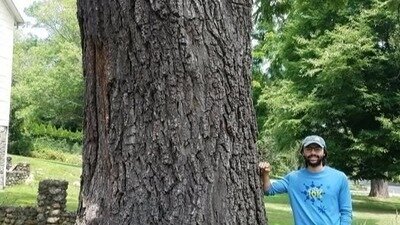
Three of the largest Black Walnuts (Juglans nigra) I’ve ever seen are on this property, right along the road, and I get great joy observing their amazing forms as I drive by. The largest of the three has a 16 foot circumference/ 64 inch diameter.
Black Walnuts are a native species of tree to the Eastern United States. The Indigenous Americans and the Dutch Colonists knew their value as a food source and would often plant, or nurture the naturally occurring walnuts around their homes. This is what remains today at 425 Island Road. These three trees are likely 200-300 years old, and are living connections between us and the people who came before.
While writing this I remembered this quote by the writer Bill Vaughn:
“Suburbia is where the developer bulldozes all the trees, then names the streets after them”. It would kill me to see “Walnut Estates” without these three amazing specimens.

734
The Issue
The recent Shade Tree commission meeting revealed all three giant walnut trees are slated for removal, but not all is lost. Left to their own unchecked authority, the developers cite that the trees must be removed because they are too close to construction and that they are not as healthy as they appear.
Here’s what I’m proposing: A second opinion, from an arborist.
I’m just not sure people are understanding the value of these trees. There is no replacement for trees of this age and stature. We’ll all be long gone before trees like that return to the landscape. If the trees truly are rotted from the inside and pose a hazard, I can live with the ruling for their removal, but if it’s just for the convenience of the developers, I’ll continue to make noise.
Three of the largest Black Walnuts (Juglans nigra) I’ve ever seen are on this property, right along the road, and I get great joy observing their amazing forms as I drive by. The largest of the three has a 16 foot circumference/ 64 inch diameter.
Black Walnuts are a native species of tree to the Eastern United States. The Indigenous Americans and the Dutch Colonists knew their value as a food source and would often plant, or nurture the naturally occurring walnuts around their homes. This is what remains today at 425 Island Road. These three trees are likely 200-300 years old, and are living connections between us and the people who came before.
While writing this I remembered this quote by the writer Bill Vaughn:
“Suburbia is where the developer bulldozes all the trees, then names the streets after them”. It would kill me to see “Walnut Estates” without these three amazing specimens.
734
The Decision Makers

Supporter Voices
Petition Updates
Share this petition
Petition created on April 24, 2026