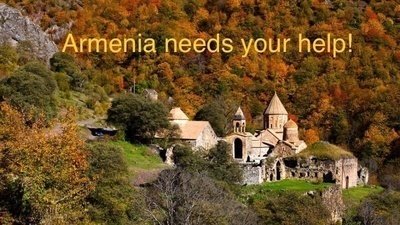
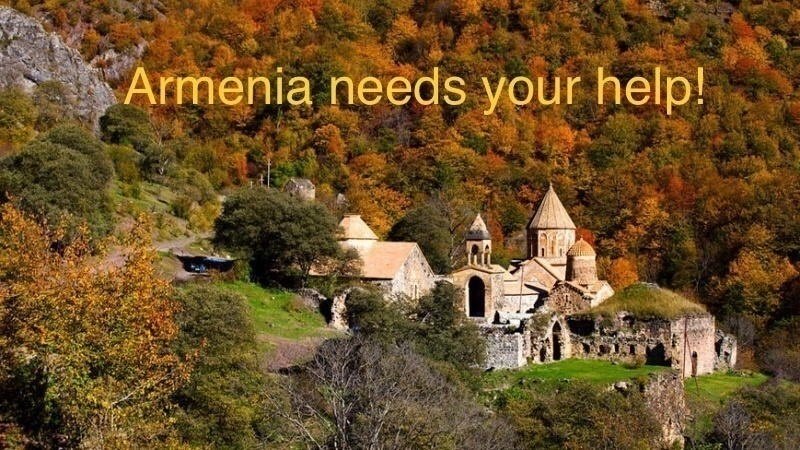
Help save Armenian Heritage in Artsakh, Monastery and churches are in danger.
Help save Armenian Heritage in Artsakh, Monastery and churches are in danger.
Le problème
On behalf of the citizens of the world, we request the UNESCO to protect Armenian Heritage as churches and monastries from destruction.
Armenia is a Christian nation since 301 AD. The first christians.
Artsakh will soon be divided, again, into Armenians and azeris/turcs.
We know for sure this peace will not last and all our monuments, treasures, patrimoine, culture are in a real danger.
Danger of destruction, danger of profanation and willing of extermination.
We request the help of international organization UNESCO for saving and helping protect in Nagorno Karabakh all armenian monuments, architecture, hospital, church, monastery and art that has an armenian history and need to be preserved from any destruction.
The art created in Armenia’s historical province of Artsakh, the largest part of which is known today as Nagorno Karabakh, constitutes one of the important chapters in the history of Armenian art. It has progressed through the same major stages as did Armenian art in a larger sense: from pre-Christian times to the adoption of Christianity early in the fourth century, through the Middle Ages, and from there—to the era of modernity.
As in many other Christian cultures, the principal expression of Artsakh’s art in the Middle Ages was through ecclesiastical architecture: churches, cathedrals, chapels and monasteries. Most other forms of art in that period, including illuminated manuscripts, khachkars (unique-to-Armenia stone slabs with engraved crosses) and mural paintings were likewise tied to Artsakh’s religious life and its primary institution—the Armenian Apostolic Church.
Artsakh has been rightfully called an open-sky treasure-house of various forms of Armenian architecture. Overall, Artsakh, including adjacent areas that lay outside of the boundaries of today’s Nagorno Karabakh Republic, contains up to 1700 architectural artifacts. In addition to ecclesiastical structures, this number includes samples of civil architecture, ancient castles and fortresses as well as numerous khachkars.
The most famous representative of the Artashessian dynasty was
Tigran II the Great (95 BC-55 BC), under whom the Kingdom of Armenia stretched from the Caspian Sea to the Mediterranean Sea. Recognizing the important position of Artsakh inside his kingdom, Tigran II built in the region one of four cities named Tigranakert, after himself, (Tigranocerta, in Roman sources); its ruins are found some 50 miles to the northeast of the Nagorno Karabakh Republic’s present-day capital of Stepanakert. Between Tigranakert and Stepanakert, and elsewhere in Artsakh’s lowlands, it was common to find well-preserved silver currency minted by the Artashessians.
Shushi ´s heritage
It seems that history will repeat unfortunately, like in 1920, Aided by expeditionary Ottoman forces, armed Turkic (“Azerbaijani”) bands burned and destroyed all Christian quarters of the city, murdering most of its Armenian residents in the process—some 20,000 people in total.
You understand since when our ancestors have been there. Our wish is always to preserve history and peace.
One of these heritage is the very famous Dadivank monastry (1214-1237). But also all Armenian churches and monastries in Karabakh.
We want to be sure that all our treasures will not be destroyed and be protected.
God bless you,
sources : nkrusa.org

Le problème
On behalf of the citizens of the world, we request the UNESCO to protect Armenian Heritage as churches and monastries from destruction.
Armenia is a Christian nation since 301 AD. The first christians.
Artsakh will soon be divided, again, into Armenians and azeris/turcs.
We know for sure this peace will not last and all our monuments, treasures, patrimoine, culture are in a real danger.
Danger of destruction, danger of profanation and willing of extermination.
We request the help of international organization UNESCO for saving and helping protect in Nagorno Karabakh all armenian monuments, architecture, hospital, church, monastery and art that has an armenian history and need to be preserved from any destruction.
The art created in Armenia’s historical province of Artsakh, the largest part of which is known today as Nagorno Karabakh, constitutes one of the important chapters in the history of Armenian art. It has progressed through the same major stages as did Armenian art in a larger sense: from pre-Christian times to the adoption of Christianity early in the fourth century, through the Middle Ages, and from there—to the era of modernity.
As in many other Christian cultures, the principal expression of Artsakh’s art in the Middle Ages was through ecclesiastical architecture: churches, cathedrals, chapels and monasteries. Most other forms of art in that period, including illuminated manuscripts, khachkars (unique-to-Armenia stone slabs with engraved crosses) and mural paintings were likewise tied to Artsakh’s religious life and its primary institution—the Armenian Apostolic Church.
Artsakh has been rightfully called an open-sky treasure-house of various forms of Armenian architecture. Overall, Artsakh, including adjacent areas that lay outside of the boundaries of today’s Nagorno Karabakh Republic, contains up to 1700 architectural artifacts. In addition to ecclesiastical structures, this number includes samples of civil architecture, ancient castles and fortresses as well as numerous khachkars.
The most famous representative of the Artashessian dynasty was
Tigran II the Great (95 BC-55 BC), under whom the Kingdom of Armenia stretched from the Caspian Sea to the Mediterranean Sea. Recognizing the important position of Artsakh inside his kingdom, Tigran II built in the region one of four cities named Tigranakert, after himself, (Tigranocerta, in Roman sources); its ruins are found some 50 miles to the northeast of the Nagorno Karabakh Republic’s present-day capital of Stepanakert. Between Tigranakert and Stepanakert, and elsewhere in Artsakh’s lowlands, it was common to find well-preserved silver currency minted by the Artashessians.
Shushi ´s heritage
It seems that history will repeat unfortunately, like in 1920, Aided by expeditionary Ottoman forces, armed Turkic (“Azerbaijani”) bands burned and destroyed all Christian quarters of the city, murdering most of its Armenian residents in the process—some 20,000 people in total.
You understand since when our ancestors have been there. Our wish is always to preserve history and peace.
One of these heritage is the very famous Dadivank monastry (1214-1237). But also all Armenian churches and monastries in Karabakh.
We want to be sure that all our treasures will not be destroyed and be protected.
God bless you,
sources : nkrusa.org
Pétition fermée
Partagez cette pétition
Les décisionnaires
Mises à jour sur la pétition
Partager la pétition
Pétition lancée le 10 novembre 2020