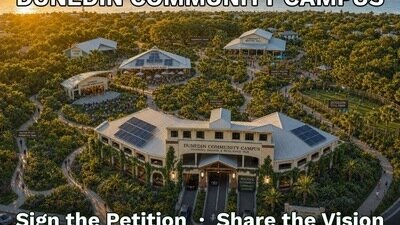

Turn Dunedin’s Idle Industrial Site Into a Community Campus
The Issue
For years, 29.65 acres of prime land in the heart of Dunedin have sat dormant — the former Coca-Cola bottling plant at 427 San Christopher Drive, home to aging industrial structures and unrealized potential in one of Florida’s most beloved small cities. Of the total site, 27.5 acres are usable. The residents of Dunedin should not have to wait to determine what becomes of it.
We, the residents, families, and neighbors of Dunedin, are asking the City Commission to formally advance the Dunedin Community Campus for community review and serious consideration — a community-held civic campus designed to serve every resident, from toddlers to seniors, from farmers market shoppers to hurricane evacuees.
A Plan Built on Evidence
This proposal is not a concept sketch. A volunteer-produced, self-funded 300-page Gap Analysis Package has been completed, encompassing 16 technical studies across planning, environmental, legal, and financial disciplines — all conducted as rigorous desktop analyses. An Adaptive Reuse Feasibility Assessment (Appendix A) accompanies that package. The groundwork has been done. What remains is for the City to act on it.
The campus is projected to generate between $1,220,000 (conservative) and $1,945,000 (optimistic) in annual revenue for the City of Dunedin — converting a vacant industrial liability into a durable civic asset at no tax burden to residents.
The Case for Building 2
Among the six structures on the site, one demands particular attention: Building 2, a dominant two-story, 265,000-plus square foot reinforced concrete structure built in 1944 as part of the Coca-Cola wartime supply chain during World War II. It is the only two-story reinforced concrete building on the site and is more than 80 years old.
Demolishing Building 2 would be a costly and irreversible mistake. The proposal recommends its preservation and adaptive reuse — for two financially compelling reasons.
First, Building 2 likely qualifies for the National Register of Historic Places under WWII supply chain criteria (Criterion A) and industrial vernacular architecture (Criterion C). That designation would unlock a 20% Federal Historic Tax Credit, estimated at approximately $3.6 million in equity.
Second, Building 2’s reinforced concrete construction makes it an ideal candidate for EHPA certification as a community hurricane resilience shelter, with capacity for 4,500-plus people. If structural assessment confirms feasibility, it would be the first 1944-era building in Florida to achieve EHPA certification — a distinction that reflects both engineering legacy and civic foresight.
The net cost advantage of preserving and adaptively reusing Building 2 — rather than demolishing it and building new — is estimated at approximately $54 million.
The vision: adaptively reuse Building 2 as a community parking garage and hurricane resilience hub, anchoring Zone 2 of the campus. This is not merely a preservation argument. It is a fiscal responsibility argument.
The FEMA BRIC Deadline
A FEMA Building Resilient Infrastructure and Communities (BRIC) grant of up to $20 million is available specifically for community resilience shelters of this kind. The application deadline is July 23, 2026. That window will not reopen on these terms. The City Commission must move before that deadline to preserve Dunedin’s eligibility.
Twelve Zones for the Whole Community
The Dunedin Community Campus is organized into twelve distinct zones:
1. Perimeter Walking & Biking Trail
2. Parking Garage / Community Resilience Hub (Building 2 adaptive reuse — EHPA hurricane shelter)
3. Farmers Market Plaza
4. Outdoor Concert Amphitheater
5. Community Food Forest & Edible Garden
6. Hammock Grove
7. Fitness Gym
8. Community Meeting Hall
9. Dogedin Dog Park
10. Sunset Observatory Tower
11. Pinellas Trail Connection
12. Family & Youth Activity Zone
What We Are Asking
Dunedin is a community that values quality of life, coastal resilience, and the kind of neighborhood character that cannot be replicated once it is lost to industrial warehousing or private development. This proposal addresses historic preservation, community resilience, and fiscal responsibility — simultaneously, on land the City could hold in perpetuity for its residents.
The research has been done. The financial case has been made. The federal funding window is open — but not for long.
We, the undersigned, urge the Dunedin City Commission to advance the Dunedin Community Campus proposal for community review and formal consideration, to engage residents in its planning, and to act before the FEMA BRIC deadline of July 23, 2026 closes permanently.
© 2026 Jerry Ivey · Dunedin Community Campus

89
The Issue
For years, 29.65 acres of prime land in the heart of Dunedin have sat dormant — the former Coca-Cola bottling plant at 427 San Christopher Drive, home to aging industrial structures and unrealized potential in one of Florida’s most beloved small cities. Of the total site, 27.5 acres are usable. The residents of Dunedin should not have to wait to determine what becomes of it.
We, the residents, families, and neighbors of Dunedin, are asking the City Commission to formally advance the Dunedin Community Campus for community review and serious consideration — a community-held civic campus designed to serve every resident, from toddlers to seniors, from farmers market shoppers to hurricane evacuees.
A Plan Built on Evidence
This proposal is not a concept sketch. A volunteer-produced, self-funded 300-page Gap Analysis Package has been completed, encompassing 16 technical studies across planning, environmental, legal, and financial disciplines — all conducted as rigorous desktop analyses. An Adaptive Reuse Feasibility Assessment (Appendix A) accompanies that package. The groundwork has been done. What remains is for the City to act on it.
The campus is projected to generate between $1,220,000 (conservative) and $1,945,000 (optimistic) in annual revenue for the City of Dunedin — converting a vacant industrial liability into a durable civic asset at no tax burden to residents.
The Case for Building 2
Among the six structures on the site, one demands particular attention: Building 2, a dominant two-story, 265,000-plus square foot reinforced concrete structure built in 1944 as part of the Coca-Cola wartime supply chain during World War II. It is the only two-story reinforced concrete building on the site and is more than 80 years old.
Demolishing Building 2 would be a costly and irreversible mistake. The proposal recommends its preservation and adaptive reuse — for two financially compelling reasons.
First, Building 2 likely qualifies for the National Register of Historic Places under WWII supply chain criteria (Criterion A) and industrial vernacular architecture (Criterion C). That designation would unlock a 20% Federal Historic Tax Credit, estimated at approximately $3.6 million in equity.
Second, Building 2’s reinforced concrete construction makes it an ideal candidate for EHPA certification as a community hurricane resilience shelter, with capacity for 4,500-plus people. If structural assessment confirms feasibility, it would be the first 1944-era building in Florida to achieve EHPA certification — a distinction that reflects both engineering legacy and civic foresight.
The net cost advantage of preserving and adaptively reusing Building 2 — rather than demolishing it and building new — is estimated at approximately $54 million.
The vision: adaptively reuse Building 2 as a community parking garage and hurricane resilience hub, anchoring Zone 2 of the campus. This is not merely a preservation argument. It is a fiscal responsibility argument.
The FEMA BRIC Deadline
A FEMA Building Resilient Infrastructure and Communities (BRIC) grant of up to $20 million is available specifically for community resilience shelters of this kind. The application deadline is July 23, 2026. That window will not reopen on these terms. The City Commission must move before that deadline to preserve Dunedin’s eligibility.
Twelve Zones for the Whole Community
The Dunedin Community Campus is organized into twelve distinct zones:
1. Perimeter Walking & Biking Trail
2. Parking Garage / Community Resilience Hub (Building 2 adaptive reuse — EHPA hurricane shelter)
3. Farmers Market Plaza
4. Outdoor Concert Amphitheater
5. Community Food Forest & Edible Garden
6. Hammock Grove
7. Fitness Gym
8. Community Meeting Hall
9. Dogedin Dog Park
10. Sunset Observatory Tower
11. Pinellas Trail Connection
12. Family & Youth Activity Zone
What We Are Asking
Dunedin is a community that values quality of life, coastal resilience, and the kind of neighborhood character that cannot be replicated once it is lost to industrial warehousing or private development. This proposal addresses historic preservation, community resilience, and fiscal responsibility — simultaneously, on land the City could hold in perpetuity for its residents.
The research has been done. The financial case has been made. The federal funding window is open — but not for long.
We, the undersigned, urge the Dunedin City Commission to advance the Dunedin Community Campus proposal for community review and formal consideration, to engage residents in its planning, and to act before the FEMA BRIC deadline of July 23, 2026 closes permanently.
© 2026 Jerry Ivey · Dunedin Community Campus
The Decision Makers


Petition Updates
Share this petition
Petition created on May 19, 2026