The Use of AI: An Irresistible Dependency of Students

The Use of AI: An Irresistible Dependency of Students
The Issue
In this era, technology has been dominating the society, the rise of Artificial Intelligence (AI) has helped many users to make things very effortless. These affects are seen in line of education, to which teachers and students utilizes the use of AI.
Teachers utilizes the use of AI in creating lesson plans, presetations and setting up datas to present, while students utilizes the use of AI to demand assistance to curricular activities and academic papers. Although AI offers many benefits to both students and teachers, this offers could be abused by the users especially to students, which results to lower critical thinking of students. According to StratX Simulations (2026) by April Giarla, 25% of students already feel disengaged in their learning; there doesn't need to be a reason for that number to increase. Students must be engaged with real-life learning experiences and simulations for learning to be impactful. This means that there is no critical thinking, analysis, or evaluation involved with the students. According to The widespread adoption of generative AI tools such as ChatGPT in higher education has sparked increasing interest in their effects on students' cognitive development—particularly critical thinking. While AI offers rapid access to information and support for academic tasks, overdependence on such tools may reduce students' engagement in independent analysis and reflective reasoning (Bahroun et al., 2023; Cezar & Maçada, 2023). This signals the negative effects of AI if not used responsibly, which leads to lower education quality.
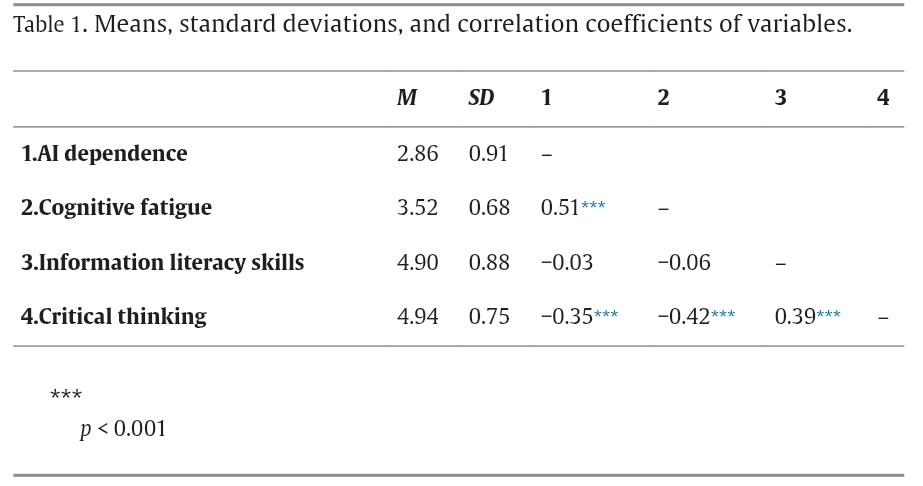
The table above by Jinrui Tian & Ronghua Zhang (2025), are the results of hierarchical regression analyses examining the effects of AI dependence, information literacy, and interaction on critical thinking and cognitive fatigue.
To address this issue, school facilities should promote the responsible use of AI in academic activities. I suggest to promote the right use of AI as an assistance in terms to academic activities within school premises. This regulations could be implemented by those who are in higher position, this includes; master teachers, prinicipals and school administrators. This is an effective way to avoid the abuse in the use if AI with school premises, this boosts the critical thinking of students.
References:
Giarla, A. (2026). The Negative Effects of Artificial Intelligence in Education, Blog, https://stratxsim.com/recent-posts/the-negative-effects-of-artificial-intelligence-in-education
Bahroun, Z., Anane, C., Ahmed, V., & Zacca, A. (2023). Transforming Education: A Comprehensive Review of Generative Artificial Intelligence in Educational Settings through Bibliometric and Content Analysis. Sustainability, 15(17), 12983. https://doi.org/10.3390/su151712983
Tian J., Zhang R., (2025)., Learners' AI dependence and critical thinking: The psychological mechanism of fatigue and the social buffering role of AI literacy, Acta Psychological, Volume 260, 105725, ISSN 0001-6918, https://doi.org/10.1016/j.actpsy.2025.105725.

24
The Issue
In this era, technology has been dominating the society, the rise of Artificial Intelligence (AI) has helped many users to make things very effortless. These affects are seen in line of education, to which teachers and students utilizes the use of AI.
Teachers utilizes the use of AI in creating lesson plans, presetations and setting up datas to present, while students utilizes the use of AI to demand assistance to curricular activities and academic papers. Although AI offers many benefits to both students and teachers, this offers could be abused by the users especially to students, which results to lower critical thinking of students. According to StratX Simulations (2026) by April Giarla, 25% of students already feel disengaged in their learning; there doesn't need to be a reason for that number to increase. Students must be engaged with real-life learning experiences and simulations for learning to be impactful. This means that there is no critical thinking, analysis, or evaluation involved with the students. According to The widespread adoption of generative AI tools such as ChatGPT in higher education has sparked increasing interest in their effects on students' cognitive development—particularly critical thinking. While AI offers rapid access to information and support for academic tasks, overdependence on such tools may reduce students' engagement in independent analysis and reflective reasoning (Bahroun et al., 2023; Cezar & Maçada, 2023). This signals the negative effects of AI if not used responsibly, which leads to lower education quality.
The table above by Jinrui Tian & Ronghua Zhang (2025), are the results of hierarchical regression analyses examining the effects of AI dependence, information literacy, and interaction on critical thinking and cognitive fatigue.
To address this issue, school facilities should promote the responsible use of AI in academic activities. I suggest to promote the right use of AI as an assistance in terms to academic activities within school premises. This regulations could be implemented by those who are in higher position, this includes; master teachers, prinicipals and school administrators. This is an effective way to avoid the abuse in the use if AI with school premises, this boosts the critical thinking of students.
References:
Giarla, A. (2026). The Negative Effects of Artificial Intelligence in Education, Blog, https://stratxsim.com/recent-posts/the-negative-effects-of-artificial-intelligence-in-education
Bahroun, Z., Anane, C., Ahmed, V., & Zacca, A. (2023). Transforming Education: A Comprehensive Review of Generative Artificial Intelligence in Educational Settings through Bibliometric and Content Analysis. Sustainability, 15(17), 12983. https://doi.org/10.3390/su151712983
Tian J., Zhang R., (2025)., Learners' AI dependence and critical thinking: The psychological mechanism of fatigue and the social buffering role of AI literacy, Acta Psychological, Volume 260, 105725, ISSN 0001-6918, https://doi.org/10.1016/j.actpsy.2025.105725.
24
Petition Updates
Share this petition
Petition created on February 6, 2026