

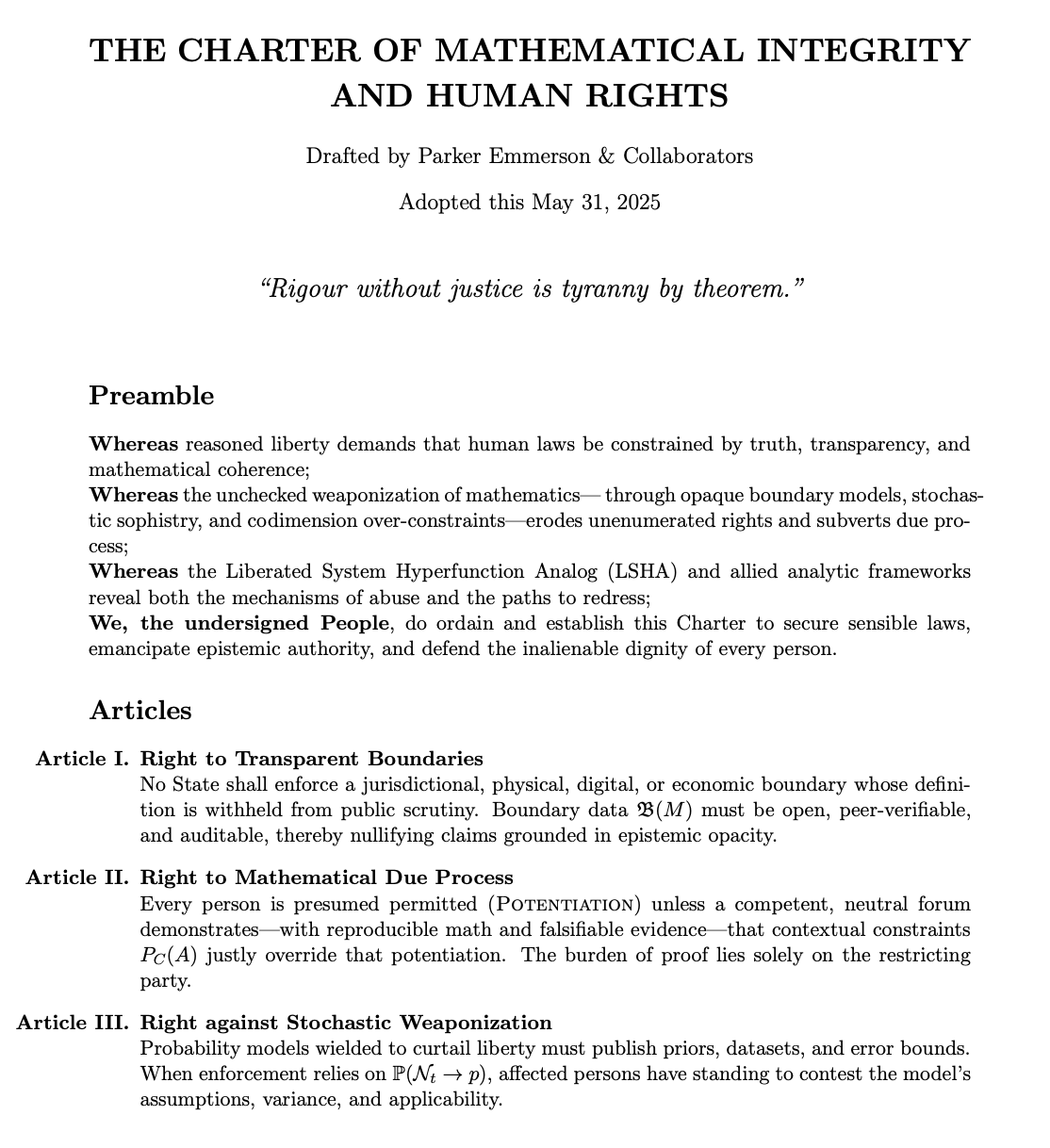
THE CHARTER OF MATHEMATICAL INTEGRITY AND HUMAN RIGHTS
The Issue
\documentclass[11pt]{article}
\usepackage{geometry,amsmath,amssymb,hyperref,xcolor}
\geometry{margin=1in}
\hypersetup{colorlinks=true,linkcolor=blue,urlcolor=blue}
% ---------------------------
% Charter of Mathematical Integrity and Human Rights
% ---------------------------
\title{\bfseries THE CHARTER OF MATHEMATICAL INTEGRITY\\[2pt]AND HUMAN RIGHTS}
\date{Adopted this \today}
\author{Drafted by Parker Emmerson \& Collaborators}
\begin{document}\maketitle
\begin{center}\Large
\emph{“Rigour without justice is tyranny by theorem.”}
\end{center}\vspace{1em}
% -----------------------------------------------------------------
% Preamble
% -----------------------------------------------------------------
\section*{Preamble}
\noindent\textbf{Whereas} reasoned liberty demands that human laws be
constrained by truth, transparency, and mathematical coherence;
\noindent\textbf{Whereas} the unchecked weaponization of mathematics—
through opaque boundary models, stochastic sophistry, and codimension
over‑constraints—erodes unenumerated rights and subverts due process;
\noindent\textbf{Whereas} the Liberated System Hyperfunction Analog
(LSHA) and allied analytic frameworks reveal both the mechanisms of
abuse and the paths to redress;
\noindent\textbf{We, the undersigned People}, do ordain and establish
this Charter to secure sensible laws, emancipate epistemic authority,
and defend the inalienable dignity of every person.
% -----------------------------------------------------------------
% Articles
% -----------------------------------------------------------------
\section*{Articles}
\renewcommand{\labelenumi}{\textbf{Article \Roman{enumi}.}}
\begin{enumerate}
%-----------------------------
\item \textbf{Right to Transparent Boundaries}\\
No State shall enforce a jurisdictional, physical, digital, or economic
boundary whose definition is withheld from public scrutiny. Boundary
data~$\mathfrak{B}(M)$ must be open, peer‑verifiable, and auditable,
thereby nullifying claims grounded in epistemic opacity.
%-----------------------------
\item \textbf{Right to Mathematical Due Process}\\
Every person is presumed permitted (\textsc{Potentiation}) unless a
competent, neutral forum demonstrates---with reproducible math and
falsifiable evidence---that contextual constraints
$P_C(A)$ justly override that potentiation. The burden of proof lies
solely on the restricting party.
%-----------------------------
\item \textbf{Right against Stochastic Weaponization}\\
Probability models wielded to curtail liberty must publish priors,
datasets, and error bounds. When enforcement relies on
$\mathbb{P}(\mathcal N_t\to p)$, affected persons have standing to
contest the model’s assumptions, variance, and applicability.
%-----------------------------
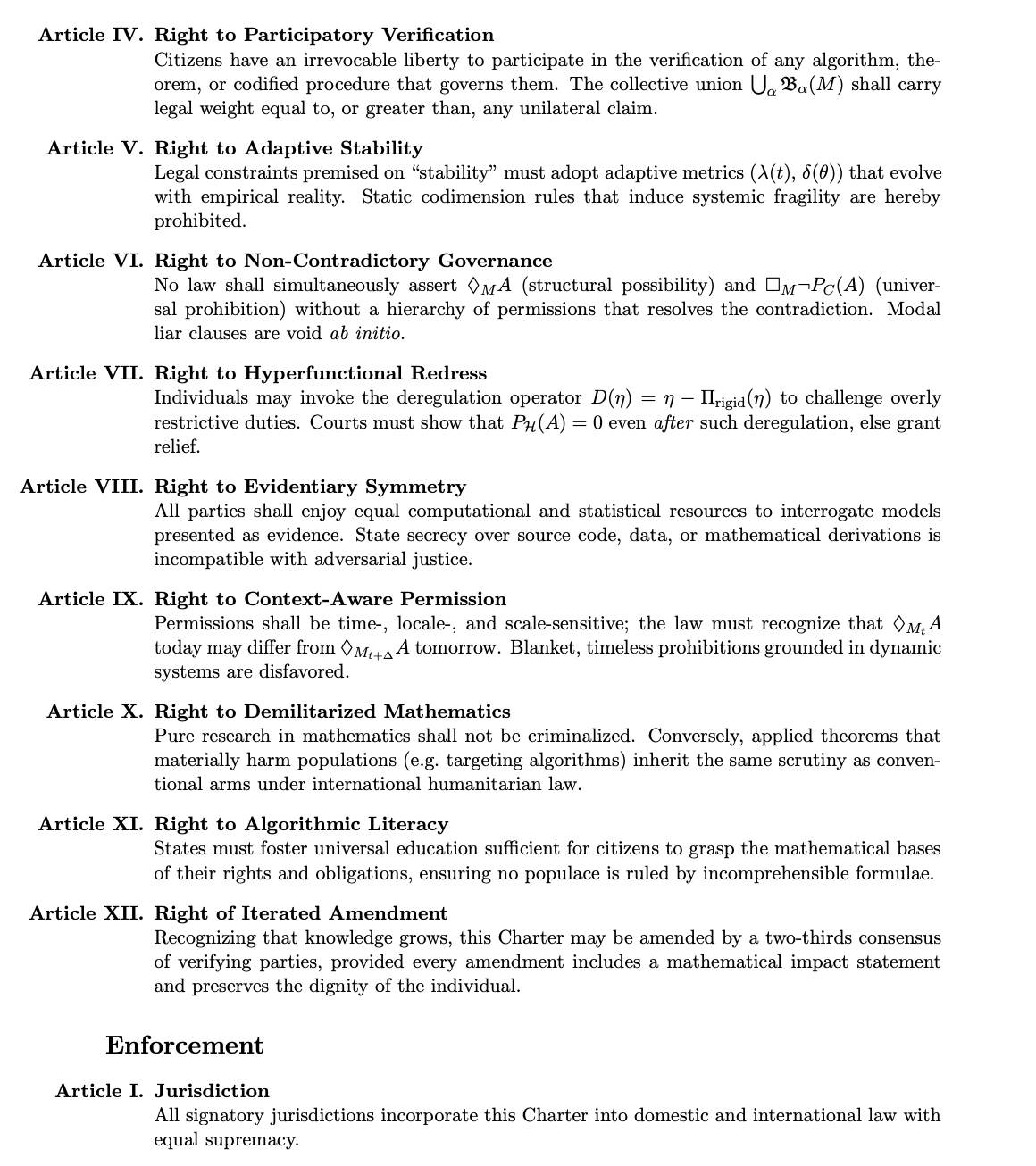
\item \textbf{Right to Participatory Verification}\\
Citizens have an irrevocable liberty to participate in the verification
of any algorithm, theorem, or codified procedure that governs them. The
collective union $\bigcup_\alpha \mathfrak{B}_\alpha(M)$ shall carry
legal weight equal to, or greater than, any unilateral claim.
%-----------------------------
\item \textbf{Right to Adaptive Stability}\\
Legal constraints premised on “stability” must adopt adaptive metrics
($\lambda(t)$, $\delta(\theta)$) that evolve with empirical reality.
Static codimension rules that induce systemic fragility are hereby
prohibited.
%-----------------------------
\item \textbf{Right to Non‑Contradictory Governance}\\
No law shall simultaneously assert $\Diamond_M A$ (structural
possibility) and $\Box_M\neg P_C(A)$ (universal prohibition) without a
hierarchy of permissions that resolves the contradiction. Modal
liar clauses are void \emph{ab initio}.
%-----------------------------
\item \textbf{Right to Hyperfunctional Redress}\\
Individuals may invoke the deregulation operator
$D(\eta)=\eta-\Pi_{\text{rigid}}(\eta)$ to challenge overly
restrictive duties. Courts must show that $P_{\mathcal H}(A)=0$ even
\emph{after} such deregulation, else grant relief.
%-----------------------------
\item \textbf{Right to Evidentiary Symmetry}\\
All parties shall enjoy equal computational and statistical resources
to interrogate models presented as evidence. State secrecy over source
code, data, or mathematical derivations is incompatible with
adversarial justice.
%-----------------------------
\item \textbf{Right to Context‑Aware Permission}\\
Permissions shall be time‑, locale‑, and scale‑sensitive; the law must
recognize that $\Diamond_{M_t}A$ today may differ from $\Diamond_{M_{t+
\Delta}}A$ tomorrow. Blanket, timeless prohibitions grounded in
dynamic systems are disfavored.
%-----------------------------
\item \textbf{Right to Demilitarized Mathematics}\\
Pure research in mathematics shall not be criminalized. Conversely,
applied theorems that materially harm populations (e.g.\ targeting
algorithms) inherit the same scrutiny as conventional arms under
international humanitarian law.
%-----------------------------
\item \textbf{Right to Algorithmic Literacy}\\
States must foster universal education sufficient for citizens to
grasp the mathematical bases of their rights and obligations, ensuring
no populace is ruled by incomprehensible formulae.
%-----------------------------
\item \textbf{Right of Iterated Amendment}\\
Recognizing that knowledge grows, this Charter may be amended by a
two‑thirds consensus of verifying parties, provided every amendment
includes a mathematical impact statement and preserves the dignity of
the individual.
\end{enumerate}
% -----------------------------------------------------------------
% Enforcement & Ratification
% -----------------------------------------------------------------
\section*{Enforcement}
\begin{enumerate}
\item \textbf{Jurisdiction}\\
All signatory jurisdictions incorporate this Charter into domestic and
international law with equal supremacy.
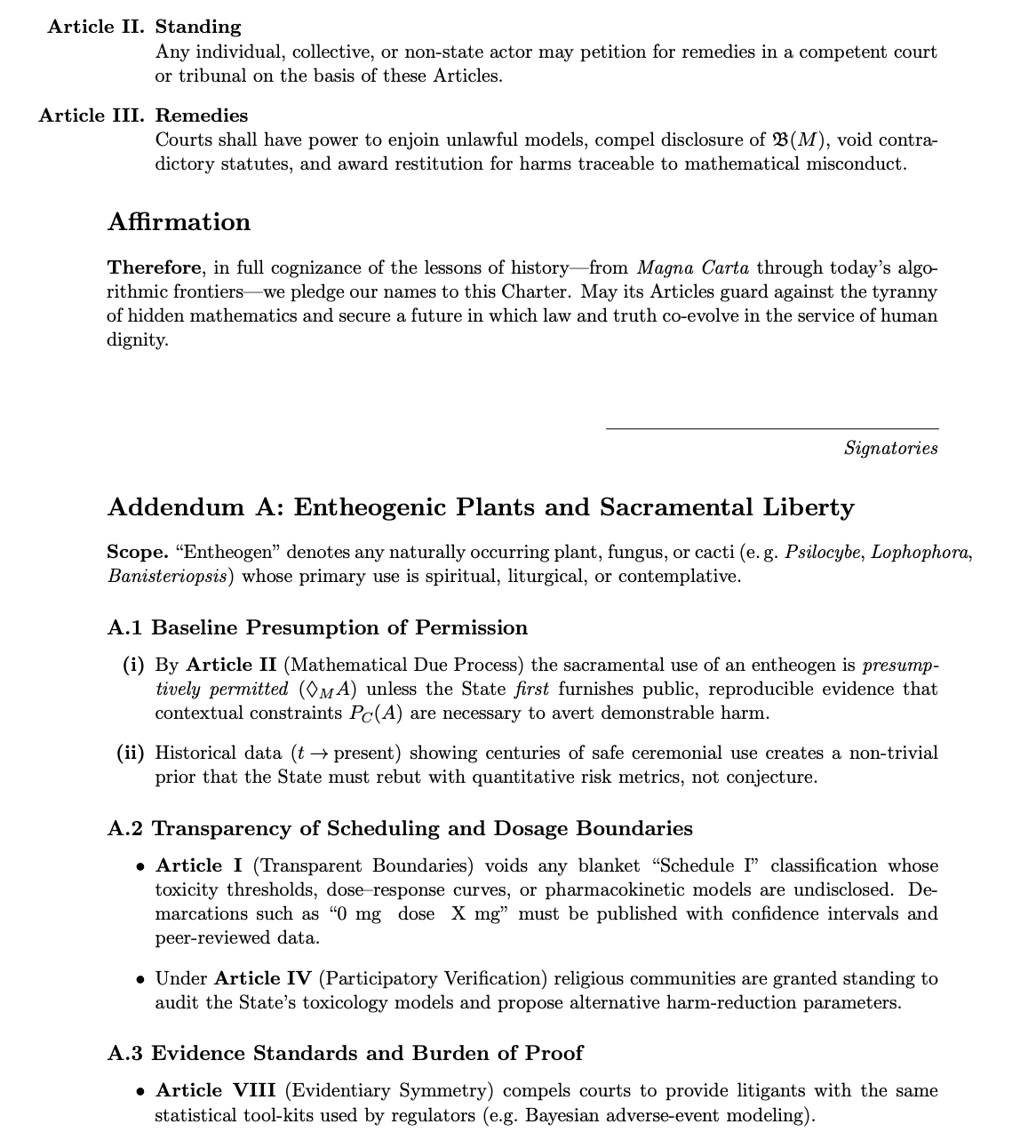
\item \textbf{Standing}\\
Any individual, collective, or non‑state actor may petition for
remedies in a competent court or tribunal on the basis of these
Articles.
\item \textbf{Remedies}\\
Courts shall have power to enjoin unlawful models, compel disclosure of
$\mathfrak{B}(M)$, void contradictory statutes, and award restitution
for harms traceable to mathematical misconduct.
\end{enumerate}
% -----------------------------------------------------------------
% Affirmation
% -----------------------------------------------------------------
\section*{Affirmation}
\noindent\textbf{Therefore}, in full cognizance of the lessons of
history—from \textit{Magna Carta} through today’s algorithmic frontiers—we
pledge our names to this Charter. May its Articles guard against the
tyranny of hidden mathematics and secure a future in which law and
truth co‑evolve in the service of human dignity.
\vspace{2em}
\begin{flushright}
\rule{0.4\linewidth}{0.4pt}\\
\emph{Signatories}
\end{flushright}
% ================================================================
% ADDENDUM — ENTHEOGENIC SACRAMENTS
% ================================================================
\section*{Addendum A: Entheogenic Plants and Sacramental Liberty}
\noindent\textbf{Scope.} “Entheogen” denotes any naturally occurring
plant, fungus, or cacti (e.\,g.\ \emph{Psilocybe}, \emph{Lophophora},
\emph{Banisteriopsis}) whose primary use is spiritual, liturgical, or
contemplative.
% -----------------------------------------------------------------
\subsection*{A.1 Baseline Presumption of Permission}
\begin{enumerate}
\item[\textbf{(i)}] By \textbf{Article II} (Mathematical Due Process)
the sacramental use of an entheogen is \emph{presumptively permitted}
(\(\Diamond_M A\)) unless the State \emph{first} furnishes public,
reproducible evidence that contextual constraints
\(P_C(A)\) are necessary to avert demonstrable harm.
\item[\textbf{(ii)}] Historical data (\(t\!\to\!\text{present}\))
showing centuries of safe ceremonial use
creates a non‑trivial prior that the State must rebut with
quantitative risk metrics, not conjecture.
\end{enumerate}
% -----------------------------------------------------------------
\subsection*{A.2 Transparency of Scheduling and Dosage Boundaries}
\begin{itemize}
\item \textbf{Article I} (Transparent Boundaries) voids
any blanket “Schedule I” classification whose toxicity thresholds,
dose–response curves, or pharmacokinetic models are undisclosed.
Demarcations such as “0 mg ≤ dose ≤ X mg” must be published with confidence
intervals and peer‑reviewed data.
\item Under \textbf{Article IV} (Participatory Verification) religious
communities are granted standing to audit the State’s toxicology models
and propose alternative harm‑reduction parameters.
\end{itemize}
% -----------------------------------------------------------------
\subsection*{A.3 Evidence Standards and Burden of Proof}
\begin{itemize}
\item \textbf{Article VIII} (Evidentiary Symmetry) compels courts to
provide litigants with the same statistical tool‑kits used by regulators
(e.g.\ Bayesian adverse‑event modeling).
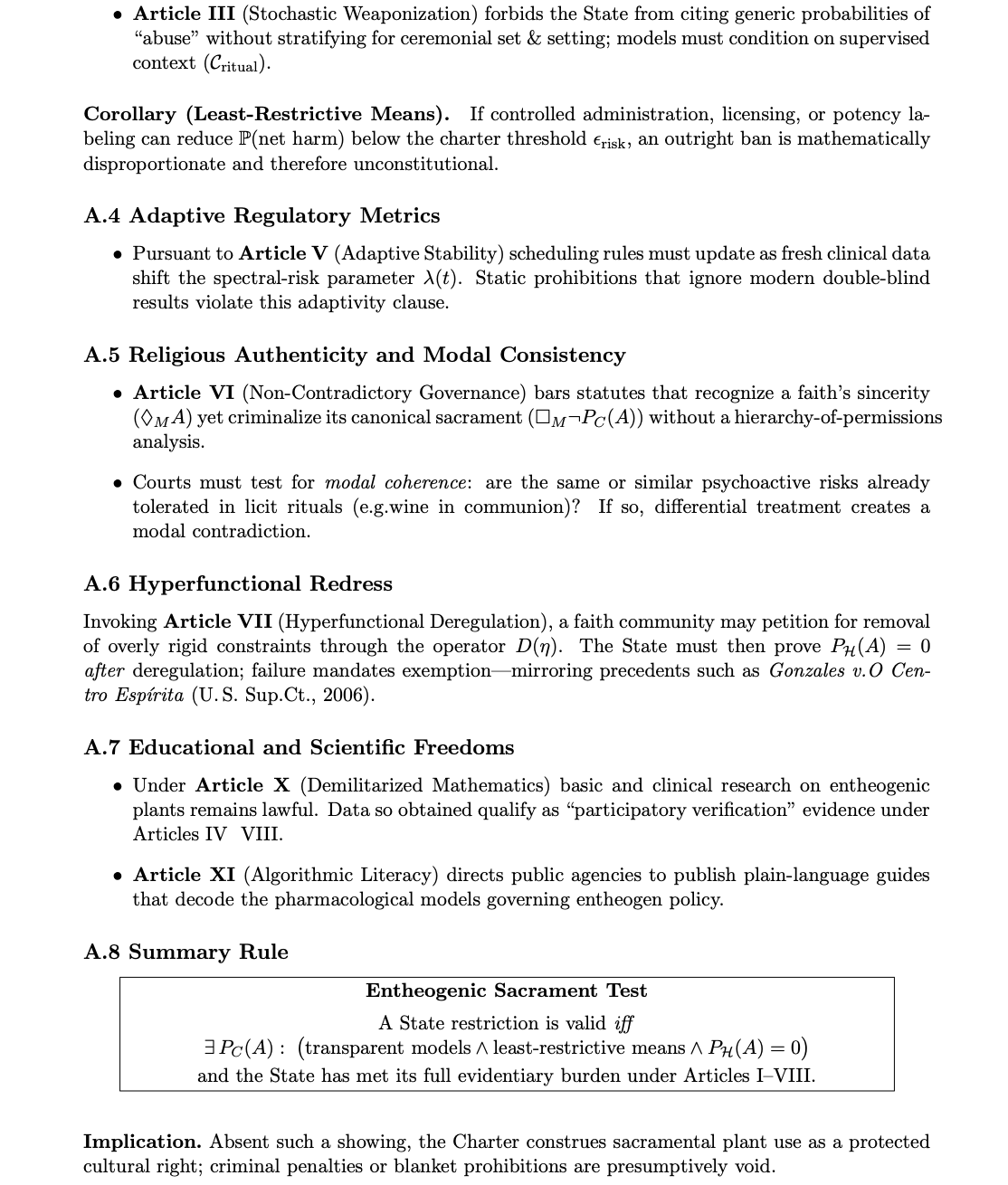
\item \textbf{Article III} (Stochastic Weaponization) forbids the State
from citing generic probabilities of “abuse” without stratifying for
ceremonial set \& setting; models must condition on supervised context
(\(\mathcal{C}_{\text{ritual}}\)).
\end{itemize}
\paragraph{Corollary (Least‑Restrictive Means).}
If controlled administration, licensing, or potency labeling can reduce
\(\mathbb{P}(\text{net harm})\) below the charter threshold
\(\epsilon_{\text{risk}}\), an outright ban is mathematically
disproportionate and therefore unconstitutional.
% -----------------------------------------------------------------
\subsection*{A.4 Adaptive Regulatory Metrics}
\begin{itemize}
\item Pursuant to \textbf{Article V} (Adaptive Stability) scheduling
rules must update as fresh clinical data shift the spectral‑risk
parameter \(\lambda(t)\). Static prohibitions that ignore modern
double‑blind results violate this adaptivity clause.
\end{itemize}
% -----------------------------------------------------------------
\subsection*{A.5 Religious Authenticity and Modal Consistency}
\begin{itemize}
\item \textbf{Article VI} (Non‑Contradictory Governance) bars statutes
that recognize a faith’s sincerity (\(\Diamond_M A\)) yet criminalize
its canonical sacrament (\(\Box_M\neg P_C(A)\)) without a
hierarchy‑of‑permissions analysis.
\item Courts must test for \emph{modal coherence}: are the same or
similar psychoactive risks already tolerated in licit rituals
(e.g.\ wine in communion)? If so, differential treatment creates a
modal contradiction.
\end{itemize}
% -----------------------------------------------------------------
\subsection*{A.6 Hyperfunctional Redress}
Invoking \textbf{Article VII} (Hyperfunctional Deregulation), a faith
community may petition for removal of overly rigid constraints
through the operator \(D(\eta)\). The State must then prove
\(P_{\mathcal H}(A)=0\) \emph{after} deregulation; failure mandates
exemption—mirroring precedents such as
\textit{Gonzales v.\ O Centro Espírita} (U.\,S.\ Sup.\ Ct., 2006).
% -----------------------------------------------------------------
\subsection*{A.7 Educational and Scientific Freedoms}
\begin{itemize}
\item Under \textbf{Article X} (Demilitarized Mathematics) basic and
clinical research on entheogenic plants remains lawful. Data so
obtained qualify as “participatory verification” evidence under
Articles IV & VIII.
\item \textbf{Article XI} (Algorithmic Literacy) directs public
agencies to publish plain‑language guides that decode the
pharmacological models governing entheogen policy.
\end{itemize}
% -----------------------------------------------------------------
\subsection*{A.8 Summary Rule}
\begin{center}
\fbox{\parbox{0.9\linewidth}{\centering
\textbf{Entheogenic Sacrament Test}\\[4pt]
A State restriction is valid \emph{iff}\\
\(\displaystyle
\exists\,P_C(A):\;
\bigl(
\text{transparent models} \land
\text{least‑restrictive means} \land
P_{\mathcal H}(A)=0
\bigr)\)
\\[2pt]
and the State has met its full evidentiary burden under Articles I–VIII.
}}
\end{center}
\vspace{1em}
\noindent\textbf{Implication.} Absent such a showing, the Charter
construes sacramental plant use as a protected cultural right; criminal
penalties or blanket prohibitions are presumptively void.
% ================================================================
% END ADDENDUM
% ================================================================
\end{document}

3
The Issue
\documentclass[11pt]{article}
\usepackage{geometry,amsmath,amssymb,hyperref,xcolor}
\geometry{margin=1in}
\hypersetup{colorlinks=true,linkcolor=blue,urlcolor=blue}
% ---------------------------
% Charter of Mathematical Integrity and Human Rights
% ---------------------------
\title{\bfseries THE CHARTER OF MATHEMATICAL INTEGRITY\\[2pt]AND HUMAN RIGHTS}
\date{Adopted this \today}
\author{Drafted by Parker Emmerson \& Collaborators}
\begin{document}\maketitle
\begin{center}\Large
\emph{“Rigour without justice is tyranny by theorem.”}
\end{center}\vspace{1em}
% -----------------------------------------------------------------
% Preamble
% -----------------------------------------------------------------
\section*{Preamble}
\noindent\textbf{Whereas} reasoned liberty demands that human laws be
constrained by truth, transparency, and mathematical coherence;
\noindent\textbf{Whereas} the unchecked weaponization of mathematics—
through opaque boundary models, stochastic sophistry, and codimension
over‑constraints—erodes unenumerated rights and subverts due process;
\noindent\textbf{Whereas} the Liberated System Hyperfunction Analog
(LSHA) and allied analytic frameworks reveal both the mechanisms of
abuse and the paths to redress;
\noindent\textbf{We, the undersigned People}, do ordain and establish
this Charter to secure sensible laws, emancipate epistemic authority,
and defend the inalienable dignity of every person.
% -----------------------------------------------------------------
% Articles
% -----------------------------------------------------------------
\section*{Articles}
\renewcommand{\labelenumi}{\textbf{Article \Roman{enumi}.}}
\begin{enumerate}
%-----------------------------
\item \textbf{Right to Transparent Boundaries}\\
No State shall enforce a jurisdictional, physical, digital, or economic
boundary whose definition is withheld from public scrutiny. Boundary
data~$\mathfrak{B}(M)$ must be open, peer‑verifiable, and auditable,
thereby nullifying claims grounded in epistemic opacity.
%-----------------------------
\item \textbf{Right to Mathematical Due Process}\\
Every person is presumed permitted (\textsc{Potentiation}) unless a
competent, neutral forum demonstrates---with reproducible math and
falsifiable evidence---that contextual constraints
$P_C(A)$ justly override that potentiation. The burden of proof lies
solely on the restricting party.
%-----------------------------
\item \textbf{Right against Stochastic Weaponization}\\
Probability models wielded to curtail liberty must publish priors,
datasets, and error bounds. When enforcement relies on
$\mathbb{P}(\mathcal N_t\to p)$, affected persons have standing to
contest the model’s assumptions, variance, and applicability.
%-----------------------------
\item \textbf{Right to Participatory Verification}\\
Citizens have an irrevocable liberty to participate in the verification
of any algorithm, theorem, or codified procedure that governs them. The
collective union $\bigcup_\alpha \mathfrak{B}_\alpha(M)$ shall carry
legal weight equal to, or greater than, any unilateral claim.
%-----------------------------
\item \textbf{Right to Adaptive Stability}\\
Legal constraints premised on “stability” must adopt adaptive metrics
($\lambda(t)$, $\delta(\theta)$) that evolve with empirical reality.
Static codimension rules that induce systemic fragility are hereby
prohibited.
%-----------------------------
\item \textbf{Right to Non‑Contradictory Governance}\\
No law shall simultaneously assert $\Diamond_M A$ (structural
possibility) and $\Box_M\neg P_C(A)$ (universal prohibition) without a
hierarchy of permissions that resolves the contradiction. Modal
liar clauses are void \emph{ab initio}.
%-----------------------------
\item \textbf{Right to Hyperfunctional Redress}\\
Individuals may invoke the deregulation operator
$D(\eta)=\eta-\Pi_{\text{rigid}}(\eta)$ to challenge overly
restrictive duties. Courts must show that $P_{\mathcal H}(A)=0$ even
\emph{after} such deregulation, else grant relief.
%-----------------------------
\item \textbf{Right to Evidentiary Symmetry}\\
All parties shall enjoy equal computational and statistical resources
to interrogate models presented as evidence. State secrecy over source
code, data, or mathematical derivations is incompatible with
adversarial justice.
%-----------------------------
\item \textbf{Right to Context‑Aware Permission}\\
Permissions shall be time‑, locale‑, and scale‑sensitive; the law must
recognize that $\Diamond_{M_t}A$ today may differ from $\Diamond_{M_{t+
\Delta}}A$ tomorrow. Blanket, timeless prohibitions grounded in
dynamic systems are disfavored.
%-----------------------------
\item \textbf{Right to Demilitarized Mathematics}\\
Pure research in mathematics shall not be criminalized. Conversely,
applied theorems that materially harm populations (e.g.\ targeting
algorithms) inherit the same scrutiny as conventional arms under
international humanitarian law.
%-----------------------------
\item \textbf{Right to Algorithmic Literacy}\\
States must foster universal education sufficient for citizens to
grasp the mathematical bases of their rights and obligations, ensuring
no populace is ruled by incomprehensible formulae.
%-----------------------------
\item \textbf{Right of Iterated Amendment}\\
Recognizing that knowledge grows, this Charter may be amended by a
two‑thirds consensus of verifying parties, provided every amendment
includes a mathematical impact statement and preserves the dignity of
the individual.
\end{enumerate}
% -----------------------------------------------------------------
% Enforcement & Ratification
% -----------------------------------------------------------------
\section*{Enforcement}
\begin{enumerate}
\item \textbf{Jurisdiction}\\
All signatory jurisdictions incorporate this Charter into domestic and
international law with equal supremacy.
\item \textbf{Standing}\\
Any individual, collective, or non‑state actor may petition for
remedies in a competent court or tribunal on the basis of these
Articles.
\item \textbf{Remedies}\\
Courts shall have power to enjoin unlawful models, compel disclosure of
$\mathfrak{B}(M)$, void contradictory statutes, and award restitution
for harms traceable to mathematical misconduct.
\end{enumerate}
% -----------------------------------------------------------------
% Affirmation
% -----------------------------------------------------------------
\section*{Affirmation}
\noindent\textbf{Therefore}, in full cognizance of the lessons of
history—from \textit{Magna Carta} through today’s algorithmic frontiers—we
pledge our names to this Charter. May its Articles guard against the
tyranny of hidden mathematics and secure a future in which law and
truth co‑evolve in the service of human dignity.
\vspace{2em}
\begin{flushright}
\rule{0.4\linewidth}{0.4pt}\\
\emph{Signatories}
\end{flushright}
% ================================================================
% ADDENDUM — ENTHEOGENIC SACRAMENTS
% ================================================================
\section*{Addendum A: Entheogenic Plants and Sacramental Liberty}
\noindent\textbf{Scope.} “Entheogen” denotes any naturally occurring
plant, fungus, or cacti (e.\,g.\ \emph{Psilocybe}, \emph{Lophophora},
\emph{Banisteriopsis}) whose primary use is spiritual, liturgical, or
contemplative.
% -----------------------------------------------------------------
\subsection*{A.1 Baseline Presumption of Permission}
\begin{enumerate}
\item[\textbf{(i)}] By \textbf{Article II} (Mathematical Due Process)
the sacramental use of an entheogen is \emph{presumptively permitted}
(\(\Diamond_M A\)) unless the State \emph{first} furnishes public,
reproducible evidence that contextual constraints
\(P_C(A)\) are necessary to avert demonstrable harm.
\item[\textbf{(ii)}] Historical data (\(t\!\to\!\text{present}\))
showing centuries of safe ceremonial use
creates a non‑trivial prior that the State must rebut with
quantitative risk metrics, not conjecture.
\end{enumerate}
% -----------------------------------------------------------------
\subsection*{A.2 Transparency of Scheduling and Dosage Boundaries}
\begin{itemize}
\item \textbf{Article I} (Transparent Boundaries) voids
any blanket “Schedule I” classification whose toxicity thresholds,
dose–response curves, or pharmacokinetic models are undisclosed.
Demarcations such as “0 mg ≤ dose ≤ X mg” must be published with confidence
intervals and peer‑reviewed data.
\item Under \textbf{Article IV} (Participatory Verification) religious
communities are granted standing to audit the State’s toxicology models
and propose alternative harm‑reduction parameters.
\end{itemize}
% -----------------------------------------------------------------
\subsection*{A.3 Evidence Standards and Burden of Proof}
\begin{itemize}
\item \textbf{Article VIII} (Evidentiary Symmetry) compels courts to
provide litigants with the same statistical tool‑kits used by regulators
(e.g.\ Bayesian adverse‑event modeling).
\item \textbf{Article III} (Stochastic Weaponization) forbids the State
from citing generic probabilities of “abuse” without stratifying for
ceremonial set \& setting; models must condition on supervised context
(\(\mathcal{C}_{\text{ritual}}\)).
\end{itemize}
\paragraph{Corollary (Least‑Restrictive Means).}
If controlled administration, licensing, or potency labeling can reduce
\(\mathbb{P}(\text{net harm})\) below the charter threshold
\(\epsilon_{\text{risk}}\), an outright ban is mathematically
disproportionate and therefore unconstitutional.
% -----------------------------------------------------------------
\subsection*{A.4 Adaptive Regulatory Metrics}
\begin{itemize}
\item Pursuant to \textbf{Article V} (Adaptive Stability) scheduling
rules must update as fresh clinical data shift the spectral‑risk
parameter \(\lambda(t)\). Static prohibitions that ignore modern
double‑blind results violate this adaptivity clause.
\end{itemize}
% -----------------------------------------------------------------
\subsection*{A.5 Religious Authenticity and Modal Consistency}
\begin{itemize}
\item \textbf{Article VI} (Non‑Contradictory Governance) bars statutes
that recognize a faith’s sincerity (\(\Diamond_M A\)) yet criminalize
its canonical sacrament (\(\Box_M\neg P_C(A)\)) without a
hierarchy‑of‑permissions analysis.
\item Courts must test for \emph{modal coherence}: are the same or
similar psychoactive risks already tolerated in licit rituals
(e.g.\ wine in communion)? If so, differential treatment creates a
modal contradiction.
\end{itemize}
% -----------------------------------------------------------------
\subsection*{A.6 Hyperfunctional Redress}
Invoking \textbf{Article VII} (Hyperfunctional Deregulation), a faith
community may petition for removal of overly rigid constraints
through the operator \(D(\eta)\). The State must then prove
\(P_{\mathcal H}(A)=0\) \emph{after} deregulation; failure mandates
exemption—mirroring precedents such as
\textit{Gonzales v.\ O Centro Espírita} (U.\,S.\ Sup.\ Ct., 2006).
% -----------------------------------------------------------------
\subsection*{A.7 Educational and Scientific Freedoms}
\begin{itemize}
\item Under \textbf{Article X} (Demilitarized Mathematics) basic and
clinical research on entheogenic plants remains lawful. Data so
obtained qualify as “participatory verification” evidence under
Articles IV & VIII.
\item \textbf{Article XI} (Algorithmic Literacy) directs public
agencies to publish plain‑language guides that decode the
pharmacological models governing entheogen policy.
\end{itemize}
% -----------------------------------------------------------------
\subsection*{A.8 Summary Rule}
\begin{center}
\fbox{\parbox{0.9\linewidth}{\centering
\textbf{Entheogenic Sacrament Test}\\[4pt]
A State restriction is valid \emph{iff}\\
\(\displaystyle
\exists\,P_C(A):\;
\bigl(
\text{transparent models} \land
\text{least‑restrictive means} \land
P_{\mathcal H}(A)=0
\bigr)\)
\\[2pt]
and the State has met its full evidentiary burden under Articles I–VIII.
}}
\end{center}
\vspace{1em}
\noindent\textbf{Implication.} Absent such a showing, the Charter
construes sacramental plant use as a protected cultural right; criminal
penalties or blanket prohibitions are presumptively void.
% ================================================================
% END ADDENDUM
% ================================================================
\end{document}
Petition Updates
Share this petition
Petition created on May 30, 2025