

The American First-Time Homebuyer Tax Credit Act
The Issue
Executive Summary
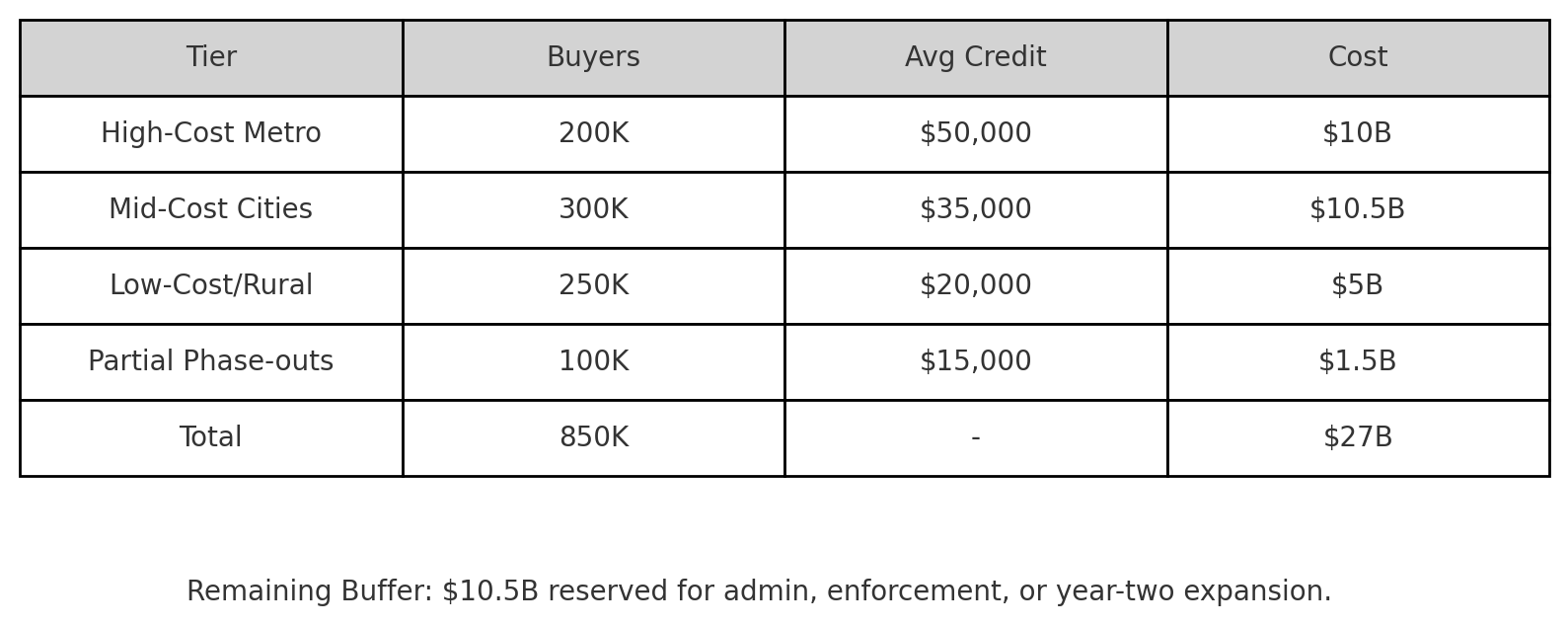
This proposal establishes a targeted, regionally adjusted federal tax credit of up to $50,000 for eligible first-time homebuyers. The credit is designed to increase homeownership, reduce generational wealth gaps, and stabilize housing markets, all while remaining fiscally responsible, capped at $37.5 billion per year, equivalent to the current ICE annual budget.
Background & Rationale
Homeownership remains the primary means of building intergenerational wealth in America. Yet, as of 2024:
· The average age of a first-time buyer hit an all-time high of 36.
· Black, Latino, and low-income families face increasing barriers to entry.
· Rising interest rates and limited housing stock have priced many out of the market entirely.
Meanwhile, existing federal support is either outdated or insufficient. This targeted tax credit offers a direct and modern solution.
Policy Proposal
Core Components:
1. Up to $50,000 tax credit for first-time homebuyers.
2. Regionally adjusted credit tiers to reflect local housing markets.
3. Income-based phase-outs to ensure funds go to those most in need.
4. Home price caps by ZIP code based on HUD and Fannie Mae guidelines.
5. Split disbursement: $25K at closing; $25K spread over five years.
6. Residency requirement: Must live in the home for 5 years to retain full credit.
7. Annual budget cap: $37.5 billion/year.
Fiscal Plan
Estimated Participation (Year One):
Benefits
- Equity: Narrows racial and generational wealth gaps.
- Flexibility: Allows regional variation without penalizing rural or low-cost areas.
- Growth: Boosts construction, retail, and local tax bases.
- Affordability: Keeps housing prices stable by limiting oversubsidization.
- Accountability: Annual cap ensures budget discipline.
Legislative Simplicity
This plan:
- Can be introduced as a standalone bill or as a housing amendment to an appropriations package.
- Leverages existing IRS infrastructure for distribution and verification.
- Builds on historical precedent (e.g., 2008–2010 first-time buyer credits).
- Requires no new agency—can operate under Treasury and HUD.
Conclusion
The American First-Time Homebuyer Tax Credit Act provides bold, equitable action on the housing crisis without expanding federal bureaucracy or overspending. Reallocating existing budgetary priorities—such as ICE's $37.5B budget—would allow the program to launch without new taxes or added deficits.
It’s a fiscally sound investment in American families, workers, and communities.

10
The Issue
Executive Summary
This proposal establishes a targeted, regionally adjusted federal tax credit of up to $50,000 for eligible first-time homebuyers. The credit is designed to increase homeownership, reduce generational wealth gaps, and stabilize housing markets, all while remaining fiscally responsible, capped at $37.5 billion per year, equivalent to the current ICE annual budget.
Background & Rationale
Homeownership remains the primary means of building intergenerational wealth in America. Yet, as of 2024:
· The average age of a first-time buyer hit an all-time high of 36.
· Black, Latino, and low-income families face increasing barriers to entry.
· Rising interest rates and limited housing stock have priced many out of the market entirely.
Meanwhile, existing federal support is either outdated or insufficient. This targeted tax credit offers a direct and modern solution.
Policy Proposal
Core Components:
1. Up to $50,000 tax credit for first-time homebuyers.
2. Regionally adjusted credit tiers to reflect local housing markets.
3. Income-based phase-outs to ensure funds go to those most in need.
4. Home price caps by ZIP code based on HUD and Fannie Mae guidelines.
5. Split disbursement: $25K at closing; $25K spread over five years.
6. Residency requirement: Must live in the home for 5 years to retain full credit.
7. Annual budget cap: $37.5 billion/year.
Fiscal Plan
Estimated Participation (Year One):
Benefits
- Equity: Narrows racial and generational wealth gaps.
- Flexibility: Allows regional variation without penalizing rural or low-cost areas.
- Growth: Boosts construction, retail, and local tax bases.
- Affordability: Keeps housing prices stable by limiting oversubsidization.
- Accountability: Annual cap ensures budget discipline.
Legislative Simplicity
This plan:
- Can be introduced as a standalone bill or as a housing amendment to an appropriations package.
- Leverages existing IRS infrastructure for distribution and verification.
- Builds on historical precedent (e.g., 2008–2010 first-time buyer credits).
- Requires no new agency—can operate under Treasury and HUD.
Conclusion
The American First-Time Homebuyer Tax Credit Act provides bold, equitable action on the housing crisis without expanding federal bureaucracy or overspending. Reallocating existing budgetary priorities—such as ICE's $37.5B budget—would allow the program to launch without new taxes or added deficits.
It’s a fiscally sound investment in American families, workers, and communities.
The Decision Makers


Petition Updates
Share this petition
Petition created on July 9, 2025