
Texas Bats Need Your Help!
The Issue
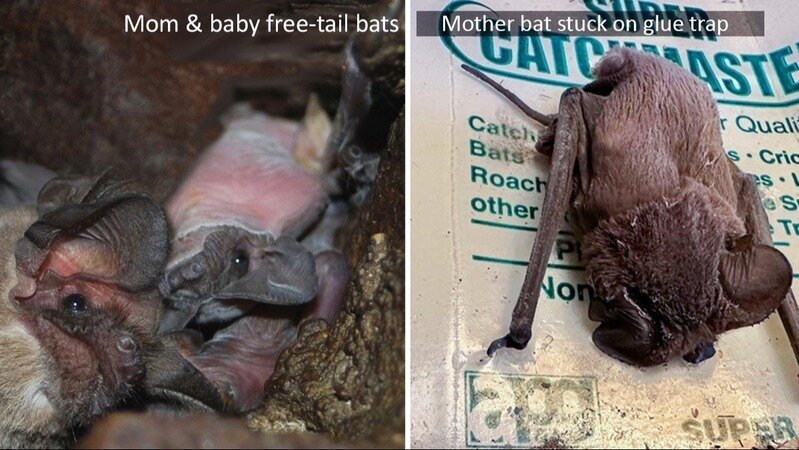
Bats play a crucial role in the Texas ecosystem, helping to control pests and providing Texas farmers and ranchers with over 1-billion dollars in pest control annually. Unfortunately, these vital animals are facing an alarming threat. Per current Texas law, any bat found within, or roosting on a building occupied by people, can be killed indiscriminately. This includes lost juvenile bats, mothers and babies, and even entire colonies roosting in a building. As the law does not dictate how bats may be killed, known methods of dispatch include being entombed, dying slowly while stuck to glue traps, and suffocating to death from fumigation.
Texas is currently home to 32 of the 47 bat species known to exist in the United States. Natural habitat for bats are being destroyed, and many have been killed out of fear and misunderstanding. Bats consume staggering numbers of insects nightly, primarily agricultural pests. The free-tailed bats of Central Texas alone consume close to 250 tons of insects on an average summer night. Nevertheless, these bats are in alarming decline. For example, a population decline in Eagle Creek Cave was documented from over 25 million in 1963 to just 30,000 six years later. Human disturbance and vandalism, especially during maternity season, is likely the single most serious causes of this decline. Grossly exaggerated media stories about rabies have led to the intentional destruction of large colonies. Sadly, Texas, boasting the most farms and ranches in the entire US, is one of only 7 states that offers no protection for bats during the maternity season. Because of this, entire nursery colonies are often destroyed when they roost in buildings.
We realize that humans should not share their living or work space with wildlife, but there are humane, safe and effective means to remove bats from buildings that do not involve killing. That is where we need your help. Our proposed draft of a critical new Bill to offer better protection for our Texas bats is below.
This is a call for change - a call to protect our bat species. We must urge the Texas state government to enforce protection laws for bats, implement educational programs to address common myths and misunderstandings about bats, and encourage practices that contribute to bat conservation. Our bats aren’t just wildlife; they’re a critical part of what makes life in Texas as we know it possible. Therefore, we urge all Texas residents to pressure our state authorities to take the much-needed action promptly.
Please sign this petition, and help us protect the bat populations of Texas!
****
Draft of the new bill
Sec. 63.101. PROTECTION OF BATS.
(a) It shall be unlawful to euthanize or kill a bat unless a bite or potential exposure to rabies has occurred. Bat colonies may be controlled in a building or structure by exclusion only. Exclusion shall not occur during maternity season from May 1 through August 31st. Bats shall not be controlled by any lethal methods including trapping and relocating, sticky traps, chemicals, aerosol animal repellents, ultrasonic devices, vacuum devices, gassing, sealing bats inside a roost or exterminating that may actually be dangerous to people and pets.
Except as provided by Subsection (b), no person may:
(1) hunt, kill, or confine a bat; or
(2) sell, offer for sale, purchase, offer to purchase, or possess after purchase a bat or any part of a bat, dead or alive.
(b) This section does not apply to:
(1) an animal control officer, a peace officer, a licensed pest control professional or a health official who captures a bat after a potential exposure to rabies has occurred
(2) a person who transports a bat for the purpose of laboratory testing if the bat has exposed or potentially exposed humans or domestic animals to rabies.
(3). a person who transports a bat to a permitted wildlife rescuer for the purpose of rehabilitation so long as the bat has had no contact with the public.
Sec. 63.101. DEFINITIONS. In this subchapter:
(1) “Exclusion device” means an approved device which allows escape from and blocks re-entry into a roost site located within a structure. This includes bat cones, PVC pipe and other cylinder shaped devices that allow escape without injury.
***
Current Texas law
Sec. 63.101. PROTECTION OF BATS. (a) Except as provided by Subsections (b) and (c), no person may:
(1) hunt a bat; or
(2) sell, offer for sale, purchase, offer to purchase, or possess after purchase a bat or any part of a bat, dead or alive.
(b) A bat may be removed or hunted if the bat is inside or on a building occupied by people.
(c) This section does not apply to:
(1) an animal control officer, a peace officer, or a health official who captures a bat that the officer or official considers injured or diseased;
(2) a person who transports a bat for the purpose of laboratory testing if the bat has exposed or potentially exposed humans or domestic animals to rabies; or
(3) a person who is licensed to provide pest control services.

2,186
The Issue
Bats play a crucial role in the Texas ecosystem, helping to control pests and providing Texas farmers and ranchers with over 1-billion dollars in pest control annually. Unfortunately, these vital animals are facing an alarming threat. Per current Texas law, any bat found within, or roosting on a building occupied by people, can be killed indiscriminately. This includes lost juvenile bats, mothers and babies, and even entire colonies roosting in a building. As the law does not dictate how bats may be killed, known methods of dispatch include being entombed, dying slowly while stuck to glue traps, and suffocating to death from fumigation.
Texas is currently home to 32 of the 47 bat species known to exist in the United States. Natural habitat for bats are being destroyed, and many have been killed out of fear and misunderstanding. Bats consume staggering numbers of insects nightly, primarily agricultural pests. The free-tailed bats of Central Texas alone consume close to 250 tons of insects on an average summer night. Nevertheless, these bats are in alarming decline. For example, a population decline in Eagle Creek Cave was documented from over 25 million in 1963 to just 30,000 six years later. Human disturbance and vandalism, especially during maternity season, is likely the single most serious causes of this decline. Grossly exaggerated media stories about rabies have led to the intentional destruction of large colonies. Sadly, Texas, boasting the most farms and ranches in the entire US, is one of only 7 states that offers no protection for bats during the maternity season. Because of this, entire nursery colonies are often destroyed when they roost in buildings.
We realize that humans should not share their living or work space with wildlife, but there are humane, safe and effective means to remove bats from buildings that do not involve killing. That is where we need your help. Our proposed draft of a critical new Bill to offer better protection for our Texas bats is below.
This is a call for change - a call to protect our bat species. We must urge the Texas state government to enforce protection laws for bats, implement educational programs to address common myths and misunderstandings about bats, and encourage practices that contribute to bat conservation. Our bats aren’t just wildlife; they’re a critical part of what makes life in Texas as we know it possible. Therefore, we urge all Texas residents to pressure our state authorities to take the much-needed action promptly.
Please sign this petition, and help us protect the bat populations of Texas!
****
Draft of the new bill
Sec. 63.101. PROTECTION OF BATS.
(a) It shall be unlawful to euthanize or kill a bat unless a bite or potential exposure to rabies has occurred. Bat colonies may be controlled in a building or structure by exclusion only. Exclusion shall not occur during maternity season from May 1 through August 31st. Bats shall not be controlled by any lethal methods including trapping and relocating, sticky traps, chemicals, aerosol animal repellents, ultrasonic devices, vacuum devices, gassing, sealing bats inside a roost or exterminating that may actually be dangerous to people and pets.
Except as provided by Subsection (b), no person may:
(1) hunt, kill, or confine a bat; or
(2) sell, offer for sale, purchase, offer to purchase, or possess after purchase a bat or any part of a bat, dead or alive.
(b) This section does not apply to:
(1) an animal control officer, a peace officer, a licensed pest control professional or a health official who captures a bat after a potential exposure to rabies has occurred
(2) a person who transports a bat for the purpose of laboratory testing if the bat has exposed or potentially exposed humans or domestic animals to rabies.
(3). a person who transports a bat to a permitted wildlife rescuer for the purpose of rehabilitation so long as the bat has had no contact with the public.
Sec. 63.101. DEFINITIONS. In this subchapter:
(1) “Exclusion device” means an approved device which allows escape from and blocks re-entry into a roost site located within a structure. This includes bat cones, PVC pipe and other cylinder shaped devices that allow escape without injury.
***
Current Texas law
Sec. 63.101. PROTECTION OF BATS. (a) Except as provided by Subsections (b) and (c), no person may:
(1) hunt a bat; or
(2) sell, offer for sale, purchase, offer to purchase, or possess after purchase a bat or any part of a bat, dead or alive.
(b) A bat may be removed or hunted if the bat is inside or on a building occupied by people.
(c) This section does not apply to:
(1) an animal control officer, a peace officer, or a health official who captures a bat that the officer or official considers injured or diseased;
(2) a person who transports a bat for the purpose of laboratory testing if the bat has exposed or potentially exposed humans or domestic animals to rabies; or
(3) a person who is licensed to provide pest control services.
Supporter Voices
Petition Updates
Share this petition
Petition created on July 17, 2024