“Tennessee’s Real Estate Regulators Are Failing Consumers — Demand They Act”
The Issue
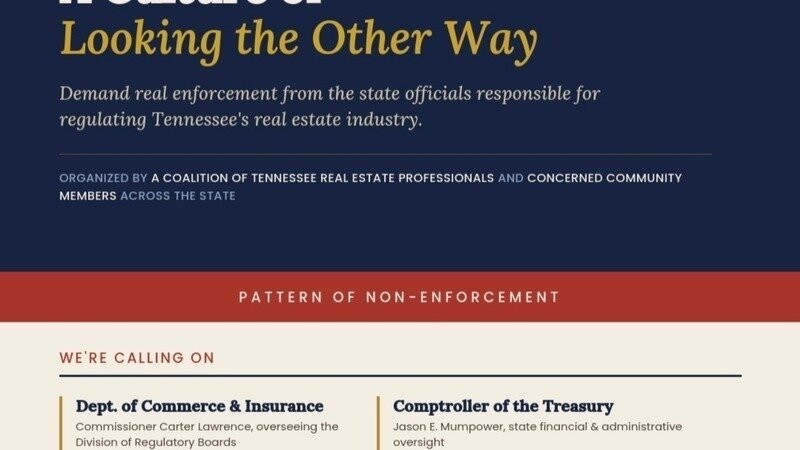
A Culture of Looking the Other Way: Demand Real Enforcement from Tennessee's Real Estate Regulators
Started by a coalition of Tennessee real estate professionals and concerned community members
This petition is about more than one licensee. It's about a regulatory culture that consistently lets serious misconduct get resolved as paperwork technicalities — while the public record shows something far more troubling underneath. We are using the case of licensee Justin Holder (License #300017) as the clearest available example of a pattern that Tennessee real estate professionals and consumers alike have watched play out for years: serious allegations go in, minor consent orders come out, and no one in a position of discretionary authority steps in to close the gap.
Members of the Tennessee real estate community have joined together with residents across the state to formally call on:
• TDCI Commissioner Carter Lawrence, who oversees the Division of Regulatory Boards under Tenn. Code Ann. § 4-3-1304(a) and to whom the Commission's day-to-day administrative functions report
• Tennessee Comptroller of the Treasury Jason E. Mumpower, whose office is charged with the financial integrity and administrative oversight of state government functions
• The members of the Tennessee Real Estate Commission— Chair Geoffrey Diaz, Vice-Chair Joan Smith, and Commissioners Kathy Tucker, Michael Gaughan, Jon Moffett, Joe Begley, Stacie Torbett, Steven Guinn, and Wyatt Rampy — who hold the discretionary regulatory authority to act on this record
• Tennessee Attorney General Jonathan Skrmetti, whose office has the authority to pursue further legal action where warranted
to conduct a full, structural reconsideration of how these cases are being handled — not just in Holder's file, but as a matter of policy going forward.
The Legal Authority That's Being Left on the Table
Under Tenn. Code Ann. § 4-3-1303, the Department of Commerce and Insurance is organized into three divisions, including the Division of Regulatory Boards. Under Tenn. Code Ann. § 4-3-1304(a), the Tennessee Real Estate Commission is attached to that division. The division administers the Commission's day-to-day administrative functions — but discretionary regulatory duties and powers are vested by law directly in the Commission's members, separate from and in addition to whatever a pending criminal case may resolve.
This petition does not ask TREC to preempt the criminal courts or rule on matters not yet adjudicated. It asks the Commission — and the state officials who oversee it — to exercise the independent discretionary authority the law already gives them, instead of quietly deferring to the narrowest possible technical violation every time a serious complaint crosses their desk.
Case Study: The Gap Between the Record and the Enforcement
Public records obtained through a Public Records Request document serious allegations against this licensee — including evidence that he used active client property listings (the "Smyrna house") to facilitate personal extramarital encounters. No version of a standard Tennessee Association of Realtors (TAR) Listing Agreement grants a licensee permission to convert a consumer's private home into a personal encounter space, and gaining entry under an ancillary title (such as "photographer") does not shield a licensee from liability. Holding a real estate license binds an individual to continuous standards of integrity, competency, and safe dealing at all times.
Across three open TREC case files, the violations actually charged bear almost no resemblance to the seriousness of the documented conduct:
Case No. 202504427
• Consumer allegation / documented evidence: Certified court filings and text logs proving a criminal DUI arrest, domestic stalking, and the unauthorized use of active consumer properties (the "Smyrna house") to conduct extramarital encounters.
• Actual violation enforced by TREC: A mailing delay only. The board did not address the trespassing or listing abuse, instead charging the licensee solely under T.C.A. § 62-13-313(a)(2) for failing to mail back his answer within 10 days.
• Penalty: $1,000.00 fine.
Case No. 202503704
• Consumer allegation / documented evidence: Marketing and representing himself as an active real estate broker on digital platforms while his license was strictly in "Retired" status.
• Actual violation enforced by TREC: Unlicensed practice — operating a real estate business without active credentials under T.C.A. § 62-13-301.
• Penalty: $1,000.00 fine and a Cease & Desist order.
Case No. 202503382
• Consumer allegation / documented evidence: Publicly running digital advertisements under the "PARKS" firm brand more than a year after his affiliation with that firm had ended.
• Actual violation enforced by TREC: An internet advertising infraction — failing to conspicuously display his true broker of record (Real Broker) on his digital media platform, under Rule 1260-02-.12(5)(a).
• Penalty: $250.00 fine.
Three files. Three technical fines totaling $2,250. Zero formal hearings. This is what "resolution" looks like under the current system — regardless of what the underlying record actually documents.
This Is a System Problem, Not an Isolated Incident
The most troubling part of this record isn't any single case — it's the structural incentives that produce this outcome again and again.
Under Rule 1260-01-.16, TREC enforces an absolute, mandatory 30-day window for a licensee to resolve an errors and omissions (E&O) insurance lapse. Miss that deadline, and the Consent Order option is automatically withdrawn — the case is referred straight to a formal contested case hearing before an Administrative Law Judge (ALJ). No discretion, no delay.
Compare that to how the system treats documented trespass, stalking, and deceptive marketing: those files are allowed to sit open for months or years, resolved eventually through the same informal consent-order process reserved for minor paperwork issues. There is no mandatory escalation trigger for serious misconduct — only for insurance paperwork.
Why does that asymmetry exist? A formal ALJ hearing carries real teeth: the state can assess actual hearing costs (ALJ billing, court reporter fees, transcript rates), private legal defense fees escalate into the thousands, and the state's attorneys are freed to pursue the maximum statutory penalty of $1,000.00 per day for continuous violations. A consent order lets a licensee avoid all of that — and lets the Commission close a file quickly and quietly. The financial and administrative incentives point the same direction: settle, don't escalate. The public record shows that's exactly what happens.
Compounding this, TREC instituted a rule change to its advertising-complaint process in October 2025 — at staff's request, approved without a rulemaking hearing — that gives staff the authority to offer a civil consent order without review by an experienced licensee (or former licensee) or by either of the two public members appointed to the Commission. A decision that used to require input from people with real industry and public-interest perspective can now be made by staff alone.
The Retirement Loophole
A review of the administrative disciplinary record shows no reference to any future restriction on this licensee's status beyond "Retired." As it stands, nothing prevents an arbitrary, portal-driven return to active practice — simply by filing a digital status-change form along with proof of E&O insurance. This isn't unique to one file; it's a structural gap that leaves the public exposed to future compliance lapses from any licensee who retires mid-complaint.
Rule 1260-01-.19 already requires that any applicant appearing before the Commission to obtain a license do so in the presence of a principal broker/managing agent — no such appearance may be heard without that presence. That same standard of in-person accountability should apply before any reactivation of a license tied to unresolved serious allegations, including consideration of the Fresh Start Act as applicable to a "Retired" licensee.
What We're Asking For
We are asking TDCI, the Comptroller's Office, the Tennessee Real Estate Commission, and the Attorney General's Office to:
1. Exercise TREC's full discretionary regulatory authority under Tenn. Code Ann. § 4-3-1304(a), independent of any pending criminal case, to evaluate documented allegations on their merits — not just the narrowest technical violation available.
2. Refer high-severity complaint files to formal contested case hearings before an Administrative Law Judge, rather than defaulting to informal consent orders.
3. Require an in-person appearance before the full Commission, consistent with Rule 1260-01-.19, before any license tied to unresolved serious allegations is reactivated.
4. Close the "Retired" status loophole that currently allows reactivation through a simple portal-driven status change with no review of underlying conduct.
5. Explain publicly, as a matter of policy, why high-risk complaint files are allowed to sit for months or years without a formal hearing, while E&O insurance lapses are subject to a strict, mandatory 30-day escalation rule under Rule 1260-01-.16 — and adopt a comparable escalation standard for serious misconduct complaints.
6. Reverse or review the October 2025 rule change to advertising-complaint procedures, restoring licensee and public-member review to consent-order decisions.
7. Conduct a broader audit of how consent orders are used across TREC's caseload, to determine how often serious allegations are being resolved as minor technical violations, and whether that pattern reflects a systemic failure to use the Commission's discretionary authority.
8. Determine whether further action by the Comptroller's Office or the Attorney General's Office is warranted, given both the specific conduct documented in this case and the broader pattern it may represent.
Who's Behind This
This petition reflects the shared concern of Tennessee real estate professionals who believe the integrity of the license they hold matters, alongside members of the public who believe consumer protection shouldn't stop at the courthouse door. Both groups agree: when a regulatory system consistently narrows serious allegations down to paperwork technicalities, it isn't just failing in one case — it's teaching every licensee in the state what they can get away with, and teaching every consumer that their complaints don't really matter.
Sign This Petition
By signing, you're telling TDCI, the Comptroller's Office, the Tennessee Real Estate Commission, and the Attorney General's Office that Tennesseans are watching — and that we expect the full weight of your regulatory and legal authority to be used when the record calls for it, in this case and every case like it.
This petition is submitted in support of a formal compliance petition filed with the Tennessee Real Estate Commission's Centralized Complaints Division regarding Case Records No. 202504427, No. 202503704, and No. 202503382.

182
The Issue
A Culture of Looking the Other Way: Demand Real Enforcement from Tennessee's Real Estate Regulators
Started by a coalition of Tennessee real estate professionals and concerned community members
This petition is about more than one licensee. It's about a regulatory culture that consistently lets serious misconduct get resolved as paperwork technicalities — while the public record shows something far more troubling underneath. We are using the case of licensee Justin Holder (License #300017) as the clearest available example of a pattern that Tennessee real estate professionals and consumers alike have watched play out for years: serious allegations go in, minor consent orders come out, and no one in a position of discretionary authority steps in to close the gap.
Members of the Tennessee real estate community have joined together with residents across the state to formally call on:
• TDCI Commissioner Carter Lawrence, who oversees the Division of Regulatory Boards under Tenn. Code Ann. § 4-3-1304(a) and to whom the Commission's day-to-day administrative functions report
• Tennessee Comptroller of the Treasury Jason E. Mumpower, whose office is charged with the financial integrity and administrative oversight of state government functions
• The members of the Tennessee Real Estate Commission— Chair Geoffrey Diaz, Vice-Chair Joan Smith, and Commissioners Kathy Tucker, Michael Gaughan, Jon Moffett, Joe Begley, Stacie Torbett, Steven Guinn, and Wyatt Rampy — who hold the discretionary regulatory authority to act on this record
• Tennessee Attorney General Jonathan Skrmetti, whose office has the authority to pursue further legal action where warranted
to conduct a full, structural reconsideration of how these cases are being handled — not just in Holder's file, but as a matter of policy going forward.
The Legal Authority That's Being Left on the Table
Under Tenn. Code Ann. § 4-3-1303, the Department of Commerce and Insurance is organized into three divisions, including the Division of Regulatory Boards. Under Tenn. Code Ann. § 4-3-1304(a), the Tennessee Real Estate Commission is attached to that division. The division administers the Commission's day-to-day administrative functions — but discretionary regulatory duties and powers are vested by law directly in the Commission's members, separate from and in addition to whatever a pending criminal case may resolve.
This petition does not ask TREC to preempt the criminal courts or rule on matters not yet adjudicated. It asks the Commission — and the state officials who oversee it — to exercise the independent discretionary authority the law already gives them, instead of quietly deferring to the narrowest possible technical violation every time a serious complaint crosses their desk.
Case Study: The Gap Between the Record and the Enforcement
Public records obtained through a Public Records Request document serious allegations against this licensee — including evidence that he used active client property listings (the "Smyrna house") to facilitate personal extramarital encounters. No version of a standard Tennessee Association of Realtors (TAR) Listing Agreement grants a licensee permission to convert a consumer's private home into a personal encounter space, and gaining entry under an ancillary title (such as "photographer") does not shield a licensee from liability. Holding a real estate license binds an individual to continuous standards of integrity, competency, and safe dealing at all times.
Across three open TREC case files, the violations actually charged bear almost no resemblance to the seriousness of the documented conduct:
Case No. 202504427
• Consumer allegation / documented evidence: Certified court filings and text logs proving a criminal DUI arrest, domestic stalking, and the unauthorized use of active consumer properties (the "Smyrna house") to conduct extramarital encounters.
• Actual violation enforced by TREC: A mailing delay only. The board did not address the trespassing or listing abuse, instead charging the licensee solely under T.C.A. § 62-13-313(a)(2) for failing to mail back his answer within 10 days.
• Penalty: $1,000.00 fine.
Case No. 202503704
• Consumer allegation / documented evidence: Marketing and representing himself as an active real estate broker on digital platforms while his license was strictly in "Retired" status.
• Actual violation enforced by TREC: Unlicensed practice — operating a real estate business without active credentials under T.C.A. § 62-13-301.
• Penalty: $1,000.00 fine and a Cease & Desist order.
Case No. 202503382
• Consumer allegation / documented evidence: Publicly running digital advertisements under the "PARKS" firm brand more than a year after his affiliation with that firm had ended.
• Actual violation enforced by TREC: An internet advertising infraction — failing to conspicuously display his true broker of record (Real Broker) on his digital media platform, under Rule 1260-02-.12(5)(a).
• Penalty: $250.00 fine.
Three files. Three technical fines totaling $2,250. Zero formal hearings. This is what "resolution" looks like under the current system — regardless of what the underlying record actually documents.
This Is a System Problem, Not an Isolated Incident
The most troubling part of this record isn't any single case — it's the structural incentives that produce this outcome again and again.
Under Rule 1260-01-.16, TREC enforces an absolute, mandatory 30-day window for a licensee to resolve an errors and omissions (E&O) insurance lapse. Miss that deadline, and the Consent Order option is automatically withdrawn — the case is referred straight to a formal contested case hearing before an Administrative Law Judge (ALJ). No discretion, no delay.
Compare that to how the system treats documented trespass, stalking, and deceptive marketing: those files are allowed to sit open for months or years, resolved eventually through the same informal consent-order process reserved for minor paperwork issues. There is no mandatory escalation trigger for serious misconduct — only for insurance paperwork.
Why does that asymmetry exist? A formal ALJ hearing carries real teeth: the state can assess actual hearing costs (ALJ billing, court reporter fees, transcript rates), private legal defense fees escalate into the thousands, and the state's attorneys are freed to pursue the maximum statutory penalty of $1,000.00 per day for continuous violations. A consent order lets a licensee avoid all of that — and lets the Commission close a file quickly and quietly. The financial and administrative incentives point the same direction: settle, don't escalate. The public record shows that's exactly what happens.
Compounding this, TREC instituted a rule change to its advertising-complaint process in October 2025 — at staff's request, approved without a rulemaking hearing — that gives staff the authority to offer a civil consent order without review by an experienced licensee (or former licensee) or by either of the two public members appointed to the Commission. A decision that used to require input from people with real industry and public-interest perspective can now be made by staff alone.
The Retirement Loophole
A review of the administrative disciplinary record shows no reference to any future restriction on this licensee's status beyond "Retired." As it stands, nothing prevents an arbitrary, portal-driven return to active practice — simply by filing a digital status-change form along with proof of E&O insurance. This isn't unique to one file; it's a structural gap that leaves the public exposed to future compliance lapses from any licensee who retires mid-complaint.
Rule 1260-01-.19 already requires that any applicant appearing before the Commission to obtain a license do so in the presence of a principal broker/managing agent — no such appearance may be heard without that presence. That same standard of in-person accountability should apply before any reactivation of a license tied to unresolved serious allegations, including consideration of the Fresh Start Act as applicable to a "Retired" licensee.
What We're Asking For
We are asking TDCI, the Comptroller's Office, the Tennessee Real Estate Commission, and the Attorney General's Office to:
1. Exercise TREC's full discretionary regulatory authority under Tenn. Code Ann. § 4-3-1304(a), independent of any pending criminal case, to evaluate documented allegations on their merits — not just the narrowest technical violation available.
2. Refer high-severity complaint files to formal contested case hearings before an Administrative Law Judge, rather than defaulting to informal consent orders.
3. Require an in-person appearance before the full Commission, consistent with Rule 1260-01-.19, before any license tied to unresolved serious allegations is reactivated.
4. Close the "Retired" status loophole that currently allows reactivation through a simple portal-driven status change with no review of underlying conduct.
5. Explain publicly, as a matter of policy, why high-risk complaint files are allowed to sit for months or years without a formal hearing, while E&O insurance lapses are subject to a strict, mandatory 30-day escalation rule under Rule 1260-01-.16 — and adopt a comparable escalation standard for serious misconduct complaints.
6. Reverse or review the October 2025 rule change to advertising-complaint procedures, restoring licensee and public-member review to consent-order decisions.
7. Conduct a broader audit of how consent orders are used across TREC's caseload, to determine how often serious allegations are being resolved as minor technical violations, and whether that pattern reflects a systemic failure to use the Commission's discretionary authority.
8. Determine whether further action by the Comptroller's Office or the Attorney General's Office is warranted, given both the specific conduct documented in this case and the broader pattern it may represent.
Who's Behind This
This petition reflects the shared concern of Tennessee real estate professionals who believe the integrity of the license they hold matters, alongside members of the public who believe consumer protection shouldn't stop at the courthouse door. Both groups agree: when a regulatory system consistently narrows serious allegations down to paperwork technicalities, it isn't just failing in one case — it's teaching every licensee in the state what they can get away with, and teaching every consumer that their complaints don't really matter.
Sign This Petition
By signing, you're telling TDCI, the Comptroller's Office, the Tennessee Real Estate Commission, and the Attorney General's Office that Tennesseans are watching — and that we expect the full weight of your regulatory and legal authority to be used when the record calls for it, in this case and every case like it.
This petition is submitted in support of a formal compliance petition filed with the Tennessee Real Estate Commission's Centralized Complaints Division regarding Case Records No. 202504427, No. 202503704, and No. 202503382.
Petition Updates
Share this petition
Petition created on August 11, 2026