

Tell Whole Foods: Feed Us Food - Not Plastic! Scrap the Plastic Caps
The Issue
This photo clearly shows the plastic caps inside the stomach of an albatross.
According to the Center for Biological Diversity, “Every year, billions of pounds of plastic end up in the world's oceans.”
What does this have to do with Whole Foods?
On the front of the Whole Foods web page, it says: “Our purpose is to nourish people and the planet.” They also claim to be "Stewards of the Environment." So let’s ask Whole Foods this: Why are you FEEDING US PLASTIC?
Whole Foods also writes: “We’re committed to reducing single-use plastics in our stores because it benefits our environment, customers, team members and suppliers.” But where is the reduction?
We don’t see it.
We see plastic.
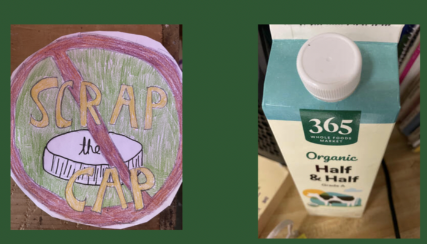
Who are we? We are the KEEP Club. KEEP stands for Kids Expect Environmental Protection.
We are an environmental group of 4th-8th graders based in Brookline, MA.
In March 2026 we did another audit of our local Whole Foods store, and what we saw does NOT match their pledge.
The Whole Foods brand '365' is sending plastics into our earth and oceans 365 days a year. Over 50% of whole foods products have plastic packaging. If Whole Foods changes this, their carbon footprint will improve and so will our earth.
- According to the Conservation Law Foundation, the neighborhoods where plastics are made are being poisoned by the process of ‘cracking’ plastic. They reported that global plastic production is drastically increasing – up from 1.5 million metric tons in 1950 to about 367 million metric tons in 2020.
- The World Wildlife Fund shows that nearly 90% of marine species are now affected by plastic contamination.
- Their reports also show that 90% of marine birds and 52% of turtles are filled with plastic.
- And now, because we are at the top of the food chain, plastic is getting into us.
- New scientific studies show that a single liter of bottled water can contain nearly 250,000 tiny plastic fragments. These are called nanoplastics, and they are so small they can enter our bloodstream and lodge in our heart and brain.
- Most recycling machines cannot process loose caps, so they almost always end up in landfills or the ocean, even when we try to recycle them.
- The plastic cap is one of the deadliest forms of ocean trash. Because they are small and float, they are easily mistaken for food by birds and sea turtles. You can see this in the trash floating in our Charles River and most places you go.
We know things cannot change all at once. So let’s start with the plastic cap. If Whole Foods wants to "set the standards of excellence," they must stop using packaging that poisons the planet. Tell Whole Foods: Feed us food. NOT PLASTIC! Scrap the cap.
P.S. Please visit our other petition: Tag, you’re not it- Keep the earth in balance- New Balance!

5,529
The Issue
This photo clearly shows the plastic caps inside the stomach of an albatross.
According to the Center for Biological Diversity, “Every year, billions of pounds of plastic end up in the world's oceans.”
What does this have to do with Whole Foods?
On the front of the Whole Foods web page, it says: “Our purpose is to nourish people and the planet.” They also claim to be "Stewards of the Environment." So let’s ask Whole Foods this: Why are you FEEDING US PLASTIC?
Whole Foods also writes: “We’re committed to reducing single-use plastics in our stores because it benefits our environment, customers, team members and suppliers.” But where is the reduction?
We don’t see it.
We see plastic.
Who are we? We are the KEEP Club. KEEP stands for Kids Expect Environmental Protection.
We are an environmental group of 4th-8th graders based in Brookline, MA.
In March 2026 we did another audit of our local Whole Foods store, and what we saw does NOT match their pledge.
The Whole Foods brand '365' is sending plastics into our earth and oceans 365 days a year. Over 50% of whole foods products have plastic packaging. If Whole Foods changes this, their carbon footprint will improve and so will our earth.
- According to the Conservation Law Foundation, the neighborhoods where plastics are made are being poisoned by the process of ‘cracking’ plastic. They reported that global plastic production is drastically increasing – up from 1.5 million metric tons in 1950 to about 367 million metric tons in 2020.
- The World Wildlife Fund shows that nearly 90% of marine species are now affected by plastic contamination.
- Their reports also show that 90% of marine birds and 52% of turtles are filled with plastic.
- And now, because we are at the top of the food chain, plastic is getting into us.
- New scientific studies show that a single liter of bottled water can contain nearly 250,000 tiny plastic fragments. These are called nanoplastics, and they are so small they can enter our bloodstream and lodge in our heart and brain.
- Most recycling machines cannot process loose caps, so they almost always end up in landfills or the ocean, even when we try to recycle them.
- The plastic cap is one of the deadliest forms of ocean trash. Because they are small and float, they are easily mistaken for food by birds and sea turtles. You can see this in the trash floating in our Charles River and most places you go.
We know things cannot change all at once. So let’s start with the plastic cap. If Whole Foods wants to "set the standards of excellence," they must stop using packaging that poisons the planet. Tell Whole Foods: Feed us food. NOT PLASTIC! Scrap the cap.
P.S. Please visit our other petition: Tag, you’re not it- Keep the earth in balance- New Balance!
Supporter Voices
Petition Updates
Share this petition
Petition created on February 10, 2023