

Tell Our Premier That New Homeowners Shouldn’t Pay Higher Property Taxes!
The Issue
Young people are struggling in Canada to enter the real estate market and realize a dream of home ownership. And right now in Nova Scotia, home buyers are paying higher property taxes than their neighbours just because they are not long time owners.
Traditionally, Canadian municipalities charge property taxes based on a market value system. However, since 2005, Nova Scotia has essentially rendered the market value system useless as capped properties are not based on their market value, but increase annually only by the Consumer Price Index (CPI). New and recent home buyers do not qualify for the CAP and pay taxes based on their property’s full market value and at an inflated tax rate.
Nova Scotia is the only province in Canada to tax property owners based on a Capped Assessment System (CAP) rather than a market value system. They do not allow municipalities to opt out of this system, despite the advocacy against the CAP by many municipalities due to its inequity. The provincial government and other stakeholders have received multiple in-depth reports over the past two decades recommending the phasing out of the CAP and have continued to ignore the recommendations. It has been controversial since its inception.
Most recently, in 2020, the Nova Scotia Federation of Municipalities commissioned a third party report and interactive map that demonstrated the inequity, and showed its negative consequences on many Nova Scotians, particularly on new homebuyers, recent home buyers, and renters. But because the tax system is misunderstood by many, all three provincial party leaders decided to leave it as is, rather than risk any potential political consequences of making change.
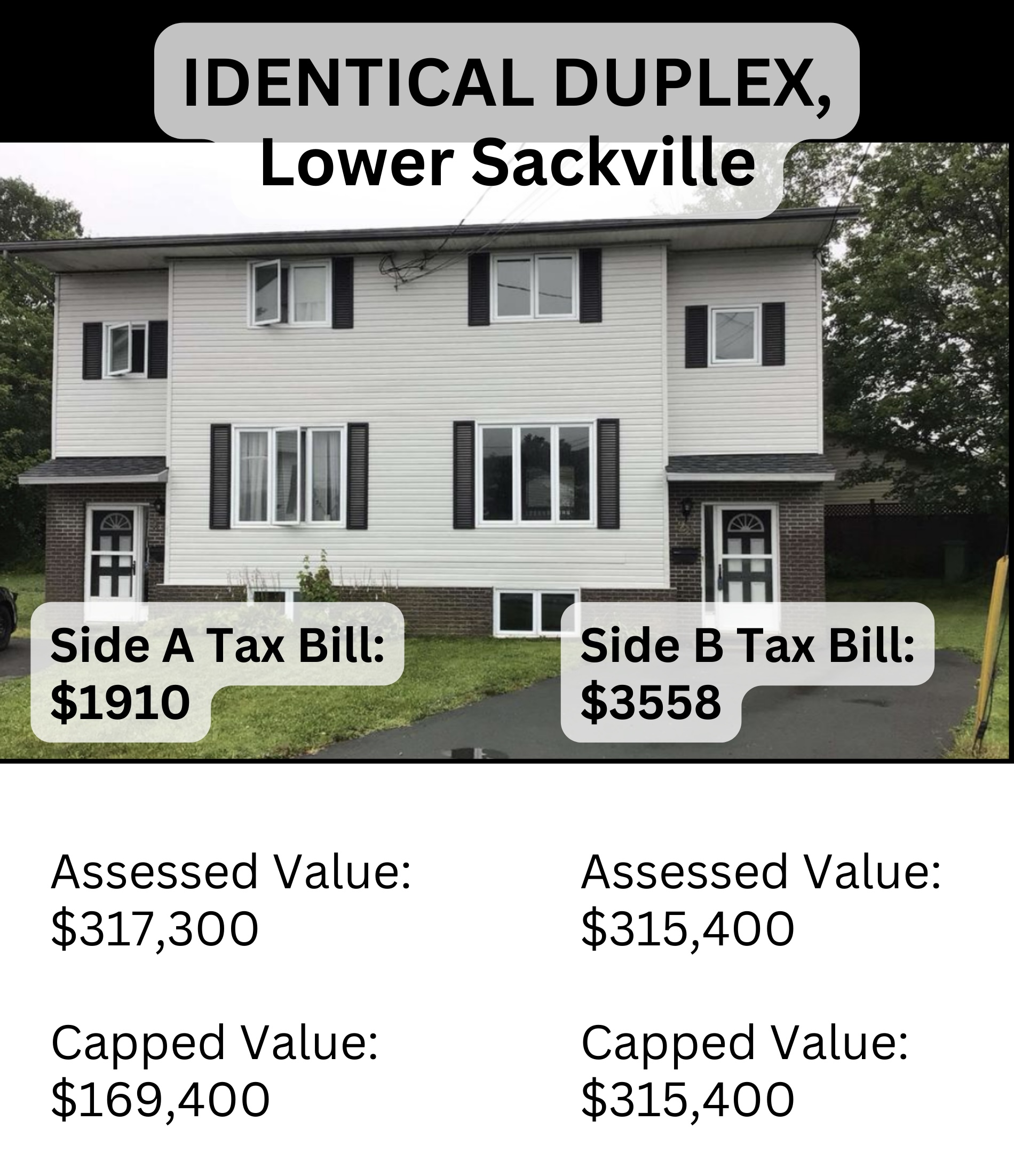
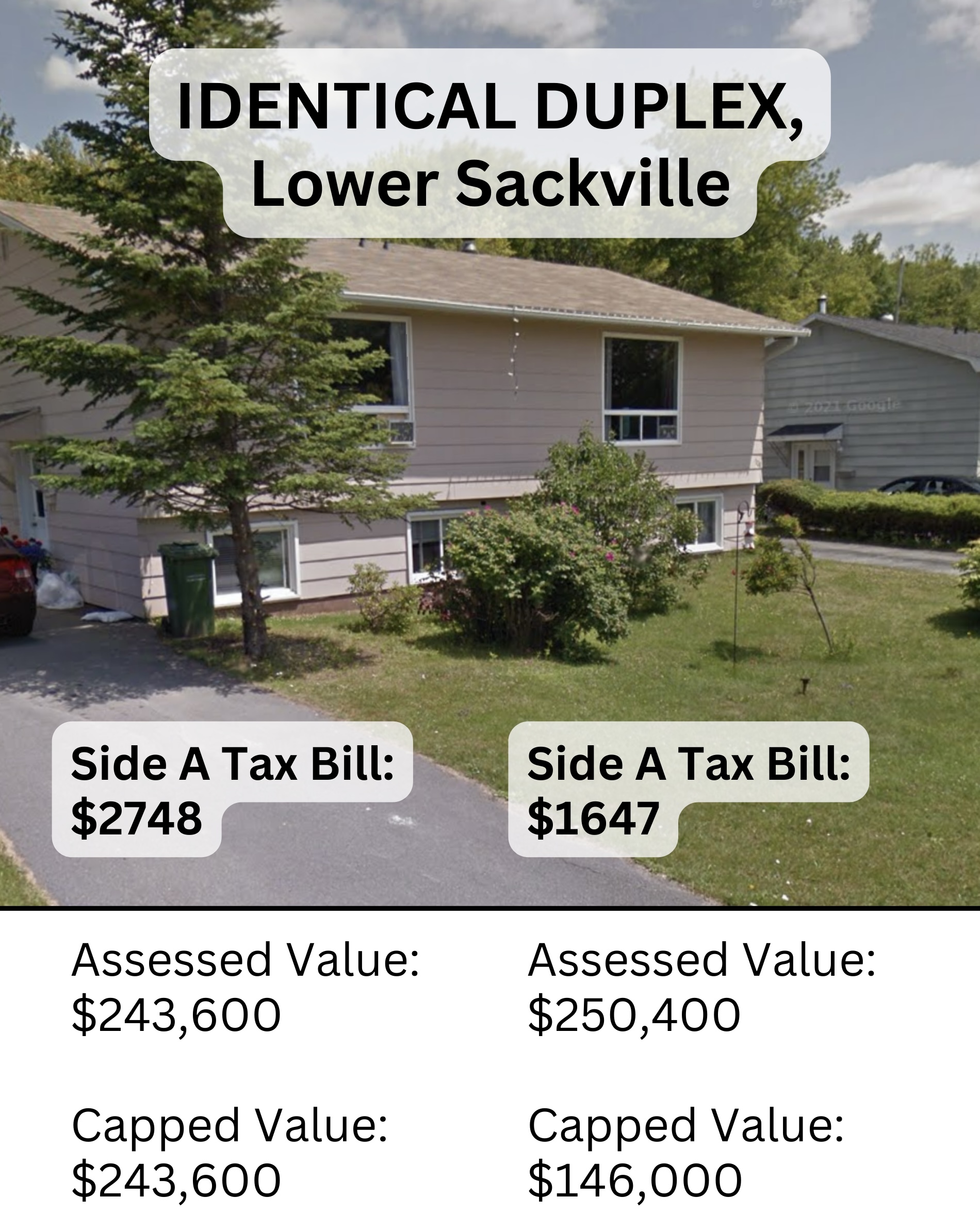
This means that new and recent home buyers are paying disproportionately higher property taxes than other property owners. They are subsidizing long term property owners, and in particular property owners who have seen the most growth in property value. For context, this means that identical homes on the same street are all charged different property taxes. You could move into one side of an identical duplex and pay double the taxes of your neighbour because you bought it at a time of higher market value, even though both homes have an equal market value today.
There are multimillion dollar homes saving tens of thousands of dollars each year as their property increases in value by millions, and every dollar they save is paid by someone else. This distorted tax base means that the tax burden is shifted around to other more recent property owners, and the tax rate for every municipality is artificially inflated to a higher rate. Because apartment buildings over four units do not qualify for the CAP, it also means that tenants are making up for landlords’ higher taxes in the form of increased rent payments.
New home buyers are already facing enough challenges, from inflated housing prices, to high interest rates, and a general lack of homes for sale (or rentals). This is just another barrier to home ownership that is within the power of our province to influence. Targeted tax relief programs including property tax deferrals and rebates would be more effective and equitable if they are available to the most vulnerable including low income households, seniors and the disabled rather than offering tax discounts to the wealthy and having new home buyers subsidize them.
To read the report from the NSFM from 2020, click here: https://mountainmath.ca/ns_cap_report.pdf
For a more detailed explanation of the CAP, see here: https://vm.tiktok.com/ZMMbxo6d6/
See below examples of the inequity in this system:
These duplex properties pay different tax amounts. Side B moved in last year, paying a premium for the property after market values went up. Now they pay nearly double the taxes of Side A in addition to likely having a larger mortgage payment.
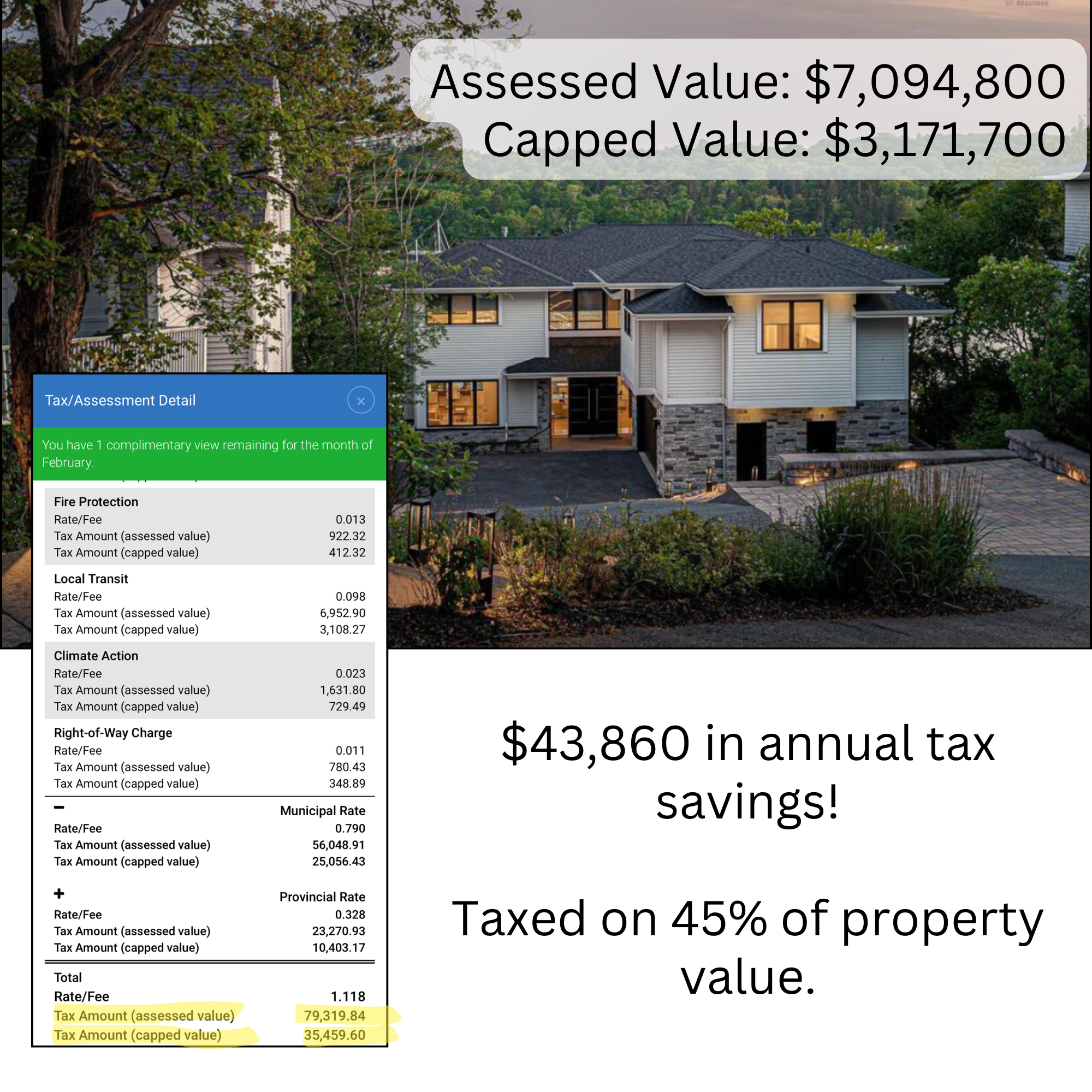
This home on the Northwest Arm has a market value of over $7 million. The property has seen a large increase in market value yet is only paying taxes on 45% of the assessed value - seeing a savings in 2024 of nearly $44,000.

20
The Issue
Young people are struggling in Canada to enter the real estate market and realize a dream of home ownership. And right now in Nova Scotia, home buyers are paying higher property taxes than their neighbours just because they are not long time owners.
Traditionally, Canadian municipalities charge property taxes based on a market value system. However, since 2005, Nova Scotia has essentially rendered the market value system useless as capped properties are not based on their market value, but increase annually only by the Consumer Price Index (CPI). New and recent home buyers do not qualify for the CAP and pay taxes based on their property’s full market value and at an inflated tax rate.
Nova Scotia is the only province in Canada to tax property owners based on a Capped Assessment System (CAP) rather than a market value system. They do not allow municipalities to opt out of this system, despite the advocacy against the CAP by many municipalities due to its inequity. The provincial government and other stakeholders have received multiple in-depth reports over the past two decades recommending the phasing out of the CAP and have continued to ignore the recommendations. It has been controversial since its inception.
Most recently, in 2020, the Nova Scotia Federation of Municipalities commissioned a third party report and interactive map that demonstrated the inequity, and showed its negative consequences on many Nova Scotians, particularly on new homebuyers, recent home buyers, and renters. But because the tax system is misunderstood by many, all three provincial party leaders decided to leave it as is, rather than risk any potential political consequences of making change.
This means that new and recent home buyers are paying disproportionately higher property taxes than other property owners. They are subsidizing long term property owners, and in particular property owners who have seen the most growth in property value. For context, this means that identical homes on the same street are all charged different property taxes. You could move into one side of an identical duplex and pay double the taxes of your neighbour because you bought it at a time of higher market value, even though both homes have an equal market value today.
There are multimillion dollar homes saving tens of thousands of dollars each year as their property increases in value by millions, and every dollar they save is paid by someone else. This distorted tax base means that the tax burden is shifted around to other more recent property owners, and the tax rate for every municipality is artificially inflated to a higher rate. Because apartment buildings over four units do not qualify for the CAP, it also means that tenants are making up for landlords’ higher taxes in the form of increased rent payments.
New home buyers are already facing enough challenges, from inflated housing prices, to high interest rates, and a general lack of homes for sale (or rentals). This is just another barrier to home ownership that is within the power of our province to influence. Targeted tax relief programs including property tax deferrals and rebates would be more effective and equitable if they are available to the most vulnerable including low income households, seniors and the disabled rather than offering tax discounts to the wealthy and having new home buyers subsidize them.
To read the report from the NSFM from 2020, click here: https://mountainmath.ca/ns_cap_report.pdf
For a more detailed explanation of the CAP, see here: https://vm.tiktok.com/ZMMbxo6d6/
See below examples of the inequity in this system:
These duplex properties pay different tax amounts. Side B moved in last year, paying a premium for the property after market values went up. Now they pay nearly double the taxes of Side A in addition to likely having a larger mortgage payment.
This home on the Northwest Arm has a market value of over $7 million. The property has seen a large increase in market value yet is only paying taxes on 45% of the assessed value - seeing a savings in 2024 of nearly $44,000.
Petition Updates
Share this petition
Petition created on April 25, 2024