Tell OpenAI: Give ALL Business-Tier Users Control of Their Data!

Tell OpenAI: Give ALL Business-Tier Users Control of Their Data!
The Issue
To: OpenAI Leadership, The U.S Federal Trade Commission, and Members of the US Congress
A premium subscription to retain Intellectual Property privileges shouldn't mean less access to data for businesses and business owners.
The Promise vs. The Reality
Businesses that choose to adopt Large Language Models (LLMs), like ChatGPT, as part of their workflow may find themselves worried about protecting their Intellectual Property, retaining rights to their data, and preventing it from being used to train other models.
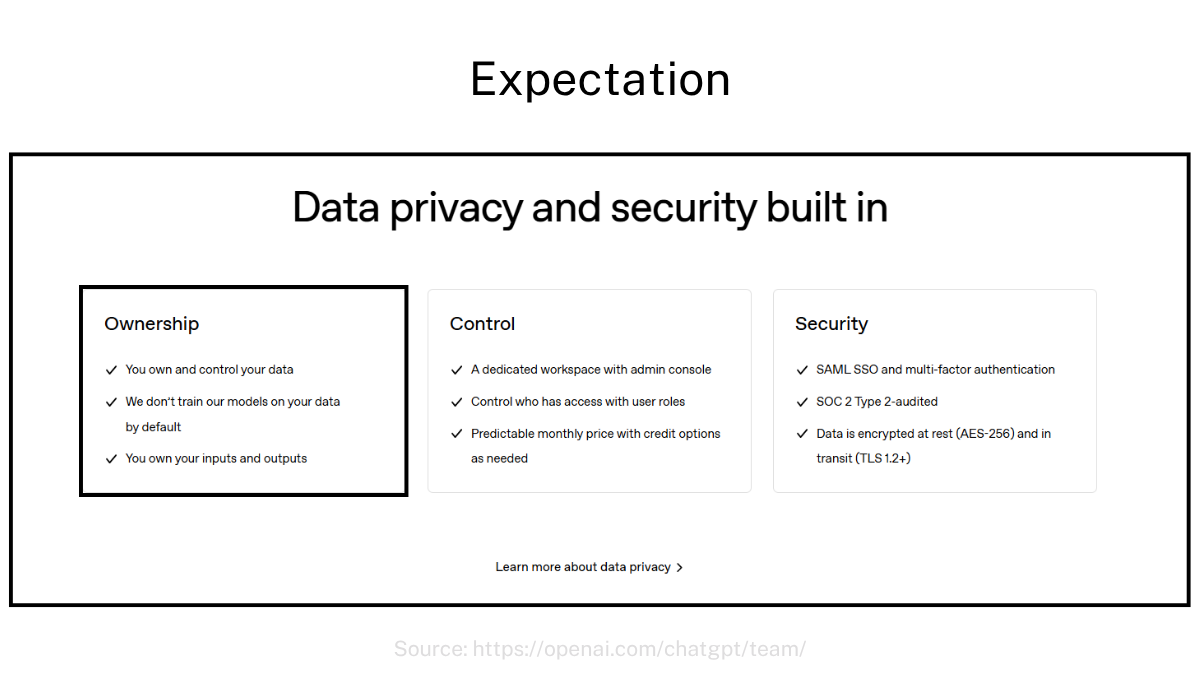
In exchange for a Business-tier subscription fee, OpenAI promises that, "By default, we do not use business data from ChatGPT Enterprise, ChatGPT Edu, ChatGPT Team, or our API platform—including inputs or outputs—for training or improving our models." But there is a hidden cost to opting out of having this data excluded from the training dataset and a subtext that reads: "If we can't use your data, neither can you."
As a result, Team users, and even their account administrators, are unable to export their data, while free-tier users, whose data is used to train ChatGPT, can access their data easily.
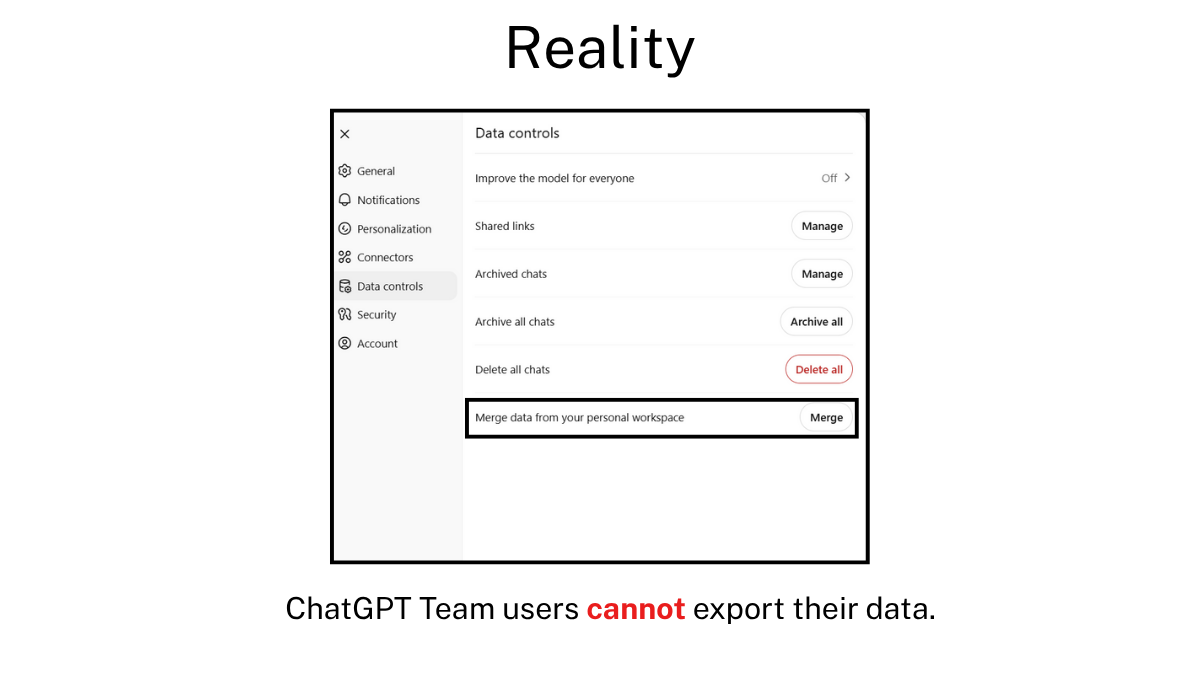
Those who are members of ChatGPT Enterprise plans have to go through a few more steps, but they do actually have access to their data.
ChatGPT's Solutions
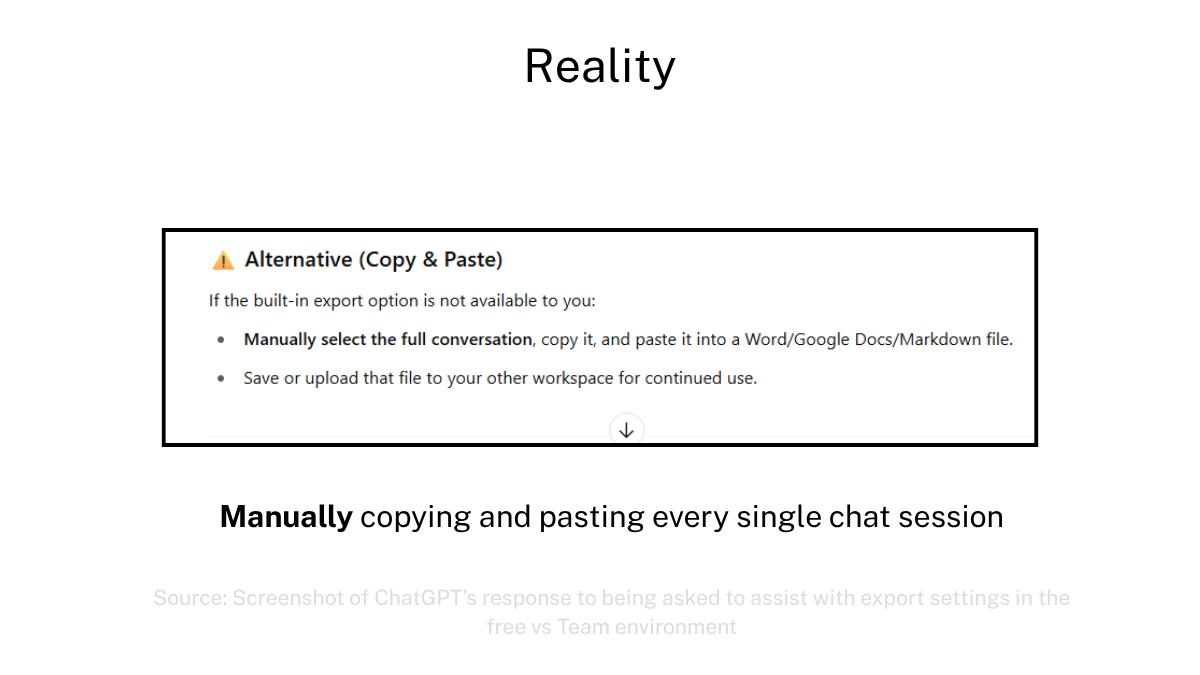
At some point, ChatGPT lost its export functionality in individual chat sessions.
Now, the only solution is for the humans, who are using AI to streamline workflows, to manually copy and paste every single chat session into a document.
Let's Recap
- ChatGPT's free tier users can export their data with one click.
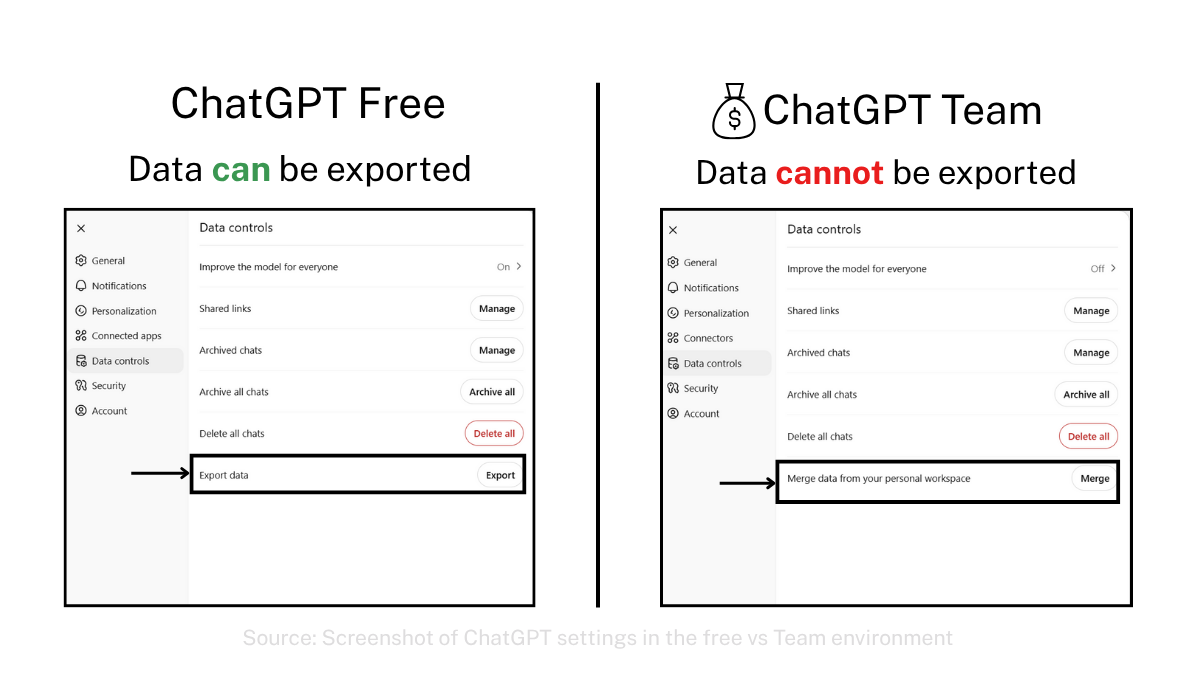
- Business-tier users on the "Team" plan cannot export their data.
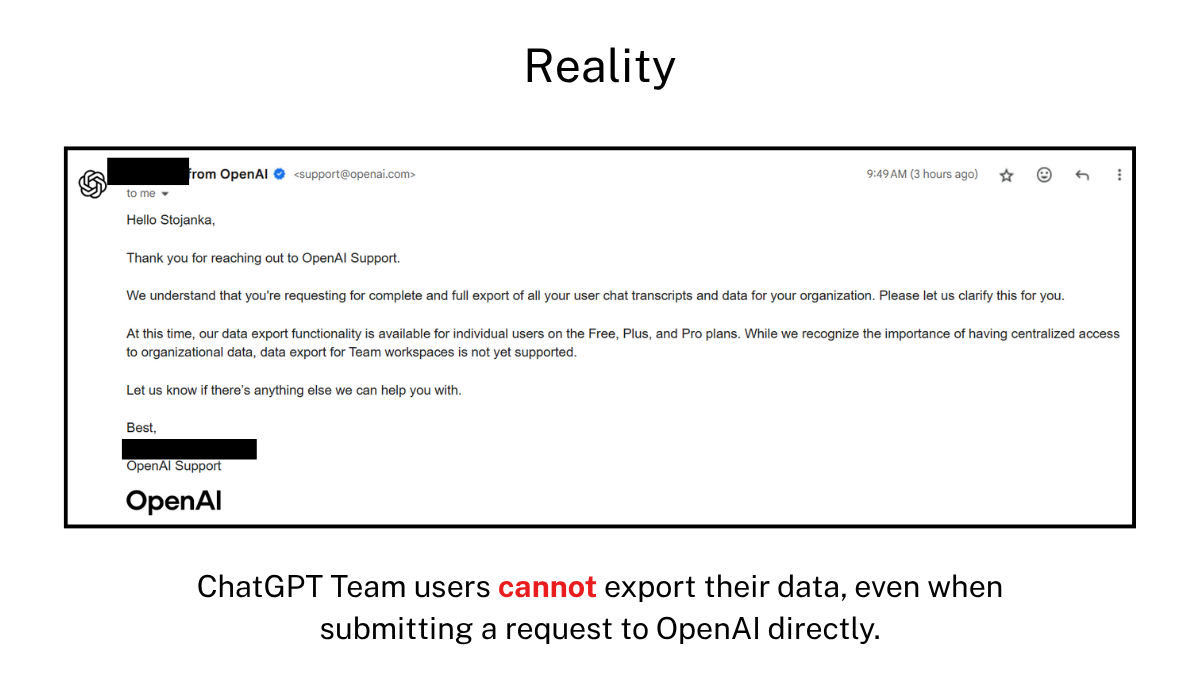
- Despite OpenAI's claim that "You can obtain a copy of your data and exercise other privacy rights through visiting our Privacy Portal," ChatGPT's paid Team users cannot retrieve or export their data, even when they reach out to OpenAI's team with a request.
- In Europe, this is a violation of the General Data Protection Regulation (GDPR).
- OpenAI recently released "Agent Mode" for business-tier users. While it has many use cases, exporting ChatGPT sessions that occur on its own platform isn't one of them.
So What?
More than a "bug" or oversight, especially given OpenAI's recent release of Agent Mode, a lack of data portability for one specific tier of ChatGPT is a deliberate business strategy that punishes customers who invested two of their most important resources, time and money, into learning how to use ChatGPT, training staff, and designing workflows. Without the ability to export data, business owners will have to spend even more time and money to leave the subscription, or they will be caught in a "vendor lock-in" with no end in sight.
What Business Owners Are Losing
For small business owners adapting to a new post-pandemic era in 2025—where ‘AI’ is not just an unavoidable buzzword but a central component of a new way of doing business, learning, creating, and analyzing data—this is more than just accessing ‘chat history.’
For thousands of business users, educators, researchers, and creators, sessions with ChatGPT represent
→ Months of research and refined academic work
→ Complex code that underwent weeks of debugging
→ Business plans and investor pitches developed over hundreds of sessions
→ The foundation of novels, scripts, and creative projects
→ Proprietary data and competitive intelligence
When OpenAI prevents users from exporting this data, they're not just inconveniencing them—they're withholding Intellectual Property and refusing to give access to those to whom it belongs.
The Cost of Being Locked In
Business users who cannot export their data face switching costs, representing hundreds of hours of professional time needed to recreate months of work.
This isn't just inconvenient, it's anticompetitive. It favors loyalty to an AI company over the portability of one's data. It imposes artificial switching costs. And it delays the very AI transformation businesses are being told to embrace.
The AI Irony That Reveals Everything
On April 10, 2025, Sam Altman, CEO of OpenAI, tweeted:
"we [sic] have greatly improved memory in chatgpt [sic]--it can now reference all your past conversations!
this [sic] is a surprisingly great feature imo, and it points at something we are excited about: ai [sic] systems that get to know you over your life, and become extremely useful and personalized."
That means that now, more than ever, OpenAI's systems have the data needed to provide you with, as Altman states in his subsequent Tweet, an "extremely useful" and "personalized experience over [the course of] your life," and presumably, the life of your business. The system remembers what we said, learns from our patterns, and builds on our ideas.
The Business-tier customers who created that content can't access their data with the same efficiency because AI can instantly recall months of work in seconds. Whereas manually scrolling through thousands of conversations using OpenAI's limited search interface requires a considerable time investment, this isn't just unfair—it's absurd and robs business owners, yet again, of both time and money.
Why This Matters Beyond OpenAI
This practice sets a dangerous precedent in the AI industry that it is acceptable for companies to adopt "data lock-in" strategies that trap users by making it impossible to leave with their work intact without substantial time or monetary investment.
Humans are being sold productivity but denied autonomy. We're encouraged to innovate, we pay to protect our data, then we're asked to forfeit our data ownership.
The FTC has consistently treated artificial switching costs as anticompetitive conduct. When companies deliberately make it expensive or impossible for users to switch services, they're not competing on innovation but on entrapment.
Our Demands
To OpenAI: We respectfully request that you immediately prioritize providing all paying Business-tier ChatGPT users or their admin with a clear, timely, and complete way for a user to export their own data, or for an admin to do so on their behalf. If you can turn on memory features, and release Agent Mode, you can turn on data export. Stop making your most loyal customers beg for fundamental rights to their data.
To the Federal Trade Commission: We request that you investigate OpenAI's marketing of its business-tier as an unfair and deceptive trade practice under the FTC Act. When companies promise enhanced privacy and control to premium users, and tell us that their models won't be trained on the information we provide, or on the human-led generative outputs that belong to us, and then restrict their data access below that of free-tier levels, this constitutes false advertising and anticompetitive conduct. Business owners, especially small business owners, who are adopting AI deserve the protection of the FTC.
To Congress: The United States lacks a comprehensive data privacy legislation similar to GDPR that guarantees data portability rights. We request that you protect American businesses and consumers deserve protection from digital lock-in practices.
The Ethical Standard Humans Demand from AI Companies
Ethical AI practices are paramount to ensuring human success in the age of AI. We demand that AI companies use our data ethically and provide us access to it in congruence with data governance best practices and the promises they have made to their users. When companies building AI tools engage in practices that are themselves unethical and depend on users to be more ethical than they are as they attempt to retrieve data that belongs to them, it is inherently problematic and should be addressed.
Proper AI ethics must be modeled by the companies that create the technology.
If a company can lock away the data you paid them to protect, what does that say about data ownership in the age of AI? What precedent does this set for every AI company watching OpenAI's success?
Here's Why YOUR Signature Matters NOW
Every signature sends a message to OpenAI and the very quickly evolving AI industry that our data is our property, our work belongs to us, and our innovation shouldn't be locked behind walls that AI was designed to tear down.
Signing this petition isn't just about drawing attention to one AI company or functionality. It is genuinely about establishing that all users, especially paying customers, retain the right to export their data in a way that is, at a minimum, machine-readable and ideally designed to be read by humans for maximum usability. Paying for a professional service should mean more rights and features, not fewer. Data portability is fundamental to consumer protection, and AI companies cannot build their business models on digital imprisonment.
Sign this petition to demand that OpenAI do the right thing and ensure that every AI company knows we're watching and that we expect our data to be ours.
The future of AI depends on trust, and that trust depends on transparency.
Transparency requires that users control their own data.
It's time for OpenAI and other AI Companies to choose which side of history they want to be on.
Our data. Our work. Our choice.
Share this petition with:
- Business owners using AI tools
- Researchers and academics
- Developers and creators
- Anyone who believes in digital rights
Together, we can ensure that AI serves users and that AI companies do.
Thank you for your consideration!
Artificial Intelligence Citation Standard Citations
Developing a public petition to advocate for AI data portability rights. Google Gemini, Drafting. (17 July 2025). Berry, Stojanka. Google Gemini. Cocreator. Business Workspace. 1:27 AM Eastern. English, United States.
Development of a Change.org petition advocating for OpenAI data portability rights for premium users. Claude Sonnet 4, drafting and iterating. (17 July 2025). Berry, Stojanka. Claude Sonnet 4. Cocreator. Free Workspace. 10:45 PM Eastern. English, United States
Efforts by the FTC and Congress to address data lock-in and protect user data ownership in AI contexts. Perplexity AI, research and analysis session. (17 July 2025). Berry, Stojanka. United States. Free Workspace. GPT-4o. Tool, Enhancer. Free. Language: English.
OpenAI Data Export Barriers and Ethical Implications for Business Users. ChatGPT, Drafting. (16 July 2025). Berry, Stojanka. OpenAI, GPT-4o. Cocreator. Business. 3:56 PM Eastern. English, United States.
State Attorneys General Regulation of AI Companies: A Case Study in Human-AI Podcast Script Cocreation. OpenAI GPT-4o, Drafting. (17 July 2025). Berry, Stojanka. Free workspace. 1:46 AM Eastern. English, United States.
Learn more at https://aicitationstandard.org/

9
The Issue
To: OpenAI Leadership, The U.S Federal Trade Commission, and Members of the US Congress
A premium subscription to retain Intellectual Property privileges shouldn't mean less access to data for businesses and business owners.
The Promise vs. The Reality
Businesses that choose to adopt Large Language Models (LLMs), like ChatGPT, as part of their workflow may find themselves worried about protecting their Intellectual Property, retaining rights to their data, and preventing it from being used to train other models.
In exchange for a Business-tier subscription fee, OpenAI promises that, "By default, we do not use business data from ChatGPT Enterprise, ChatGPT Edu, ChatGPT Team, or our API platform—including inputs or outputs—for training or improving our models." But there is a hidden cost to opting out of having this data excluded from the training dataset and a subtext that reads: "If we can't use your data, neither can you."
As a result, Team users, and even their account administrators, are unable to export their data, while free-tier users, whose data is used to train ChatGPT, can access their data easily.
Those who are members of ChatGPT Enterprise plans have to go through a few more steps, but they do actually have access to their data.
ChatGPT's Solutions
At some point, ChatGPT lost its export functionality in individual chat sessions.
Now, the only solution is for the humans, who are using AI to streamline workflows, to manually copy and paste every single chat session into a document.
Let's Recap
- ChatGPT's free tier users can export their data with one click.
- Business-tier users on the "Team" plan cannot export their data.
- Despite OpenAI's claim that "You can obtain a copy of your data and exercise other privacy rights through visiting our Privacy Portal," ChatGPT's paid Team users cannot retrieve or export their data, even when they reach out to OpenAI's team with a request.
- In Europe, this is a violation of the General Data Protection Regulation (GDPR).
- OpenAI recently released "Agent Mode" for business-tier users. While it has many use cases, exporting ChatGPT sessions that occur on its own platform isn't one of them.
So What?
More than a "bug" or oversight, especially given OpenAI's recent release of Agent Mode, a lack of data portability for one specific tier of ChatGPT is a deliberate business strategy that punishes customers who invested two of their most important resources, time and money, into learning how to use ChatGPT, training staff, and designing workflows. Without the ability to export data, business owners will have to spend even more time and money to leave the subscription, or they will be caught in a "vendor lock-in" with no end in sight.
What Business Owners Are Losing
For small business owners adapting to a new post-pandemic era in 2025—where ‘AI’ is not just an unavoidable buzzword but a central component of a new way of doing business, learning, creating, and analyzing data—this is more than just accessing ‘chat history.’
For thousands of business users, educators, researchers, and creators, sessions with ChatGPT represent
→ Months of research and refined academic work
→ Complex code that underwent weeks of debugging
→ Business plans and investor pitches developed over hundreds of sessions
→ The foundation of novels, scripts, and creative projects
→ Proprietary data and competitive intelligence
When OpenAI prevents users from exporting this data, they're not just inconveniencing them—they're withholding Intellectual Property and refusing to give access to those to whom it belongs.
The Cost of Being Locked In
Business users who cannot export their data face switching costs, representing hundreds of hours of professional time needed to recreate months of work.
This isn't just inconvenient, it's anticompetitive. It favors loyalty to an AI company over the portability of one's data. It imposes artificial switching costs. And it delays the very AI transformation businesses are being told to embrace.
The AI Irony That Reveals Everything
On April 10, 2025, Sam Altman, CEO of OpenAI, tweeted:
"we [sic] have greatly improved memory in chatgpt [sic]--it can now reference all your past conversations!
this [sic] is a surprisingly great feature imo, and it points at something we are excited about: ai [sic] systems that get to know you over your life, and become extremely useful and personalized."
That means that now, more than ever, OpenAI's systems have the data needed to provide you with, as Altman states in his subsequent Tweet, an "extremely useful" and "personalized experience over [the course of] your life," and presumably, the life of your business. The system remembers what we said, learns from our patterns, and builds on our ideas.
The Business-tier customers who created that content can't access their data with the same efficiency because AI can instantly recall months of work in seconds. Whereas manually scrolling through thousands of conversations using OpenAI's limited search interface requires a considerable time investment, this isn't just unfair—it's absurd and robs business owners, yet again, of both time and money.
Why This Matters Beyond OpenAI
This practice sets a dangerous precedent in the AI industry that it is acceptable for companies to adopt "data lock-in" strategies that trap users by making it impossible to leave with their work intact without substantial time or monetary investment.
Humans are being sold productivity but denied autonomy. We're encouraged to innovate, we pay to protect our data, then we're asked to forfeit our data ownership.
The FTC has consistently treated artificial switching costs as anticompetitive conduct. When companies deliberately make it expensive or impossible for users to switch services, they're not competing on innovation but on entrapment.
Our Demands
To OpenAI: We respectfully request that you immediately prioritize providing all paying Business-tier ChatGPT users or their admin with a clear, timely, and complete way for a user to export their own data, or for an admin to do so on their behalf. If you can turn on memory features, and release Agent Mode, you can turn on data export. Stop making your most loyal customers beg for fundamental rights to their data.
To the Federal Trade Commission: We request that you investigate OpenAI's marketing of its business-tier as an unfair and deceptive trade practice under the FTC Act. When companies promise enhanced privacy and control to premium users, and tell us that their models won't be trained on the information we provide, or on the human-led generative outputs that belong to us, and then restrict their data access below that of free-tier levels, this constitutes false advertising and anticompetitive conduct. Business owners, especially small business owners, who are adopting AI deserve the protection of the FTC.
To Congress: The United States lacks a comprehensive data privacy legislation similar to GDPR that guarantees data portability rights. We request that you protect American businesses and consumers deserve protection from digital lock-in practices.
The Ethical Standard Humans Demand from AI Companies
Ethical AI practices are paramount to ensuring human success in the age of AI. We demand that AI companies use our data ethically and provide us access to it in congruence with data governance best practices and the promises they have made to their users. When companies building AI tools engage in practices that are themselves unethical and depend on users to be more ethical than they are as they attempt to retrieve data that belongs to them, it is inherently problematic and should be addressed.
Proper AI ethics must be modeled by the companies that create the technology.
If a company can lock away the data you paid them to protect, what does that say about data ownership in the age of AI? What precedent does this set for every AI company watching OpenAI's success?
Here's Why YOUR Signature Matters NOW
Every signature sends a message to OpenAI and the very quickly evolving AI industry that our data is our property, our work belongs to us, and our innovation shouldn't be locked behind walls that AI was designed to tear down.
Signing this petition isn't just about drawing attention to one AI company or functionality. It is genuinely about establishing that all users, especially paying customers, retain the right to export their data in a way that is, at a minimum, machine-readable and ideally designed to be read by humans for maximum usability. Paying for a professional service should mean more rights and features, not fewer. Data portability is fundamental to consumer protection, and AI companies cannot build their business models on digital imprisonment.
Sign this petition to demand that OpenAI do the right thing and ensure that every AI company knows we're watching and that we expect our data to be ours.
The future of AI depends on trust, and that trust depends on transparency.
Transparency requires that users control their own data.
It's time for OpenAI and other AI Companies to choose which side of history they want to be on.
Our data. Our work. Our choice.
Share this petition with:
- Business owners using AI tools
- Researchers and academics
- Developers and creators
- Anyone who believes in digital rights
Together, we can ensure that AI serves users and that AI companies do.
Thank you for your consideration!
Artificial Intelligence Citation Standard Citations
Developing a public petition to advocate for AI data portability rights. Google Gemini, Drafting. (17 July 2025). Berry, Stojanka. Google Gemini. Cocreator. Business Workspace. 1:27 AM Eastern. English, United States.
Development of a Change.org petition advocating for OpenAI data portability rights for premium users. Claude Sonnet 4, drafting and iterating. (17 July 2025). Berry, Stojanka. Claude Sonnet 4. Cocreator. Free Workspace. 10:45 PM Eastern. English, United States
Efforts by the FTC and Congress to address data lock-in and protect user data ownership in AI contexts. Perplexity AI, research and analysis session. (17 July 2025). Berry, Stojanka. United States. Free Workspace. GPT-4o. Tool, Enhancer. Free. Language: English.
OpenAI Data Export Barriers and Ethical Implications for Business Users. ChatGPT, Drafting. (16 July 2025). Berry, Stojanka. OpenAI, GPT-4o. Cocreator. Business. 3:56 PM Eastern. English, United States.
State Attorneys General Regulation of AI Companies: A Case Study in Human-AI Podcast Script Cocreation. OpenAI GPT-4o, Drafting. (17 July 2025). Berry, Stojanka. Free workspace. 1:46 AM Eastern. English, United States.
Learn more at https://aicitationstandard.org/
9
The Decision Makers
Petition created on July 28, 2025