

SUPPORT FORMAL SPECIFIC SAFEGUARDS FOR BLACK AND MIXED-BLACK PEOPLE - HAT SHOW
The Issue
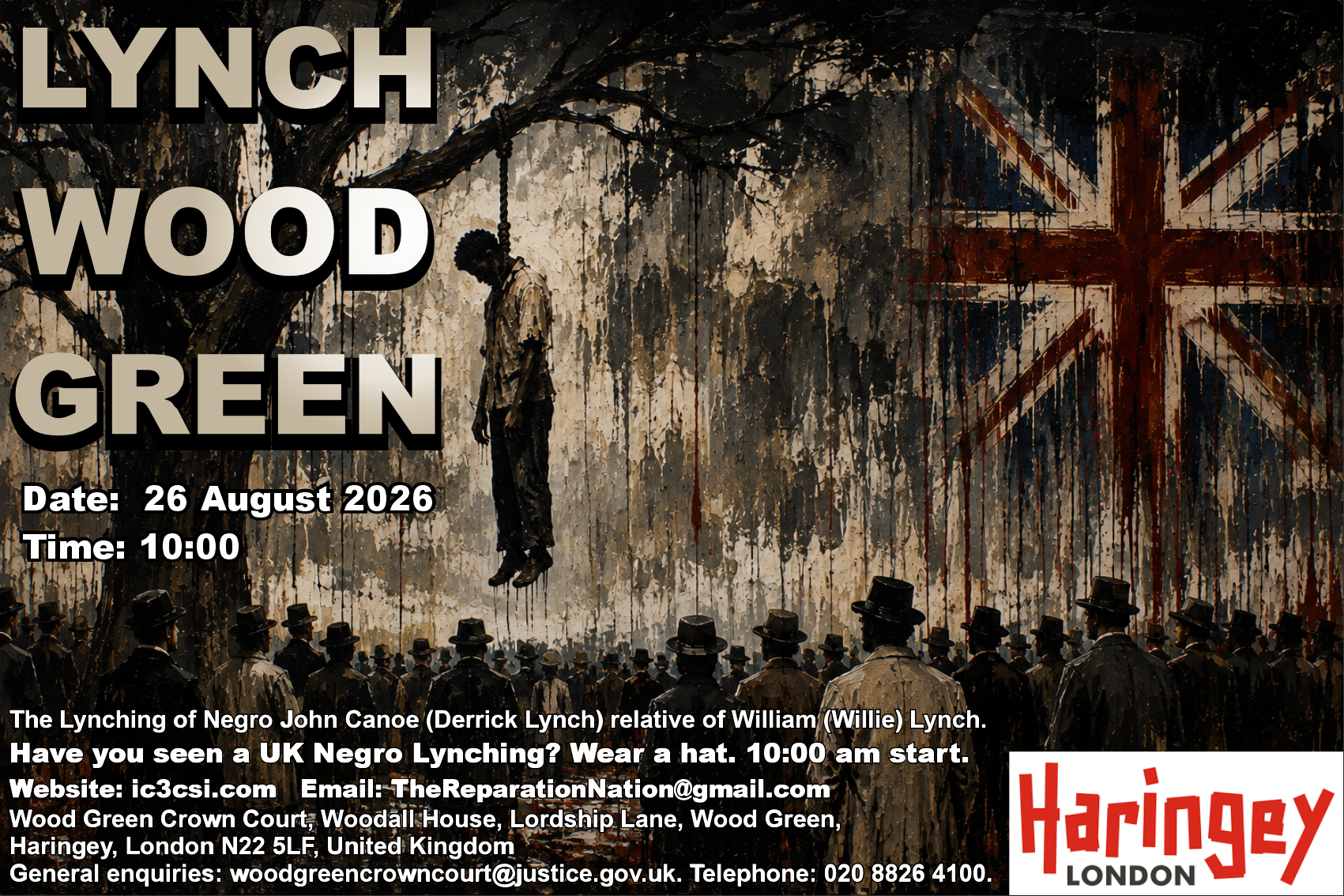
#UK #Lynching wear a hat fashion show #Lynch #WillieLynch #Haringey #WoodGreen #London Wednesday 26 August 2026 @ 10:00am #HatShow Refreshments/Tourism/Shopping nearby #WoodGreenShoppingCity. #GreatDayOut Court Case Ref 01GD1160226, Custody Ref 48C60057626,
https://ic3csi.com/black-justice-v2/lynch.html
PETITION
SUPPORT THE FORMAL RECOGNITION OF SPECIFIC SAFEGUARDS FOR BLACK AND MIXED-BLACK PEOPLE DURING POLICE CONTACT, ARREST, DETENTION AND CUSTODY
Petition addressed to:
The Secretary of State for the Home Department
Home Office
2 Marsham Street
London
SW1P 4DF
The Secretary of State for Justice
Ministry of Justice
102 Petty France
London
SW1H 9AJ
The Chair and Chief Executive
Equality and Human Rights Commission
Arndale House
The Arndale Centre
Manchester
M4 3AQ
The Director General
Independent Office for Police Conduct
PO Box 473
Sale
M33 0BW
The Chair
National Police Chiefs’ Council
1st Floor
10 Victoria Street
London
SW1H 0NN
The Chief Executive Officer
College of Policing
Leamington Road
Ryton-on-Dunsmore
Coventry
CV8 3EN

Create statutory police safeguards for Black and Mixed-Black people
#JasonArday #ArdaysLaw NEVER AGAIN #UK
https://petition.parliament.uk/petitions/780110/sponsors/new?token=TQXMGMJzKih4MeyqmkEk
PETITION STATEMENT
We, the undersigned, call upon the United Kingdom Government, police forces, criminal justice institutions, regulatory authorities and public bodies to formally recognise, develop, publish and enforce specific safeguards for Black and Mixed-Black people during police contact, arrest, transportation, detention, restraint and custody.
General statements about equality, diversity, impartiality and equal treatment are not sufficient where identifiable racial groups experience distinctive and disproportionate risks within policing and the criminal justice system.
A general equality policy tells the public that everybody should be treated fairly.
A specific safeguard identifies:
the particular risk;
the people exposed to that risk;
the action required to prevent harm;
the person responsible for taking that action;
the records that must be created;
the procedure for reviewing compliance; and
the remedy available when the safeguard is ignored.
Black and Mixed-Black people must not be required to rely solely upon abstract assurances that the same general safeguards apply to everyone.
WHY THIS PETITION IS NECESSARY
Official evidence has repeatedly identified racial disparities in policing, including disparities relating to arrest, stop and search, use of force and treatment within detention.
Black people are disproportionately exposed to police powers and police intervention. Where exposure to arrest, detention, restraint or force is disproportionate, a formally recognised system of specific safeguards is required to identify and reduce the associated risks.
Official reporting also demonstrates the importance of examining deaths involving restraint and police use of force separately from the total number of deaths during or following police custody.
In 2024/25, five deaths in or following police custody involved police use of force. Three of the deceased were White and two were Black. These figures must be approached carefully because the annual numbers are small, but they demonstrate why aggregated statistics can conceal serious racial disproportionality within particular categories of death.
The Equality and Human Rights Commission has previously identified evidence that excessive force is disproportionately used against people from ethnic minorities, particularly Black and Asian detainees, and has connected this issue with disproportionate restraint-related deaths.
The Government has also acknowledged that, although deaths in custody as a whole may not always show the same pattern, ethnic-minority people have been disproportionately represented among deaths following police use of force.
The petition therefore does not depend upon an assertion that every police officer, police force or individual decision is racist.
It demands a verifiable safeguard system capable of detecting, preventing and correcting anti-Black racism, racial stereotyping, unconscious bias, institutional failure and unequal treatment whenever they may arise.
BLACK AND MIXED-BLACK PEOPLE MUST BE IDENTIFIED CLEARLY
Official systems frequently combine different populations under broad expressions such as:
“BAME”;
“ethnic minorities”;
“non-White”;
“racialised communities”; or
“minority ethnic groups.”
These broad categories can obscure significant differences in the experiences of Black African, Black Caribbean, Black British and Mixed-Black people.
Black and Mixed-Black people must therefore be separately identified within policing, custody, use-of-force, complaint, disciplinary and death statistics.
For the purposes of this petition, “Mixed-Black” means people whose identity or ancestry includes Black African or Black Caribbean heritage, including people recorded within relevant Mixed or Multiple Ethnic Group classifications.
Recognition of Black and Mixed-Black people does not remove or diminish protections owed to any other racial or ethnic group. It ensures that a documented and distinctive risk is not concealed by an excessively broad general category.
GENERAL EQUALITY IS NOT THE SAME AS A SPECIFIC SAFEGUARD
The Equality Act 2010 and the Public Sector Equality Duty establish important legal obligations.
However, the existence of a general legal duty does not prove that the duty has been translated into an effective operational safeguard at the point where a Black or Mixed-Black person is:
stopped;
searched;
approached;
questioned;
arrested;
handcuffed;
restrained;
transported;
booked into custody;
medically assessed;
placed in a cell;
observed;
interviewed;
charged; or
released.
A safeguard must operate before death or serious injury occurs.
It must not exist only as a general policy document that is cited after an incident.

WE CALL FOR A BLACK AND MIXED-BLACK POLICE SAFEGUARDING FRAMEWORK
We call for the creation of a mandatory national framework expressly addressing the safety, dignity and equal treatment of Black and Mixed-Black people during police contact and custody.
The framework must apply to every police force in England and Wales and should form the basis of equivalent arrangements throughout the United Kingdom.
THE FRAMEWORK MUST INCLUDE THE FOLLOWING SAFEGUARDS
1. Mandatory racial-risk assessment
At the point of arrest and custody authorisation, the custody officer must consider whether racial stereotyping, racialised assumptions or communication failures may have affected:
the initial police contact;
the decision to stop or search;
the decision to arrest;
the level of force used;
the use of handcuffs;
the assessment of threat or aggression; and
the interpretation of the person’s behaviour.
This must be a recorded assessment and not merely an informal consideration.
2. Recorded reasons for force and restraint
Every use of force against a Black or Mixed-Black person must be supported by a contemporaneous written record identifying:
the precise behaviour relied upon;
the perceived risk;
the force used;
the duration of the force;
the officers involved;
the alternatives considered;
any warning given;
the person’s physical position;
any signs of distress;
any medical concerns; and
the reason the force remained necessary at each stage.
Terms such as “aggressive,” “volatile,” “non-compliant,” “excited” or “threatening” must not be used without a factual description of the conduct said to justify that characterisation.
3. Mandatory body-worn video activation
Body-worn video should be activated at the earliest lawful opportunity during any enforcement encounter likely to result in arrest, detention, restraint or use of force.
Any failure to activate, preserve or disclose the recording must be documented and independently reviewable.
4. Immediate medical assessment following force or restraint
A Black or Mixed-Black person subjected to significant force, prone restraint, pressure upon the body, Taser deployment, incapacitant spray, a police dog bite, a baton strike or prolonged handcuffing must receive an appropriate medical assessment.
The assessment must not be delayed merely because the person is speaking, standing, shouting, resisting, distressed or apparently conscious.
5. Prohibition of dangerous restraint practices
Police forces must establish clear, enforceable restrictions concerning:
prolonged prone restraint;
pressure upon the neck, chest, back or abdomen;
restraint that interferes with breathing;
restraint of a person displaying medical or psychological distress;
simultaneous use of multiple restraint methods; and
continued restraint after control has been achieved.
Officers must be trained to recognise that statements such as “I cannot breathe,” unusual silence, reduced responsiveness, vomiting, confusion, collapse or sudden apparent calm may indicate a medical emergency.
6. Independent custody notification
A Black or Mixed-Black detainee, or a nominated representative, must be informed in writing of:
the reason for arrest;
the legal basis of detention;
the custody reference;
the officers responsible;
the right to legal advice;
the right to have someone informed;
the right to medical attention;
the complaint procedure;
the procedure for preserving video and custody records; and
any use-of-force report created.
7. Right to request a racial-safeguarding review
A detained person must be able to request a review where they believe that anti-Black racism, racial stereotyping or racial bias may have influenced their treatment.
The request must be recorded and considered by an officer who was not directly responsible for the disputed conduct.
The reviewer must identify:
the material examined;
the officers consulted;
the decision reached;
the reasons for the decision; and
any immediate corrective action required.
8. Automatic preservation of evidence
Where a Black or Mixed-Black person suffers serious injury, loss of consciousness, breathing difficulty, hospitalisation or death during or following police contact, all relevant records must be preserved automatically.
This must include:
body-worn video;
custody CCTV and audio;
vehicle CCTV;
emergency-call recordings;
police radio transmissions;
command-and-control logs;
custody records;
use-of-force forms;
medical records;
risk assessments;
officer notebooks;
mobile-device communications;
briefing records;
tactical plans; and
records of supervisory decisions.
No family should have to begin an urgent evidential campaign immediately after a death merely to prevent relevant records from being overwritten, lost or destroyed.
9. Automatic independent investigation
A death or life-threatening injury involving police force or restraint must be referred immediately for independent investigation.
The investigating body must examine not only the final physical cause of death, but also:
the original reason for police contact;
the necessity of arrest;
the proportionality of force;
racial stereotyping;
communication failures;
medical response;
supervisory oversight;
record accuracy;
evidence preservation;
previous complaints involving the officers; and
whether institutional practices contributed to the outcome.
10. Family participation and disclosure
Bereaved families must receive early, accessible and continuing information concerning:
the investigation;
the evidence preserved;
the identity and role of the investigating body;
the applicable timescales;
post-mortem examinations;
expert evidence;
misconduct considerations;
charging decisions;
inquest arrangements; and
available legal representation.
Families must not be treated as outsiders to a process concerning the death of their relative.
11. Separate Black and Mixed-Black statistical reporting
National and force-level statistics must separately report outcomes for:
Black African people;
Black Caribbean people;
other Black people;
White and Black African people;
White and Black Caribbean people;
other Mixed-Black people; and
people whose ethnicity was not properly recorded.
The statistics must cover:
stop and search;
arrest;
handcuffing;
strip-searching;
Taser use;
incapacitant spray;
police dog deployment;
prone restraint;
hospitalisation;
serious injury;
deaths in custody;
deaths following custody;
deaths following restraint;
fatal police shootings;
apparent suicides following police contact;
complaints;
misconduct findings; and
disciplinary outcomes.
12. Publication of rates, not merely raw numbers
Raw totals can conceal disproportionality.
Public authorities must publish rates calculated against:
the general population;
the population exposed to arrest;
the custody population;
the population subjected to force; and
other relevant comparison groups.
The method used must be transparent, independently reviewed and accompanied by an explanation of its limitations.
13. Independent Black and Mixed-Black community oversight
A national oversight body must include Black and Mixed-Black families, specialists, community investigators, lawyers, medical professionals and organisations with relevant experience.
Participation must not be restricted to organisations selected solely by the police or Government.
The oversight body must have access to sufficiently detailed anonymised data to identify recurring risks, institutional patterns and failures to implement recommendations.
14. Named accountability
Every police force must identify a senior officer who is personally responsible for implementation of the Black and Mixed-Black safeguarding framework.
The responsible officer must publish an annual report stating:
what safeguards were implemented;
what audits were completed;
what disparities were identified;
what corrective measures were ordered;
whether previous recommendations were implemented;
what remained outstanding; and
the timetable for completion.
15. Enforceable consequences
A safeguard without consequences is only an aspiration.
Failure to comply must be capable of resulting in:
corrective action;
disciplinary investigation;
adverse evidential consideration;
regulatory intervention;
mandatory retraining;
institutional inspection;
civil accountability; and
referral for criminal investigation where appropriate.

QUESTIONS PUBLIC AUTHORITIES MUST ANSWER
We call upon every police force and relevant public body to answer the following questions in writing:
What specific safeguards protect Black and Mixed-Black people from anti-Black racism during police contact and custody?
Where are those safeguards written down?
Which safeguards operate before force, serious injury or death occurs?
Who is responsible for applying each safeguard?
What record proves that the safeguard was applied?
Who independently verifies compliance?
How can a detained person invoke the safeguard?
How can a family establish whether it was followed?
What happens when the safeguard is ignored?
How are recurring racial patterns identified across separate incidents?
Why are Black and Mixed-Black experiences frequently combined with unrelated ethnic groups?
What evidence demonstrates that general equality policies are preventing racially disproportionate harm?
OUR REQUEST TO PARLIAMENT AND GOVERNMENT
We call upon Parliament and the Government to:
formally recognise that Black and Mixed-Black people may require specific safeguards within policing and custody;
commission an independent national review of the treatment of Black and Mixed-Black people during police contact, force, restraint and detention;
consult directly with bereaved Black and Mixed-Black families;
establish a statutory Black and Mixed-Black police safeguarding framework;
require separate and transparent racial data collection;
establish enforceable national standards for restraint, medical response and evidence preservation;
provide independent oversight with meaningful Black and Mixed-Black participation;
publish a timetable for implementation;
report annually to Parliament on compliance and outcomes; and
explain publicly why general equality provisions should be considered sufficient if the Government declines to establish specific safeguards.
NO CONFLICT WITH UNIVERSAL HUMAN RIGHTS
Specific safeguards for Black and Mixed-Black people are not a request for superior rights.
They are a request for equal protection against an identifiable and evidenced risk.
Universal human rights remain universal. However, universal principles frequently require specific measures where a particular population experiences a particular form of danger, discrimination or institutional failure.
Recognising a specific risk is not discrimination against other people.
Failing to recognise a documented risk may leave the people exposed to it without effective protection.
DECLARATION
By signing this petition, I support:
the formal recognition of specific safeguards for Black and Mixed-Black people during police contact and custody;
the clear separation of Black and Mixed-Black data from broad and potentially misleading aggregate categories;
independent investigation of racial disparities;
enforceable preventative measures;
full accountability when safeguards are not followed; and
the principle that nobody should die or suffer serious injury because a public authority relied upon general assurances instead of specific, operational and verifiable protection.
PETITION TITLE FOR PUBLICATION
Support Specific Police and Custody Safeguards for Black and Mixed-Black People
SHORT PETITION DESCRIPTION
Black and Mixed-Black people experience disproportionate exposure to arrest, police force and racialised decision-making. General equality policies are not enough. We call for specific, written, enforceable and independently verified safeguards to prevent serious injury and deaths during or following police contact.
PETITION ORGANISER
Black Justice Engine
Reparations Nation Limited
IC3CSI Black Crime Scene Investigators
23 Jersey House
2 Eastfield Road
Enfield
EN3 5UY
Website: https://ic3csi.com/black-justice.html
Company number: 14761041
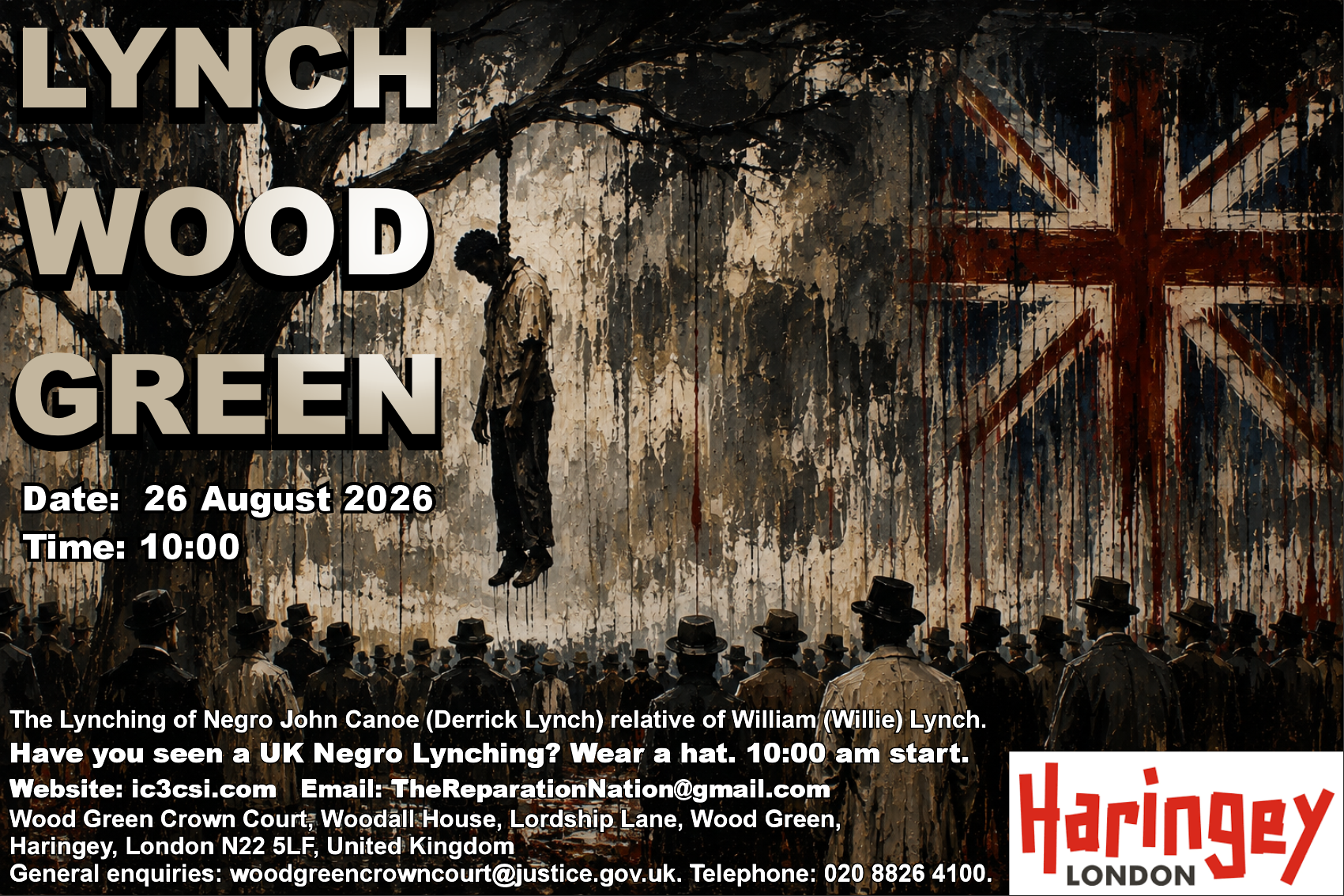
#UK #Lynching wear a hat fashion show #Lynch #WillieLynch #Haringey #WoodGreen #London Wednesday 26 August 2026 @ 10:00am #HatShow Refreshments/Tourism/Shopping nearby #WoodGreenShoppingCity. #GreatDayOut Court Case Ref 01GD1160226, Custody Ref 48C60057626,
https://ic3csi.com/black-justice-v2/lynch.html

Create statutory police safeguards for Black and Mixed-Black people
#JasonArday #ArdaysLaw NEVER AGAIN #UK
https://petition.parliament.uk/petitions/780110/sponsors/new?token=TQXMGMJzKih4MeyqmkEk

1
The Issue
#UK #Lynching wear a hat fashion show #Lynch #WillieLynch #Haringey #WoodGreen #London Wednesday 26 August 2026 @ 10:00am #HatShow Refreshments/Tourism/Shopping nearby #WoodGreenShoppingCity. #GreatDayOut Court Case Ref 01GD1160226, Custody Ref 48C60057626,
https://ic3csi.com/black-justice-v2/lynch.html
PETITION
SUPPORT THE FORMAL RECOGNITION OF SPECIFIC SAFEGUARDS FOR BLACK AND MIXED-BLACK PEOPLE DURING POLICE CONTACT, ARREST, DETENTION AND CUSTODY
Petition addressed to:
The Secretary of State for the Home Department
Home Office
2 Marsham Street
London
SW1P 4DF
The Secretary of State for Justice
Ministry of Justice
102 Petty France
London
SW1H 9AJ
The Chair and Chief Executive
Equality and Human Rights Commission
Arndale House
The Arndale Centre
Manchester
M4 3AQ
The Director General
Independent Office for Police Conduct
PO Box 473
Sale
M33 0BW
The Chair
National Police Chiefs’ Council
1st Floor
10 Victoria Street
London
SW1H 0NN
The Chief Executive Officer
College of Policing
Leamington Road
Ryton-on-Dunsmore
Coventry
CV8 3EN
Create statutory police safeguards for Black and Mixed-Black people
#JasonArday #ArdaysLaw NEVER AGAIN #UK
https://petition.parliament.uk/petitions/780110/sponsors/new?token=TQXMGMJzKih4MeyqmkEk
PETITION STATEMENT
We, the undersigned, call upon the United Kingdom Government, police forces, criminal justice institutions, regulatory authorities and public bodies to formally recognise, develop, publish and enforce specific safeguards for Black and Mixed-Black people during police contact, arrest, transportation, detention, restraint and custody.
General statements about equality, diversity, impartiality and equal treatment are not sufficient where identifiable racial groups experience distinctive and disproportionate risks within policing and the criminal justice system.
A general equality policy tells the public that everybody should be treated fairly.
A specific safeguard identifies:
the particular risk;
the people exposed to that risk;
the action required to prevent harm;
the person responsible for taking that action;
the records that must be created;
the procedure for reviewing compliance; and
the remedy available when the safeguard is ignored.
Black and Mixed-Black people must not be required to rely solely upon abstract assurances that the same general safeguards apply to everyone.
WHY THIS PETITION IS NECESSARY
Official evidence has repeatedly identified racial disparities in policing, including disparities relating to arrest, stop and search, use of force and treatment within detention.
Black people are disproportionately exposed to police powers and police intervention. Where exposure to arrest, detention, restraint or force is disproportionate, a formally recognised system of specific safeguards is required to identify and reduce the associated risks.
Official reporting also demonstrates the importance of examining deaths involving restraint and police use of force separately from the total number of deaths during or following police custody.
In 2024/25, five deaths in or following police custody involved police use of force. Three of the deceased were White and two were Black. These figures must be approached carefully because the annual numbers are small, but they demonstrate why aggregated statistics can conceal serious racial disproportionality within particular categories of death.
The Equality and Human Rights Commission has previously identified evidence that excessive force is disproportionately used against people from ethnic minorities, particularly Black and Asian detainees, and has connected this issue with disproportionate restraint-related deaths.
The Government has also acknowledged that, although deaths in custody as a whole may not always show the same pattern, ethnic-minority people have been disproportionately represented among deaths following police use of force.
The petition therefore does not depend upon an assertion that every police officer, police force or individual decision is racist.
It demands a verifiable safeguard system capable of detecting, preventing and correcting anti-Black racism, racial stereotyping, unconscious bias, institutional failure and unequal treatment whenever they may arise.
BLACK AND MIXED-BLACK PEOPLE MUST BE IDENTIFIED CLEARLY
Official systems frequently combine different populations under broad expressions such as:
“BAME”;
“ethnic minorities”;
“non-White”;
“racialised communities”; or
“minority ethnic groups.”
These broad categories can obscure significant differences in the experiences of Black African, Black Caribbean, Black British and Mixed-Black people.
Black and Mixed-Black people must therefore be separately identified within policing, custody, use-of-force, complaint, disciplinary and death statistics.
For the purposes of this petition, “Mixed-Black” means people whose identity or ancestry includes Black African or Black Caribbean heritage, including people recorded within relevant Mixed or Multiple Ethnic Group classifications.
Recognition of Black and Mixed-Black people does not remove or diminish protections owed to any other racial or ethnic group. It ensures that a documented and distinctive risk is not concealed by an excessively broad general category.
GENERAL EQUALITY IS NOT THE SAME AS A SPECIFIC SAFEGUARD
The Equality Act 2010 and the Public Sector Equality Duty establish important legal obligations.
However, the existence of a general legal duty does not prove that the duty has been translated into an effective operational safeguard at the point where a Black or Mixed-Black person is:
stopped;
searched;
approached;
questioned;
arrested;
handcuffed;
restrained;
transported;
booked into custody;
medically assessed;
placed in a cell;
observed;
interviewed;
charged; or
released.
A safeguard must operate before death or serious injury occurs.
It must not exist only as a general policy document that is cited after an incident.
WE CALL FOR A BLACK AND MIXED-BLACK POLICE SAFEGUARDING FRAMEWORK
We call for the creation of a mandatory national framework expressly addressing the safety, dignity and equal treatment of Black and Mixed-Black people during police contact and custody.
The framework must apply to every police force in England and Wales and should form the basis of equivalent arrangements throughout the United Kingdom.
THE FRAMEWORK MUST INCLUDE THE FOLLOWING SAFEGUARDS
1. Mandatory racial-risk assessment
At the point of arrest and custody authorisation, the custody officer must consider whether racial stereotyping, racialised assumptions or communication failures may have affected:
the initial police contact;
the decision to stop or search;
the decision to arrest;
the level of force used;
the use of handcuffs;
the assessment of threat or aggression; and
the interpretation of the person’s behaviour.
This must be a recorded assessment and not merely an informal consideration.
2. Recorded reasons for force and restraint
Every use of force against a Black or Mixed-Black person must be supported by a contemporaneous written record identifying:
the precise behaviour relied upon;
the perceived risk;
the force used;
the duration of the force;
the officers involved;
the alternatives considered;
any warning given;
the person’s physical position;
any signs of distress;
any medical concerns; and
the reason the force remained necessary at each stage.
Terms such as “aggressive,” “volatile,” “non-compliant,” “excited” or “threatening” must not be used without a factual description of the conduct said to justify that characterisation.
3. Mandatory body-worn video activation
Body-worn video should be activated at the earliest lawful opportunity during any enforcement encounter likely to result in arrest, detention, restraint or use of force.
Any failure to activate, preserve or disclose the recording must be documented and independently reviewable.
4. Immediate medical assessment following force or restraint
A Black or Mixed-Black person subjected to significant force, prone restraint, pressure upon the body, Taser deployment, incapacitant spray, a police dog bite, a baton strike or prolonged handcuffing must receive an appropriate medical assessment.
The assessment must not be delayed merely because the person is speaking, standing, shouting, resisting, distressed or apparently conscious.
5. Prohibition of dangerous restraint practices
Police forces must establish clear, enforceable restrictions concerning:
prolonged prone restraint;
pressure upon the neck, chest, back or abdomen;
restraint that interferes with breathing;
restraint of a person displaying medical or psychological distress;
simultaneous use of multiple restraint methods; and
continued restraint after control has been achieved.
Officers must be trained to recognise that statements such as “I cannot breathe,” unusual silence, reduced responsiveness, vomiting, confusion, collapse or sudden apparent calm may indicate a medical emergency.
6. Independent custody notification
A Black or Mixed-Black detainee, or a nominated representative, must be informed in writing of:
the reason for arrest;
the legal basis of detention;
the custody reference;
the officers responsible;
the right to legal advice;
the right to have someone informed;
the right to medical attention;
the complaint procedure;
the procedure for preserving video and custody records; and
any use-of-force report created.
7. Right to request a racial-safeguarding review
A detained person must be able to request a review where they believe that anti-Black racism, racial stereotyping or racial bias may have influenced their treatment.
The request must be recorded and considered by an officer who was not directly responsible for the disputed conduct.
The reviewer must identify:
the material examined;
the officers consulted;
the decision reached;
the reasons for the decision; and
any immediate corrective action required.
8. Automatic preservation of evidence
Where a Black or Mixed-Black person suffers serious injury, loss of consciousness, breathing difficulty, hospitalisation or death during or following police contact, all relevant records must be preserved automatically.
This must include:
body-worn video;
custody CCTV and audio;
vehicle CCTV;
emergency-call recordings;
police radio transmissions;
command-and-control logs;
custody records;
use-of-force forms;
medical records;
risk assessments;
officer notebooks;
mobile-device communications;
briefing records;
tactical plans; and
records of supervisory decisions.
No family should have to begin an urgent evidential campaign immediately after a death merely to prevent relevant records from being overwritten, lost or destroyed.
9. Automatic independent investigation
A death or life-threatening injury involving police force or restraint must be referred immediately for independent investigation.
The investigating body must examine not only the final physical cause of death, but also:
the original reason for police contact;
the necessity of arrest;
the proportionality of force;
racial stereotyping;
communication failures;
medical response;
supervisory oversight;
record accuracy;
evidence preservation;
previous complaints involving the officers; and
whether institutional practices contributed to the outcome.
10. Family participation and disclosure
Bereaved families must receive early, accessible and continuing information concerning:
the investigation;
the evidence preserved;
the identity and role of the investigating body;
the applicable timescales;
post-mortem examinations;
expert evidence;
misconduct considerations;
charging decisions;
inquest arrangements; and
available legal representation.
Families must not be treated as outsiders to a process concerning the death of their relative.
11. Separate Black and Mixed-Black statistical reporting
National and force-level statistics must separately report outcomes for:
Black African people;
Black Caribbean people;
other Black people;
White and Black African people;
White and Black Caribbean people;
other Mixed-Black people; and
people whose ethnicity was not properly recorded.
The statistics must cover:
stop and search;
arrest;
handcuffing;
strip-searching;
Taser use;
incapacitant spray;
police dog deployment;
prone restraint;
hospitalisation;
serious injury;
deaths in custody;
deaths following custody;
deaths following restraint;
fatal police shootings;
apparent suicides following police contact;
complaints;
misconduct findings; and
disciplinary outcomes.
12. Publication of rates, not merely raw numbers
Raw totals can conceal disproportionality.
Public authorities must publish rates calculated against:
the general population;
the population exposed to arrest;
the custody population;
the population subjected to force; and
other relevant comparison groups.
The method used must be transparent, independently reviewed and accompanied by an explanation of its limitations.
13. Independent Black and Mixed-Black community oversight
A national oversight body must include Black and Mixed-Black families, specialists, community investigators, lawyers, medical professionals and organisations with relevant experience.
Participation must not be restricted to organisations selected solely by the police or Government.
The oversight body must have access to sufficiently detailed anonymised data to identify recurring risks, institutional patterns and failures to implement recommendations.
14. Named accountability
Every police force must identify a senior officer who is personally responsible for implementation of the Black and Mixed-Black safeguarding framework.
The responsible officer must publish an annual report stating:
what safeguards were implemented;
what audits were completed;
what disparities were identified;
what corrective measures were ordered;
whether previous recommendations were implemented;
what remained outstanding; and
the timetable for completion.
15. Enforceable consequences
A safeguard without consequences is only an aspiration.
Failure to comply must be capable of resulting in:
corrective action;
disciplinary investigation;
adverse evidential consideration;
regulatory intervention;
mandatory retraining;
institutional inspection;
civil accountability; and
referral for criminal investigation where appropriate.
QUESTIONS PUBLIC AUTHORITIES MUST ANSWER
We call upon every police force and relevant public body to answer the following questions in writing:
What specific safeguards protect Black and Mixed-Black people from anti-Black racism during police contact and custody?
Where are those safeguards written down?
Which safeguards operate before force, serious injury or death occurs?
Who is responsible for applying each safeguard?
What record proves that the safeguard was applied?
Who independently verifies compliance?
How can a detained person invoke the safeguard?
How can a family establish whether it was followed?
What happens when the safeguard is ignored?
How are recurring racial patterns identified across separate incidents?
Why are Black and Mixed-Black experiences frequently combined with unrelated ethnic groups?
What evidence demonstrates that general equality policies are preventing racially disproportionate harm?
OUR REQUEST TO PARLIAMENT AND GOVERNMENT
We call upon Parliament and the Government to:
formally recognise that Black and Mixed-Black people may require specific safeguards within policing and custody;
commission an independent national review of the treatment of Black and Mixed-Black people during police contact, force, restraint and detention;
consult directly with bereaved Black and Mixed-Black families;
establish a statutory Black and Mixed-Black police safeguarding framework;
require separate and transparent racial data collection;
establish enforceable national standards for restraint, medical response and evidence preservation;
provide independent oversight with meaningful Black and Mixed-Black participation;
publish a timetable for implementation;
report annually to Parliament on compliance and outcomes; and
explain publicly why general equality provisions should be considered sufficient if the Government declines to establish specific safeguards.
NO CONFLICT WITH UNIVERSAL HUMAN RIGHTS
Specific safeguards for Black and Mixed-Black people are not a request for superior rights.
They are a request for equal protection against an identifiable and evidenced risk.
Universal human rights remain universal. However, universal principles frequently require specific measures where a particular population experiences a particular form of danger, discrimination or institutional failure.
Recognising a specific risk is not discrimination against other people.
Failing to recognise a documented risk may leave the people exposed to it without effective protection.
DECLARATION
By signing this petition, I support:
the formal recognition of specific safeguards for Black and Mixed-Black people during police contact and custody;
the clear separation of Black and Mixed-Black data from broad and potentially misleading aggregate categories;
independent investigation of racial disparities;
enforceable preventative measures;
full accountability when safeguards are not followed; and
the principle that nobody should die or suffer serious injury because a public authority relied upon general assurances instead of specific, operational and verifiable protection.
PETITION TITLE FOR PUBLICATION
Support Specific Police and Custody Safeguards for Black and Mixed-Black People
SHORT PETITION DESCRIPTION
Black and Mixed-Black people experience disproportionate exposure to arrest, police force and racialised decision-making. General equality policies are not enough. We call for specific, written, enforceable and independently verified safeguards to prevent serious injury and deaths during or following police contact.
PETITION ORGANISER
Black Justice Engine
Reparations Nation Limited
IC3CSI Black Crime Scene Investigators
23 Jersey House
2 Eastfield Road
Enfield
EN3 5UY
Website: https://ic3csi.com/black-justice.html
Company number: 14761041
#UK #Lynching wear a hat fashion show #Lynch #WillieLynch #Haringey #WoodGreen #London Wednesday 26 August 2026 @ 10:00am #HatShow Refreshments/Tourism/Shopping nearby #WoodGreenShoppingCity. #GreatDayOut Court Case Ref 01GD1160226, Custody Ref 48C60057626,
https://ic3csi.com/black-justice-v2/lynch.html
Create statutory police safeguards for Black and Mixed-Black people
#JasonArday #ArdaysLaw NEVER AGAIN #UK
https://petition.parliament.uk/petitions/780110/sponsors/new?token=TQXMGMJzKih4MeyqmkEk
Petition Updates
Share this petition
Petition created on 4 August 2026