Suggestions on The Waqf (Amendment) Bill 2024
Suggestions on The Waqf (Amendment) Bill 2024
The Issue
To
The Join Secretary (JM),
Lok Sabha Secretariat, Room No. 440,
Parliament House Annexe, New Delhi - 110001
Based on advertisement in from official X (formerly twitter) handle of Loksabha Secretariat (@LokSabhaSectt) published on 30th August 2024 inviting suggestions on the "The Waqf (Amendment) Bill, 2024" we the desirous an Indian Citizens have gone through the Bills and would suggest to make bill more favourable for the every individual of Muslim communities instead making it to believe against the Muslim communities.
SUGGESTION FOR THE WAQF AMENDMENT BILL, 2024
PREAMBLE
Given the importance of Waqf properties in supporting social welfare, education, and religious activities within the Muslim community, and recognizing the need for modernization and enhanced governance, the following amendments are proposed to the Waqf Act to ensure transparency, better management, and protection of Waqf assets.
1. Strengthening Governance and Accountability
1.1. Establishment of Independent Waqf Tribunals
Amend the Act to establish independent Waqf Tribunals at the state level with a mandate to resolve disputes related to Waqf properties in an expedited manner.
Tribunals should be chaired by a retired judge with members who have expertise in Islamic law, property law, and public administration.
The decisions of these Tribunals should be binding, with the possibility of appeal only in higher courts under specific circumstances.
1.2. Mandatory Audits by Independent Agencies
Introduce a provision for mandatory annual audits of all Waqf properties by independent auditors appointed by the state Waqf Boards but reporting directly to the Waqf Tribunal.
Audit reports should be made publicly accessible to ensure transparency.
2. Enhancing Transparency and Public Participation
2.1. Digitalization of Waqf Records
Mandate the digitization of all Waqf property records, including registration, ownership, revenue, and expenditure.
Create a centralized online portal accessible to the public where all relevant information about Waqf properties can be viewed, ensuring transparency.
2.2. Community Involvement and Oversight
Amend the Act to include provisions for community involvement in the management of Waqf properties.
Establish local Waqf committees comprising community members with a track record of public service, responsible for overseeing the day-to-day management and reporting any irregularities to the state Waqf Board.
3. Streamlining Management and Utilization of Waqf Properties
3.1. Professional Management of Waqf Properties
Introduce provisions for the professional management of Waqf properties, including the appointment of property managers with expertise in real estate and asset management.
Waqf Boards should be empowered to enter into public-private partnerships (PPPs) for the development and better utilization of Waqf properties, provided such arrangements do not violate the religious principles governing Waqf.
3.2. Regulation of Leasing and Transfer of Waqf Properties
Amend the Act to impose stricter regulations on the leasing and transfer of Waqf properties, ensuring that such transactions are conducted at market value and are subject to approval by the Waqf Tribunal.
Introduce penalties for unauthorized leases, transfers, or misuse of Waqf properties, with clear mechanisms for the recovery of such assets.
4. Protecting Waqf Properties from Encroachment and Misuse
4.1. Special Task Force for Waqf Property Protection
Create a special task force within the state police dedicated to the protection of Waqf properties from encroachment, unauthorized construction, or illegal occupation.
The task force should work in collaboration with local authorities to promptly address any threats to Waqf properties.
4.2. Enhanced Legal Provisions Against Encroachment
Strengthen legal provisions to ensure that any encroachment or misuse of Waqf properties is treated as a criminal offense, with penalties including imprisonment, fines, and restoration of the property to its original status.
5. Capacity Building and Training
5.1. Training Programs for Waqf Board Members and Staff
Introduce mandatory training programs for Waqf Board members and staff on property management, financial accounting, legal aspects of Waqf, and community engagement.
Collaborate with academic institutions and professional bodies to develop and deliver these training programs.
5.2. Public Awareness Campaigns
Implement public awareness campaigns to educate the community about the significance of Waqf, the rights and duties of mutawallis (caretakers), and the legal frameworks governing Waqf properties.
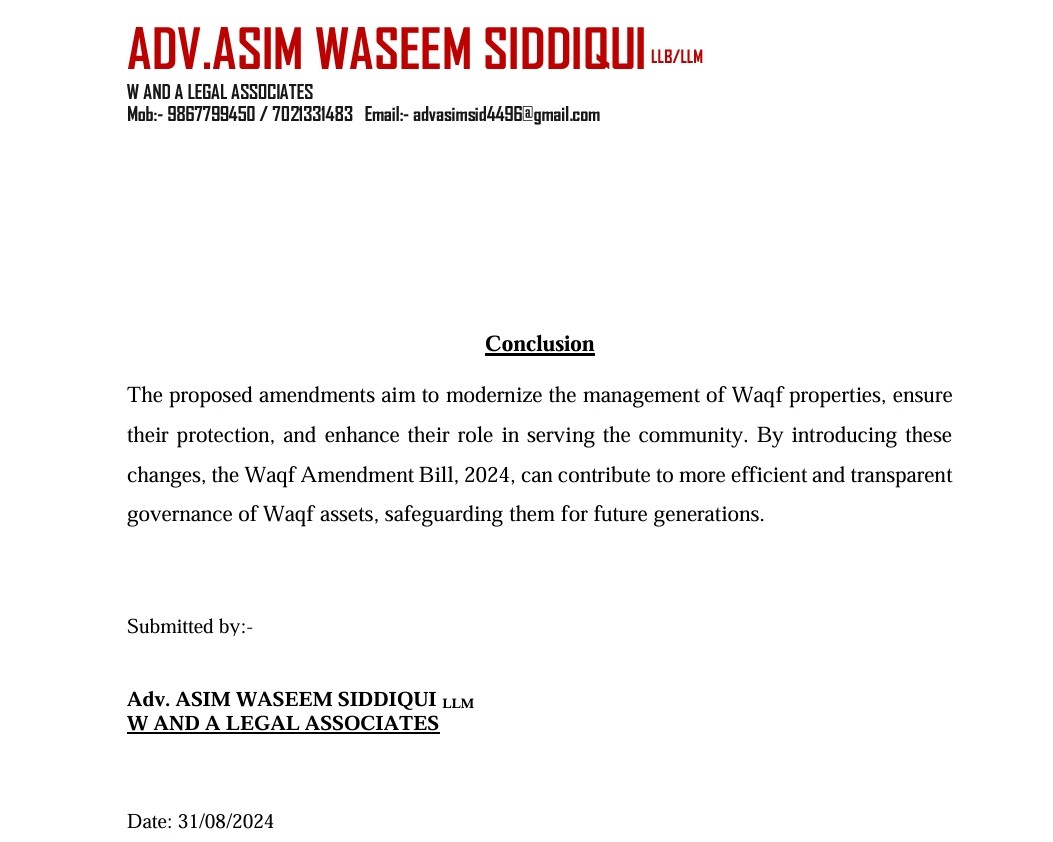
Conclusion
The proposed amendments aim to modernize the management of Waqf properties, ensure their protection, and enhance their role in serving the community. By introducing these changes, the Waqf Amendment Bill, 2024, can contribute to more efficient and transparent governance of Waqf assets, safeguarding them for future generations.
Submitted by:-
Adv. ASIM WASEEM SIDDIQUI LLM
W AND A LEGAL ASSOCIATES
Date: 31/08/2024

The Issue
To
The Join Secretary (JM),
Lok Sabha Secretariat, Room No. 440,
Parliament House Annexe, New Delhi - 110001
Based on advertisement in from official X (formerly twitter) handle of Loksabha Secretariat (@LokSabhaSectt) published on 30th August 2024 inviting suggestions on the "The Waqf (Amendment) Bill, 2024" we the desirous an Indian Citizens have gone through the Bills and would suggest to make bill more favourable for the every individual of Muslim communities instead making it to believe against the Muslim communities.
SUGGESTION FOR THE WAQF AMENDMENT BILL, 2024
PREAMBLE
Given the importance of Waqf properties in supporting social welfare, education, and religious activities within the Muslim community, and recognizing the need for modernization and enhanced governance, the following amendments are proposed to the Waqf Act to ensure transparency, better management, and protection of Waqf assets.
1. Strengthening Governance and Accountability
1.1. Establishment of Independent Waqf Tribunals
Amend the Act to establish independent Waqf Tribunals at the state level with a mandate to resolve disputes related to Waqf properties in an expedited manner.
Tribunals should be chaired by a retired judge with members who have expertise in Islamic law, property law, and public administration.
The decisions of these Tribunals should be binding, with the possibility of appeal only in higher courts under specific circumstances.
1.2. Mandatory Audits by Independent Agencies
Introduce a provision for mandatory annual audits of all Waqf properties by independent auditors appointed by the state Waqf Boards but reporting directly to the Waqf Tribunal.
Audit reports should be made publicly accessible to ensure transparency.
2. Enhancing Transparency and Public Participation
2.1. Digitalization of Waqf Records
Mandate the digitization of all Waqf property records, including registration, ownership, revenue, and expenditure.
Create a centralized online portal accessible to the public where all relevant information about Waqf properties can be viewed, ensuring transparency.
2.2. Community Involvement and Oversight
Amend the Act to include provisions for community involvement in the management of Waqf properties.
Establish local Waqf committees comprising community members with a track record of public service, responsible for overseeing the day-to-day management and reporting any irregularities to the state Waqf Board.
3. Streamlining Management and Utilization of Waqf Properties
3.1. Professional Management of Waqf Properties
Introduce provisions for the professional management of Waqf properties, including the appointment of property managers with expertise in real estate and asset management.
Waqf Boards should be empowered to enter into public-private partnerships (PPPs) for the development and better utilization of Waqf properties, provided such arrangements do not violate the religious principles governing Waqf.
3.2. Regulation of Leasing and Transfer of Waqf Properties
Amend the Act to impose stricter regulations on the leasing and transfer of Waqf properties, ensuring that such transactions are conducted at market value and are subject to approval by the Waqf Tribunal.
Introduce penalties for unauthorized leases, transfers, or misuse of Waqf properties, with clear mechanisms for the recovery of such assets.
4. Protecting Waqf Properties from Encroachment and Misuse
4.1. Special Task Force for Waqf Property Protection
Create a special task force within the state police dedicated to the protection of Waqf properties from encroachment, unauthorized construction, or illegal occupation.
The task force should work in collaboration with local authorities to promptly address any threats to Waqf properties.
4.2. Enhanced Legal Provisions Against Encroachment
Strengthen legal provisions to ensure that any encroachment or misuse of Waqf properties is treated as a criminal offense, with penalties including imprisonment, fines, and restoration of the property to its original status.
5. Capacity Building and Training
5.1. Training Programs for Waqf Board Members and Staff
Introduce mandatory training programs for Waqf Board members and staff on property management, financial accounting, legal aspects of Waqf, and community engagement.
Collaborate with academic institutions and professional bodies to develop and deliver these training programs.
5.2. Public Awareness Campaigns
Implement public awareness campaigns to educate the community about the significance of Waqf, the rights and duties of mutawallis (caretakers), and the legal frameworks governing Waqf properties.
Conclusion
The proposed amendments aim to modernize the management of Waqf properties, ensure their protection, and enhance their role in serving the community. By introducing these changes, the Waqf Amendment Bill, 2024, can contribute to more efficient and transparent governance of Waqf assets, safeguarding them for future generations.
Submitted by:-
Adv. ASIM WASEEM SIDDIQUI LLM
W AND A LEGAL ASSOCIATES
Date: 31/08/2024
Victory
Share this petition
The Decision Makers

Petition Updates
Share this petition
Petition created on August 31, 2024