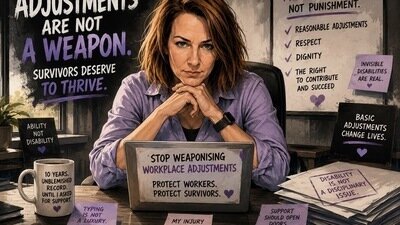

Stop Weaponising Workplace Adjustments Against Domestic Violence Survivors
The issue
Why this matters
I survived severe domestic violence, spent months in a women’s refuge, and spent a decade rebuilding my life from scratch. I built a highly successful career, typing 115 words per minute. But when a manager suddenly instructed me to use pen and paper—something a past head injury prevents me from doing—my career was targeted. Sign this petition to demand that Australian laws protect workers from being pushed out when they request basic workplace adjustments.
The Triumph: Building a Career from Scratch
Eleven years ago, I left an abusive relationship with nothing but the clothes on my back. I spent two months in a women’s refuge and lived in shared housing for five years. Slowly, I rebuilt my life.
I built a new career, bought a car, and regained my independence. I worked successfully for nearly a decade with an unblemished record. Because I type 115 words per minute, I easily worked around a permanent handwriting limitation caused by a domestic violence head injury. I believed the violence—and its consequences—were finally behind me.
The Catalyst: The Order That Unravelled My Safety
Without warning, I was instructed to stop typing. I was told to use a pen, Post-it notes, and a notebook instead.
Being asked to rely on handwritten notes was devastating. I worried about whether people would suddenly judge me because of an injury I had spent years quietly managing. I wanted to be seen for everything I could do, rather than judged by the one thing I could not.
The Retaliation: From Valued Employee to "The Problem"
When I sought support and a review of this instruction, everything changed. My work, my methods, and my capabilities were repeatedly questioned.
Somewhere along the way, I became "the problem" instead of the person who had simply asked for a reasonable workplace adjustment. Today, while trying to preserve the career I built over a decade, I am facing workplace allegations for the very first time.
The Bigger Issue: Workers Deserve to Thrive
My experience is personal, but the issue is structural. Reasonable workplace adjustments are not special treatment. They are often the difference between a person being able to contribute successfully or being pushed out of the workforce altogether.
No worker should have to fear that asking for support will result in intense, punitive scrutiny. When skilled workers are disadvantaged, everyone loses.
Our Demands to Australian Decision-Makers
We call on the Minister for Employment and Workplace Relations, the Minister for Social Services, and Australian employers to amend employment standards to require:
- Mandatory Consultation: Employers must genuinely consult with an affected worker before changing their duties, location, or working arrangements due to a disability.
- Prioritise Existing Success: If a worker has successfully performed their role using specific tools (like typing) for years, employers cannot arbitrarily revoke those tools without proving an undue business hardship.
- Trauma-Informed Training: Compulsory training for managers regarding invisible disabilities, acquired brain injuries (ABI), and trauma-informed practices.
- Stronger Legal Protections: Strengthen the Fair Work Act to prevent adverse treatment or disciplinary actions immediately following a worker's disclosure of a disability or request for accommodation.
- Recognition of Lifelong Impact: Formal recognition by employers that domestic and family violence can cause lifelong physical, neurological, and psychological disabilities that require appropriate workplace support.
The hardest part of domestic violence is not always leaving. Sometimes it is discovering that an injury caused by that violence can still threaten your livelihood eleven years later. Survivors should not have to apologise for the adjustments that allow them to work, contribute, and succeed.
Please sign this petition to ensure survivors can seek support without risking their careers, reputations, or futures.

33
The issue
Why this matters
I survived severe domestic violence, spent months in a women’s refuge, and spent a decade rebuilding my life from scratch. I built a highly successful career, typing 115 words per minute. But when a manager suddenly instructed me to use pen and paper—something a past head injury prevents me from doing—my career was targeted. Sign this petition to demand that Australian laws protect workers from being pushed out when they request basic workplace adjustments.
The Triumph: Building a Career from Scratch
Eleven years ago, I left an abusive relationship with nothing but the clothes on my back. I spent two months in a women’s refuge and lived in shared housing for five years. Slowly, I rebuilt my life.
I built a new career, bought a car, and regained my independence. I worked successfully for nearly a decade with an unblemished record. Because I type 115 words per minute, I easily worked around a permanent handwriting limitation caused by a domestic violence head injury. I believed the violence—and its consequences—were finally behind me.
The Catalyst: The Order That Unravelled My Safety
Without warning, I was instructed to stop typing. I was told to use a pen, Post-it notes, and a notebook instead.
Being asked to rely on handwritten notes was devastating. I worried about whether people would suddenly judge me because of an injury I had spent years quietly managing. I wanted to be seen for everything I could do, rather than judged by the one thing I could not.
The Retaliation: From Valued Employee to "The Problem"
When I sought support and a review of this instruction, everything changed. My work, my methods, and my capabilities were repeatedly questioned.
Somewhere along the way, I became "the problem" instead of the person who had simply asked for a reasonable workplace adjustment. Today, while trying to preserve the career I built over a decade, I am facing workplace allegations for the very first time.
The Bigger Issue: Workers Deserve to Thrive
My experience is personal, but the issue is structural. Reasonable workplace adjustments are not special treatment. They are often the difference between a person being able to contribute successfully or being pushed out of the workforce altogether.
No worker should have to fear that asking for support will result in intense, punitive scrutiny. When skilled workers are disadvantaged, everyone loses.
Our Demands to Australian Decision-Makers
We call on the Minister for Employment and Workplace Relations, the Minister for Social Services, and Australian employers to amend employment standards to require:
- Mandatory Consultation: Employers must genuinely consult with an affected worker before changing their duties, location, or working arrangements due to a disability.
- Prioritise Existing Success: If a worker has successfully performed their role using specific tools (like typing) for years, employers cannot arbitrarily revoke those tools without proving an undue business hardship.
- Trauma-Informed Training: Compulsory training for managers regarding invisible disabilities, acquired brain injuries (ABI), and trauma-informed practices.
- Stronger Legal Protections: Strengthen the Fair Work Act to prevent adverse treatment or disciplinary actions immediately following a worker's disclosure of a disability or request for accommodation.
- Recognition of Lifelong Impact: Formal recognition by employers that domestic and family violence can cause lifelong physical, neurological, and psychological disabilities that require appropriate workplace support.
The hardest part of domestic violence is not always leaving. Sometimes it is discovering that an injury caused by that violence can still threaten your livelihood eleven years later. Survivors should not have to apologise for the adjustments that allow them to work, contribute, and succeed.
Please sign this petition to ensure survivors can seek support without risking their careers, reputations, or futures.
The Decision Makers


Supporter voices
Petition Updates
Share this petition
Petition created on 12 July 2026