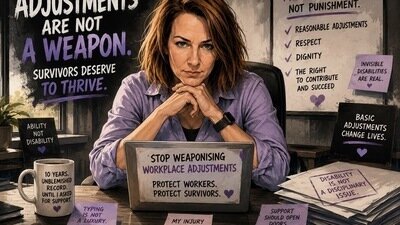

Stop Weaponising Workplace Adjustments
The issue
Protect workers with disability, including disabilities resulting from domestic and family violence.
The issue
No Australian worker should face adverse treatment, disproportionate scrutiny or disciplinary action simply because they requested a reasonable workplace adjustment for disability.
Why this matters
I survived domestic violence, spent months in a women’s refuge and spent a decade rebuilding my life from scratch.
I went on to build a successful career, using my ability to type 115 words per minute to work around a permanent handwriting impairment.
But when I was suddenly instructed to stop typing and instead use pen, paper, Post-it notes and a notebook—despite a past head injury that prevents me from relying on handwriting—I feared the career and professional reputation I had worked so hard to build were at risk.
Please sign this petition to call for stronger Australian protections for workers who request reasonable workplace adjustments.
The Triumph: Building a Career from Scratch
Eleven years ago, I left an abusive relationship with nothing but the clothes on my back. I spent two months in a women’s refuge and lived in shared housing for five years. Slowly, I rebuilt my life.
I established a new career, bought a car and regained my independence. I worked successfully for nearly a decade with an unblemished record.
Because I type approximately 115 words per minute, I was able to work effectively around a permanent handwriting limitation caused by a domestic violence head injury. I believed the violence—and its consequences—were finally behind me.
The Catalyst: When Everything Changed
Without warning, I was instructed to stop typing and instead use handwritten notes, Post-it notes and a notebook.
Being asked to rely on handwriting was devastating. I worried that people would suddenly judge me because of an injury I had spent years quietly managing.
I wanted to continue being recognised for everything I could do—not defined by the one thing I could not.
After I Asked for Support
After I asked for the instruction to be reconsidered and sought support, my experience of the workplace changed significantly.
My work, my methods and my capabilities came under increasing scrutiny.
Somewhere along the way, I became “the problem” instead of the employee who had simply asked to continue using the method that had enabled me to perform my role successfully for years.
Today, while trying to preserve the career I spent more than a decade building, I am facing workplace allegations for the first time.
The Bigger Issue: All Workers Deserve to Thrive
My experience is personal, but the issue is structural.
Every day, Australian workers disclose disabilities, chronic illnesses, neurodivergence, acquired injuries and the ongoing effects of trauma. Most simply want to continue contributing their skills with appropriate support.
Workplace systems should encourage those conversations—not create fear that asking for assistance could jeopardise someone’s career.
Reasonable workplace adjustments are not special treatment. They are often what enables a person with disability to contribute, succeed and remain in employment.
No worker should have to fear that disclosing a disability or requesting support will result in adverse treatment, damage to their reputation or disciplinary escalation.
When skilled workers are pushed out instead of supported, individuals, workplaces and the wider community all lose.
Our Demands to Australian Decision-Makers
We call upon the Minister for Employment and Workplace Relations, the Minister for Social Services, Australian governments and employers to strengthen workplace protections by requiring:
Mandatory Consultation
Employers must genuinely consult with an affected worker before changing duties, work methods, location or working arrangements where disability or an existing adjustment may be affected.
Protection of Successful Existing Adjustments
Where a worker has successfully performed their role using particular tools, methods or arrangements for an extended period, those arrangements should not be removed without consultation, documented reasons and genuine consideration of reasonable alternatives.
Trauma-Informed Leadership
Managers should receive appropriate education about invisible disabilities, acquired brain injuries, trauma-informed practice and the lifelong effects of domestic and family violence.
Stronger Protection Against Adverse Treatment
Australian workplace laws should provide clear protection for workers who disclose a disability or request a reasonable workplace adjustment, ensuring they are not subjected to adverse treatment or disciplinary processes because they sought appropriate support.
Recognition of the Lifelong Impact of Violence
Workplace laws and policies should recognise that domestic and family violence can result in lifelong physical, neurological and psychological disabilities requiring ongoing workplace support.
A Note About My Identity
I am sharing this petition anonymously while related legal and employment proceedings remain unresolved.
I work within a large public institution. As an individual worker, there is a significant imbalance between my personal resources and those available to a government employer when employment disputes arise.
Government employers may have access to publicly funded legal representation when defending employment claims. Individual workers often have to fund legal advice themselves while simultaneously managing reduced income and ordinary living expenses. That imbalance can make it extremely difficult to pursue legitimate legal remedies.
This petition is not about denying employers legal representation. It is about recognising the reality many workers face when challenging powerful institutions while trying to protect their livelihood, health, financial security and professional reputation.
Speaking publicly while legal proceedings remain active could expose me to further personal and professional consequences and may affect my legal position. Remaining anonymous is therefore not about avoiding scrutiny; it is a necessary safeguard while I pursue the legal processes available to me.
Once those proceedings have concluded, and subject to legal advice and any applicable restrictions, I intend to share the fuller circumstances that inspired this campaign.
Eleven years ago, I publicly campaigned for stronger protections for victims of domestic violence after repeated breaches of my violence restraining order were negotiated away. That petition attracted more than 30,000 supporters and my story was reported nationally.
When it is legally safe and appropriate to do so, I hope to connect that earlier campaign with the full story behind this one.
Until then, I ask people to consider the principle at the heart of this petition:
No Australian worker should risk their career, reputation or livelihood simply because they disclosed a disability or requested a reasonable workplace adjustment.
If you believe no Australian worker should have to choose between protecting their health and protecting their career, please sign and share this petition. Together we can help create workplaces where fairness, dignity and inclusion are more than aspirations—they are everyday practice.

90
The issue
Protect workers with disability, including disabilities resulting from domestic and family violence.
The issue
No Australian worker should face adverse treatment, disproportionate scrutiny or disciplinary action simply because they requested a reasonable workplace adjustment for disability.
Why this matters
I survived domestic violence, spent months in a women’s refuge and spent a decade rebuilding my life from scratch.
I went on to build a successful career, using my ability to type 115 words per minute to work around a permanent handwriting impairment.
But when I was suddenly instructed to stop typing and instead use pen, paper, Post-it notes and a notebook—despite a past head injury that prevents me from relying on handwriting—I feared the career and professional reputation I had worked so hard to build were at risk.
Please sign this petition to call for stronger Australian protections for workers who request reasonable workplace adjustments.
The Triumph: Building a Career from Scratch
Eleven years ago, I left an abusive relationship with nothing but the clothes on my back. I spent two months in a women’s refuge and lived in shared housing for five years. Slowly, I rebuilt my life.
I established a new career, bought a car and regained my independence. I worked successfully for nearly a decade with an unblemished record.
Because I type approximately 115 words per minute, I was able to work effectively around a permanent handwriting limitation caused by a domestic violence head injury. I believed the violence—and its consequences—were finally behind me.
The Catalyst: When Everything Changed
Without warning, I was instructed to stop typing and instead use handwritten notes, Post-it notes and a notebook.
Being asked to rely on handwriting was devastating. I worried that people would suddenly judge me because of an injury I had spent years quietly managing.
I wanted to continue being recognised for everything I could do—not defined by the one thing I could not.
After I Asked for Support
After I asked for the instruction to be reconsidered and sought support, my experience of the workplace changed significantly.
My work, my methods and my capabilities came under increasing scrutiny.
Somewhere along the way, I became “the problem” instead of the employee who had simply asked to continue using the method that had enabled me to perform my role successfully for years.
Today, while trying to preserve the career I spent more than a decade building, I am facing workplace allegations for the first time.
The Bigger Issue: All Workers Deserve to Thrive
My experience is personal, but the issue is structural.
Every day, Australian workers disclose disabilities, chronic illnesses, neurodivergence, acquired injuries and the ongoing effects of trauma. Most simply want to continue contributing their skills with appropriate support.
Workplace systems should encourage those conversations—not create fear that asking for assistance could jeopardise someone’s career.
Reasonable workplace adjustments are not special treatment. They are often what enables a person with disability to contribute, succeed and remain in employment.
No worker should have to fear that disclosing a disability or requesting support will result in adverse treatment, damage to their reputation or disciplinary escalation.
When skilled workers are pushed out instead of supported, individuals, workplaces and the wider community all lose.
Our Demands to Australian Decision-Makers
We call upon the Minister for Employment and Workplace Relations, the Minister for Social Services, Australian governments and employers to strengthen workplace protections by requiring:
Mandatory Consultation
Employers must genuinely consult with an affected worker before changing duties, work methods, location or working arrangements where disability or an existing adjustment may be affected.
Protection of Successful Existing Adjustments
Where a worker has successfully performed their role using particular tools, methods or arrangements for an extended period, those arrangements should not be removed without consultation, documented reasons and genuine consideration of reasonable alternatives.
Trauma-Informed Leadership
Managers should receive appropriate education about invisible disabilities, acquired brain injuries, trauma-informed practice and the lifelong effects of domestic and family violence.
Stronger Protection Against Adverse Treatment
Australian workplace laws should provide clear protection for workers who disclose a disability or request a reasonable workplace adjustment, ensuring they are not subjected to adverse treatment or disciplinary processes because they sought appropriate support.
Recognition of the Lifelong Impact of Violence
Workplace laws and policies should recognise that domestic and family violence can result in lifelong physical, neurological and psychological disabilities requiring ongoing workplace support.
A Note About My Identity
I am sharing this petition anonymously while related legal and employment proceedings remain unresolved.
I work within a large public institution. As an individual worker, there is a significant imbalance between my personal resources and those available to a government employer when employment disputes arise.
Government employers may have access to publicly funded legal representation when defending employment claims. Individual workers often have to fund legal advice themselves while simultaneously managing reduced income and ordinary living expenses. That imbalance can make it extremely difficult to pursue legitimate legal remedies.
This petition is not about denying employers legal representation. It is about recognising the reality many workers face when challenging powerful institutions while trying to protect their livelihood, health, financial security and professional reputation.
Speaking publicly while legal proceedings remain active could expose me to further personal and professional consequences and may affect my legal position. Remaining anonymous is therefore not about avoiding scrutiny; it is a necessary safeguard while I pursue the legal processes available to me.
Once those proceedings have concluded, and subject to legal advice and any applicable restrictions, I intend to share the fuller circumstances that inspired this campaign.
Eleven years ago, I publicly campaigned for stronger protections for victims of domestic violence after repeated breaches of my violence restraining order were negotiated away. That petition attracted more than 30,000 supporters and my story was reported nationally.
When it is legally safe and appropriate to do so, I hope to connect that earlier campaign with the full story behind this one.
Until then, I ask people to consider the principle at the heart of this petition:
No Australian worker should risk their career, reputation or livelihood simply because they disclosed a disability or requested a reasonable workplace adjustment.
If you believe no Australian worker should have to choose between protecting their health and protecting their career, please sign and share this petition. Together we can help create workplaces where fairness, dignity and inclusion are more than aspirations—they are everyday practice.
The Decision Makers


Supporter voices
Petition Updates
Share this petition
Petition created on 12 July 2026