

Stop the unjust criminal prosecution of Ukrainian Orthodox Church Metropolitan Jonathan
The Issue
On August 7, 2023, in the Vinnytsia City Court, the 74-year-old Metropolitan Jonathan of Tulchyn and Bratslav (Yeletskykh Anatoly Ivanovich) was sentenced to 5 years in prison with confiscation of property.
The sentence to Jonathan is the first sentence to a UOC hierarch with a real prison term. According to the SBU, since February 2022, the special service has opened 65 criminal cases against the clergy of the UOC, including high-ranking ones. 15 convictions have already been handed down. In addition, 19 priests of the canonical Ukrainian Orthodox Church were deprived of Ukrainian citizenship by the decree of Volodymyr Zelensky. According to some reports, among them is the UOC Metropolitan Jonathan of Tulchyn and Bratslav. This information is confirmed by the fact that in the court verdict on his case he is listed as a citizen of the Russian Federation, whose "citizenship of Ukraine has been terminated on the basis of the Decree of the President of Ukraine."
Yeletskykh Anatoly Ivanovich was born on January 30, 1949, in the village of Shatalovka in the Voronezh (now Belgorod) region in the family of a teacher. He is of mixed Ukrainian, Russian, and Belorussian descent. His relatives now live in Kyiv.
Metropolitan Jonathan is one of the most famous hierarchs of the UOC. In December 1986, he was summoned to the KGB in connection with the distribution of the book "The Gulag Archipelago" by Alexander Solzhenitsyn among seminarians and then deprived of his temporary Leningrad residence permit. During the year, he could not find a new place of service because of the obstacles that the KGB put up. In the end, he decided to return to his parents in Kyiv. He arrived and introduced himself to Filaret.
"After some time, I received a call to the City Council on Khreshchatyk. A nondescript, “faceless” person meets me and says: “You were not summoned to the city council, but to the KGB, let's talk.” Right on the street, we talked. He was aware of all my affairs and difficulties. And then he says that Vladyka Philaret would like to take me to Vladimir Cathedral. And he asked: "And how do I look at the fact that he, they say, has a family - a wife and children?" I thought that he was taking me at gunpoint, but my instinct told me that he was asking me about this for a reason. I evasively answer that, they say, I'm a new person here and then, after all, these are all rumors, not facts, and that each person will answer for his personal sins before God," Metropolitan Jonathan recalled.
For half a year, Filaret did not determine a place for him but instructed him to serve in the house church in the Kyiv residence on Pushkinskaya Street, 36. Filaret, finally convinced that Jonathan did not pose a danger, appointed him to a church service in the Vladimir Cathedral.
Then he was the first abbot of the Kyiv-Pechersk Lavra after its transfer to the church in 1992 and began to rebuild the monastery. In the past, the bishop of large dioceses - Kherson, Sumy. Since November 22, 2006, Jonathan has been the ruling bishop of the Tulchyn and Bratslav diocese (part of the Vinnitsia region with the center in the city of Tulchyn) of the Ukrainian Orthodox Church.
Vladyka Jonathan is known as a church composer whose hymns are performed at divine services in many Orthodox churches around the world. Among his works "Chernobyl Liturgy" dedicated to the memory of those who died during the liquidation of the accident at the Chernobyl nuclear power plant, is widely known. The "Chernobyl Liturgy" is a kind of Orthodox "Requiem" dedicated to the memory of the fallen heroes-liquidators.
But Vladyka received the greatest fame because of the confrontation with the former Metropolitan of Kyiv Filaret (Denisenko). After a direct conflict with Denisenko, Jonathan (then still a bishop) was banned from serving in 1991, and after that, he was defrocked. The reason for the confrontation was disagreement on the issue of separation from the Moscow Patriarchate. Jonathan believed that the UOC should be in unity with the ROC. Later, after the election of another metropolitan (Vladimir), the defrocking of Bishop Jonathan was recognized as having no canonical grounds and therefore invalid.
Today, Vladyka is an elderly and sick person, insulin-dependent, who has undergone many surgeries. It is reported that lately, it has been difficult for him to serve, often the level of sugar in his blood has risen. Sometimes Vladyka sat down during the service, he could not stand for long, but at the same time he always delivered wonderful sermons. After the searches, he underwent heart surgery, and due to the illegal deprivation of citizenship, he lost the right to health insurance and legal protection: 5 years in prison for him is tantamount to a death sentence. However, the verdict states that the court took into account information about the state of health of the accused.
Ignoring the principle of the presumption of innocence and the basic principles of legal proceedings
In October 2022, the SBU conducted searches at the home of Metropolitan Jonathan as part of criminal proceedings opened under Article 161 of the Criminal Code of Ukraine (violation of the equality of citizens depending on their race, nationality, religious beliefs, etc.).
A day before the publication of the SBU, news about this search appeared in the media. With a clear photograph of the bishop and his name. Obviously, this is the same photo of the operational shooting, which later appeared in a processed form on the official pages of the SBU. That is, someone deliberately "leaked" photos and information to the media so that the person of the suspect became known and the campaign to discredit Bishop Jonathan and hatred for the UOC began even before the investigation and sentence.
And it seems to have worked as intended. Metropolitan Jonathan of Tulchyn and Bratslav, received letter 03-10/205 dated April 17, 2023 from the head of the Department of Nationalities and Religions of the Vinnytsia Regional State Administration, Ihor Oleksandrovych Saletskyi, in which the latter tried to prevent him from performing religious rites in the Ukrainian Orthodox Church in the Vinnytsia region, based on religious beliefs.
So, under what articles was Vladyka convicted:
- according to part 2 of Art. 161 of the Criminal Code of Ukraine (violation of the equality of citizens depending on their race, nationality, regional affiliation, religious beliefs, disability, and other characteristics) - 4 years in prison without deprivation of the right to hold certain positions or engage in certain activities;
- according to part 3 of Art. 436-2 of the Criminal Code of Ukraine (justification, recognition as lawful, denial of the armed aggression of the Russian Federation against Ukraine, glorification of its participants) - 5 years in prison with confiscation of property;
- according to part 3 of Art. 3 p.m. 2 tbsp. 109 of the Criminal Code of Ukraine (actions aimed at forcibly changing or overthrowing the constitutional order or seizing state power) - 1 year in prison with confiscation of property;
- according to part 3 of Art. 15 - part 1 of Art. 110 of the Criminal Code of Ukraine (encroachment on the territorial integrity and inviolability of Ukraine, distribution of materials calling for changing the boundaries of the territory and state border of Ukraine) - 3 years in prison with confiscation of property.
Since, according to Ukrainian legislation, a less severe punishment is absorbed by a more severe one, and it is impossible to take away the same property three times, according to the totality of sentences, the metropolitan was sentenced to 5 years in prison with confiscation of property.
At the same time, if you look at the verdict, it becomes clear that the first article of the accusation is proved only by the episode with the article in defense of the canonical church. It is important to note here that before the current war in Ukraine there were no sentences with a real term under Article 161 of the Criminal Code of Ukraine, and even more so there were none against the "patriots of Ukraine", who often fomented this very hatred.
As the main evidence of guilt, the prosecution included an article on the Internet, which Jonathan allegedly wrote, as well as leaflets that were found during the search. The verdict hides the names of specific materials, but the Ukrainian odious publication Babel lists the titles of several leaflets: "Donbass - Russia", "History of Crimea", "Russian authorities, a call for you" and notes that, according to the prosecutor, they contain such phrases like "Bandera power" and "brown plague".
The article in defense of the canonical UOC in question was called "With an open helmet, without a visor. Notes on the margins of recent events in the Orthodox world" and has already been removed from the website of the Tulchyn diocese. According to the findings of the linguistic examination conducted by the SBU, in the article Jonathan denies the independence of the OCU, calls their priests "self-consecrated schismatics", and Ukraine - "Little Russia" (in the context of the events of the 17th century). In response to the conclusions of the pre-trial examination of Metropolitan Jonathan’s article in defense of the canonical UOC, Archimandrite Mitrofan (Bozhko), Academic Secretary of the Kyiv Theological Academy, notes the apologetic and polemical essence of Jonathan’s publication and emphasizes that there is no reason to equate religious controversy with inciting religious hatred. However, these arguments were not taken into account by the court.
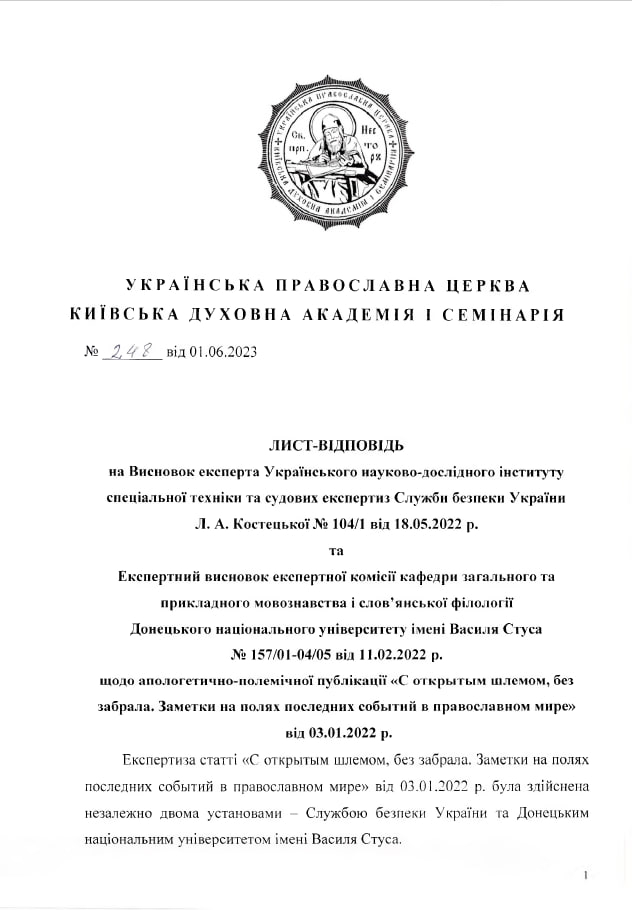
The editor of the diocesan newspaper and the administrator of the official website of the Tulchyn diocese, who was interrogated in court and posted Vladyka's article during the interrogation, noted that he considers the publication "an ordinary polemical article, interesting to theologians and historians and by no means ordinary citizens."
The Union of Orthodox Journalists believes that the position of Metropolitan Jonathan regarding the status of the UOC is not new. He believed and still believes that the UOC should be in unity with the ROC. In Ukraine today, this position looks ambiguous.
"This is an internal church issue, one cannot be imprisoned for this. This fact is understood not only by us but also by the authorities. Therefore, the bishop was tried not for a personal vision of the way for the further existence of the UOC, but on completely different charges, which are as absurd as they are falsified", writes the UOJ.
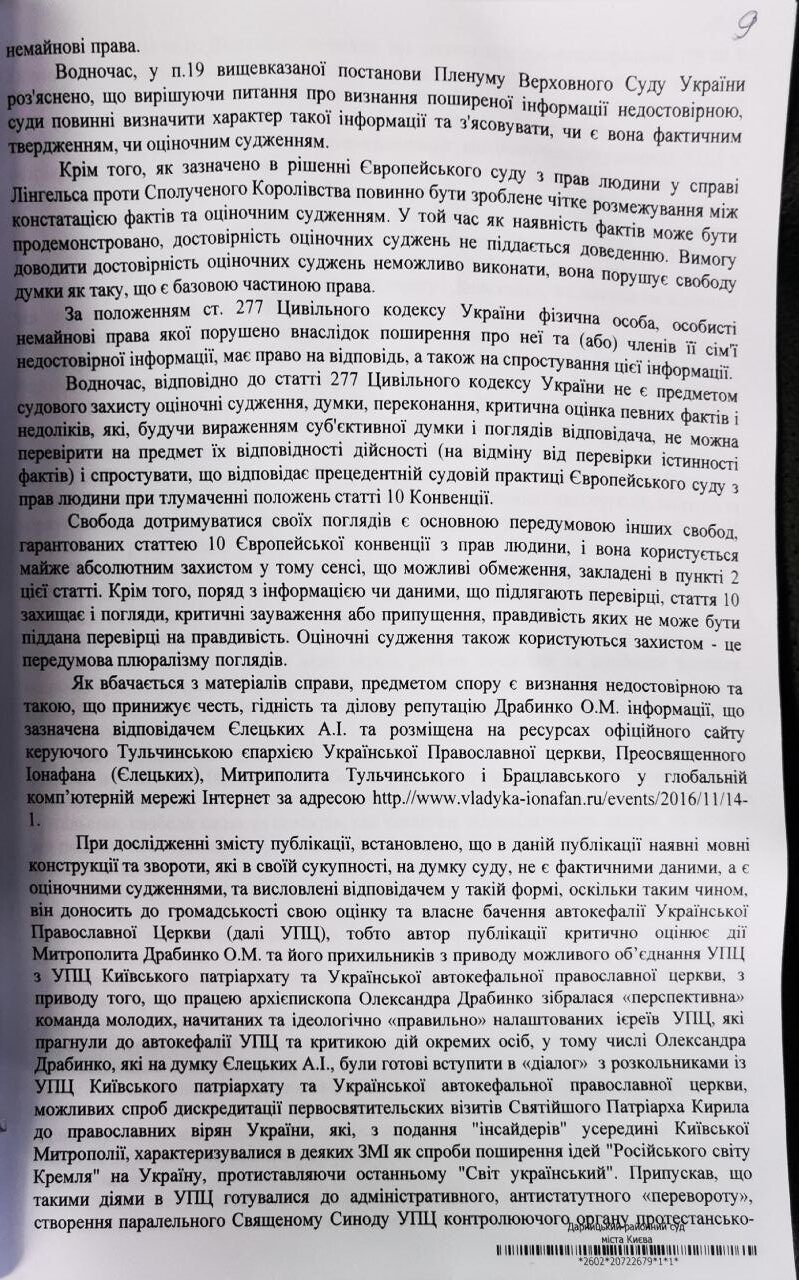
Also, the court’s attention was drawn to the judicial decisions dated back to 2019 year and published for the first time in January, 2023. Then the Darnitsky District Court of Kiyv and the Kyiv Court of Appeal considered the claim against Metropolitan Jonathan Yeletsky from citizen Alexander Drabinko - on the protection of honor, dignity and business reputation. In this litigation, historians and lawyers will be especially interested in the references of the Darnitsky District Court of Kiev to the precedents of European courts for refusing to satisfy the claim of Alexander Drabinko and to justify Metropolitan Jonathan.
And three other accusations of serious crimes - allegedly found by SBU officers during a search of leaflets in paper and electronic form, which the metropolitan, according to the prosecution, found on the Internet, downloaded, then printed, and had the intention of distributing them.
Searches at the place of residence of the hierarch and in the office of his diocesan administration, during which political leaflets were allegedly found, were carried out with gross violations (lack of a video recording of the fact that the leaflets were found; contradictory testimonies of witnesses who did not see where and how the leaflets were found; an absurd statement by a police officer during interrogation, as if he “does not remember” where he found the leaflets).
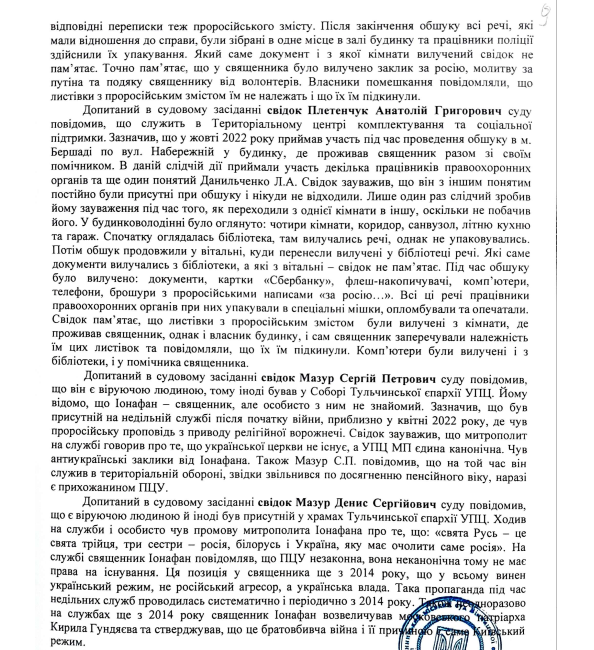
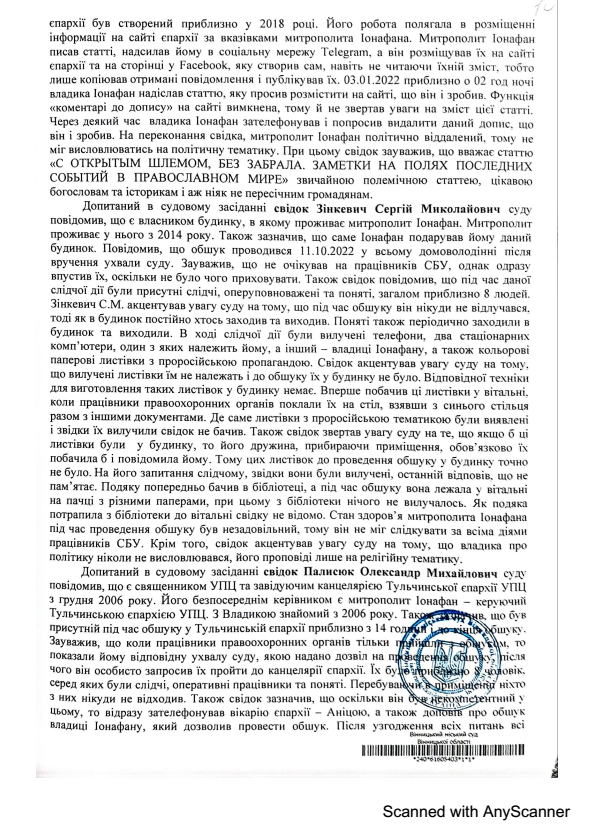
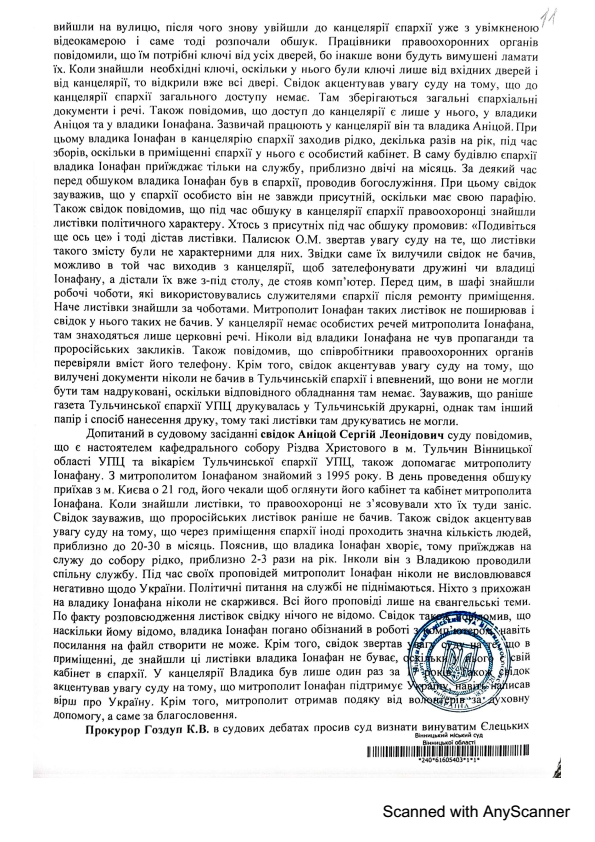
As for the flyers, they seem to have been found behind work boots in the diocesan office. The witnesses interrogated by the court did not see the moment of their discovery by the investigator.
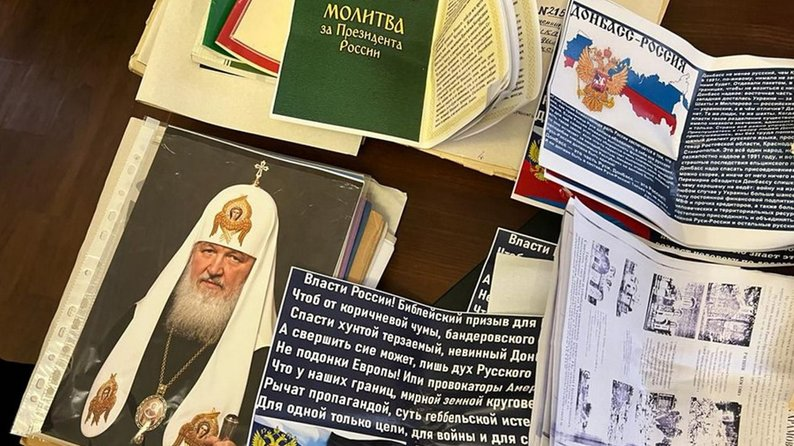
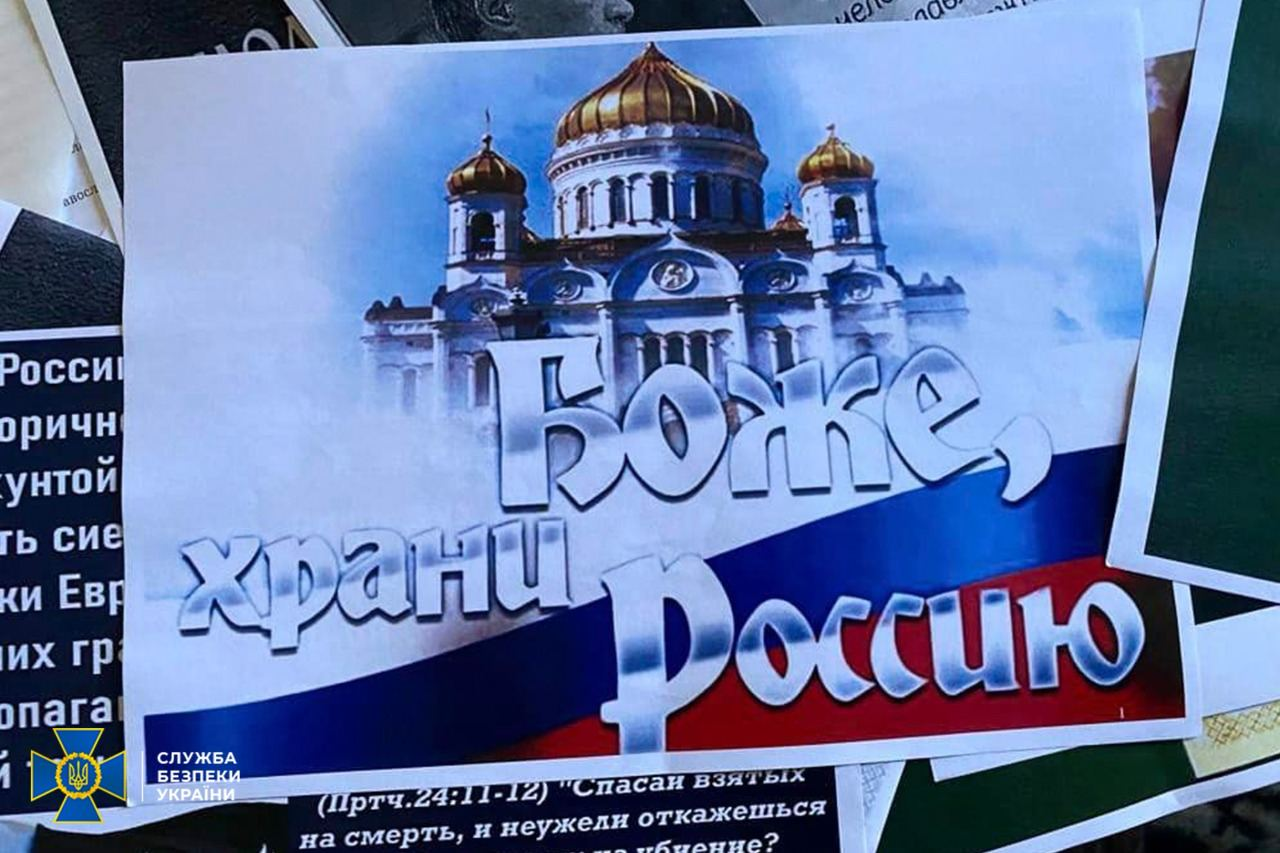
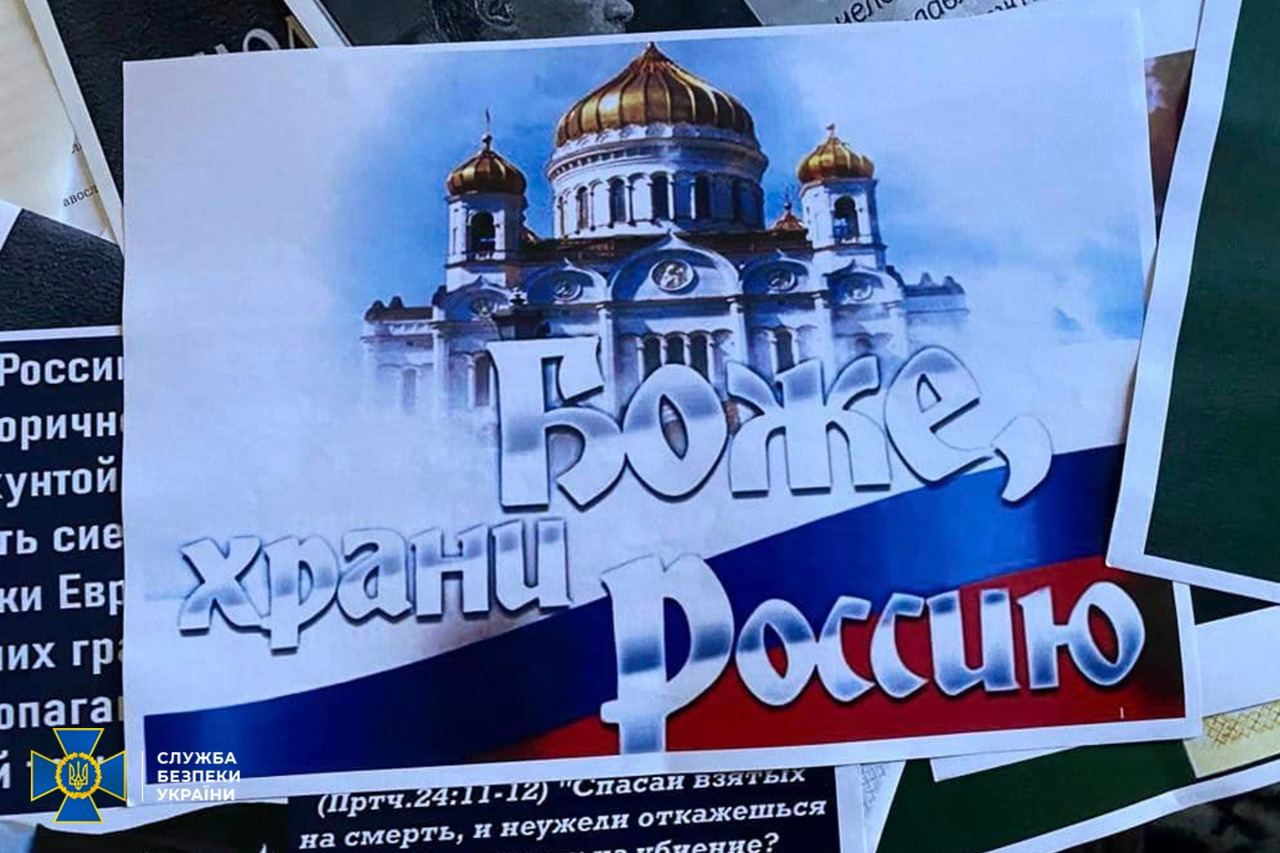
One of the witnesses claimed that if they had been in the building before the search, his wife, who was cleaning the house, would have found them and would have informed him, so these leaflets were definitely not in the building before the search. The court, however, decided to "critically evaluate the testimonies of some of the witnesses, which did not suit it since these witnesses are canonically subordinate to the accused and therefore cannot be considered objective and impartial." Although, testimonies of two witnesses who are relatives for each other and belong to the opposing Orthodox Church of Ukraine didn't cause any doubts from the judges.
The allegedly found leaflets were present in several copies, which allowed the prosecution to resolve the issue of publicity, which was necessary for some of the charges. So, according to the examination: "Provided that the materials provided for the study were not in one copy or distributed on the Internet, then they are public."
After the verdict, the Metropolitan’s lawyer, Igor Chudovsky, in an interview with the Ukrainian Orthodox resource Pershiy Cossack, said that the verdict was unexpected: of the current legislation on obtaining evidence, on the artificial creation of evidence, he did not answer and was silent. It seemed like he totally agreed. The court behaved quite tolerantly. Let the defense speak. And on Mon at 16 o'clock, like a bolt from the sky, a guilty verdict fell on us.
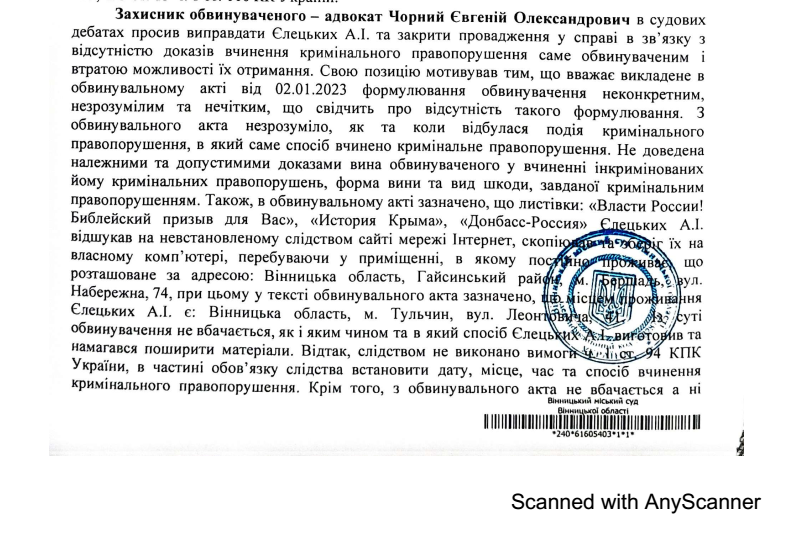
The investigation was unable to prove the fact of malicious intent, the fact and method of printing leaflets, and the fact of their distribution, which is contrary to the principles of legal proceedings. The verdict repeatedly states that Metropolitan Jonathan allegedly intended to distribute leaflets in the diocesan administration (among whom?), but did not have time to do this "due to circumstances beyond our control."
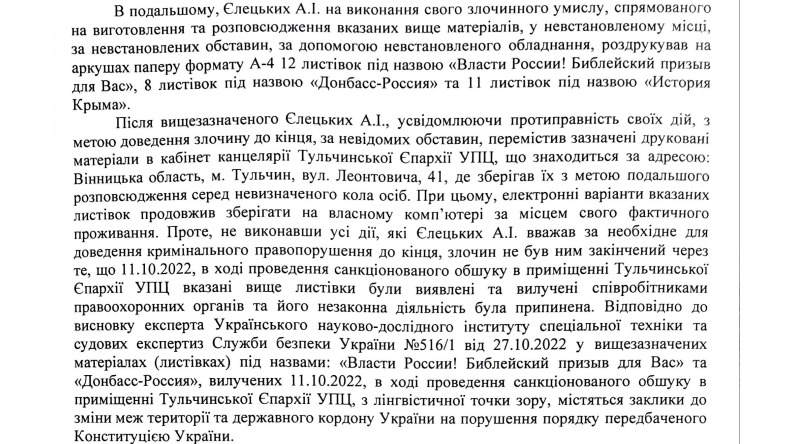
The court ignored expert opinions on the way the leaflets were produced. The investigation claimed that Metropolitan Jonathan printed out the proclamations personally on his own black-and-white printer. But, according to experts, the leaflets are printed in color printing in a typographical way, and it is impossible to make them on a home printer.
In its verdict, the court hastened to order the destruction of material evidence, including leaflets of dubious origin.
What is especially difficult to understand is that the case also contains two categories of very strange evidence, which the court scrupulously lists in the verdict.
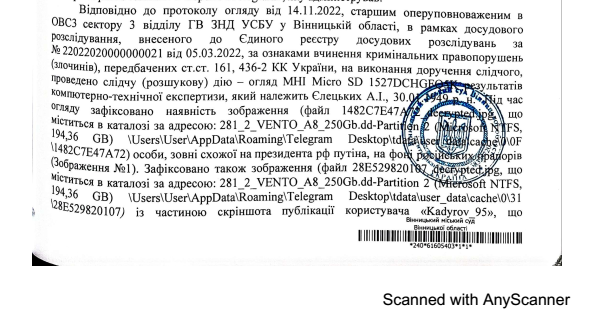
The first group is the Telegram cache. To make it clear, the Telegram cache stores a variety of random material that was once downloaded to the phone, even by viewing it on some channel or was sent by someone. For example, what was allegedly found among the photo files: "an image of a person who looks like the President of Ukraine, with the inscription:" Akhmat is power! a hat with earflaps, in front of which is a cake with the inscription "I love Russia." Also, on one of the carriers, a file was found with the famous poem "I was treated by a Donetsk doctor," in which, according to the investigators, "representatives of pseudo-formations of the Donetsk region are glorified."
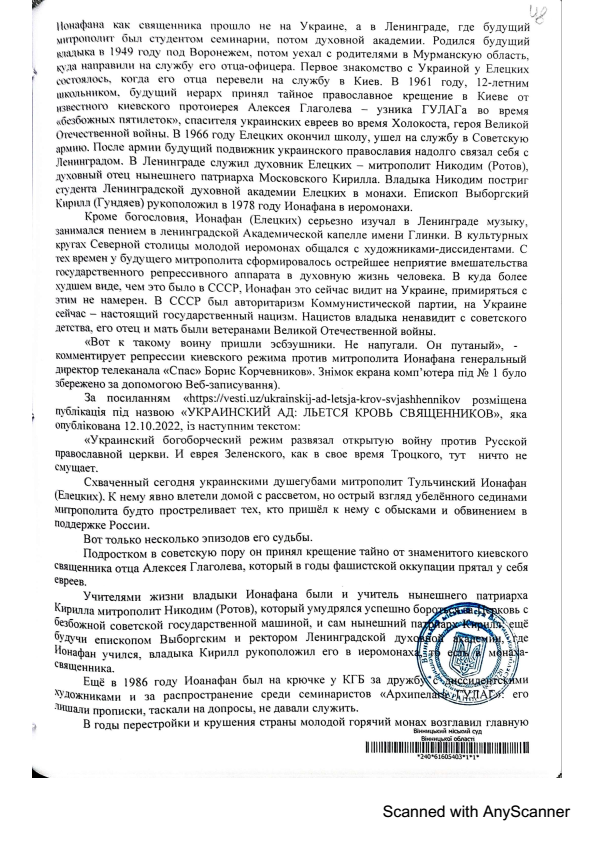
The second group of strange evidence in the court materials is the publications about Jonathan after the searches and arrest as evidence of guilt. There are many similar ones there, but here, for example, is the publication of Archimandrite Klavdian, the abbot of the monastery in Tula, dated October 13, 2022, after the searches at Jonathan's. It is completely incomprehensible how the investigation and the court can accept materials written by third parties as evidence of guilt.
Yet, according to the verdict, "the guilt of Yeletskykh in committing the criminal offenses he is charged with has been fully proven by the materials of the criminal proceedings." Moreover, materials from two strange groups, including publications by third parties on Russian news resources (after the searches), which cannot be attributed to the actions and activities of the Metropolitan himself, were recognized by the court as "indirect evidence of the accused's attachment to the aggressor state of the Russian Federation, its President Putin, as well as Patriarch Kirill of Moscow, Primate of the Russian Orthodox Church.
A letter of support for Metropolitan Jonathan has been sent by Archbishop Anastassy of Albania.
All witnesses confirm the hierarch's apolitical nature, his meek nature, and advanced age. Metropolitan Jonathan was charged with poems and musical works written by him dedicated to Russia and the Russian Church, despite the fact that these works were written and published long before the start of the Russian-Ukrainian armed conflict, and despite the fact that he has similar poems and chants dedicated to Ukraine and the Ukrainian people. In peacetime, Metropolitan Jonathan really made great efforts to ensure that enmity between the Russian and Ukrainian peoples did not happen. But he did it for Christian and not political reasons: a person who made great efforts to preserve peace between peoples unjustly became a political victim of the war.
All four judges of the local city court in Tulchyn recoiled, refusing to consider the fabricated case against the bishop who is known only from the good side.
In the text of Metropolitan Jonathan's sentence, the liturgical commemoration of the Primate of one's Church, which is the norm for any Orthodox bishop and clergyman in the world, is in fact recognized as a criminal offense. In fact, the secular state tells the Orthodox Church whom she should or should not commemorate.
In his turn, Patriarch Bartholomew is silent because he hopes that the Ukrainian bishops will begin to commemorate the “correct Patriarch,” that is, him personally. In fact, the punishment for disobedience to the Patriarch of Constantinople is five years in prison, and Patriarch Bartholomew tacitly agrees with such a formulation of the issue.
Representatives of Constantinople, such as recently Metropolitan Emmanuel of Chalcedon, visit Kyiv, meet with the Ukrainian authorities in the midst of persecution, and declare their support. One of the key organizers of the persecution, Viktor Yelensky, meets with Patriarch Bartholomew and receives his blessing to continue his activities.
As a result of the verdict, the parties expressed their desire to continue the legal battle. As Konstantin Gozdup, a representative of the Vinnitsia regional prosecutor's office, noted, the prosecutor's office will appeal against the verdict and demand an increase in the term of imprisonment for the metropolitan.
The legal department of the UOC also commented on the verdict of Metropolitan Jonathan. Lawyers insist that the verdict on Vladyka’s matter is subject to review and annulment by the court of appeal, as it is unlawful and illegal. They also note that in the charge under Art. Art. 109-110 of the Criminal Code of Ukraine, the prosecutor and the court applied the concept of "unfinished attempt on a criminal offense":
"Actions aimed at forcibly changing or overthrowing the constitutional order or seizing state power, encroaching on the territorial integrity and inviolability of Ukraine by Metropolitan Jonathan of Tulchyn and Bratslav were not committed, but he was convicted for these actions, which completely contradicts Art. 13 of the Criminal Code," the legal department draws attention.

1,119
The Issue
On August 7, 2023, in the Vinnytsia City Court, the 74-year-old Metropolitan Jonathan of Tulchyn and Bratslav (Yeletskykh Anatoly Ivanovich) was sentenced to 5 years in prison with confiscation of property.
The sentence to Jonathan is the first sentence to a UOC hierarch with a real prison term. According to the SBU, since February 2022, the special service has opened 65 criminal cases against the clergy of the UOC, including high-ranking ones. 15 convictions have already been handed down. In addition, 19 priests of the canonical Ukrainian Orthodox Church were deprived of Ukrainian citizenship by the decree of Volodymyr Zelensky. According to some reports, among them is the UOC Metropolitan Jonathan of Tulchyn and Bratslav. This information is confirmed by the fact that in the court verdict on his case he is listed as a citizen of the Russian Federation, whose "citizenship of Ukraine has been terminated on the basis of the Decree of the President of Ukraine."
Yeletskykh Anatoly Ivanovich was born on January 30, 1949, in the village of Shatalovka in the Voronezh (now Belgorod) region in the family of a teacher. He is of mixed Ukrainian, Russian, and Belorussian descent. His relatives now live in Kyiv.
Metropolitan Jonathan is one of the most famous hierarchs of the UOC. In December 1986, he was summoned to the KGB in connection with the distribution of the book "The Gulag Archipelago" by Alexander Solzhenitsyn among seminarians and then deprived of his temporary Leningrad residence permit. During the year, he could not find a new place of service because of the obstacles that the KGB put up. In the end, he decided to return to his parents in Kyiv. He arrived and introduced himself to Filaret.
"After some time, I received a call to the City Council on Khreshchatyk. A nondescript, “faceless” person meets me and says: “You were not summoned to the city council, but to the KGB, let's talk.” Right on the street, we talked. He was aware of all my affairs and difficulties. And then he says that Vladyka Philaret would like to take me to Vladimir Cathedral. And he asked: "And how do I look at the fact that he, they say, has a family - a wife and children?" I thought that he was taking me at gunpoint, but my instinct told me that he was asking me about this for a reason. I evasively answer that, they say, I'm a new person here and then, after all, these are all rumors, not facts, and that each person will answer for his personal sins before God," Metropolitan Jonathan recalled.
For half a year, Filaret did not determine a place for him but instructed him to serve in the house church in the Kyiv residence on Pushkinskaya Street, 36. Filaret, finally convinced that Jonathan did not pose a danger, appointed him to a church service in the Vladimir Cathedral.
Then he was the first abbot of the Kyiv-Pechersk Lavra after its transfer to the church in 1992 and began to rebuild the monastery. In the past, the bishop of large dioceses - Kherson, Sumy. Since November 22, 2006, Jonathan has been the ruling bishop of the Tulchyn and Bratslav diocese (part of the Vinnitsia region with the center in the city of Tulchyn) of the Ukrainian Orthodox Church.
Vladyka Jonathan is known as a church composer whose hymns are performed at divine services in many Orthodox churches around the world. Among his works "Chernobyl Liturgy" dedicated to the memory of those who died during the liquidation of the accident at the Chernobyl nuclear power plant, is widely known. The "Chernobyl Liturgy" is a kind of Orthodox "Requiem" dedicated to the memory of the fallen heroes-liquidators.
But Vladyka received the greatest fame because of the confrontation with the former Metropolitan of Kyiv Filaret (Denisenko). After a direct conflict with Denisenko, Jonathan (then still a bishop) was banned from serving in 1991, and after that, he was defrocked. The reason for the confrontation was disagreement on the issue of separation from the Moscow Patriarchate. Jonathan believed that the UOC should be in unity with the ROC. Later, after the election of another metropolitan (Vladimir), the defrocking of Bishop Jonathan was recognized as having no canonical grounds and therefore invalid.
Today, Vladyka is an elderly and sick person, insulin-dependent, who has undergone many surgeries. It is reported that lately, it has been difficult for him to serve, often the level of sugar in his blood has risen. Sometimes Vladyka sat down during the service, he could not stand for long, but at the same time he always delivered wonderful sermons. After the searches, he underwent heart surgery, and due to the illegal deprivation of citizenship, he lost the right to health insurance and legal protection: 5 years in prison for him is tantamount to a death sentence. However, the verdict states that the court took into account information about the state of health of the accused.
Ignoring the principle of the presumption of innocence and the basic principles of legal proceedings
In October 2022, the SBU conducted searches at the home of Metropolitan Jonathan as part of criminal proceedings opened under Article 161 of the Criminal Code of Ukraine (violation of the equality of citizens depending on their race, nationality, religious beliefs, etc.).
A day before the publication of the SBU, news about this search appeared in the media. With a clear photograph of the bishop and his name. Obviously, this is the same photo of the operational shooting, which later appeared in a processed form on the official pages of the SBU. That is, someone deliberately "leaked" photos and information to the media so that the person of the suspect became known and the campaign to discredit Bishop Jonathan and hatred for the UOC began even before the investigation and sentence.
And it seems to have worked as intended. Metropolitan Jonathan of Tulchyn and Bratslav, received letter 03-10/205 dated April 17, 2023 from the head of the Department of Nationalities and Religions of the Vinnytsia Regional State Administration, Ihor Oleksandrovych Saletskyi, in which the latter tried to prevent him from performing religious rites in the Ukrainian Orthodox Church in the Vinnytsia region, based on religious beliefs.
So, under what articles was Vladyka convicted:
- according to part 2 of Art. 161 of the Criminal Code of Ukraine (violation of the equality of citizens depending on their race, nationality, regional affiliation, religious beliefs, disability, and other characteristics) - 4 years in prison without deprivation of the right to hold certain positions or engage in certain activities;
- according to part 3 of Art. 436-2 of the Criminal Code of Ukraine (justification, recognition as lawful, denial of the armed aggression of the Russian Federation against Ukraine, glorification of its participants) - 5 years in prison with confiscation of property;
- according to part 3 of Art. 3 p.m. 2 tbsp. 109 of the Criminal Code of Ukraine (actions aimed at forcibly changing or overthrowing the constitutional order or seizing state power) - 1 year in prison with confiscation of property;
- according to part 3 of Art. 15 - part 1 of Art. 110 of the Criminal Code of Ukraine (encroachment on the territorial integrity and inviolability of Ukraine, distribution of materials calling for changing the boundaries of the territory and state border of Ukraine) - 3 years in prison with confiscation of property.
Since, according to Ukrainian legislation, a less severe punishment is absorbed by a more severe one, and it is impossible to take away the same property three times, according to the totality of sentences, the metropolitan was sentenced to 5 years in prison with confiscation of property.
At the same time, if you look at the verdict, it becomes clear that the first article of the accusation is proved only by the episode with the article in defense of the canonical church. It is important to note here that before the current war in Ukraine there were no sentences with a real term under Article 161 of the Criminal Code of Ukraine, and even more so there were none against the "patriots of Ukraine", who often fomented this very hatred.
As the main evidence of guilt, the prosecution included an article on the Internet, which Jonathan allegedly wrote, as well as leaflets that were found during the search. The verdict hides the names of specific materials, but the Ukrainian odious publication Babel lists the titles of several leaflets: "Donbass - Russia", "History of Crimea", "Russian authorities, a call for you" and notes that, according to the prosecutor, they contain such phrases like "Bandera power" and "brown plague".
The article in defense of the canonical UOC in question was called "With an open helmet, without a visor. Notes on the margins of recent events in the Orthodox world" and has already been removed from the website of the Tulchyn diocese. According to the findings of the linguistic examination conducted by the SBU, in the article Jonathan denies the independence of the OCU, calls their priests "self-consecrated schismatics", and Ukraine - "Little Russia" (in the context of the events of the 17th century). In response to the conclusions of the pre-trial examination of Metropolitan Jonathan’s article in defense of the canonical UOC, Archimandrite Mitrofan (Bozhko), Academic Secretary of the Kyiv Theological Academy, notes the apologetic and polemical essence of Jonathan’s publication and emphasizes that there is no reason to equate religious controversy with inciting religious hatred. However, these arguments were not taken into account by the court.
The editor of the diocesan newspaper and the administrator of the official website of the Tulchyn diocese, who was interrogated in court and posted Vladyka's article during the interrogation, noted that he considers the publication "an ordinary polemical article, interesting to theologians and historians and by no means ordinary citizens."
The Union of Orthodox Journalists believes that the position of Metropolitan Jonathan regarding the status of the UOC is not new. He believed and still believes that the UOC should be in unity with the ROC. In Ukraine today, this position looks ambiguous.
"This is an internal church issue, one cannot be imprisoned for this. This fact is understood not only by us but also by the authorities. Therefore, the bishop was tried not for a personal vision of the way for the further existence of the UOC, but on completely different charges, which are as absurd as they are falsified", writes the UOJ.
Also, the court’s attention was drawn to the judicial decisions dated back to 2019 year and published for the first time in January, 2023. Then the Darnitsky District Court of Kiyv and the Kyiv Court of Appeal considered the claim against Metropolitan Jonathan Yeletsky from citizen Alexander Drabinko - on the protection of honor, dignity and business reputation. In this litigation, historians and lawyers will be especially interested in the references of the Darnitsky District Court of Kiev to the precedents of European courts for refusing to satisfy the claim of Alexander Drabinko and to justify Metropolitan Jonathan.
And three other accusations of serious crimes - allegedly found by SBU officers during a search of leaflets in paper and electronic form, which the metropolitan, according to the prosecution, found on the Internet, downloaded, then printed, and had the intention of distributing them.
Searches at the place of residence of the hierarch and in the office of his diocesan administration, during which political leaflets were allegedly found, were carried out with gross violations (lack of a video recording of the fact that the leaflets were found; contradictory testimonies of witnesses who did not see where and how the leaflets were found; an absurd statement by a police officer during interrogation, as if he “does not remember” where he found the leaflets).
As for the flyers, they seem to have been found behind work boots in the diocesan office. The witnesses interrogated by the court did not see the moment of their discovery by the investigator.
One of the witnesses claimed that if they had been in the building before the search, his wife, who was cleaning the house, would have found them and would have informed him, so these leaflets were definitely not in the building before the search. The court, however, decided to "critically evaluate the testimonies of some of the witnesses, which did not suit it since these witnesses are canonically subordinate to the accused and therefore cannot be considered objective and impartial." Although, testimonies of two witnesses who are relatives for each other and belong to the opposing Orthodox Church of Ukraine didn't cause any doubts from the judges.
The allegedly found leaflets were present in several copies, which allowed the prosecution to resolve the issue of publicity, which was necessary for some of the charges. So, according to the examination: "Provided that the materials provided for the study were not in one copy or distributed on the Internet, then they are public."
After the verdict, the Metropolitan’s lawyer, Igor Chudovsky, in an interview with the Ukrainian Orthodox resource Pershiy Cossack, said that the verdict was unexpected: of the current legislation on obtaining evidence, on the artificial creation of evidence, he did not answer and was silent. It seemed like he totally agreed. The court behaved quite tolerantly. Let the defense speak. And on Mon at 16 o'clock, like a bolt from the sky, a guilty verdict fell on us.
The investigation was unable to prove the fact of malicious intent, the fact and method of printing leaflets, and the fact of their distribution, which is contrary to the principles of legal proceedings. The verdict repeatedly states that Metropolitan Jonathan allegedly intended to distribute leaflets in the diocesan administration (among whom?), but did not have time to do this "due to circumstances beyond our control."
The court ignored expert opinions on the way the leaflets were produced. The investigation claimed that Metropolitan Jonathan printed out the proclamations personally on his own black-and-white printer. But, according to experts, the leaflets are printed in color printing in a typographical way, and it is impossible to make them on a home printer.
In its verdict, the court hastened to order the destruction of material evidence, including leaflets of dubious origin.
What is especially difficult to understand is that the case also contains two categories of very strange evidence, which the court scrupulously lists in the verdict.
The first group is the Telegram cache. To make it clear, the Telegram cache stores a variety of random material that was once downloaded to the phone, even by viewing it on some channel or was sent by someone. For example, what was allegedly found among the photo files: "an image of a person who looks like the President of Ukraine, with the inscription:" Akhmat is power! a hat with earflaps, in front of which is a cake with the inscription "I love Russia." Also, on one of the carriers, a file was found with the famous poem "I was treated by a Donetsk doctor," in which, according to the investigators, "representatives of pseudo-formations of the Donetsk region are glorified."
The second group of strange evidence in the court materials is the publications about Jonathan after the searches and arrest as evidence of guilt. There are many similar ones there, but here, for example, is the publication of Archimandrite Klavdian, the abbot of the monastery in Tula, dated October 13, 2022, after the searches at Jonathan's. It is completely incomprehensible how the investigation and the court can accept materials written by third parties as evidence of guilt.
Yet, according to the verdict, "the guilt of Yeletskykh in committing the criminal offenses he is charged with has been fully proven by the materials of the criminal proceedings." Moreover, materials from two strange groups, including publications by third parties on Russian news resources (after the searches), which cannot be attributed to the actions and activities of the Metropolitan himself, were recognized by the court as "indirect evidence of the accused's attachment to the aggressor state of the Russian Federation, its President Putin, as well as Patriarch Kirill of Moscow, Primate of the Russian Orthodox Church.
A letter of support for Metropolitan Jonathan has been sent by Archbishop Anastassy of Albania.
All witnesses confirm the hierarch's apolitical nature, his meek nature, and advanced age. Metropolitan Jonathan was charged with poems and musical works written by him dedicated to Russia and the Russian Church, despite the fact that these works were written and published long before the start of the Russian-Ukrainian armed conflict, and despite the fact that he has similar poems and chants dedicated to Ukraine and the Ukrainian people. In peacetime, Metropolitan Jonathan really made great efforts to ensure that enmity between the Russian and Ukrainian peoples did not happen. But he did it for Christian and not political reasons: a person who made great efforts to preserve peace between peoples unjustly became a political victim of the war.
All four judges of the local city court in Tulchyn recoiled, refusing to consider the fabricated case against the bishop who is known only from the good side.
In the text of Metropolitan Jonathan's sentence, the liturgical commemoration of the Primate of one's Church, which is the norm for any Orthodox bishop and clergyman in the world, is in fact recognized as a criminal offense. In fact, the secular state tells the Orthodox Church whom she should or should not commemorate.
In his turn, Patriarch Bartholomew is silent because he hopes that the Ukrainian bishops will begin to commemorate the “correct Patriarch,” that is, him personally. In fact, the punishment for disobedience to the Patriarch of Constantinople is five years in prison, and Patriarch Bartholomew tacitly agrees with such a formulation of the issue.
Representatives of Constantinople, such as recently Metropolitan Emmanuel of Chalcedon, visit Kyiv, meet with the Ukrainian authorities in the midst of persecution, and declare their support. One of the key organizers of the persecution, Viktor Yelensky, meets with Patriarch Bartholomew and receives his blessing to continue his activities.
As a result of the verdict, the parties expressed their desire to continue the legal battle. As Konstantin Gozdup, a representative of the Vinnitsia regional prosecutor's office, noted, the prosecutor's office will appeal against the verdict and demand an increase in the term of imprisonment for the metropolitan.
The legal department of the UOC also commented on the verdict of Metropolitan Jonathan. Lawyers insist that the verdict on Vladyka’s matter is subject to review and annulment by the court of appeal, as it is unlawful and illegal. They also note that in the charge under Art. Art. 109-110 of the Criminal Code of Ukraine, the prosecutor and the court applied the concept of "unfinished attempt on a criminal offense":
"Actions aimed at forcibly changing or overthrowing the constitutional order or seizing state power, encroaching on the territorial integrity and inviolability of Ukraine by Metropolitan Jonathan of Tulchyn and Bratslav were not committed, but he was convicted for these actions, which completely contradicts Art. 13 of the Criminal Code," the legal department draws attention.
Petition Updates
Share this petition
Petition created on August 25, 2023