

Stop the Unethical Indefinite Delays in Australian Study Visa Processing for PhD Students
The Issue
Unethical Blackbox of an Expensive Australia Student Visa for research students with unjustifiable delays and no explanation jeopardises the lives, careers, and Australia’s future as a knowledge-based economy.
Extraordinary visa processing time, non-transparent process and unresponsiveness for PhD applicants of visa subclass 500 has significantly undermined researchers' career, Australia's Economy and research Flourishment. While some recent applications are being finalised in short times, many applications lodged very long ago (even more than one year ago) remain unfinalised.
Buggy Non-transparent Application System & Discriminatory Visa Processing
- Unclear Character Assessments: Agencies like ASIO conduct open-ended assessments with no deadlines, leaving applicants with no transparency on their status.
- Ambiguous Requests for Additional Information: Applicants are often asked to resubmit Forms 80 and 1221 with no clear explanation or updates.
- Buggy Application System: Errors like the "1221 bug" prevent progress, with no resolutions offered despite repeated inquiries.
- Deprioritizing and Backlog: It is also reported that immigration agents intentionally backlog and deprioritise the applications for public visa statistics like processing time, grants etc
It is hard to understand why the Australian government and universities are providing funding for outstanding international students to support their research in Australia, but DHA is then forbidding (not entirely forbidding, but very close to that) them from entering Australia, it is just a contradiction. Some of the students moved on and found other positions in other places, making contributions to other countries. However, most of the students put their lives on hold and receive nothing but anxiety and career disruption.
A MS student takes 2 weeks to get the security clearance (MS students get their VISA within 1 month). For PhD students in the same country it cannot take a year or more. Moreover, they are a service provider by taking VISA fee DHA should provide their services in the published time frame. What should be the compensation for the huge delay in service?
Many PhD students are marked with 1221 bug (1221 bug refers to the situation that students already uploaded Form 1221 but the system asked them to upload again and they received no email notifications from visa officers), no students who have been marked 1221 bug have been issued visas. And the most frustrating part is when they try to make an inquiry about their visa status through emails/phones/website inquiry forms, what they receive are just some ambiguous replies asking them to wait without any useful information or just no reply. They can do nothing but wait, listen to the same useless answers to their visa status, and give up. In this seesaw battle, DHA only needs to prolong the visa processing and wait until all engineering students withdraw their applications. They still have very nice visa grant statistics, because they do not count these figures! And for the visa grant time, it is so tricky that what DHA published is the time that those who have been granted need, what about those who have been waiting for 3 years?
Whether applications from engineering students are being processed or not just thrown away is really doubtful.
There is absolutely no communication link for the students to follow up on the processing of their visas. All complaints are responded to with automatic responses that ask us to wait. While granting a visa is granting a privilege to the visa holder, forcing applicants to remain in limbo for years and keeping them in mental and financial hardship is a violation of their basic rights. Waiting time of 1.5+ years for 3+ years PhD is unjustifiable.
Most PhD students are distinguished researchers and scientists and their time is as valuable as you.
Note: Above information is based on my personal experience, reported by other applicants through several channels, data from DoHA website and complaints available on https://www.homeaffairs.gov.au/reports-and-publications/reviews-and-inquiries/departmental-reviews/migration-system-for-australias-future/public-submissions
Comparison with other countries
Processing time and Cost

Australia’s student Visa is most expensive in the world, yet takes the most time to process, lagging far behind other countries in cost, transparency, and efficiency:
Security Clearance

Countries like the UK and US implement clear processes for sensitive fields, unlike Australia, which provides no communication or timeframes: Only Australia has a blackbox on security check with indefinite time and no transparency on updates
Impact on Applicants
Long delays and a lack of transparency have devastating consequences for applicants, including:
- Loss of other offers: Applicants turn down offers from other countries based on their commitment to the research project in Australia.
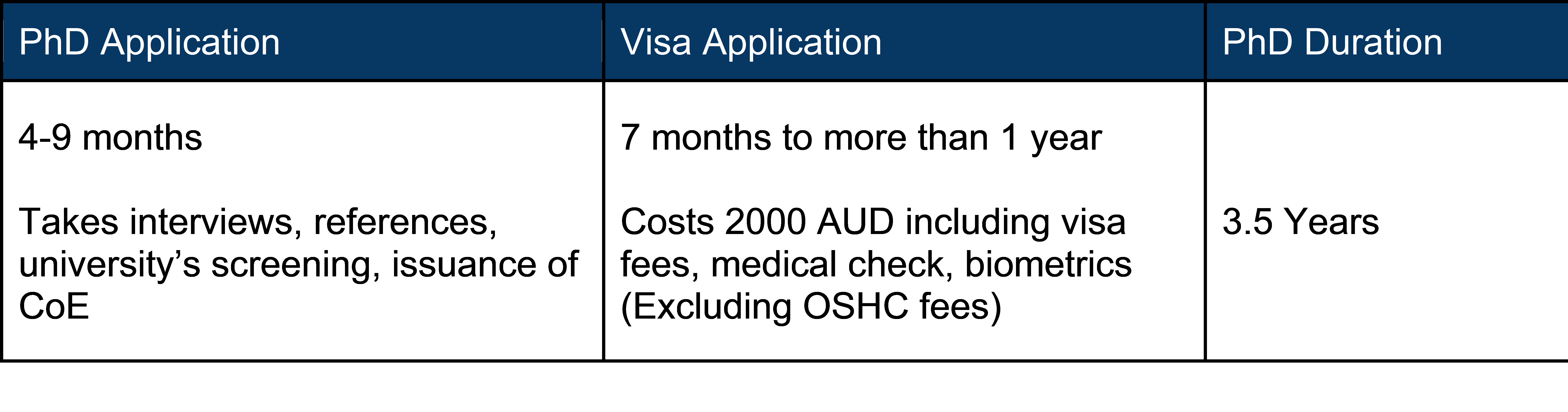
- Financial loss: Applicants invest over AUD 2,000 for visa applications, medical checks, and biometrics, often losing scholarships due to delays.
- Career loss and uncertainty: Months or years in limbo disrupt applicants' professional trajectories, causing stress and anxiety.
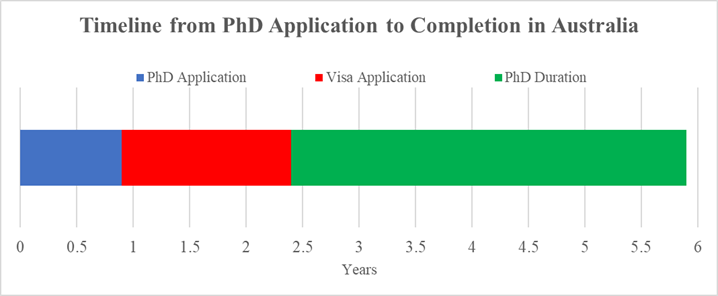
- Loss of time: The extended timeline for a 3.5-year PhD becomes untenable due to an additional 2+ years of processing.
- Expiration of scholarship after long waiting for the visa that also caused all of above points
Starting a PhD of 3.5 years requires around 2+ years of expensive hectic process just because of no transparency on decision timeline.
Impact on universities
This significant delay is highly affecting the Australian scientific community and was brought to the attention of the Australian government numerous times. https://tinyurl.com/2p8etn2k
Australia's reputation as a desirable destination for education and research is undermined by these delays. Many skilled researchers and scientists move to the USA, Canada, or Germany, where visas are processed more efficiently..
Australia risks losing its competitive edge in global university and research institution rankings, which are crucial for attracting international talent and investments.
Loss of funding from different international agencies, administration cost of repeatedly issuing CoE, losing the time/deadline on critical research projects for supervisors, and collaboration also hurts the universities' international reputation.
Inefficient execution of Critical Technology Regulation (8208) counterproductive to Australia’s Economy and Society
Inefficienct execution of the regulation that was implemented on 1 July 2022 through no transparency in process to applicants and unlimited deadline for security agencies doing check has made this precaution counterproductive to australia’s economy.

Countries like the USA have successfully fostered entrepreneurial ecosystems in places like Silicon Valley by attracting global talent and researchers. Australia risks falling behind in innovation-driven industries due to delays and inefficiencies. Prioritising diploma, vocational courses students and work holiday vacationers over distinguished scientists who can significantly transform the economy of Australia towards entrepreneurship like those of USA and Europe should be a point of concern for Australians.
These skilled researchers could otherwise contribute significantly to innovation, research, and development in Australia. They are job-creators with their patents, products and innovation and can create startups which can provide jobs to immigrants getting grants based on PR points and yet are unemployed in Australia.
It is deplorable to put these researchers in agony instead of prioritising them.
Delaying the entry of highly skilled researchers means lost economic benefits. These professionals not only contribute directly through research but also indirectly by fostering industries, creating jobs, and attracting investments.
A 2020 OECD study shows that skilled researchers are more likely to start businesses, file patents, and contribute to high-value sectors, driving long-term economic growth. It is crucial for other immigrants who are seeking jobs after they are granted PR and for Australia to become a knowledge based economy instead of relying on mining, students and vacationers
Call to Action
- Provide Timely Decisions: Establish clear deadlines for visa processing, with updates provided regularly, even if the decision is a rejection.Give decision within respectful time even if you have to reject, So applicants can look for other options.
- Clear the backlog: Please announce decision on VISAs which are waiting for more than 4 months.
- Enhance Transparency and Time-bound decisions: Allow applicants to track the status of security checks and other assessments. Enforce a deadline to complete the security checks in respect of applicants’ life, skills, and money that he paid.
- Address Systemic Flaws: Fix issues like the 1221 bug and ensure all applicants receive responses to their inquiries.
- Respect the Researchers, University, Supervisor and Course Commencement Date: Instead of a norm of granting the applicants several months before commencement date (to keep the processing times in check), Prioritise the backlogged applications with deferred CoE. Respect the University and Supervisor’s conscience and Research that is vital to driving Australia’s innovation economy. Delays also contradict the government’s funding of research scholarships.
- Create a UK’s ATAS based system: Forbid the universities to issue offers to researchers which DHA don’t “like”. Stopping the applicants at this stage will help keep the visa applications low and avoid the losses and uncertain situations for distinguished researcher.
- Refund the application fees if you can’t make decision
Conclusion
Waiting 1.5+ years for a visa to undertake a 3+ year PhD is unjustifiable. Applicants deserve respect, transparency, and timely decisions. The current system jeopardises lives, careers, and Australia’s future as a knowledge-based economy.
It’s time for action—your leadership can restore confidence in Australia’s migration system.

202
The Issue
Unethical Blackbox of an Expensive Australia Student Visa for research students with unjustifiable delays and no explanation jeopardises the lives, careers, and Australia’s future as a knowledge-based economy.
Extraordinary visa processing time, non-transparent process and unresponsiveness for PhD applicants of visa subclass 500 has significantly undermined researchers' career, Australia's Economy and research Flourishment. While some recent applications are being finalised in short times, many applications lodged very long ago (even more than one year ago) remain unfinalised.
Buggy Non-transparent Application System & Discriminatory Visa Processing
- Unclear Character Assessments: Agencies like ASIO conduct open-ended assessments with no deadlines, leaving applicants with no transparency on their status.
- Ambiguous Requests for Additional Information: Applicants are often asked to resubmit Forms 80 and 1221 with no clear explanation or updates.
- Buggy Application System: Errors like the "1221 bug" prevent progress, with no resolutions offered despite repeated inquiries.
- Deprioritizing and Backlog: It is also reported that immigration agents intentionally backlog and deprioritise the applications for public visa statistics like processing time, grants etc
It is hard to understand why the Australian government and universities are providing funding for outstanding international students to support their research in Australia, but DHA is then forbidding (not entirely forbidding, but very close to that) them from entering Australia, it is just a contradiction. Some of the students moved on and found other positions in other places, making contributions to other countries. However, most of the students put their lives on hold and receive nothing but anxiety and career disruption.
A MS student takes 2 weeks to get the security clearance (MS students get their VISA within 1 month). For PhD students in the same country it cannot take a year or more. Moreover, they are a service provider by taking VISA fee DHA should provide their services in the published time frame. What should be the compensation for the huge delay in service?
Many PhD students are marked with 1221 bug (1221 bug refers to the situation that students already uploaded Form 1221 but the system asked them to upload again and they received no email notifications from visa officers), no students who have been marked 1221 bug have been issued visas. And the most frustrating part is when they try to make an inquiry about their visa status through emails/phones/website inquiry forms, what they receive are just some ambiguous replies asking them to wait without any useful information or just no reply. They can do nothing but wait, listen to the same useless answers to their visa status, and give up. In this seesaw battle, DHA only needs to prolong the visa processing and wait until all engineering students withdraw their applications. They still have very nice visa grant statistics, because they do not count these figures! And for the visa grant time, it is so tricky that what DHA published is the time that those who have been granted need, what about those who have been waiting for 3 years?
Whether applications from engineering students are being processed or not just thrown away is really doubtful.
There is absolutely no communication link for the students to follow up on the processing of their visas. All complaints are responded to with automatic responses that ask us to wait. While granting a visa is granting a privilege to the visa holder, forcing applicants to remain in limbo for years and keeping them in mental and financial hardship is a violation of their basic rights. Waiting time of 1.5+ years for 3+ years PhD is unjustifiable.
Most PhD students are distinguished researchers and scientists and their time is as valuable as you.
Note: Above information is based on my personal experience, reported by other applicants through several channels, data from DoHA website and complaints available on https://www.homeaffairs.gov.au/reports-and-publications/reviews-and-inquiries/departmental-reviews/migration-system-for-australias-future/public-submissions
Comparison with other countries
Processing time and Cost
Australia’s student Visa is most expensive in the world, yet takes the most time to process, lagging far behind other countries in cost, transparency, and efficiency:
Security Clearance
Countries like the UK and US implement clear processes for sensitive fields, unlike Australia, which provides no communication or timeframes: Only Australia has a blackbox on security check with indefinite time and no transparency on updates
Impact on Applicants
Long delays and a lack of transparency have devastating consequences for applicants, including:
- Loss of other offers: Applicants turn down offers from other countries based on their commitment to the research project in Australia.
- Financial loss: Applicants invest over AUD 2,000 for visa applications, medical checks, and biometrics, often losing scholarships due to delays.
- Career loss and uncertainty: Months or years in limbo disrupt applicants' professional trajectories, causing stress and anxiety.
- Loss of time: The extended timeline for a 3.5-year PhD becomes untenable due to an additional 2+ years of processing.
- Expiration of scholarship after long waiting for the visa that also caused all of above points
Starting a PhD of 3.5 years requires around 2+ years of expensive hectic process just because of no transparency on decision timeline.
Impact on universities
This significant delay is highly affecting the Australian scientific community and was brought to the attention of the Australian government numerous times. https://tinyurl.com/2p8etn2k
Australia's reputation as a desirable destination for education and research is undermined by these delays. Many skilled researchers and scientists move to the USA, Canada, or Germany, where visas are processed more efficiently..
Australia risks losing its competitive edge in global university and research institution rankings, which are crucial for attracting international talent and investments.
Loss of funding from different international agencies, administration cost of repeatedly issuing CoE, losing the time/deadline on critical research projects for supervisors, and collaboration also hurts the universities' international reputation.
Inefficient execution of Critical Technology Regulation (8208) counterproductive to Australia’s Economy and Society
Inefficienct execution of the regulation that was implemented on 1 July 2022 through no transparency in process to applicants and unlimited deadline for security agencies doing check has made this precaution counterproductive to australia’s economy.
Countries like the USA have successfully fostered entrepreneurial ecosystems in places like Silicon Valley by attracting global talent and researchers. Australia risks falling behind in innovation-driven industries due to delays and inefficiencies. Prioritising diploma, vocational courses students and work holiday vacationers over distinguished scientists who can significantly transform the economy of Australia towards entrepreneurship like those of USA and Europe should be a point of concern for Australians.
These skilled researchers could otherwise contribute significantly to innovation, research, and development in Australia. They are job-creators with their patents, products and innovation and can create startups which can provide jobs to immigrants getting grants based on PR points and yet are unemployed in Australia.
It is deplorable to put these researchers in agony instead of prioritising them.
Delaying the entry of highly skilled researchers means lost economic benefits. These professionals not only contribute directly through research but also indirectly by fostering industries, creating jobs, and attracting investments.
A 2020 OECD study shows that skilled researchers are more likely to start businesses, file patents, and contribute to high-value sectors, driving long-term economic growth. It is crucial for other immigrants who are seeking jobs after they are granted PR and for Australia to become a knowledge based economy instead of relying on mining, students and vacationers
Call to Action
- Provide Timely Decisions: Establish clear deadlines for visa processing, with updates provided regularly, even if the decision is a rejection.Give decision within respectful time even if you have to reject, So applicants can look for other options.
- Clear the backlog: Please announce decision on VISAs which are waiting for more than 4 months.
- Enhance Transparency and Time-bound decisions: Allow applicants to track the status of security checks and other assessments. Enforce a deadline to complete the security checks in respect of applicants’ life, skills, and money that he paid.
- Address Systemic Flaws: Fix issues like the 1221 bug and ensure all applicants receive responses to their inquiries.
- Respect the Researchers, University, Supervisor and Course Commencement Date: Instead of a norm of granting the applicants several months before commencement date (to keep the processing times in check), Prioritise the backlogged applications with deferred CoE. Respect the University and Supervisor’s conscience and Research that is vital to driving Australia’s innovation economy. Delays also contradict the government’s funding of research scholarships.
- Create a UK’s ATAS based system: Forbid the universities to issue offers to researchers which DHA don’t “like”. Stopping the applicants at this stage will help keep the visa applications low and avoid the losses and uncertain situations for distinguished researcher.
- Refund the application fees if you can’t make decision
Conclusion
Waiting 1.5+ years for a visa to undertake a 3+ year PhD is unjustifiable. Applicants deserve respect, transparency, and timely decisions. The current system jeopardises lives, careers, and Australia’s future as a knowledge-based economy.
It’s time for action—your leadership can restore confidence in Australia’s migration system.
The Decision Makers


Supporter Voices
Petition Updates
Share this petition
Petition created on 12 January 2025