

Stop racially discriminatory police questioning.
The Issue
日本語 | やさしい日本語(にほんご) | Français
“Excuse me, do you have a moment?”
“Please show me your ID.”
“I’d like you to show me the contents of your bag.”
"Police questioning" occurs when a police officer suddenly stops a civilian for questioning on the streets. A particular type of person tends to be the target of this questioning quite often. This includes, for example, people who are judged to be “foreigners” based on their appearance, or people who have foreign roots.
The following is one person’s real experience.
‘As I was walking through the station, a police officer approached me for questioning because “Based on experience, people who look like you are often carrying drugs”. The reason was that I was wearing a hairstyle that is most commonly worn by people of African descent.
On another occasion, a patrolling police officer deemed me suspicious simply for trying to retrieve mail from my apartment's mailbox and followed me to the front door of my apartment. Even though I claimed to have the key to my room, they persistently demanded that I show my ID, using absurd logic. “Just because you have the key, it doesn’t mean that this is your home.” This happened twice in just half a year.’
The following is another experience from a Black American male.
‘When I was about to take my dog for a walk, I ran into a police officer in front of my house and was questioned. The police officer said that the reason for this was that “instances of dognapping were on the rise.” I wonder how many Japanese people have ever been approached in such a ridiculous way while taking their dog out for a walk.’
This kind of questioning in which a police officer makes assumptions about someone’s involvement in criminal behavior based on race or outward appearance is called “racial profiling.”
Police treating people as criminal or suspects based on the appearance of a foreigner or a person with foreign roots—this is racial discrimination by those with governmental power and an egregious violation of human rights that undermine human dignity. Below are additional comments from people who have lived these experiences:
“As soon as it became clear that I was a foreigner, the officer became arrogant”
“As soon as they saw that I am Japanese, the officer treated me politely”
“I was told that my hairstyle and fashion were suspicious”
“I wondered why I was the only person in the crowd to be stopped and questioned.”
“The only imaginable reason why I was stopped and questioned was that I’m a foreigner”
(※We are conducting an ongoing survey on real-world experiences with racial profiling. Details are at the end of this article.)
■Reality uncovered by surveys
According to the 2021 Questionnaire Survey on Police Questioning (Racial Profiling) for People with Foreign Roots conducted by the Tokyo Bar Association, the following information has come to light.
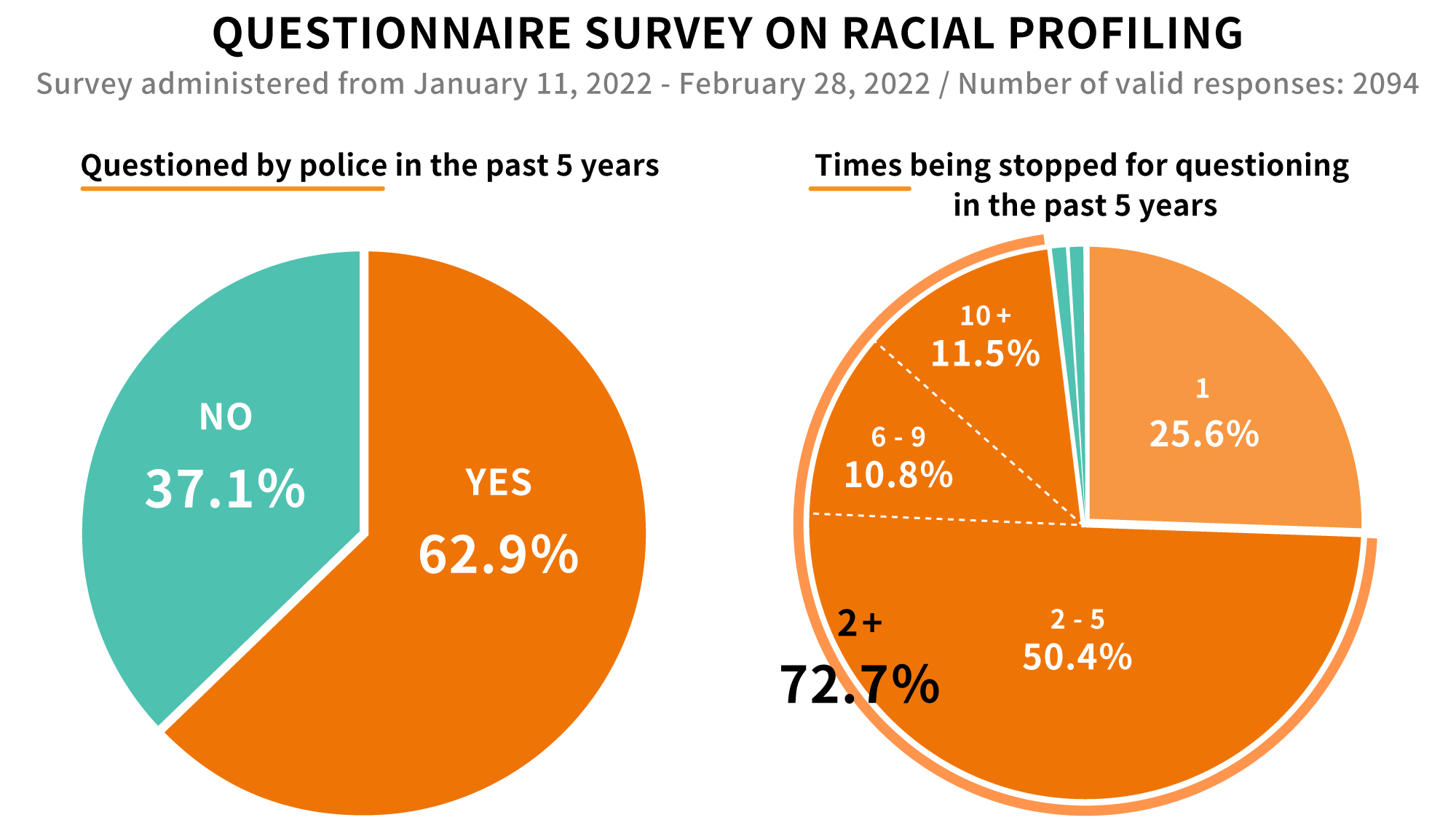
First, 62.9% of respondents answered that they had been subjected to police questioning over the past five years or so (pie chart on the left), 72.7% of whom had been questioned more than once (pie chart on the right).
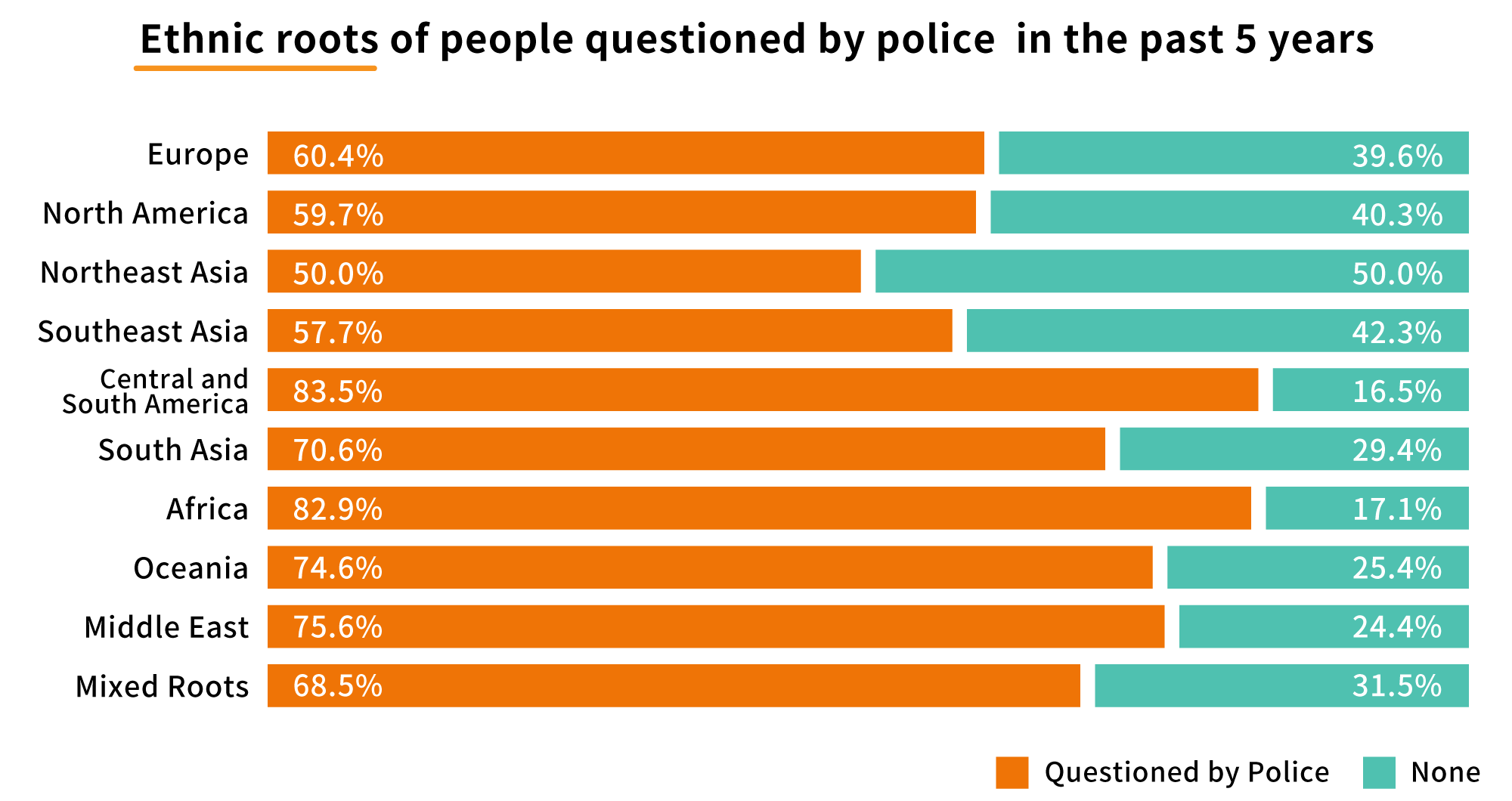
Additionally, when this data is analyzed by the ethnic roots of respondents, we can see that those with roots from Central and South America (83.5%), Africa (82.9%), and the Middle East (75.6%) are most likely to be stopped for police questioning.
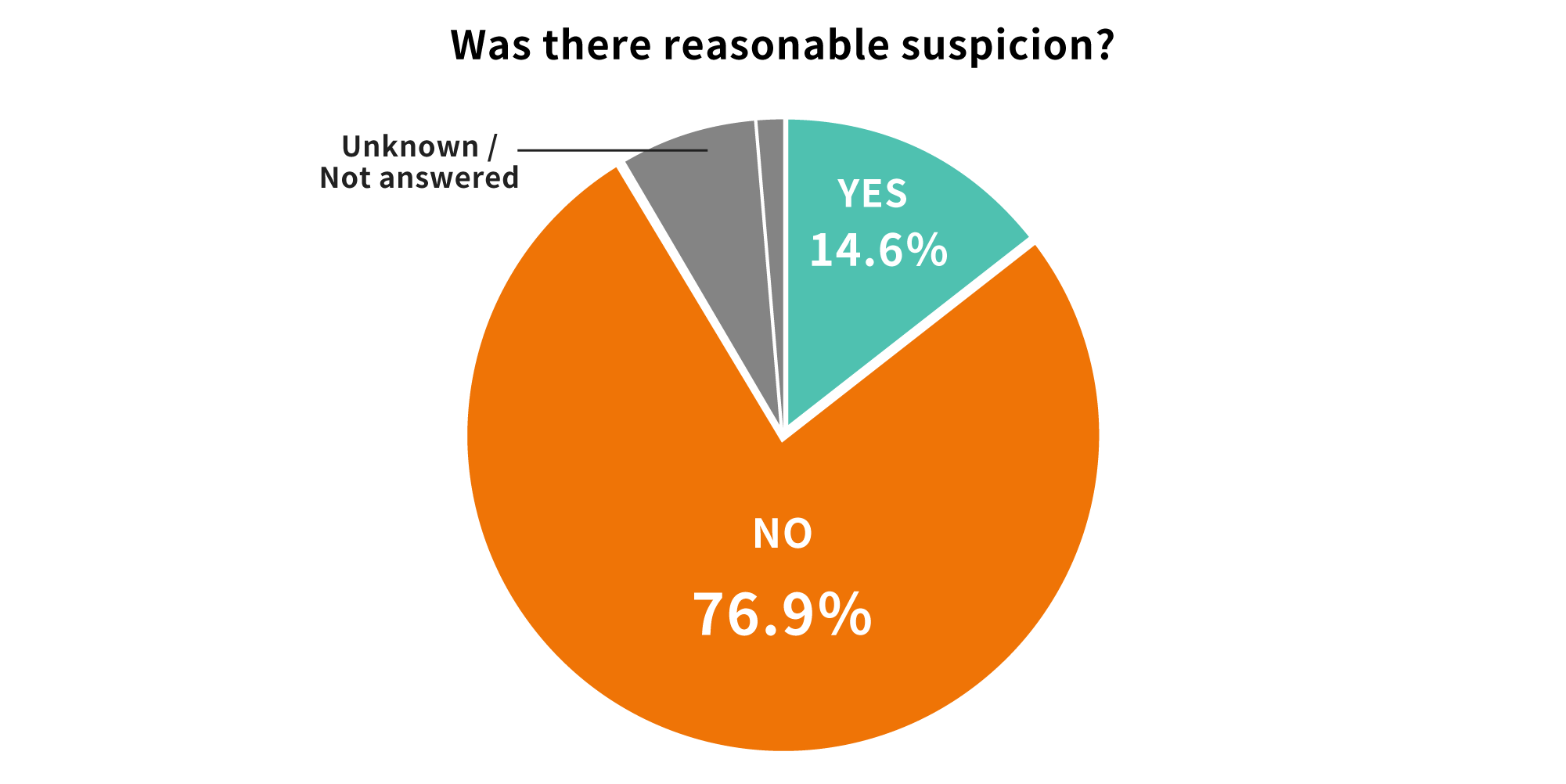
As for the respondents themselves, 85.4% of those who were questioned by police over the past five years answered that the police were aware of their foreign roots (92.9% of the reasons selected were “physical characteristics.”) while 76.9% of the people acknowledged that there was no reasonable cause for suspicion that led to police questioning*.
(*Reasonable cause for suspicion denotes “sufficient probable cause to suspect that the person has committed or is about to commit a crime.” Reasonable cause for suspicion is determined by contextual circumstances such as by a person’s odd behavior or attitude.)
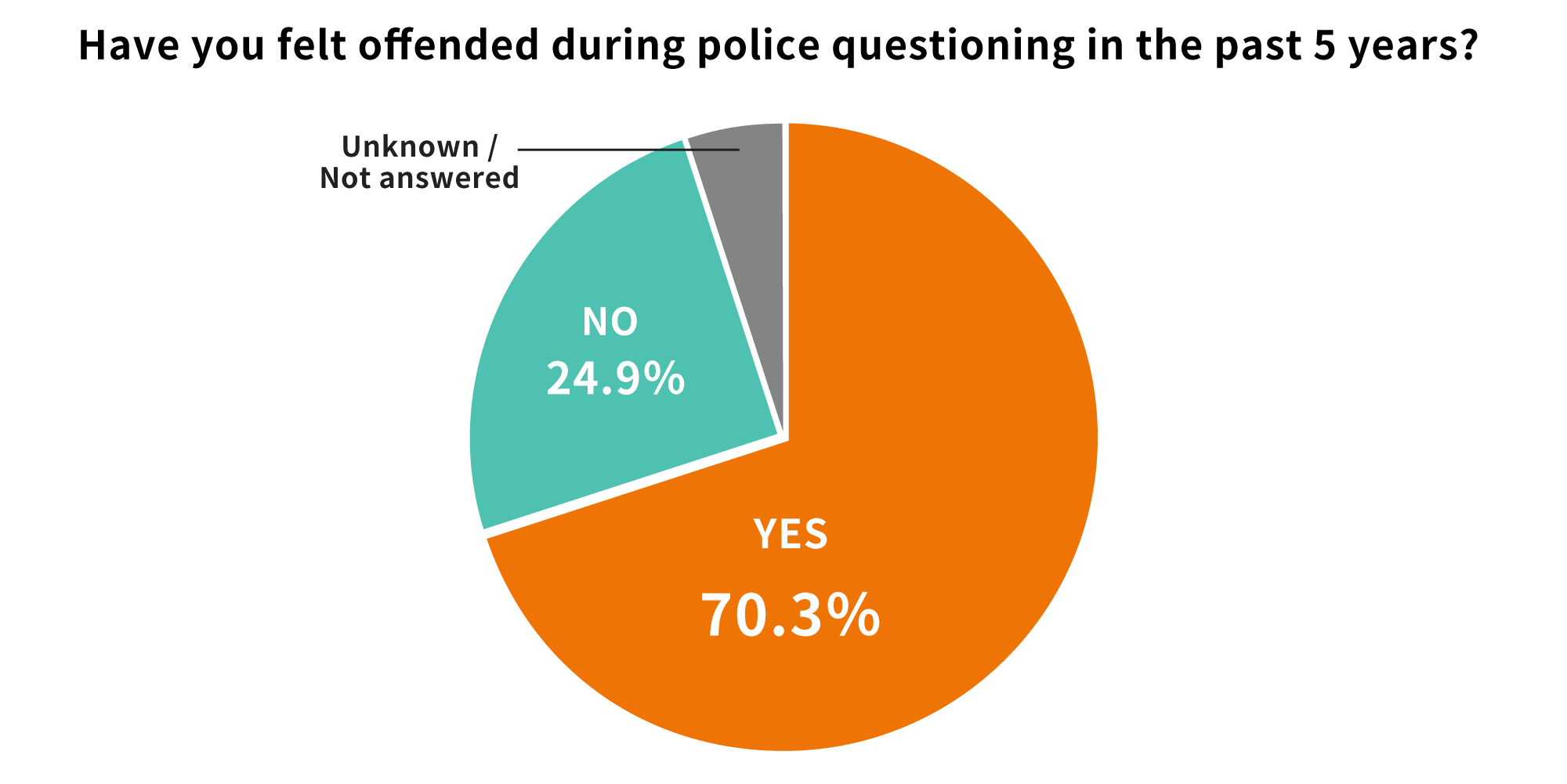
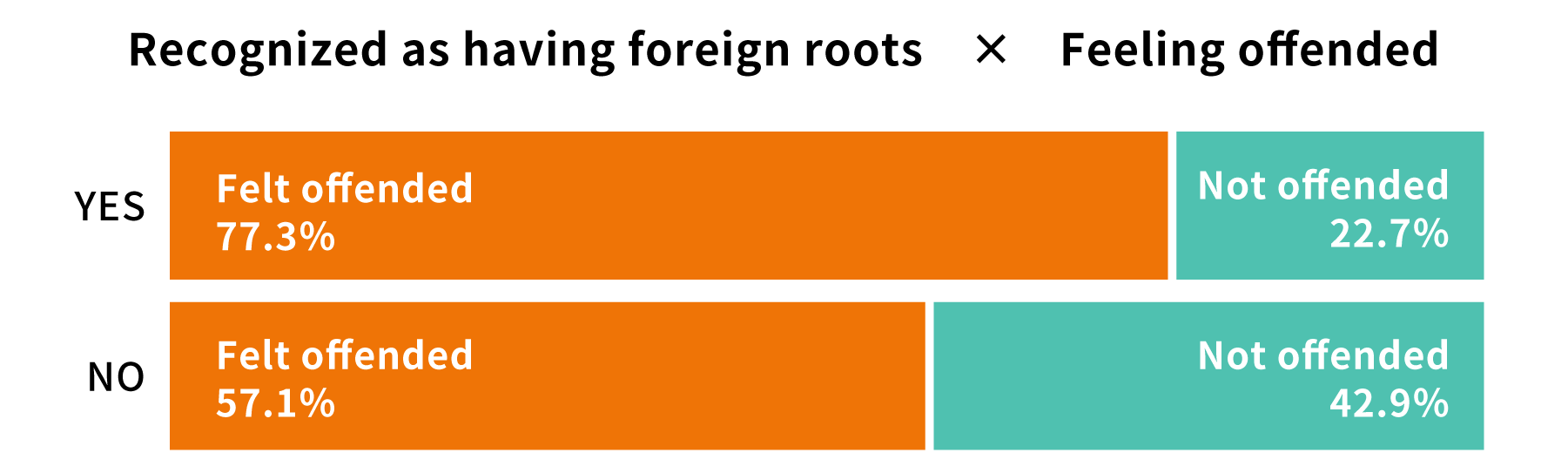
Finally, 70.3% of respondents who were questioned over the past five years answered that they felt offended by the attitude of police officers. Further analysis of this data based on whether the police recognized the respondents as having foreign roots revealed a stark difference between the 77.3% of those whom police identified as having foreign roots feeling offended, and only 57.1% of respondents whom the police did not recognize as having foreign roots feeling offended.
In the “other comments” section, a considerable number of remarks alluded to “rude behavior”, “offensive”, “unpleasant”, “impolite (specifically, not using keigo)”, “overbearing”, “arrogant”, etc.
These results are enough to infer that police questioning initiated on the basis of racial profiling is widespread throughout Japan.
The two stories of people’s lived experiences illustrated in the beginning are not the only times when an objection against being stopped was raised by a civilian who pointed out bias—there is footage of a police officer arguing “why can’t a police officer talk to you based on what you look like?” It is questionable whether they are aware that such conduct diverges significantly from the standard stipulated in the Police Duties Execution Act, and that they are operating in a biased and discriminatory manner.
■The problem is not the intention of racism
According to news coverage, results of a study conducted by the Metropolitan Police Department on reports filed to prefectural public safety commissions throughout Japan concerning police questioning revealed 6 occurrences in which police officers used inappropriate language, to which the Police Department commented “It was inappropriate although there was no intention of discrimination based on biases against race or nationality.”
However, the fact that certain characteristics such as race, skin color, or country of origin lead to adverse impact is the precise definition of racism, which does not require the intention to discriminate. The answer given by the Police Department clearly indicates that they do not understand what racism is. Taken with the actuality of the situation uncovered by the Tokyo Bar Association study, it is hard to believe that only 6 occurrences of cases handled “inappropriately” is an accurate representation of the actual number of such cases.
As a matter of fact, there are no laws in Japan prohibiting racism, nor any domestic independent human rights organization providing remedies for human rights violations. Consequently, Japan is failing to fulfill its responsibility in the international community by leaving racism unchecked, while 120 other countries around the world have a domestic independent human rights organization established.
The status quo in Japan hinders understanding around “human rights” or “discrimination” and could lead only to insufficient training. The study on racial profiling by the police cited above spoke on how racial discrimination was “not intended”, although the issue is not whether it was intended, but that racist behavior is impacting real people’s lives. What matters is to see the situation for what it is and change it for the better.
■ Our Demands
Given these circumstances, we demand the Metropolitan Police Department and the National Public Safety Commission to rectify and improve racist police questioning.
- The Metropolitan Police Department or the National Public Safety Commission will regularly hold mandatory trainings for police officials regarding racism, including hearing stories of the parties involved;
- If “training regarding racism” is conducted, the Metropolitan Police Department or the National Public Safety Commission will disclose specific dates, places, and frequency of such trainings, as well as the organization to which a lecturer belongs if lectures are part of the training;
- The Metropolitan Police Department or the National Public Safety Commission will clearly present key materials used in the training regarding racism;
- The Metropolitan Police Department will, to enable reviews after police questioning occurrences, obligate police officers to document the demographic of the subject of, and how the police officer conducted the questioning, and require police officers performing questioning to wear body cameras;
- The Metropolitan Police Department will regularly conduct surveys on racial profiling to understand the actual situation; and
- The Metropolitan Police Department or the National Public Safety Commission will prepare and disclose concrete guidelines for prevention of racial profiling.
End
■Please share your experience about racial profiling
The reality of racial profiling is not documented by law enforcement, therefore is rarely shown to the public. We have created a survey so you can tell us your experience of being racially profiled.
If you think you have been racially profiled, or had an uncomfortable encounter with a police officer, let us know what your experience was like.
All testimonies shared with us will be used for our “STOP Racial Profiling” activities, with a special attention to privacy. We appreciate your generosity and cooperation.
<Racial Profiling Questionnaire Form>
【Japanese】
【Simplified Japanese】
【English】
【Français】
Petitioner: “STOP Racial Profiling”
STOP Racial Profiling is a voluntary association consisting of victims, lawyers, scholars, supporters, and supporting groups working under the purpose of researching racial profiling in Japan and demanding legislative change.
Supporting Organizations:
Africa Japan Forum
AMNESTY INTERNATIONAL JAPAN
Together with Kurds in Japan
Japan for Black Lives
The Japan Civil Liberties Union (JCLU)
Japan Association for Refugees(JAR)
Human Rights Watch
BLM TOKYO
Voice Up Japan
RAFIQ JAPAN
Legacy Foundation Japan
specialist team for public litigation LEDGE
Supporters: Click here for the list of individual supporters.
*When you support this campaign, a prompt from change.org will appear: “Will you help this campaign spread the word and build support?” This way of supporting will be used to increase visibility of this campaign by showing up on more ads to raise awareness of this issue. This is a call for supporting ads for this campaign, and not for donations towards STOP Racial Profiling, the petitioner of this campaign.
[1] Asahi Shimbun “Racially Inappropriate Questioning by Police—6 Cases Confirmed Last Year through First Survey by Metropolitan Police Department” 2022/11/16
https://digital.asahi.com/articles/ASQCJ5FHLQCJUTIL00T.html?_requesturl=articles%2FASQCJ5FHLQCJUTIL00T.html&pn=6
Cover by storyset, macrovector_official /Source:Freepik

20,838
The Issue
日本語 | やさしい日本語(にほんご) | Français
“Excuse me, do you have a moment?”
“Please show me your ID.”
“I’d like you to show me the contents of your bag.”
"Police questioning" occurs when a police officer suddenly stops a civilian for questioning on the streets. A particular type of person tends to be the target of this questioning quite often. This includes, for example, people who are judged to be “foreigners” based on their appearance, or people who have foreign roots.
The following is one person’s real experience.
‘As I was walking through the station, a police officer approached me for questioning because “Based on experience, people who look like you are often carrying drugs”. The reason was that I was wearing a hairstyle that is most commonly worn by people of African descent.
On another occasion, a patrolling police officer deemed me suspicious simply for trying to retrieve mail from my apartment's mailbox and followed me to the front door of my apartment. Even though I claimed to have the key to my room, they persistently demanded that I show my ID, using absurd logic. “Just because you have the key, it doesn’t mean that this is your home.” This happened twice in just half a year.’
The following is another experience from a Black American male.
‘When I was about to take my dog for a walk, I ran into a police officer in front of my house and was questioned. The police officer said that the reason for this was that “instances of dognapping were on the rise.” I wonder how many Japanese people have ever been approached in such a ridiculous way while taking their dog out for a walk.’
This kind of questioning in which a police officer makes assumptions about someone’s involvement in criminal behavior based on race or outward appearance is called “racial profiling.”
Police treating people as criminal or suspects based on the appearance of a foreigner or a person with foreign roots—this is racial discrimination by those with governmental power and an egregious violation of human rights that undermine human dignity. Below are additional comments from people who have lived these experiences:
“As soon as it became clear that I was a foreigner, the officer became arrogant”
“As soon as they saw that I am Japanese, the officer treated me politely”
“I was told that my hairstyle and fashion were suspicious”
“I wondered why I was the only person in the crowd to be stopped and questioned.”
“The only imaginable reason why I was stopped and questioned was that I’m a foreigner”
(※We are conducting an ongoing survey on real-world experiences with racial profiling. Details are at the end of this article.)
■Reality uncovered by surveys
According to the 2021 Questionnaire Survey on Police Questioning (Racial Profiling) for People with Foreign Roots conducted by the Tokyo Bar Association, the following information has come to light.
First, 62.9% of respondents answered that they had been subjected to police questioning over the past five years or so (pie chart on the left), 72.7% of whom had been questioned more than once (pie chart on the right).
Additionally, when this data is analyzed by the ethnic roots of respondents, we can see that those with roots from Central and South America (83.5%), Africa (82.9%), and the Middle East (75.6%) are most likely to be stopped for police questioning.
As for the respondents themselves, 85.4% of those who were questioned by police over the past five years answered that the police were aware of their foreign roots (92.9% of the reasons selected were “physical characteristics.”) while 76.9% of the people acknowledged that there was no reasonable cause for suspicion that led to police questioning*.
(*Reasonable cause for suspicion denotes “sufficient probable cause to suspect that the person has committed or is about to commit a crime.” Reasonable cause for suspicion is determined by contextual circumstances such as by a person’s odd behavior or attitude.)
Finally, 70.3% of respondents who were questioned over the past five years answered that they felt offended by the attitude of police officers. Further analysis of this data based on whether the police recognized the respondents as having foreign roots revealed a stark difference between the 77.3% of those whom police identified as having foreign roots feeling offended, and only 57.1% of respondents whom the police did not recognize as having foreign roots feeling offended.
In the “other comments” section, a considerable number of remarks alluded to “rude behavior”, “offensive”, “unpleasant”, “impolite (specifically, not using keigo)”, “overbearing”, “arrogant”, etc.
These results are enough to infer that police questioning initiated on the basis of racial profiling is widespread throughout Japan.
The two stories of people’s lived experiences illustrated in the beginning are not the only times when an objection against being stopped was raised by a civilian who pointed out bias—there is footage of a police officer arguing “why can’t a police officer talk to you based on what you look like?” It is questionable whether they are aware that such conduct diverges significantly from the standard stipulated in the Police Duties Execution Act, and that they are operating in a biased and discriminatory manner.
■The problem is not the intention of racism
According to news coverage, results of a study conducted by the Metropolitan Police Department on reports filed to prefectural public safety commissions throughout Japan concerning police questioning revealed 6 occurrences in which police officers used inappropriate language, to which the Police Department commented “It was inappropriate although there was no intention of discrimination based on biases against race or nationality.”
However, the fact that certain characteristics such as race, skin color, or country of origin lead to adverse impact is the precise definition of racism, which does not require the intention to discriminate. The answer given by the Police Department clearly indicates that they do not understand what racism is. Taken with the actuality of the situation uncovered by the Tokyo Bar Association study, it is hard to believe that only 6 occurrences of cases handled “inappropriately” is an accurate representation of the actual number of such cases.
As a matter of fact, there are no laws in Japan prohibiting racism, nor any domestic independent human rights organization providing remedies for human rights violations. Consequently, Japan is failing to fulfill its responsibility in the international community by leaving racism unchecked, while 120 other countries around the world have a domestic independent human rights organization established.
The status quo in Japan hinders understanding around “human rights” or “discrimination” and could lead only to insufficient training. The study on racial profiling by the police cited above spoke on how racial discrimination was “not intended”, although the issue is not whether it was intended, but that racist behavior is impacting real people’s lives. What matters is to see the situation for what it is and change it for the better.
■ Our Demands
Given these circumstances, we demand the Metropolitan Police Department and the National Public Safety Commission to rectify and improve racist police questioning.
- The Metropolitan Police Department or the National Public Safety Commission will regularly hold mandatory trainings for police officials regarding racism, including hearing stories of the parties involved;
- If “training regarding racism” is conducted, the Metropolitan Police Department or the National Public Safety Commission will disclose specific dates, places, and frequency of such trainings, as well as the organization to which a lecturer belongs if lectures are part of the training;
- The Metropolitan Police Department or the National Public Safety Commission will clearly present key materials used in the training regarding racism;
- The Metropolitan Police Department will, to enable reviews after police questioning occurrences, obligate police officers to document the demographic of the subject of, and how the police officer conducted the questioning, and require police officers performing questioning to wear body cameras;
- The Metropolitan Police Department will regularly conduct surveys on racial profiling to understand the actual situation; and
- The Metropolitan Police Department or the National Public Safety Commission will prepare and disclose concrete guidelines for prevention of racial profiling.
End
■Please share your experience about racial profiling
The reality of racial profiling is not documented by law enforcement, therefore is rarely shown to the public. We have created a survey so you can tell us your experience of being racially profiled.
If you think you have been racially profiled, or had an uncomfortable encounter with a police officer, let us know what your experience was like.
All testimonies shared with us will be used for our “STOP Racial Profiling” activities, with a special attention to privacy. We appreciate your generosity and cooperation.
<Racial Profiling Questionnaire Form>
【Japanese】
【Simplified Japanese】
【English】
【Français】
Petitioner: “STOP Racial Profiling”
STOP Racial Profiling is a voluntary association consisting of victims, lawyers, scholars, supporters, and supporting groups working under the purpose of researching racial profiling in Japan and demanding legislative change.
Supporting Organizations:
Africa Japan Forum
AMNESTY INTERNATIONAL JAPAN
Together with Kurds in Japan
Japan for Black Lives
The Japan Civil Liberties Union (JCLU)
Japan Association for Refugees(JAR)
Human Rights Watch
BLM TOKYO
Voice Up Japan
RAFIQ JAPAN
Legacy Foundation Japan
specialist team for public litigation LEDGE
Supporters: Click here for the list of individual supporters.
*When you support this campaign, a prompt from change.org will appear: “Will you help this campaign spread the word and build support?” This way of supporting will be used to increase visibility of this campaign by showing up on more ads to raise awareness of this issue. This is a call for supporting ads for this campaign, and not for donations towards STOP Racial Profiling, the petitioner of this campaign.
[1] Asahi Shimbun “Racially Inappropriate Questioning by Police—6 Cases Confirmed Last Year through First Survey by Metropolitan Police Department” 2022/11/16
https://digital.asahi.com/articles/ASQCJ5FHLQCJUTIL00T.html?_requesturl=articles%2FASQCJ5FHLQCJUTIL00T.html&pn=6
Cover by storyset, macrovector_official /Source:Freepik
The Decision Makers

Petition Updates
Share this petition
Petition created on May 9, 2023