

Stop Moree Pool From Being Relocated to Taylor Oval
The issue
Introduction
We, the concerned residents and community members of the Moree Plains Shire, stand in strong and unified opposition to the proposed relocation of the 50-meter swimming pool to Taylor Oval. This petition calls for the immediate halt of this project. We demand that the Council respects the heritage of Moree, listens to the voices of its residents, and focus on restoring the existing 50-meter pool at its historic home or at least consider involving community decision-making into the relocation.
Socio-Economic and Logistical Impact: CBD Congestion and Local Business
Centralised infrastructure shifts can destabilise local micro-economies. The MAAC is the core of Moree’s visitor economy, drawing tourists from Sydney, Melbourne, and Brisbane who specifically visit for the artesian waters. Local hotel investors have invested a lot based on the pool’s current location. Abandoning the 50m pool at this site threatens to turn these investments into stranded assets.
Logistically, Taylor Oval is incompatible for a high-traffic aquatic complex. Its central location near Moree Public School, Moree Secondary College, Woolworths, and the fire station creates a congestion hazard.
Child Safety: Increased traffic in high-density school zones during swimming carnivals poses an unacceptable risk to children.
Emergency Interruption: High visitor density and CBD parking shortages threaten the rapid deployment capabilities of the Fire Station.
Logistical Bottlenecks: The lack of parking—evidenced by the feasibility study's provision for only 30 vehicles—will impact the CBD during events.
Cultural and Historical Integrity: MAAC & Taylor Oval
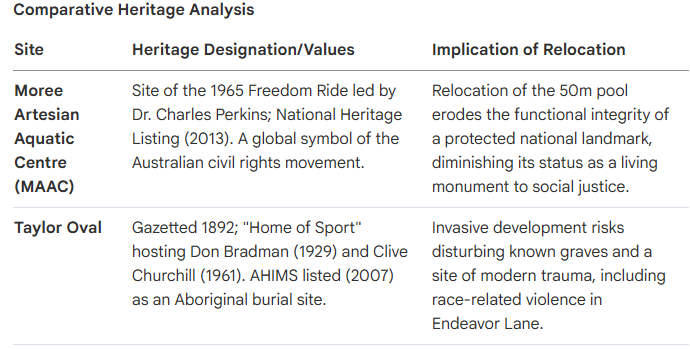
Responsible urban planning dictates that historical significance is a non-negotiable metric. In Moree, the proposed relocation is not merely a move across town; it is a shift from a site of historical significance to a site of deep cultural sensitivity and unresolved trauma. Historical records from 1903 explicitly detail the discovery of a grave containing two bodies covered in an "opossum rug and bark." Beyond ancient history, the site is associated with the "modern massacre" and race-related violence of Endeavour Lane, where Ronald "Cheeky" Macintosh was shot. Proposing to build a recreational facility on such a contested landscape is an act of cultural erasure. This stands in stark contrast to the MAAC, which remains a protected landmark. Transitioning from these cultural values to technical realities, it becomes evident that the issues at the MAAC are not inherent to the land, but are the result of systemic management failures.
Environmental and Structural Challenges: Evaluating the "Leak" Narrative
The technical issues at the MAAC have been framed by the Council as an uncontrollable environmental failure. However, a rigorous analysis reveals that the site's "unsuitability" is actually a narrative of prolonged asset management neglect.
Summary of Technical and Maintenance Failures
Engineering Malpractice: During the 2011 redevelopment, new hot pools were poured as a "topping slab" directly over the original 1913 liner. This poor-quality construction ensured structural vulnerability from the outset.
Neglected Schedules: Asset maintenance and replacement schedules were ignored. Equipment due for replacement in 2016 remained in operation until it reached total failure, leading to SafeWork NSW closing the facility in January 2025.
Substandard Infrastructure: The use of incorrect pipe sizes, inappropriate fittings not rated for chlorine, and a failure to adhere to as-built standards created a cycle of ongoing repairs.
Management Failure: Complicating all leak detection is the near-total absence of accurate "as-built" documentation from the 2011 works, turning standard maintenance into speculative guesswork.
The much-discussed "underground spring" discovered in March 2024 was actually artesian water leaking from the facility itself—a direct result of these long-term failures. Yet, as Cr. James recently noted, "If anybody's checked lately, you'll see the pool is no longer leaking." This suggests that the "uncontrollable leak" narrative is being used to justify an unnecessary relocation. Moving to Taylor Oval trades these fixable management issues for infrastructure risks: a highly reactive soil profile and the prohibitive cost of new artesian connections. These technical risks translate directly into a threat to the town's local economy.
The Case for Inclusive Governance: Demanding Community Consultation
Sustainable civic trust is built on dialogue, yet the Council’s decision-making timeline has been marked by a lack of transparency. The July 2025 resolution to proceed with "Scenario 1" was characterised by Cr. McGrady as a decision made without any consultation with the Moree community or the Aboriginal Traditional Owners.
Governance that ignores "knowledge holders" is fundamentally fragile. Cr. James and Cr. McGrady has highlighted that the decision to pursue Taylor Oval was arbitrary and non-inclusive. A community's right to shape its town is a cornerstone of democratic planning, and the current "Scenario 1" path violates that right by prioritising a timeline over the voices of the Gomeroi people and the broader residency.
This decision was made without proper consultation with the broader Moree community or the Aboriginal traditional owners. For five years, our children have been denied their right to swim in a 50m pool. We refuse to wait another five years while the Council pursues a high-risk gamble at Taylor Oval. The MAAC is a site of national significance and an economic engine for our town. To abandon it for a site of Aboriginal significance is an affront to our history and a risk to our future.

2
The issue
Introduction
We, the concerned residents and community members of the Moree Plains Shire, stand in strong and unified opposition to the proposed relocation of the 50-meter swimming pool to Taylor Oval. This petition calls for the immediate halt of this project. We demand that the Council respects the heritage of Moree, listens to the voices of its residents, and focus on restoring the existing 50-meter pool at its historic home or at least consider involving community decision-making into the relocation.
Socio-Economic and Logistical Impact: CBD Congestion and Local Business
Centralised infrastructure shifts can destabilise local micro-economies. The MAAC is the core of Moree’s visitor economy, drawing tourists from Sydney, Melbourne, and Brisbane who specifically visit for the artesian waters. Local hotel investors have invested a lot based on the pool’s current location. Abandoning the 50m pool at this site threatens to turn these investments into stranded assets.
Logistically, Taylor Oval is incompatible for a high-traffic aquatic complex. Its central location near Moree Public School, Moree Secondary College, Woolworths, and the fire station creates a congestion hazard.
Child Safety: Increased traffic in high-density school zones during swimming carnivals poses an unacceptable risk to children.
Emergency Interruption: High visitor density and CBD parking shortages threaten the rapid deployment capabilities of the Fire Station.
Logistical Bottlenecks: The lack of parking—evidenced by the feasibility study's provision for only 30 vehicles—will impact the CBD during events.
Cultural and Historical Integrity: MAAC & Taylor Oval
Responsible urban planning dictates that historical significance is a non-negotiable metric. In Moree, the proposed relocation is not merely a move across town; it is a shift from a site of historical significance to a site of deep cultural sensitivity and unresolved trauma. Historical records from 1903 explicitly detail the discovery of a grave containing two bodies covered in an "opossum rug and bark." Beyond ancient history, the site is associated with the "modern massacre" and race-related violence of Endeavour Lane, where Ronald "Cheeky" Macintosh was shot. Proposing to build a recreational facility on such a contested landscape is an act of cultural erasure. This stands in stark contrast to the MAAC, which remains a protected landmark. Transitioning from these cultural values to technical realities, it becomes evident that the issues at the MAAC are not inherent to the land, but are the result of systemic management failures.
Environmental and Structural Challenges: Evaluating the "Leak" Narrative
The technical issues at the MAAC have been framed by the Council as an uncontrollable environmental failure. However, a rigorous analysis reveals that the site's "unsuitability" is actually a narrative of prolonged asset management neglect.
Summary of Technical and Maintenance Failures
Engineering Malpractice: During the 2011 redevelopment, new hot pools were poured as a "topping slab" directly over the original 1913 liner. This poor-quality construction ensured structural vulnerability from the outset.
Neglected Schedules: Asset maintenance and replacement schedules were ignored. Equipment due for replacement in 2016 remained in operation until it reached total failure, leading to SafeWork NSW closing the facility in January 2025.
Substandard Infrastructure: The use of incorrect pipe sizes, inappropriate fittings not rated for chlorine, and a failure to adhere to as-built standards created a cycle of ongoing repairs.
Management Failure: Complicating all leak detection is the near-total absence of accurate "as-built" documentation from the 2011 works, turning standard maintenance into speculative guesswork.
The much-discussed "underground spring" discovered in March 2024 was actually artesian water leaking from the facility itself—a direct result of these long-term failures. Yet, as Cr. James recently noted, "If anybody's checked lately, you'll see the pool is no longer leaking." This suggests that the "uncontrollable leak" narrative is being used to justify an unnecessary relocation. Moving to Taylor Oval trades these fixable management issues for infrastructure risks: a highly reactive soil profile and the prohibitive cost of new artesian connections. These technical risks translate directly into a threat to the town's local economy.
The Case for Inclusive Governance: Demanding Community Consultation
Sustainable civic trust is built on dialogue, yet the Council’s decision-making timeline has been marked by a lack of transparency. The July 2025 resolution to proceed with "Scenario 1" was characterised by Cr. McGrady as a decision made without any consultation with the Moree community or the Aboriginal Traditional Owners.
Governance that ignores "knowledge holders" is fundamentally fragile. Cr. James and Cr. McGrady has highlighted that the decision to pursue Taylor Oval was arbitrary and non-inclusive. A community's right to shape its town is a cornerstone of democratic planning, and the current "Scenario 1" path violates that right by prioritising a timeline over the voices of the Gomeroi people and the broader residency.
This decision was made without proper consultation with the broader Moree community or the Aboriginal traditional owners. For five years, our children have been denied their right to swim in a 50m pool. We refuse to wait another five years while the Council pursues a high-risk gamble at Taylor Oval. The MAAC is a site of national significance and an economic engine for our town. To abandon it for a site of Aboriginal significance is an affront to our history and a risk to our future.
The Decision Makers
Petition Updates
Share this petition
Petition created on 8 April 2026